Electronic configurations of the d-block elements
NCERT Class 12 Chemistry Chapter 4 Section 4.2
Quick answer
The d-block elements usually fill the penultimate d subshell while retaining electrons in the outer s subshell. Chromium and copper illustrate exceptions to a simple filling pattern, and transition-metal cations generally lose outer s electrons first. Ground configurations reflect the total energy of the atom; exchange-pair counting is a useful introductory model rather than a literal electron-swapping process.
With your textbook
NCERT Chemistry Part I (Class 12), Chapter 4 “The d- and f-Block Elements”, Section 4.2 “Electronic Configurations of the d-Block Elements”, pages 90–92.
Open the official NCERT chapter (PDF, 4.2 MB, ncert.nic.in) (opens in a new tab)
Checked against the 2026-27 reprint on .
What are the electronic configurations of the d-block elements?
Outer configuration of the d-block elements
In a d-block atom the outer electrons sit in two subshells: the inner (n − 1)d, with one to ten electrons, and the outer ns, with one or two. The general outer configuration is (n − 1)d1–10 ns1–2; palladium, 4d10 5s0, is the exception (NCERT page 90). In NCERT’s words:
The (n–1) stands for the inner d orbitals which may have one to ten electrons and the outermost ns orbital may have one or two electrons.
NCERT Chemistry Part I (Class 12), Section 4.2, page 90
- The (n − 1)d and ns energies are very close, and half-filled and completely filled sets of orbitals are relatively more stable, so there are several exceptions to the general pattern, the best known being chromium and copper (NCERT page 90).
- Zinc, cadmium, mercury and copernicium are (n − 1)d10 ns2, a full d subshell, and are not regarded as transition elements (NCERT page 91).
- NCERT Class 11 Chemistry (Section 3.6.3, page 84) writes the range as ns0–2, the 0 covering palladium. Both books describe the same configurations.
In plain words: across a d series, the ground-state configurations progressively fill the d subshell one shell in, with occasional redistribution between d and s occupations. Two things bend this neat pattern: the d and s levels are so close that an electron can move between them, and a d subshell that is exactly half full or full is extra stable.
General outer configuration (n − 1)d ns
For the 3d series NCERT’s Table 4.1 gives, beyond the argon core (NCERT page 90):
| Element | Z | Outer configuration |
|---|---|---|
| Sc | 21 | 3d1 4s2 |
| Ti | 22 | 3d2 4s2 |
| V | 23 | 3d3 4s2 |
| Cr | 24 | 3d5 4s1 |
| Mn | 25 | 3d5 4s2 |
| Fe | 26 | 3d6 4s2 |
| Co | 27 | 3d7 4s2 |
| Ni | 28 | 3d8 4s2 |
| Cu | 29 | 3d10 4s1 |
| Zn | 30 | 3d10 4s2 |
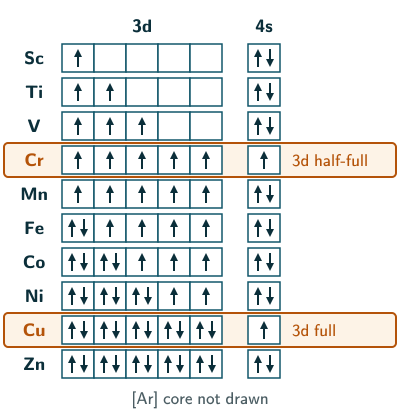
- The heavier series follow the same pattern with more exceptions. In the 4d series niobium is 4d4 5s1, molybdenum 4d5 5s1, ruthenium 4d7 5s1, rhodium 4d8 5s1, palladium 4d10 and silver 4d10 5s1. In the 5d series platinum is 5d9 6s1 and gold 5d10 6s1, but tungsten is 5d4 6s2, unlike chromium and molybdenum above it (NCERT Table 4.1, page 91). The 5d elements after lanthanum, hafnium to mercury, also hold a full 4f14 inside (Wikipedia, “Electron configurations of the elements”).
- The 6d series beyond actinium is made of short-lived synthetic elements. From meitnerium on, their configurations are marked as predictions (Wikipedia, “Electron configurations of the elements”). NCERT’s entries agree with that list from rutherfordium to darmstadtium and for copernicium. For roentgenium NCERT gives 6d10 7s1, like gold; the predicted configuration is 6d9 7s2. In an exam, use NCERT’s.
- Ions lose the ns electrons first. When d-block elements form ions, ns electrons are lost before (n − 1)d electrons, so the usual ions of the first transition series with charge +2 or more have dn configurations with no 4s electrons and an intact argon core (NCERT page 95). Iron, [Ar] 3d6 4s2, gives Fe2+, [Ar] 3d6, and Fe3+, [Ar] 3d5 (reasoned). Removing an electron also changes the relative energies of the 4s and 3d orbitals (NCERT page 95).
- Why the d electrons matter. NCERT: the d orbitals of the transition elements “protrude to the periphery of an atom more than the other orbitals (i.e., s and p)”, so they are more influenced by their surroundings and affect neighbouring atoms or molecules more, and in some respects ions of a given dn configuration (n = 1–9) have similar magnetic and electronic properties (NCERT page 91); give that in an exam. Strictly, the same d count does not guarantee the same properties, since ligands, geometry and spin state matter (reasoned).
- NCERT slip (Table 4.1, page 91): the table lists technetium (Z = 43) as 4d6 5s1. Its ground state is [Kr] 4d5 5s2, confirmed by the NIST atomic level tables; the listed 4d5s configuration corresponds to excited levels. NCERT’s own Class 11 Chemistry, Table 2.6 (page 66), gives exactly this, and it matches manganese (3d5 4s2) and rhenium (5d5 6s2) in Table 4.1 itself (Wikipedia, “Electron configurations of the elements”). In an exam, write 4d5 5s2.
Configurations of chromium and copper
By the filling order alone, chromium would be 3d4 4s2 and copper 3d9 4s2. In fact chromium is 3d5 4s1 and copper is 3d10 4s1. The 3d and 4s energies are close enough for an electron to move into 3d, and half-filled and completely filled sets of orbitals are relatively more stable (NCERT page 90).
- NCERT slip (page 90): the sentence on chromium says the 3d–4s gap “is small enough to prevent electron entering the 3d orbitals”. The configuration it explains, 3d5 4s1, shows the opposite: the gap is small enough for one electron to go into 3d instead of pairing in 4s. NCERT Class 11 Chemistry (page 64) puts it the right way round: an electron shifts from 4s to 3d. Answer that way in an exam.
NCERT Class 11 gives the reasons for the extra stability (Class 11 configurations page):
- Symmetry. Half-filled and completely filled subshells have a symmetrical distribution of electrons, which leads to stability (NCERT Class 11 Chemistry, page 65).
- Exchange energy. NCERT: electrons with the same spin in the degenerate orbitals of a subshell “tend to exchange their positions and the energy released due to this exchange is called exchange energy”, and the number of exchanges is maximum when the subshell is half filled or completely filled (NCERT Class 11 Chemistry, page 65); give that account in an exam. NCERT leaves the details of exchange energy for “higher classes” (Class 11, page 65). Beyond the NCERT text: the exchange interaction is a quantum constraint on indistinguishable particles, whose wave function changes sign when two electrons are exchanged (Wikipedia, “Exchange interaction”), so it is not a process of electrons literally swapping places; the total energy also includes attraction, repulsion and pairing costs (reasoned). Five parallel d electrons give 4 + 3 + 2 + 1 = 10 same-spin pairs (NCERT Class 11 Chemistry, Figure 2.18, page 65); four allow only 3 + 2 + 1 = 6 (reasoned).
The tendency repeats down the groups but is not a law. Molybdenum, 4d5 5s1, follows chromium, and silver and gold, (n − 1)d10 ns1, follow copper; tungsten, 5d4 6s2, does not follow chromium (NCERT Table 4.1, page 91).
Why zinc, cadmium and mercury are not transition elements
- Full d subshells throughout. Zinc, cadmium, mercury and copernicium have the outer configuration (n − 1)d10 ns2. Their d orbitals are completely filled in the ground state and in their common oxidation states, so they are not regarded as transition elements (NCERT page 91). Zinc, for example, is 3d10 4s2, and Zn2+, which loses the 4s pair, is 3d10 (reasoned).
- Still studied with them. As the end members of the 3d, 4d and 5d series, their chemistry is studied along with that of the transition metals (NCERT page 89).
- Scandium, by contrast, has an incompletely filled 3d subshell, 3d1, in its ground state, so it is a transition element (NCERT Example 4.1, page 91).
- The ions count too. The definition asks for an incomplete d subshell in the atom or in its ions (NCERT page 89). Silver’s atom has a full 4d10, but silver can show the +2 state, with an incomplete 4d subshell, so it is a transition element (NCERT Intext Question 4.1, answer on page 117). Copper in Cu2+, 3d9, is the same case (reasoned).
Solved examples
Example 1: Chromium and Cr
Write the configurations of chromium (Z = 24) and of Cr3+ (Cr3+ is from NCERT Exercise 4.1).
Answer: Cr is [Ar] 3d5 4s1, not 3d4 4s2 (NCERT page 90). To make Cr3+, the 4s electron goes first, then two 3d electrons: [Ar] 3d3 (reasoned from NCERT page 95).
Example 2: Three more ions
Write the configurations of Cu+, Co2+ and Mn2+ (NCERT Exercise 4.1).
Answer: Cu, [Ar] 3d10 4s1, loses its 4s electron: Cu+ is [Ar] 3d10. Co, [Ar] 3d7 4s2, loses 4s2: Co2+ is [Ar] 3d7. Mn, [Ar] 3d5 4s2, loses 4s2: Mn2+ is [Ar] 3d5 (reasoned from NCERT pages 90 and 95).
Example 3: Counting d electrons in ions
How many 3d electrons are there in Sc3+, V3+ and Co3+?
Answer: For the ordinary 3d ions considered here, a charge of +2 or more leaves no 4s electrons (NCERT page 95), so its 3d electrons number Z − 18 − charge. Sc3+: 21 − 18 − 3 = 0. V3+: 23 − 18 − 3 = 2. Co3+: 27 − 18 − 3 = 6 (reasoned).
Example 4: Is palladium a transition element?
Palladium is 4d10 5s0, a full 4d subshell. Is it a transition element?
Answer: Yes. It is found mainly in the 0 and +2 states (Wikipedia, “Palladium”). Pd2+ has lost two 4d electrons and is 4d8, an incomplete d subshell, which is what NCERT’s definition asks for, in the atom or its ions (NCERT pages 89–90; reasoned).
Common mistakes to avoid
Common mistake
Taking the 4s electrons last when forming ions
Ions lose the outer ns electrons first, even when there is only one: Cr2+ is [Ar] 3d4, not [Ar] 3d3 4s1.
Common mistake
Writing Cr as 3d 4s or Cu as 3d 4s
The half-filled 3d5 and the full 3d10 are more stable: Cr is 3d5 4s1 and Cu is 3d10 4s1.
Common mistake
Judging a transition element by its atom alone
Silver’s atom is 4d10 5s1, yet silver is a transition element, because Ag(II) has an incomplete 4d subshell. Zinc is not, because its d subshell stays full in the atom and in Zn2+.
Quick revision summary
- General outer configuration (n − 1)d1–10 ns1–2; palladium is 4d10 5s0.
- Cr is 3d5 4s1 and Cu is 3d10 4s1: half-filled and full sets are extra stable (symmetry and exchange energy).
- Ions lose ns electrons first; ions of charge +2 or more have no 4s electrons.
- Zn, Cd, Hg and Cn are (n − 1)d10 ns2, full in the atom and the common ions, so they are not transition elements; Ag is, through Ag(II).
- NCERT Table 4.1 lists Tc as 4d6 5s1; the ground state is 4d5 5s2.
Formula sheet
- General: (n − 1)d ns (Pd: 4d 5s)
- Cr: [Ar] 3d 4s; Cu: [Ar] 3d 4s
- Zn, Cd, Hg, Cn: (n − 1)d ns
- Ions lose ns electrons first: Fe = [Ar] 3d
- For usual 3d-series ions with no 4s electrons and intact [Ar] core: d count = Z − 18 − charge
Questions students ask
Why do transition metals lose their 4s electrons before their 3d electrons?
For the usual first-row transition-metal cations, the observed configurations lose 4s occupation before further 3d occupation. Orbital energies depend on the atom, charge and occupation, and the remaining electrons relax during ionisation; a single fixed 4s/3d energy ladder is not valid for every species. NCERT notes that removing an electron alters the relative energies of 4s and 3d (NCERT page 95). So 4s filling first, in potassium and calcium, does not clash with 4s emptying first: the filling order compares one element with the next, ionisation the electrons of a single atom (why 4s fills first).
Should 4s be written before or after 3d in an electronic configuration?
4s may be written before or after 3d, because an electronic configuration records only how many electrons each subshell holds: titanium can be written [Ar] 4s2 3d2 or [Ar] 3d2 4s2 (beyond the NCERT text; Wikipedia, “Electron configuration”). Writing 4s first follows the order in which the subshells fill from potassium on; NCERT writes the 3d first, shell by shell, as in its general formula (n − 1)d1–10 ns1–2 (NCERT page 90). The shell-by-shell order has a bonus: the 4s electrons, written last, are the first to go when the atom forms a positive ion (NCERT page 95).
How do you write the electronic configuration of a transition element from its atomic number?
To write a transition element’s configuration, take the noble-gas core of the period before, add two ns electrons and, after lanthanum and actinium, a full (n − 2)f14, then put the rest in (n − 1)d (reasoned from NCERT Table 4.1, pages 90–91). Osmium, Z = 76, has 76 − 54 − 2 − 14 = 6 left for 5d, so it is [Xe] 4f14 5d6 6s2, as in the table. Last, check the table for exceptions with one s electron or none, such as platinum, 5d9 6s1, but read its technetium, 4d6 5s1, as 4d5 5s2 (NCERT Class 11 Chemistry, Table 2.6, page 66).
How do you find a transition element from the electronic configuration of its ion?
For an ion of the first transition series with a charge of +2 or more, add the argon core and the charge back to the 3d electrons: Z = 18 + (3d electrons) + charge, because such ions keep no 4s electrons (NCERT page 95). An M4+ ion that is [Ar] 3d1, for example, has Z = 18 + 1 + 4 = 23, so it is V4+, from vanadium, [Ar] 3d3 4s2 (NCERT Table 4.1, page 90). Do not use the rule for M+ ions, which can keep a 4s electron: Mn+ is 3d5 4s1 (NCERT page 96).
Practice questions
Try each question first, then open the answer to check your working.
-
Q1. Why is copper 3d10 4s1 and not 3d9 4s2?
Show answerHide answer
The 3d and 4s energies are very close, and a completely filled 3d set is relatively more stable, so one 4s electron moves into 3d (NCERT page 90). Completely filled subshells are extra stable (NCERT Class 11 Chemistry, page 65); strictly, that is one stabilising factor in the total-energy balance, not an automatic rule overriding every d–s energy difference (reasoned).
-
Q2. In what way is the electronic configuration of the transition elements different from that of the non-transition elements? (NCERT Exercise 4.9.)
Show answerHide answer
In the s- and p-block elements the last electron enters the outermost shell, ns or np. In the transition elements it enters the (n − 1)d subshell, one shell in, which is partly filled, while outer ns occupation can be zero, one or two. A transition element may have a full d subshell in its neutral atom if it forms a cation with an incomplete d subshell (NCERT pages 89–90). These partly filled d orbitals give the transition elements their variable oxidation states, coloured ions and complexes (NCERT page 91).
-
Q3. Which of the d-block elements may not be regarded as transition elements, and why? (Part of NCERT Exercise 4.8.)
Show answerHide answer
Zinc, cadmium and mercury, and copernicium below them. Their configuration is (n − 1)d10 ns2, and NCERT classifies their ordinary chemistry using filled d subshells (page 91). Copernicium’s placement also involves predictions and analogy, since its experimental chemistry is very limited.