Position of the d-block in the periodic table
NCERT Class 12 Chemistry Chapter 4 Section 4.1
Quick answer
The d-block occupies groups 3 to 12, between the s-block and p-block, with ten elements in each series. A transition element has an incomplete d subshell in its atom or an ordinary ion, so the familiar group 12 metals are excluded. NCERT uses a particular group 3 layout; the classifications of the heaviest elements rely partly on predicted configurations.
With your textbook
NCERT Chemistry Part I (Class 12), Chapter 4 “The d- and f-Block Elements”, Section 4.1 “Position in the Periodic Table”, page 90.
Open the official NCERT chapter (PDF, 4.2 MB, ncert.nic.in) (opens in a new tab)
Checked against the 2026-27 reprint on .
Where is the d-block in the periodic table?
Position of the d-block
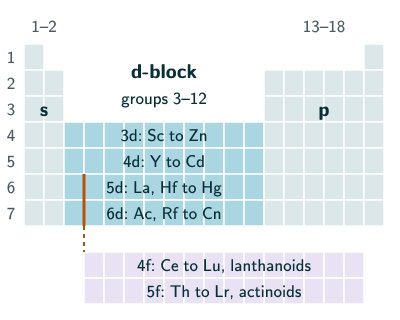
The d-block is the wide middle part of the periodic table, groups 3 to 12, between the s-block on the left and the p-block on the right. In its elements the d orbitals of the second-outermost shell are being filled (NCERT pages 89–90). In NCERT’s words:
The d-block of the periodic table contains the elements of the groups 3-12 in which the d orbitals are progressively filled in each of the four long periods.
NCERT Chemistry Part I (Class 12), Chapter 4, Introduction, page 89
- The four rows are the 3d, 4d, 5d and 6d series, in periods 4, 5, 6 and 7 (NCERT pages 89–90).
- The d-block elements are often called the transition metals. The f-block elements, the lanthanoids and actinoids, are the inner transition metals, and sit in a separate panel at the bottom of the table (NCERT page 89).
Convention: this lesson follows NCERT’s La/Ac arrangement and its fourteen-member f-block rows. Group-3 placement is convention-dependent; IUPAC also uses the family names lanthanoids for La–Lu and actinoids for Ac–Lr. A block-filling pattern is a classification of ground-state configurations, not a literal sequence in which an atom is assembled.
In plain words: every period from the fourth on has a ten-element stretch in the middle where electrons go into an inner d subshell instead of the outer shell. Stack those stretches and you get the d-block. It sits between groups 2 and 13, because that is when, in the filling order, the d orbitals fill.
The d-block between the s- and p-blocks
Follow period 4 across. In potassium and calcium the 4s orbital, lower in energy than 3d, takes one and then two electrons. From scandium the 3d orbitals fill, ten elements to zinc, and only then do the 4p orbitals fill, from gallium to krypton (NCERT Class 11 Chemistry, page 64; the aufbau order). So the d elements come after group 2 and before group 13. NCERT puts it this way:
The d–orbitals of the penultimate energy level of atoms receive electrons giving rise to four rows of the transition metals, i.e., 3d, 4d, 5d and 6d.
NCERT Chemistry Part I (Class 12), Section 4.1, page 90
- Why ten columns. A d subshell has five orbitals, so it holds ten electrons, and each d series has ten elements (reasoned).
- Why “penultimate”. The d orbitals being filled belong to the shell below the outermost one. In period 4 the outer shell is n = 4, while the 3d orbitals fill: the series is (n − 1)d (NCERT page 90).
- Why “transition”. The name first came from their chemical properties, which were transitional between those of the s- and p-block elements (NCERT page 89). In 1921 the English chemist Charles Bury applied the word to the series of elements across which an inner shell expands from 8 to 18 electrons (Wikipedia, “Transition metal”).
- The letter d comes from “diffuse”, in the old spectroscopic notation, and marks orbitals with azimuthal quantum number l = 2 (Wikipedia, “Block (periodic table)”).
Is every d-block element a transition element? Not by NCERT’s definition. Following IUPAC, NCERT defines a transition element by an incomplete d subshell in its atom or in a cation it can form. Zinc, cadmium and mercury, in group 12, have a full d10 configuration in the atom and in their common oxidation states, so they are not regarded as transition metals; they are still studied with them, as the last members of their series (NCERT page 89). Terminology differs across some classification schemes; the IUPAC Gold Book uses an incomplete d subshell in the atom or a cation. For the board exam, JEE and NEET, follow NCERT.
The 3d, 4d, 5d and 6d series
NCERT names the four series with their first and last members (NCERT page 89):
| Series | Period | Elements (atomic number) |
|---|---|---|
| 3d | 4 | Sc 21 to Zn 30 |
| 4d | 5 | Y 39 to Cd 48 |
| 5d | 6 | La 57; Hf 72 to Hg 80 |
| 6d | 7 | Ac 89; Rf 104 to Cn 112 |
- Ten elements in each. The 3d and 4d series are unbroken runs of ten. The 5d series is lanthanum plus the nine elements hafnium to mercury, and the 6d series is actinium plus the nine elements rutherfordium to copernicium (NCERT page 89).
- The gap in atomic number. Between lanthanum (57) and hafnium (72) come the fourteen lanthanoids, cerium (58) to lutetium (71), which fill the 4f orbitals. Between actinium (89) and rutherfordium (104) come the fourteen actinoids, thorium (90) to lawrencium (103), which fill 5f (NCERT page 89). These two rows make up the f-block, placed in a separate panel at the bottom of the table (NCERT page 89).
- The period number is one more than the d shell. The 3d series is in period 4, 4d in period 5, and so on, because the outer s orbital of that period fills first (reasoned from NCERT page 90).
- The heaviest 6d elements are synthetic. Roentgenium and copernicium, for example, have only been made in laboratories; half-lives belong to particular isotopes, and the limited chemistry of these short-lived elements should not be treated as fully measured bulk behaviour (Wikipedia, “Roentgenium” and “Copernicium”).
- Group number from the configuration. For a d-block element the group number is the number of (n − 1)d electrons plus ns electrons: iron, 3d6 4s2, is in group 8 (reasoned; the rule is set out on the s-, p-, d- and f-blocks page).
Lanthanum or lutetium in group 3? NCERT places lanthanum and actinium in group 3, below scandium and yttrium. Many chemists now argue for lutetium and lawrencium instead. The official IUPAC periodic-table page describes the competing arrangements and links its group-3 project. This lesson follows NCERT’s convention; use the convention specified by a question rather than treating one layout as a new experimental discovery.
Solved examples
Example 1: Placing iron
Iron has Z = 26 and the configuration [Ar] 3d6 4s2. Find its block, period, group and series.
Answer: The last electrons enter the 3d orbitals, so iron is in the d-block. Its outermost shell is n = 4, so it is in period 4, in the 3d series. Group number = 6 + 2 = 8 (reasoned; configuration from NCERT Table 4.1, page 90).
Example 2: Placing cadmium
Cadmium, Z = 48, is [Kr] 4d10 5s2. Where is it, and is it a transition element?
Answer: d-block, period 5, group 12 (10 + 2), the last member of the 4d series. It is not a transition element by NCERT’s definition: its d subshell is full both in the atom and in Cd2+, its common ion (NCERT pages 89 and 91).
Example 3: The jump from lanthanum to hafnium
In the 5d series, lanthanum (Z = 57) is followed by hafnium (Z = 72). How many elements lie between them, and where are they?
Answer: 72 − 57 − 1 = 14 elements, cerium (58) to lutetium (71). They are the lanthanoids, which fill the 4f orbitals and are placed in the f-block panel below the table (NCERT page 89).
Example 4: Placing palladium
Palladium, Z = 46, is [Kr] 4d10 5s0 (NCERT page 90). Its outermost occupied shell is n = 4. Is it in period 4?
Answer: No. It is in period 5, the row in which 4d fills, between rhodium (45) and silver (47): period = d shell + 1 = 5. Group = 10 + 0 = 10, below nickel. Among the familiar d-block atoms, Pd is the important exception to identifying a period from the highest occupied shell number (reasoned; periods and subshells).
Common mistakes to avoid
Common mistake
Reading the group from the d electrons alone
The group number counts the (n − 1)d and the ns electrons: nickel, 3d8 4s2, is in group 10, not group 8.
Common mistake
Counting the 4f electrons in a 5d element’s group
Hafnium is [Xe] 4f14 5d2 6s2. The full 4f14 is an inner subshell and does not count: hafnium is in group 2 + 2 = 4, below zirconium.
Common mistake
Expecting hafnium right after lanthanum in atomic number
The 5d series jumps from lanthanum, 57, to hafnium, 72: the fourteen lanthanoids, 58 to 71, come in between, in the f-block.
Quick revision summary
- The d-block is groups 3 to 12, between the s-block and the p-block, in periods 4 to 7.
- Its elements fill the (n − 1)d orbitals of the penultimate shell; each series has ten elements.
- Series: 3d Sc to Zn, 4d Y to Cd, 5d La and Hf to Hg, 6d Ac and Rf to Cn.
- The lanthanoids (Ce to Lu, 4f) and actinoids (Th to Lr, 5f) form the f-block, placed below the table.
- Transition metals have an incomplete d subshell in the atom or its ions, so Zn, Cd and Hg are not transition metals.
Formula sheet
- d-block: groups 3–12, periods 4–7
- Series: 3d Sc–Zn, 4d Y–Cd, 5d La and Hf–Hg, 6d Ac and Rf–Cn
- Period number = d shell number + 1
- Group number = (n − 1)d electrons + ns electrons
- f-block: 4f Ce–Lu (lanthanoids), 5f Th–Lr (actinoids)
Questions students ask
Are transition elements and transition metals the same thing?
Yes, transition elements and transition metals are two names for the same elements, since all of them are metals: NCERT says of the d-block elements “They are all metals” (NCERT Class 11 Chemistry, Unit 3, page 84) and calls the f-block elements the inner transition metals (NCERT page 89). Neither name covers the whole d-block in NCERT’s usage: zinc, cadmium and mercury are d-block metals it does not count as transition elements.
Why are the lanthanoids and actinoids placed separately at the bottom of the periodic table?
The lanthanoids and actinoids are placed in a separate panel at the bottom because each is a run of fourteen elements, filling the inner 4f or 5f subshell, that belong together: within each series “the properties of the elements are quite similar” (NCERT Class 11 Chemistry, Unit 3, page 84). Their place is after lanthanum (57) and actinium (89), and written there they would stretch periods 6 and 7 to 18 + 14 = 32 columns, so the panel keeps the long form 18 columns wide. Which group to give them in an exam is answered on the s-, p-, d- and f-blocks page.
Are the d- and f-block elements in the JEE Main 2027 and NEET (UG) 2026 syllabus?
Yes, the d- and f-block elements are Unit 11 of both the JEE Main 2027 and the NEET (UG) 2026 syllabus. It opens with the transition elements’ “General introduction, electronic configuration, occurrence and characteristics”, covers the general trends in properties of the first-row transition elements and K2Cr2O7 and KMnO4, and ends with the configurations and oxidation states of the lanthanoids and actinoids and the lanthanoid contraction. Unit 9 of both also names the s-, p-, d- and f-block elements, and Unit 20 the KMnO4 titrations with oxalic acid and Mohr’s salt.
Practice questions
Try each question first, then open the answer to check your working.
-
Q1. Zirconium has Z = 40 and the configuration [Kr] 4d2 5s2. Give its period, group and series.
Show answerHide answer
Period 5 (outer shell n = 5), group 4 (2 + 2), in the 4d series (reasoned; configuration from NCERT Table 4.1, page 91).
-
Q2. Name the four series of the d-block with their first and last members.
Show answerHide answer
3d: scandium to zinc; 4d: yttrium to cadmium; 5d: lanthanum, then hafnium to mercury; 6d: actinium, then rutherfordium to copernicium (NCERT page 89).
-
Q3. Which of these are d-block elements: gallium (Z = 31), yttrium (39), cerium (58), mercury (80) and rutherfordium (104)?
Show answerHide answer
Yttrium (4d series), mercury (5d) and rutherfordium (6d). Gallium comes after zinc, at the start of the 4p row, so it is in the p-block (group 13). Cerium is the first lanthanoid, in the f-block (NCERT page 89).