Occurrence of transition elements
Beyond NCERT In the JEE Main and NEET syllabus; the Class 12 book has no section for it.
Quick answer
Most transition metals occur in compounds such as oxides, sulphides and carbonates, while some less reactive metals also occur native. An ore is material from which a valuable constituent can be extracted economically, so it may be a mineral or a mixture. Important examples include haematite and magnetite for iron, chalcopyrite for copper, chromite for chromium and pyrolusite for manganese.
How do the transition elements occur in nature?
Occurrence of the transition elements
Most metals come from the earth’s crust, and seawater holds some as soluble salts. The elements or compounds that occur naturally in it are minerals, and a mineral from which a metal can be extracted profitably is an ore (NCERT Class 10 Science, Chapter 3, page 49). The transition metals occur in both ways that metals can: a few unreactive ones as the free metal, and most as compounds in ores. NCERT names the best-known ones:
Various precious metals such as silver, gold and platinum and industrially important metals like iron, copper and titanium belong to the transition metals series.
NCERT Chemistry Part I (Class 12), Chapter 4, Introduction, page 90
- Native metals. Gold, silver, platinum and copper are found in the free state; copper and silver also occur combined, in sulphide or oxide ores (NCERT Class 10 Science, Chapter 3, page 50).
- Ores. Moderately reactive metals such as zinc and iron occur mainly as oxides, sulphides or carbonates; many ores are oxides because oxygen is very reactive and very abundant (NCERT Class 10 Science, Chapter 3, page 50).
In plain words: how a metal is found depends on how reactive it is. Gold barely reacts, so it lies in the ground as gold. Iron combines readily with oxygen, so in the crust it is found combined, mostly as oxides, and we have to dig those up and reduce them to the metal.
NCERT’s Class 12 chapter names occurrence in its opening lines but has no section on it (NCERT page 90); the JEE Main 2027 and NEET (UG) 2026 syllabuses list it in Unit 11. Facts from beyond the NCERT books are labelled with their source.
Native metals and ores
- Minerals and ores. In the school usage, an ore mineral contains a metal that can be extracted economically. More precisely, mined ore can be a rock or mineral mixture; economic value depends on grade, processing and costs (NCERT Class 10 Science, Chapter 3, page 49). Whether a rock counts as ore is an economic question: the metal in it must be worth the cost of mining and processing (Wikipedia, “Ore”). Mined ore comes mixed with soil, sand and other impurities, called gangue (NCERT Class 10 Science, Chapter 3, page 50).
- Native transition metals. Small native grains of many metals are known, but only the platinum metals, gold, silver and copper are found uncombined in quantity (Wikipedia, “Native metal”). They are among the least reactive metals (NCERT Class 10 Science, Chapter 3, pages 49–50).
- Oxides, sulphides and carbonates. Most transition metals are reactive enough to be found only as compounds (reasoned from NCERT Class 10 Science, Chapter 3, page 50). For the textbook zinc route, sulphide and carbonate minerals are converted to oxides before reduction. This is not universal: other extraction routes can use sulphide melts, leaching or electrochemical steps. A sulphide is roasted, heated strongly in excess air; a carbonate is calcined, heated strongly in limited air (NCERT Class 10 Science, Chapter 3, page 51). For zinc, the last member of the 3d series:
- 2ZnS + 3O2 → 2ZnO + 2SO2 (roasting)
- ZnCO3 → ZnO + CO2 (calcination)
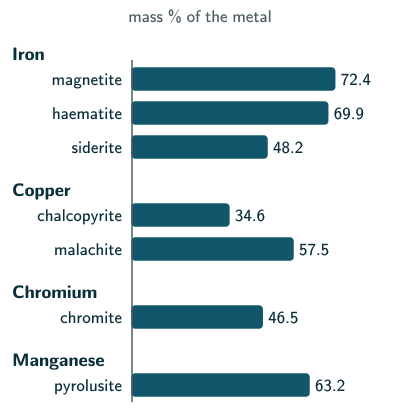
Common ores of iron, copper, chromium and manganese
| Metal | Chief ore minerals |
|---|---|
| Iron | magnetite, Fe3O4; haematite, Fe2O3; siderite, FeCO3 |
| Copper | chalcopyrite, CuFeS2; chalcocite, Cu2S; malachite, Cu2CO3(OH)2 |
| Chromium | chromite, FeCr2O4 |
| Manganese | pyrolusite, MnO2 |
- Iron. Most iron ore is iron oxide. Its chief minerals are magnetite and haematite, with goethite, limonite and the carbonate siderite (Wikipedia, “Iron ore”). From their formulas, pure magnetite is 72.4% iron by mass, haematite 69.9% and siderite 48.2% (Example 1 and Q8), the same figures as Wikipedia’s “Iron ore”. Magnetite holds both Fe2+ and Fe3+ and is drawn to a magnet (Wikipedia, “Magnetite”).
- Copper. Copper’s chief ore mineral is chalcopyrite, CuFeS2, a brassy-yellow sulphide that holds iron as well as copper (Wikipedia, “Chalcopyrite”). Copper also occurs as the sulphide Cu2S, which gives the metal on heating in air alone (NCERT Class 10 Science, Chapter 3, page 51). Among the oxidised copper ores are two carbonates, malachite and azurite (Wikipedia, “Copper extraction”); malachite, Cu2CO3(OH)2, is green (Wikipedia, “Malachite”); the same atoms are often written CuCO3·Cu(OH)2 (reasoned).
- Chromium. In chromite, FeCr2O4, iron is +2 and chromium +3 (Wikipedia, “Chromite”), so it can also be written FeO·Cr2O3 (reasoned). NCERT gives the same formula, and makes chromates, and from them potassium dichromate, by fusing chromite ore with sodium or potassium carbonate in air (NCERT page 105).
- Manganese. Pyrolusite, mostly MnO2, is a major manganese ore (Wikipedia, “Pyrolusite”; NCERT page 114 also gives it as MnO2). Potassium permanganate is made by fusing MnO2 with an alkali metal hydroxide and an oxidising agent such as KNO3 (NCERT page 106), and NCERT’s Exercise 4.26 asks for the steps from pyrolusite ore to KMnO4 (NCERT page 116).
Solved examples
Example 1: Iron in haematite and magnetite
Find the percentage of iron by mass in Fe2O3 and Fe3O4. (Fe = 55.85, O = 16.00 g mol−1.)
Answer: Fe2O3: M = 2 × 55.85 + 3 × 16.00 = 159.70 g mol−1; % Fe = 111.70/159.70 × 100 = 69.9%. Fe3O4: M = 167.55 + 64.00 = 231.55 g mol−1; % Fe = 167.55/231.55 × 100 = 72.4% (reasoned; percentage composition). Both agree with Wikipedia, “Iron ore”.
Example 2: Iron in magnetite
Find the average oxidation state of iron in Fe3O4, and show that it fits one Fe2+ and two Fe3+.
Answer: 3x + 4(−2) = 0, so x = 8/3 ≈ +2.67 on average (rules for oxidation numbers). One Fe2+ and two Fe3+ give 2 + 3 + 3 = 8, the same total, as in the formula Fe2+Fe3+2O4 (Wikipedia, “Magnetite”).
Example 3: Roasting or calcination?
Zinc occurs as zinc sulphide and as zinc carbonate. Which process turns each into ZnO, and what gas is given off?
Answer: ZnS is roasted, heated strongly in excess air, giving off SO2. ZnCO3 is calcined, heated strongly in limited air, giving off CO2 (NCERT Class 10 Science, Chapter 3, page 51).
Example 4: Chromium from chromite
How much chromium is there in 1.00 kg of pure chromite, FeCr2O4? (Fe = 55.85, Cr = 52.00, O = 16.00 g mol−1.)
Answer: M = 55.85 + 104.00 + 64.00 = 223.85 g mol−1; % Cr = 104.00/223.85 × 100 = 46.5%. So 1.00 kg holds about 465 g of chromium (reasoned).
Common mistakes to avoid
Common mistake
Calling every mineral an ore
A mineral is an ore only if the metal can be extracted from it profitably.
Common mistake
Mixing up magnetite and haematite
Magnetite is Fe3O4, magnetic and with both Fe2+ and Fe3+; haematite is Fe2O3, all Fe3+.
Common mistake
Swapping roasting and calcination
In the textbook zinc examples, sulphide is roasted in excess air and carbonate is calcined in limited air; extraction routes for other metals need not follow the same sequence.
Quick revision summary
- Minerals occur naturally in the earth’s crust; ores are minerals from which a metal can be extracted profitably.
- Gold, silver, platinum and copper occur native; copper and silver also occur in sulphide and oxide ores.
- Many transition metals occur as oxides, sulphides or carbonates; in the textbook zinc route sulphides are roasted and carbonates calcined to oxides.
- Iron: magnetite, haematite, siderite; copper: chalcopyrite, CuS, malachite; chromium: chromite; manganese: pyrolusite.
Formula sheet
- Iron: magnetite FeO, haematite FeO, siderite FeCO
- Copper: chalcopyrite CuFeS, CuS, malachite CuCO(OH)
- Chromium: chromite FeCrO; manganese: pyrolusite MnO
- Roasting: 2ZnS + 3O → 2ZnO + 2SO
- Calcination: ZnCO → ZnO + CO
- Mass % of metal = (mass of metal in one mole of compound ÷ molar mass of compound) × 100
Questions students ask
What is the most abundant transition metal in the earth’s crust?
Iron is the most abundant transition metal in the earth’s crust, about 5.63% of it by mass, and the fourth most abundant element after oxygen, silicon and aluminium (beyond the NCERT text; Wikipedia, “Abundance of elements in Earth’s crust”, from the CRC Handbook). The next transition metals are titanium, about 0.565%, and manganese, about 0.095%, so iron is about ten times as common as titanium (same source). Copper, for all its uses, makes up only about 60 parts per million of the crust (same source).
What is copper glance, and what is its formula?
Copper glance is an old name for chalcocite, copper(I) sulphide, Cu2S, a dark, metallic-looking mineral and one of the richest copper ores (beyond the NCERT text; Wikipedia, “Chalcocite”). With Cu = 63.55 and S = 32.06 g mol it is 127.10/159.16 × 100 = 79.9% copper by mass (reasoned), and heating it in air alone gives the metal (NCERT Class 10 Science, Chapter 3, page 51). Do not confuse it with chalcopyrite, CuFeS2, the brass-yellow copper–iron sulphide that is the commonest copper ore mineral (Wikipedia, “Chalcopyrite”).
Is iron pyrites an ore of iron?
Iron pyrites, FeS2, the brassy “fool’s gold”, is a common iron mineral but is not normally a principal iron-making ore: iron is made from the oxides magnetite and haematite, with goethite, limonite and the carbonate siderite (beyond the NCERT text; Wikipedia, “Iron ore”), while pyrite is used to make sulphur dioxide and sulphuric acid (Wikipedia, “Pyrite”). It also holds less iron than pure magnetite, haematite and siderite, 55.85/119.97 × 100 = 46.6% by mass (Fe = 55.85, S = 32.06 g mol), and its sulphur would first have to be roasted off as SO2 (reasoned).
Is metallurgy in the JEE Main 2027 and NEET (UG) 2026 syllabus?
No, metallurgy, the extraction of metals from their ores, has no unit of its own in the JEE Main 2027 or the NEET (UG) 2026 syllabus, and the 2026–27 NCERT Class 12 Chemistry books have none either: their Units 1 to 10 run from Solutions to Biomolecules. Unit 11 of both syllabuses lists the transition elements’ “occurrence and characteristics”, and the only mention of extracting metals is in Unit 12, Coordination Compounds, which lists their importance “in qualitative analysis, extraction of metals and in biological systems” (see extraction of metals).
Practice questions
Try each question first, then open the answer to check your working.
-
Q1. Name the chief ores of chromium and manganese and give their formulas.
Show answerHide answer
Chromium: chromite, FeCr2O4 (Wikipedia, “Chromite”; NCERT page 105). Manganese: pyrolusite, MnO2 (Wikipedia, “Pyrolusite”; NCERT page 114).
-
Q2. Name three transition metals found in the free state, and say why they are found that way.
Show answerHide answer
Gold, silver and platinum (copper too). They are among the least reactive metals, at the bottom of the activity series, so they are often found uncombined (NCERT Class 10 Science, Chapter 3, pages 49–50).
-
Q3. What is the difference between a mineral and an ore?
Show answerHide answer
NCERT uses mineral for a naturally occurring elemental or compound form of a metal. In geology a mineral is a naturally occurring solid with an ordered structure and characteristic composition; an ore is economically workable mineral-bearing material (NCERT Class 10 Science, Chapter 3, page 49).