Oxidation number
NCERT Class 11 Chemistry Chapter 7 Section 7.3
Quick answer
An oxidation number is a formal electron assignment: bonding electrons are assigned to the more electronegative atom, while bonds between identical atoms are split equally. Oxidation increases this number and reduction decreases it; totals equal the species charge. Balance redox equations by matching total increases and decreases, then checking every atom and the total charge in the specified medium.
With your textbook
NCERT Chemistry Part II (Class 11), Chapter 7 “Redox Reactions”, Section 7.3 “Oxidation Number”, pages 239–249.
Open the official NCERT chapter (PDF, 1.9 MB, ncert.nic.in) (opens in a new tab)
Checked against the 2026-27 reprint on .
What is an oxidation number?
Oxidation number
The oxidation number of an element in a compound is the charge its atom would carry if the electron pair in every covalent bond belonged entirely to the more electronegative atom; a bond between two atoms of the same element is split equally. It is found with a set of rules (NCERT Section 7.3, pages 239–240). In these terms:
Oxidation: An increase in the oxidation number of the element in the given substance. Reduction : A decrease in the oxidation number of the element in the given substance.
NCERT Chemistry Part II (Class 11), Section 7.3, page 241
- An oxidising agent (oxidant) raises the oxidation number of an element in another substance, and is itself reduced; a reducing agent (reductant) lowers it, and is itself oxidised.
- A redox reaction is one in which oxidation numbers change.
In plain words: in a covalent molecule such as water no electron is fully handed over, but we can pretend it is. Give each shared pair to the atom that pulls harder, count the charge each atom is left with, and you have its oxidation number. Then any rise in that number is oxidation and any fall is reduction, whether the compound is ionic or covalent.
Why oxidation numbers are needed
In 2H2(g) + O2(g) → 2H2O(l), hydrogen goes from a neutral state in H2 to a positive state in water and oxygen to a dinegative state, as if electrons passed from H to O. In fact the charge transfer is only partial, an electron shift, as in many reactions of covalent compounds (NCERT page 239). To keep track of such shifts, oxidation numbers assume a complete transfer from the less electronegative atom to the more electronegative one (see electronegativity). This is book-keeping only, but it describes every redox reaction simply:
- 2H2 + O2 → 2H2O: H 0 → +1, O 0 → −2;
- H2 + Cl2 → 2HCl: H 0 → +1, Cl 0 → −1;
- CH4 + 4Cl2 → CCl4 + 4HCl: C −4 → +4, Cl 0 → −1, H stays +1.
(NCERT’s equations 7.19 and 7.22 print hydrogen as H2(s); it is a gas, H2(g).)
Rules for assigning oxidation numbers
NCERT gives six rules (page 240):
- Every atom of an element in the free state has oxidation number 0: H2, O2, Cl2, O3, P4, S8, Na, Mg, Al.
- A one-atom ion has the oxidation number of its charge: Na+ +1, Mg2+ +2, Fe3+ +3, Cl− −1, O2− −2. In their compounds, alkali metals are +1, alkaline earth metals +2 and aluminium +3 (page 240); strictly, these are rules for ordinary compounds (reasoned).
- Oxygen is −2 in most compounds, with two kinds of exception: −1 in peroxides (H2O2, Na2O2) and −½ in superoxides (KO2, RbO2), where oxygen atoms are bonded to each other; and +2 in OF2 and +1 in O2F2, where it is bonded to fluorine.
- Hydrogen is +1, except when it is bonded to metals in binary compounds, such as LiH, NaH and CaH2, where it is −1 (page 240). More generally, hydrogen is −1 whenever its partner is less electronegative, as for the B–H bonds of BH4− (reasoned from the definition above).
- Fluorine is −1 in all its compounds. Chlorine, bromine and iodine are −1 as halide ions, but positive when combined with oxygen, as in oxoacids and oxoanions.
- The sum rule:
The algebraic sum of the oxidation number of all the atoms in a compound must be zero.
NCERT Chemistry Part II (Class 11), Section 7.3, page 240
For a polyatomic ion the sum equals the charge on the ion: in CO32−, x + 3(−2) = −2 gives carbon +4. When an element has several atoms in one species, as in Na2S2O3 or Cr2O72−, the rules give the average oxidation number of those atoms (page 240).
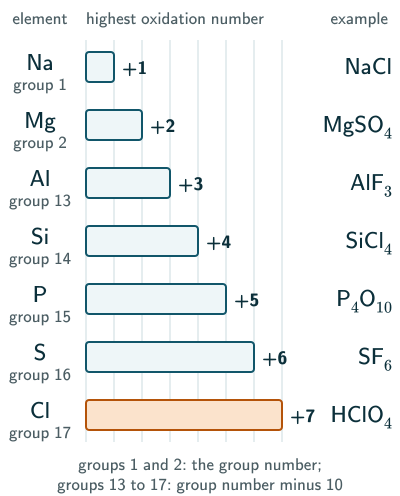
Patterns. Metals have positive oxidation numbers in their compounds; non-metals can be positive or negative, and transition elements usually show several positive states. The highest oxidation number of a representative element is the group number for groups 1 and 2 and the group number minus 10 for groups 13 to 17, so it generally rises across a period (page 240). Strictly, a metal can also be 0 in some compounds, as nickel in the neutral carbonyl Ni(CO)4 (reasoned). Oxygen and fluorine are exceptions: fluorine is never positive, and oxygen reaches only +2 (in OF2). The term oxidation state is used interchangeably: in CO2 the oxidation state, and the oxidation number, of carbon is +4.
| Group | Compound | Highest |
|---|---|---|
| 1 | NaCl | +1 |
| 2 | MgSO4 | +2 |
| 13 | AlF3 | +3 |
| 14 | SiCl4 | +4 |
| 15 | P4O10 | +5 |
| 16 | SF6 | +6 |
| 17 | HClO4 | +7 |
NCERT’s table (page 241) gives HClO for chlorine. That is an error: in HClO, hypochlorous acid, chlorine is only +1 (+1 + x − 2 = 0). The +7 compound is perchloric acid, HClO4 (+1 + x − 8 = 0).
Stock notation
In NCERT’s Stock notation, the oxidation number is expressed by a Roman numeral in parenthesis after the symbol of the metal in the molecular formula (page 241). Aurous and auric chloride become Au(I)Cl and Au(III)Cl3; stannous and stannic chloride become Sn(II)Cl2 and Sn(IV)Cl4. Beyond the NCERT text: today the numeral is usually written after the element’s name, as in iron(III) oxide, or as a superscript on the symbol, FeIII (Wikipedia, “Oxidation state”). In an exam on NCERT’s Stock notation, write NCERT’s form, Au(I)Cl. The numeral shows at once which is the oxidised and which the reduced form: Hg2(I)Cl2 is the reduced form of Hg(II)Cl2. In NCERT Problem 7.3, HAuCl4, Tl2O, FeO, Fe2O3, CuI, CuO, MnO and MnO2 become HAu(III)Cl4, Tl2(I)O, Fe(II)O, Fe2(III)O3, Cu(I)I, Cu(II)O, Mn(II)O and Mn(IV)O2.
Types of redox reactions
NCERT Section 7.3.1 (pages 242–245) sorts redox reactions into four types.
1. Combination, A + B → C. A free element is common but not required: NO + NO2 → N2O3 is a combination and comproportionation, with N +2 and +4 becoming +3. Combustion in dioxygen is always redox. NCERT lists these examples here, although methane’s combustion gives two products and so is not strictly A + B → C:
- C(s) + O2(g) → CO2(g): C 0 → +4, O 0 → −2;
- 3Mg(s) + N2(g) → Mg3N2(s): Mg 0 → +2, N 0 → −3;
- CH4(g) + 2O2(g) → CO2(g) + 2H2O(l): C −4 → +4, while hydrogen stays +1.
2. Decomposition, the opposite: a compound breaks into two or more products. A redox decomposition need not produce an element: NH4NO3 → N2O + 2H2O changes nitrogen oxidation states although all products are compounds.
- 2H2O(l) → 2H2(g) + O2(g)
- 2NaH(s) → 2Na(s) + H2(g)
- 2KClO3(s) → 2KCl(s) + 3O2(g): Cl +5 → −1, O −2 → 0, potassium unchanged.
Not every decomposition is redox. In CaCO3(s) → CaO(s) + CO2(g), Ca stays +2, C +4 and O −2 (page 242).
3. Displacement, X + YZ → XZ + Y: an atom or ion in a compound is replaced by one of another element.
Metal displacement is used in metallurgy to obtain pure metals. In each case the reducing metal is a better reducing agent than the metal it displaces (page 242):
- CuSO4(aq) + Zn(s) → Cu(s) + ZnSO4(aq)
- V2O5(s) + 5Ca(s) → 2V(s) + 5CaO(s)
- TiCl4(l) + 2Mg(s) → Ti(s) + 2MgCl2(s)
- Cr2O3(s) + 2Al(s) → Al2O3(s) + 2Cr(s)
Hydrogen displacement. All alkali metals and calcium, strontium and barium displace hydrogen from cold water: 2Na + 2H2O → 2NaOH + H2, and Ca + 2H2O → Ca(OH)2 + H2. Iron reacts with steam; magnesium reacts with hot water and more readily with steam (page 243). With steam, magnesium gives its oxide, Mg + H2O(g) → MgO + H2, and iron gives Fe3O4: 3Fe + 4H2O(g) → Fe3O4 + 4H2. NCERT’s equations 7.35 and 7.36 write the water as a liquid and give Mg(OH)2, which magnesium forms with hot water, and Fe2O3, which iron does not form with steam.
Many metals, even some that do not react with steam, such as cadmium and tin, displace hydrogen from acids. Zn, Mg and Fe with hydrochloric acid are used to make dihydrogen in the laboratory: Zn + 2HCl → ZnCl2 + H2. The rate of hydrogen evolution reflects the reactivity of the metal: slowest for the least active, iron, and fastest for the most reactive, magnesium; much less active metals, such as silver and gold, do not react even with hydrochloric acid (page 243). Strictly, surface films and temperature also affect the rate, so compare clean surfaces under the same conditions (reasoned).
Halogen displacement. The oxidising power of the halogens falls from fluorine to iodine. Fluorine is so reactive that it even displaces the oxygen of water, 2H2O + 2F2 → 4HF + O2, so its displacement reactions are not carried out in water. Chlorine displaces bromide and iodide, and bromine displaces iodide:
- Cl2 + 2Br− → 2Cl− + Br2
- Cl2 + 2I− → 2Cl− + I2
- Br2 + 2I− → 2Br− + I2
Bromine and iodine colour a layer of CCl4 shaken with the solution, which is the basis of the layer test for Br− and I− (page 243). Recovering a halogen from its halide, 2X− → X2 + 2e−, is an oxidation. Chemical oxidants can do this for Cl−, Br− and I− (page 243).
NCERT slip (page 244): NCERT says there is no way to convert F− ions to F2 by chemical means, and that the only way is to oxidise them electrolytically. Ordinary oxidants in water cannot do it (reasoned), but beyond the NCERT text, in 1986 Karl Christe made fluorine chemically, from K2MnF6 and SbF5; industrial fluorine is still made by electrolysis (Wikipedia, “Fluorine”). In an exam, give NCERT’s answer: electrolysis.
4. Disproportionation.
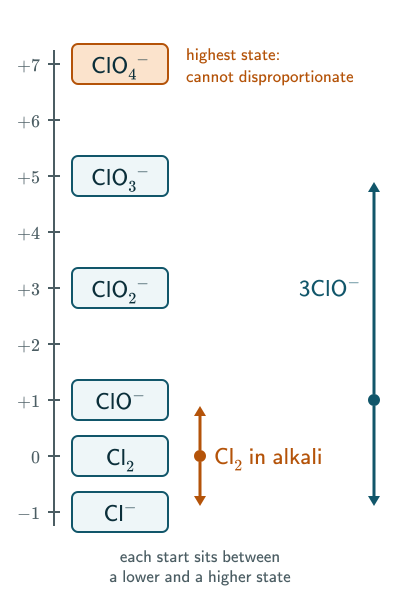
In a disproportionation reaction an element in one oxidation state is simultaneously oxidised and reduced.
NCERT Chemistry Part II (Class 11), Section 7.3.1, page 244
The element must be able to exist in at least three oxidation states, and the reacting substance holds it in an intermediate one, so that both a higher and a lower state can form. Examples (page 244):
- 2H2O2 → 2H2O + O2: O −1 → −2 and 0;
- P4 + 3OH− + 3H2O → PH3 + 3H2PO2−: P 0 → −3 and +1;
- S8 + 12OH− → 4S2− + 2S2O32− + 6H2O: S 0 → −2 and average +2 in thiosulphate (whose individual S assignments are +5 and −1);
- Cl2 + 2OH− → ClO− + Cl− + H2O: Cl 0 → +1 and −1.
The last reaction makes household bleach: hypochlorite oxidises coloured stains to colourless compounds. Bromine and iodine “follow the same trend as exhibited by chlorine” (NCERT page 244). Beyond the NCERT text: their hypohalites differ in stability, and the hypoiodite ions formed disproportionate at once to iodide and iodate (Wikipedia, “Iodine”). Fluorine does not follow this pattern. With alkali it gives 2F2 + 2OH− → 2F− + OF2 + H2O, in which fluorine is −1 in both products and it is oxygen that is oxidised. Being the most electronegative element, fluorine cannot take a positive oxidation state, so it cannot disproportionate (page 244).
Fractional oxidation numbers
Sometimes the rules give a fraction: carbon 4/3 in C3O2, bromine 16/3 in Br3O8, and sulphur 2.5 in Na2S4O6 (NCERT page 245). NCERT explains that electrons are never shared or transferred in fractions, so the fraction is the average oxidation state of atoms that are in different states (page 245); give that in an exam. Strictly, a fraction can also describe equivalent atoms over which the electrons are spread, as in the superoxide ion O2− (reasoned).
- Carbon suboxide, O=C=C=C=O: the two end carbons are +2 and the middle one 0; average 4/3.
- Br3O8: in NCERT’s structure the two end bromines are +6 and the middle one +4 (page 245); average 16/3.
- Tetrathionate, S4O62−: the two end sulphurs are +5 and the two middle ones 0; average 2.5.
Mixed oxides such as Fe3O4, Mn3O4 and Pb3O4 give fractional averages for the metal in the same way. Fe3O4 contains one Fe2+ and two Fe3+, average 8/3. In O2+ and O2−, though, the equivalent oxygens are assigned average +½ and −½ (page 245).
Balancing redox equations
NCERT Section 7.3.2 (pages 246–249) gives two methods. Either may be used.
(a) Oxidation number method.
- Write the correct formula of every reactant and product.
- Assign oxidation numbers and find the atoms whose numbers change.
- Find the increase and the decrease per atom and per formula, and multiply so that the total increase equals the total decrease. If no oxidation balances a reduction in the complete reaction, check for an omitted species or external electron source, as well as incorrect formulae or oxidation numbers.
- In water, add H+ (acidic solution) or OH− (basic solution) to the side that makes the total ionic charges equal.
- Add H2O to balance hydrogen, then check oxygen. If oxygen balances, the equation is balanced.
Examples 6 and 7 below are worked by this method (NCERT Problems 7.8 and 7.9).
(b) Half reaction (ion–electron) method. Each half reaction is balanced separately, then the two are added. NCERT’s example (pages 247–248) is the oxidation of Fe2+ by dichromate in acid:
- Skeleton: Fe2+ + Cr2O72− → Fe3+ + Cr3+.
- Split: oxidation Fe2+ → Fe3+; reduction Cr2O72− → Cr3+.
- Balance atoms other than O and H: Cr2O72− → 2Cr3+.
- In acid, add H2O for oxygen and H+ for hydrogen: Cr2O72− + 14H+ → 2Cr3+ + 7H2O.
- Add electrons to balance charge. The left side has +12 and the right +6, so 6e− go on the left: Cr2O72− + 14H+ + 6e− → 2Cr3+ + 7H2O. The iron half becomes Fe2+ → Fe3+ + e−, multiplied by 6.
- Add and cancel the electrons.
- Check atoms and charges.
Iron(II) with dichromate in acid
6Fe2+ + Cr2O72− + 14H+
→ 6Fe3+ + 2Cr3+ + 7H2O
Charge check: 12 − 2 + 14 = +24 on the left and 18 + 6 = +24 on the right.
In basic solution, balance first as in acid, then add as many OH− to both sides as there are H+. Wherever H+ and OH− stand on the same side, combine them into H2O (page 248; see Example 8).
Redox reactions as the basis for titrations
Just as acid–base titrations use a pH-sensitive indicator, redox titrations find the strength of a reductant or oxidant with a redox-sensitive indicator (NCERT Section 7.3.3, page 249):
- Permanganate as its own indicator. MnO4− is intensely coloured. After the last of the reductant (Fe2+ or C2O42−) is oxidised, the first lasting tinge of pink appears at an MnO4− concentration as low as 10−6 mol L−1, so the colour overshoots the equivalence point, where oxidant and reductant match in mole stoichiometry, only slightly. The acid used is dilute H2SO4, not HCl: permanganate would also oxidise Cl− to Cl2, so too much KMnO4 would be used.
- An added indicator. Dichromate is not a self-indicator, but just after the equivalence point it oxidises diphenylamine to an intense blue.
- Iodine and thiosulphate. An oxidant such as Cu2+ frees iodine from iodide, 2Cu2+ + 4I− → Cu2I2(s) + I2. The iodine, kept in solution by KI as KI3, is titrated with thiosulphate: I2 + 2S2O32− → 2I− + S4O62−. Starch gives an intense blue with iodine that vanishes when the last iodine is used up.
The volumes then give the amounts through the balanced equation (see reactions in solution), as in Example 9.
Limitations of the oxidation number concept
The idea of redox has kept changing: from adding oxygen, to losing electrons, to changing oxidation numbers. Oxidation numbers are a formal device; the fractional averages above show that they need not match the real state of each atom. NCERT Section 7.3.4 pictures oxidation as decreasing and reduction as increasing electron density. Strictly, this is a qualitative picture: changes of calculated partial charge alone are not a universal redox test, whereas oxidation state is a defined formal assignment (reasoned).
Solved examples
Example 1: Using the rules
Find the oxidation number of (a) Cr in K2Cr2O7; (b) Mn in MnO4−; (c) S in Na2S2O3; (d) O in KO2; (e) H in CaH2.
(a) 2(+1) + 2x + 7(−2) = 0, so x = +6. (b) x + 4(−2) = −1, so x = +7. (c) 2(+1) + 2x + 3(−2) = 0, so x = +2 (an average). (d) +1 + 2x = 0, so x = −½ (a superoxide). (e) +2 + 2x = 0, so x = −1 (a metal hydride).
Answer: +6, +7, +2, −½, −1.
Example 2: Copper(I) oxide and copper(I) sulphide (NCERT Problem 7.4, pages 241–242)
Justify that 2Cu2O(s) + Cu2S(s) → 6Cu(s) + SO2(g) is a redox reaction, and name the oxidant and the reductant.
Oxidation numbers: Cu +1 in both Cu2O and Cu2S, 0 in Cu; S −2 in Cu2S, +4 in SO2; O −2 throughout.
Answer: Copper is reduced (+1 → 0) and sulphur is oxidised (−2 → +4), so it is a redox reaction. Cu(I) is the oxidant, and the sulphur of Cu2S is the reductant: it lowers the oxidation number of the copper both in Cu2S itself and in Cu2O.
Example 3: Which oxoanions disproportionate? (NCERT Problem 7.5, page 244)
Which of ClO−, ClO2−, ClO3− and ClO4− do not disproportionate, and why? Write the reactions of those that do.
Chlorine is +1, +3, +5 and +7 in these ions. ClO4− has chlorine in its highest state, +7, so it cannot be oxidised further. The others are intermediate:
- 3ClO− → 2Cl− + ClO3− (+1 → −1 and +5)
- 3ClO2− → 2ClO3− + Cl−, in light (NCERT doubles this) (+3 → +5 and −1)
- 4ClO3− → Cl− + 3ClO4− (+5 → −1 and +7)
Answer: Only ClO4− does not disproportionate.
Example 4: Classifying redox reactions (NCERT Problem 7.6, pages 244–245)
Classify: (a) N2 + O2 → 2NO; (b) 2Pb(NO3)2 → 2PbO + 4NO2 + O2; (c) NaH + H2O → NaOH + H2; (d) 2NO2 + 2OH− → NO2− + NO3− + H2O.
(a) Two elements combine. (b) Lead nitrate breaks into three components, one of them the element oxygen. (c) The hydride ion (H −1) displaces the hydrogen of water (H +1) as dihydrogen. (d) Nitrogen at +4 in NO2 goes to +3 in NO2− and +5 in NO3−.
Answer: (a) combination; (b) decomposition; (c) displacement; (d) disproportionation.
Example 5: Red lead with two acids (NCERT Problem 7.7, page 246)
Why does Pb3O4 + 8HCl → 3PbCl2 + Cl2 + 4H2O happen, while with nitric acid the products are Pb3O4 + 4HNO3 → 2Pb(NO3)2 + PbO2 + 2H2O?
Pb3O4 behaves as 2PbO + PbO2: lead +2 in the basic oxide PbO and +4 in PbO2, an oxidant. With HCl, PbO gives an acid–base reaction, 2PbO + 4HCl → 2PbCl2 + 2H2O, and PbO2 oxidises chloride, PbO2 + 4HCl → PbCl2 + Cl2 + 2H2O (Pb +4 → +2, Cl −1 → 0). Nitric acid is itself an oxidising agent, so PbO2 has nothing to oxidise and stays unchanged, while PbO reacts as a base.
Answer: The difference is that chloride can be oxidised by PbO2 but nitrate cannot.
Example 6: Dichromate and sulphite, oxidation number method (NCERT Problem 7.8, pages 246–247)
Write the net ionic equation for the reaction of K2Cr2O7 with Na2SO3 in acid, giving Cr3+ and sulphate.
Skeleton: Cr2O72− + SO32− → Cr3+ + SO42−. Cr goes +6 → +3, a fall of 3 per Cr and 6 per Cr2O72−; S goes +4 → +6, a rise of 2. So 1 dichromate needs 3 sulphite: Cr2O72− + 3SO32− → 2Cr3+ + 3SO42−. Charges: −8 on the left, 0 on the right, so add 8H+ on the left; then 4H2O on the right balances hydrogen.
Answer: Cr2O72− + 3SO32− + 8H+ → 2Cr3+ + 3SO42− + 4H2O. Oxygen check: 7 + 9 = 16 = 12 + 4.
Example 7: Permanganate and bromide in base (NCERT Problem 7.9, page 247)
Permanganate oxidises bromide in basic solution to bromate, giving MnO2. Balance the ionic equation.
Skeleton: MnO4− + Br− → MnO2 + BrO3−. Mn falls by 3 (+7 → +4); Br rises by 6 (−1 → +5). So 2MnO4− + Br− → 2MnO2 + BrO3−. Charges: −3 on the left, −1 on the right; in base add 2OH− on the right. Hydrogen: add one H2O on the left.
Answer: 2MnO4− + Br− + H2O → 2MnO2 + BrO3− + 2OH−.
Example 8: Permanganate and iodide in base, half reaction method (NCERT Problem 7.10, pages 248–249)
MnO4− oxidises I− in basic solution to I2, giving MnO2. Balance the equation.
Oxidation half: 2I− → I2 + 2e−. Reduction half, first as in acid: MnO4− + 4H+ → MnO2 + 2H2O. Add 4OH− to both sides and combine 4H+ + 4OH− into 4H2O: MnO4− + 2H2O + 3e− → MnO2 + 4OH−. Multiply the iodide half by 3 and the permanganate half by 2 (6e− each), then add.
Answer: 6I− + 2MnO4− + 4H2O → 3I2 + 2MnO2 + 8OH−. Charges: −8 on each side.
Example 9: A permanganate titration
25.0 mL of an iron(II) solution acidified with dilute H2SO4 needs 20.0 mL of 0.0200 M KMnO4 to reach the first lasting pink. Find the concentration of Fe2+.
Half reactions: MnO4− + 8H+ + 5e− → Mn2+ + 4H2O and Fe2+ → Fe3+ + e− (× 5), so MnO4− + 5Fe2+ + 8H+ → Mn2+ + 5Fe3+ + 4H2O. Moles of MnO4− = 0.0200 mol L−1 × 0.0200 L = 4.00 × 10⁻⁴ mol; moles of Fe2+ = 5 × 4.00 × 10−4 = 2.00 × 10⁻³.
Answer: [Fe2+] = 2.00 × 10⁻³/0.0250 L = 0.0800 M.
Common mistakes to avoid
Common mistake
Forgetting the exceptions for oxygen and hydrogen
Oxygen is −1 in peroxides, −½ in superoxides and positive with fluorine; hydrogen is −1 in metal hydrides. In BaO2, barium is +2, so oxygen must be −1, not −2.
Common mistake
Getting an impossible value from an O–O link
In H2SO5, taking every oxygen as −2 gives sulphur +8, above its group maximum of +6. The molecule has one O–O (peroxo) link, so those two oxygens are −1: 2(+1) + x + 3(−2) + 2(−1) = 0 gives x = +6 (NCERT Exercise 7.5). In CrO5, chromium is +6 for the same reason, not +10.
Common mistake
Calling every decomposition a redox reaction
CaCO3 → CaO + CO2 changes no oxidation number. Check the numbers, not the type of reaction.
Common mistake
Applying the group rule to oxygen and fluorine
The highest oxidation number is “group number minus 10” for most p-block elements, but fluorine is never positive and oxygen reaches only +2.
Common mistake
Reading an average as the real state
In S4O62− no sulphur is +2.5: two are +5 and two are 0. Use the structure when a question asks about individual atoms.
Common mistake
Leaving H<sup>+</sup> in a basic-medium answer
In basic solution, the final equation must contain OH− and H2O, never H+.
Quick revision summary
- Oxidation number: the charge an atom would have if every shared pair went to the more electronegative atom.
- Oxidation is an increase in oxidation number, reduction a decrease; redox reactions change oxidation numbers.
- Rules: element 0; simple ion = charge; O −2 (peroxide −1, superoxide −½, with F positive); H +1 (metal hydride −1); F −1; the sum is 0, or the charge of an ion.
- Common maximum oxidation-number pattern: group number for groups 1–2 and group number −10 for groups 13–17, with exceptions including oxygen and fluorine.
- Types: combination, decomposition, displacement (metal, hydrogen, halogen), disproportionation.
- Fractional values can describe averages or equivalent delocalised sites; structural information is needed for individual assignments, which remain formal.
- Balance by oxidation numbers or by half reactions: total increase = total decrease.
- Redox titrations: KMnO4 as its own indicator, Cr2O72− with diphenylamine, iodine with starch.
Formula sheet
- Sum of oxidation numbers = 0 (compound) or the charge (ion)
- Oxidation = increase in oxidation number; reduction = decrease
- Common maximum: group number (1, 2) or group number − 10 (13–17); O and F are exceptions
- Total increase in oxidation number = total decrease
Questions students ask
What is the difference between oxidation number and valency?
Valency is an atom’s combining capacity, a whole number without a sign that counts the bonds it forms or the electrons it loses or gains, while oxidation number is the charge the atom would carry if each shared pair went wholly to the more electronegative atom, so it has a sign and can be zero or, as an average, fractional. Carbon has valency 4 in CH4, CH2Cl2 and CCl4, but oxidation numbers −4, 0 and +4, because it takes the bonding electrons from the less electronegative hydrogen and gives them to the more electronegative chlorine. In N2, likewise, each nitrogen has valency 3 (a triple bond) but oxidation number 0.
Are oxidation number and oxidation state the same?
Yes, in NCERT and in JEE and NEET questions oxidation number and oxidation state mean the same thing: the charge an atom would carry if every shared pair went to the more electronegative atom, such as +6 for sulphur in H2SO4. NCERT itself calls oxidation state “a term that is often used interchangeably with the oxidation number” (page 240). Roman numerals in names such as iron(III) chloride are a notation for this value, not a separate physical property. Neither is the same as formal charge, which splits each shared pair equally between the two atoms.
Is oxidation number the same as the charge on an atom?
Oxidation number equals the real charge only in simple cases, such as a one-atom ion like Fe3+ or Cl−; in a covalent molecule it is a bookkeeping charge, because the shared electrons are only drawn towards the more electronegative atom, never fully handed over. In water, for example, oxygen is −2 and each hydrogen +1, but the actual partial charges are much smaller, and in SF6 sulphur is +6 although SF6 does not contain a bare S6+ ion. By convention the sign is written first for an oxidation number (+3) and last for an ionic charge (3+).
What are the oxidation states of nitrogen?
Nitrogen shows every oxidation state from −3 to +5: −3 in NH3, −2 in N2H4, −1 in NH2OH, 0 in N2, average +1 in N2O (its two N atoms are inequivalent), +2 in NO, +3 in HNO2, +4 in NO2 and +5 in HNO3. The limits follow from its five valence electrons: it can take three more to complete an octet, giving −3, or lose all five to more electronegative atoms, giving +5, the group number (15) minus 10. In hydrazoic acid, HN3, the rules even give an average of −1/3, which here hides different states of the three nitrogen atoms.
What is the difference between disproportionation and comproportionation?
In disproportionation one element in a single intermediate oxidation state is both oxidised and reduced, while in comproportionation, the reverse, the same element in two different oxidation states reacts to give one intermediate state. For example, 2H2S + SO2 → 3S + 2H2O takes sulphur from −2 and +4 to 0, and IO3− + 5I− + 6H+ → 3I2 + 3H2O takes iodine from +5 and −1 to 0. NCERT does not name comproportionation, but it is a redox reaction like any other: in the sulphur example the 4 electrons lost by two H2S are the 4 gained by one SO2.
What does KMnO4 change into in acidic, neutral and basic solution?
Potassium permanganate, with manganese at +7, is reduced to different products in different media: to nearly colourless Mn2+ (+2, five electrons per MnO4−) in acidic solution, to a brown precipitate of MnO2 (+4, three electrons) in neutral or weakly basic solution, and to green manganate, MnO42− (+6, one electron), in strongly basic solution with suitable reduction conditions. The reductant and conditions also matter, so medium alone does not guarantee a unique product. The electrons taken per formula unit, 5, 3 or 1, are what coaching books call the n-factor, so the equivalent mass of KMnO4 (molar mass 158.0 g mol) is 31.6, 52.7 or 158.0 g per mole of electron equivalents for those respective reduction products.
Practice questions
Try each question first, then open the answer to check your working.
-
Q1. Find the oxidation number of (a) P in NaH2PO4; (b) Mn in K2MnO4; (c) B in NaBH4; (d) S in H2S2O7 (from NCERT Exercise 7.1).
Show answerHide answer
(a) 1 + 2 + x − 8 = 0, x = +5. (b) 2 + x − 8 = 0, x = +6. (c) 1 + x − 4 = 0, x = +3 (hydrogen is −1 bonded to boron, the less electronegative element). (d) 2 + 2x − 14 = 0, x = +6.
-
Q2. Find the average oxidation number of iron in Fe3O4 and of carbon in CH3COOH, and explain each result (from NCERT Exercise 7.2).
Show answerHide answer
Fe3O4: 3x = 8, x = 8/3; it is a mixed oxide with one Fe2+ and two Fe3+. CH3COOH: 2x + 4 − 4 = 0, x = 0; in fact the CH3 carbon is −3 and the COOH carbon +3.
-
Q3. Balance H2O2 + Fe2+ → Fe3+ + H2O in acidic solution (NCERT Exercise 7.18 (c)).
Show answerHide answer
Reduction: H2O2 + 2H+ + 2e− → 2H2O (O −1 → −2). Oxidation: Fe2+ → Fe3+ + e−, × 2. Sum: H2O2 + 2Fe2+ + 2H+ → 2Fe3+ + 2H2O.