Kössel–Lewis approach to chemical bonding
NCERT Class 11 Chemistry Chapter 4 Section 4.1
Quick answer
Kössel and Lewis (1916) explained bonding as atoms reaching a stable noble gas octet, either by transferring electrons to form ions held by electrostatic attraction, or by sharing electron pairs in covalent bonds. Lewis structures show shared pairs and lone pairs, and formal charges help pick the best structure. The octet rule fails for incomplete octets, odd-electron molecules and expanded octets.
With your textbook
NCERT Chemistry Part I (Class 11), Chapter 4 “Chemical Bonding and Molecular Structure”, Section 4.1 “Kössel-Lewis Approach to Chemical Bonding”, pages 101–106.
Open the official NCERT chapter (PDF, 4.5 MB, ncert.nic.in) (opens in a new tab)
Checked against the 2026-27 reprint on .
What is the Kössel–Lewis approach to chemical bonding?
The Kössel–Lewis approach
In 1916 Kössel and Lewis independently explained chemical bonding through the stability of the noble gas configuration (NCERT Section 4.1, pages 101–106):
- atoms combine so that each reaches an octet, eight electrons in its outer shell (two, a duplet, for hydrogen), like a noble gas: the octet rule;
- they do this either by transferring electrons, forming ions held by electrostatic attraction (an ionic or electrovalent bond, Kössel), or by sharing pairs of electrons (a covalent bond, Lewis and Langmuir);
- Lewis symbols and Lewis structures show the valence electrons as dots, bonds as shared pairs and the rest as lone pairs.
In plain words: noble gases hardly react, and they all have full outer shells. So the idea is that other atoms react in order to get a full outer shell too. Sodium gives away its one outer electron and chlorine takes it, and both end up with full shells as ions. Two chlorine atoms, each one electron short, share a pair between them instead. The octet rule is a rule of thumb, not a law: it explains a great deal, but there are exceptions.
Chemical bonds and Lewis symbols
The attractive force which holds various constituents (atoms, ions, etc.) together in different chemical species is called a chemical bond.
NCERT Chemistry Part I (Class 11), Chapter 4, Introduction, page 100
Bonding is nature’s way of lowering the energy of a system and so making it more stable (page 100). The first satisfactory explanation in terms of electrons came in 1916, from Kössel and Lewis independently, based on the inertness of the noble gases (NCERT page 101).
Lewis pictured an atom as a positively charged “kernel” (the nucleus plus the inner electrons) surrounded by an outer shell that holds at most eight electrons, at the corners of a cube; a noble gas fills all eight corners.
Lewis postulated that atoms achieve the stable octet when they are linked by chemical bonds.
NCERT Chemistry Part I (Class 11), Section 4.1, page 101
For these main-group examples, the outer-shell electrons are the valence electrons used in the Lewis model. Transition-metal bonding can also involve inner d electrons. In a Lewis symbol, they are shown as dots around the element symbol: Li has one dot, Be two, B three, C four, N five, O six, F seven and Ne eight. The number of dots gives the group valence: generally either the number of dots or 8 minus it (page 101). Carbon (4 dots) has valence 4; oxygen (6 dots) has valence 8 − 6 = 2.
Kössel’s view: the ionic bond
Kössel pointed out that (NCERT page 101):
- the highly electronegative halogens and the highly electropositive alkali metals are separated in the periodic table by the noble gases;
- a halogen forms a negative ion by gaining an electron, and an alkali metal a positive ion by losing one;
- the ions so formed have stable noble gas configurations, ns2 np6 (helium’s is a duplet, 1s2);
- the ions are held together by electrostatic attraction.
Formation of sodium chloride
Na → Na+ + e−; Cl + e− → Cl−; Na+ + Cl− → NaCl
Na, [Ne] 3s1, becomes Na+, [Ne]; Cl, [Ne] 3s2 3p5, becomes Cl−, [Ar]. In the same way, calcium ([Ar] 4s2) gives two electrons to two fluorine atoms to form CaF2, Ca2+(F−)2 (page 101).
The bond formed by the electrostatic attraction between positive and negative ions is the electrovalent bond. The electrovalence equals the number of unit charges on the ion: calcium has a positive electrovalence of 2, chlorine a negative electrovalence of 1 (page 102). Kössel’s ideas are the basis of the modern picture of ion formation by electron transfer and of ionic crystals, though he recognised that many compounds did not fit them. The ionic bond is taken further in NCERT Section 4.2.
The octet rule
In 1916 Kössel and Lewis developed the electronic theory of chemical bonding: atoms combine either by transferring valence electrons from one atom to another, or by sharing valence electrons, so as to have an octet in their valence shells. This is the octet rule (NCERT Section 4.1.1, page 102).
The covalent bond
In 1919 Langmuir refined Lewis’s ideas: he dropped the stationary cubical octet and introduced the term covalent bond (NCERT Section 4.1.2, page 102). In the chlorine molecule, each Cl atom ([Ne] 3s2 3p5) is one electron short of argon; each contributes one electron to a shared pair, and both reach an octet. The bond is written Cl–Cl.
The conditions for a Lewis dot structure (page 102):
- each bond is a shared pair of electrons between two atoms;
- each combining atom contributes at least one electron to the shared pair (in a coordinate bond one atom supplies both, as when NH3 bonds to H+ in NH4+);
- the combining atoms reach noble gas configurations by sharing.
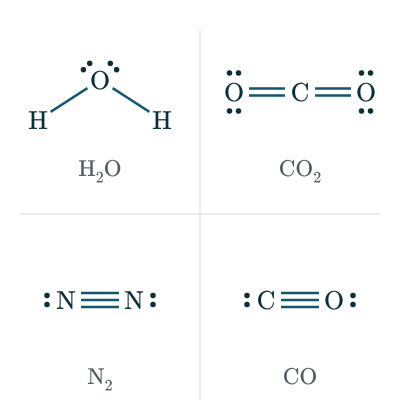
So in water, each H attains a duplet and O an octet; in CCl4, carbon and all four chlorines have octets.
- One shared pair is a single bond (Cl–Cl, H–O in water).
- Two shared pairs make a double bond: CO2 has two C=O double bonds, and ethene, C2H4, a C=C double bond.
- Three shared pairs make a triple bond: N≡N in nitrogen and C≡C in ethyne, C2H2 (pages 102–103).
Writing Lewis structures
The Lewis dot structures provide a picture of bonding in molecules and ions in terms of the shared pairs of electrons and the octet rule.
NCERT Chemistry Part I (Class 11), Section 4.1.3, page 103
The steps (NCERT page 103):
- Add up the valence electrons of all the atoms. CH4 has 4 (C) + 4 × 1 (H) = 8.
- For an anion, add one electron per negative charge; for a cation, subtract one per positive charge. CO32− has 4 + 3 × 6 + 2 = 24; NH4+ has 5 + 4 − 1 = 8.
- Write the skeleton. In general the least electronegative atom other than hydrogen is central: N in NF3, C in CO32−, with F and O at the ends.
- Put a shared pair in each bond, then use the remaining electrons for multiple bonds or as lone pairs, so that each atom gets an octet.
NCERT’s Table 4.1 (page 103) gives the Lewis structures of H2, O2, O3, NF3, CO32− and HNO3.
Formal charge
Lewis structures do not show the real shapes of molecules. In a polyatomic ion the charge belongs to the ion as a whole, but a formal charge can be assigned to each atom: the difference between its valence electrons as a free atom and the electrons assigned to it in the Lewis structure (NCERT Section 4.1.4, pages 104–105):
Formal charge
F.C. = V − L − ½B
where V is the number of valence electrons of the free atom, L the number of non-bonding (lone pair) electrons and B the number of bonding (shared) electrons. The atom is taken to own one electron of each shared pair and both electrons of each lone pair.
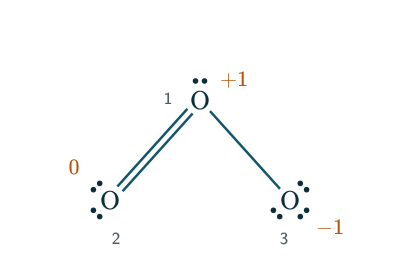
Formal charges do not mean that the charge is really separated in the molecule; they are bookkeeping. Their use is in choosing between possible Lewis structures (page 105):
Generally the lowest energy structure is the one with the smallest formal charges on the atoms.
NCERT Chemistry Part I (Class 11), Section 4.1.4, page 105
For example (reasoned from NCERT page 105), SO42− drawn with four S–O single bonds gives S +2 and each O −1; drawn with two S=O and two S–O bonds it gives S 0, the two single-bonded O −1 and the others 0. The smaller formal charges favour the second Lewis representation; these S=O lines do not prove localised d-orbital double bonds. This is why H2SO4 is drawn with 12 electrons round S (page 105). ClO4− works the same way: Cl is +3 with four single bonds but 0 with three Cl=O bonds.
Limitations of the octet rule
The octet rule is useful, especially for organic compounds and the second-period elements, but it is not universal. There are three types of exception (NCERT Section 4.1.5, pages 105–106):
- Incomplete octet of the central atom, common for elements with fewer than four valence electrons. Such electron-deficient molecules complete the octet by accepting a lone pair (BF3 + F− → BF4−; AlCl3 + Cl− → AlCl4−, NCERT Exercise 4.25). Examples in simple molecular Lewis drawings: BeH2 (4 electrons round Be), BCl3 (6 round B), AlCl3 and BF3. These are isolated-molecule descriptions: solid BeH2 has bridging bonds. NCERT also lists LiCl, but in the ionic picture Li+ has a stable helium-like duplet, not an unstable incomplete shell.
- Odd-electron molecules, such as nitric oxide, NO, and nitrogen dioxide, NO2, in which not every atom can have an octet. An odd total of valence electrons is the test: NO 11, NO2 17, ClO2 19.
- Expanded octet: elements of the third period and beyond can have more than eight electrons round the central atom. NCERT uses a d-orbital hybridisation model, but modern explanations use delocalised bonding without requiring large d-orbital participation. “Expanded octet” here counts electrons in a Lewis drawing. Examples: PF5 (10 electrons round P), SF6 (12 round S) and H2SO4 (12 round S in its usual Lewis structure). Sulphur still obeys the octet rule in many compounds, such as SCl2. Second-period atoms never exceed eight: NF5, NCl5 and OF4 do not exist, while PF5 and PCl5 do.
Other drawbacks (page 106):
- the rule rests on the inertness of the noble gases, yet xenon and krypton form compounds such as XeF2, KrF2 and XeOF2;
- it says nothing about the shapes of molecules;
- it does not explain the relative stability of molecules, being silent about their energy.
Solved examples
Example 1: Carbon monoxide (NCERT Problem 4.1, page 104)
Write the Lewis dot structure of CO.
Valence electrons: C (2s2 2p2) 4 + O (2s2 2p4) 6 = 10. Skeleton C O. A single bond with the octet completed on O leaves carbon with only one lone pair, 4 electrons. To give both atoms octets, make a triple bond.
Answer: :C≡O:, a triple bond with one lone pair on each atom.
Example 2: The nitrite ion (NCERT Problem 4.2, page 104)
Write the Lewis structure of NO2−.
Valence electrons: N 5 + 2 × O 6 + 1 (the charge) = 18. Skeleton O N O. Single bonds with octets on both oxygens use 16; the last two go on N as a lone pair, leaving N with only 6. So make one N=O double bond.
Answer: [O=N–O]− with one lone pair on N, two on the double-bonded O and three on the single-bonded O; the double bond can be on either side.
Example 3: Formal charges in carbon monoxide
Find the formal charges on C and O in :C≡O:.
C: V = 4, one lone pair (L = 2), triple bond (B = 6): 4 − 2 − 3 = −1. O: V = 6, L = 2, B = 6: 6 − 2 − 3 = +1.
Answer: C −1 and O +1; they add up to 0, the charge on the molecule. Usually the negative formal charge should sit on the more electronegative atom; CO is an exception forced by the octets.
Example 4: The carbonate ion
Count the valence electrons in CO32− and find the formal charges in the structure with one C=O and two C–O bonds.
Electrons: 4 + 3 × 6 + 2 = 24. C (no lone pairs, 4 bonds): 4 − 0 − 4 = 0. The double-bonded O (2 lone pairs): 6 − 4 − 2 = 0. Each single-bonded O (3 lone pairs): 6 − 6 − 1 = −1.
Answer: 24 electrons; formal charges 0, 0, −1 and −1, adding to −2, the ion’s charge. By resonance (NCERT Section 4.3.5) the three C–O bonds are in fact identical, with an average formal-charge label of −⅔ on each O, not an experimentally determined partial charge.
Example 5: Electron transfer (NCERT Exercise 4.14, page 134)
Use Lewis symbols to show electron transfer between (a) K and S, (b) Ca and O, (c) Al and N.
(a) Each K (1 dot) gives its electron to S (6 dots): 2K+ and S2− with 8 dots in brackets, K2S. (b) Ca (2 dots) gives both to O (6 dots): Ca2+ and O2− with 8 dots, CaO. (c) Al (3 dots) gives all three to N (5 dots): Al3+ and N3− with 8 dots, AlN.
Answer: K2S, CaO and AlN, each ion with a noble gas configuration.
Common mistakes to avoid
Common mistake
Forgetting the charge when counting electrons
Add one electron for each negative charge and remove one for each positive charge: NO2− has 18, not 17; NH4+ has 8, not 9.
Common mistake
Putting the most electronegative atom in the centre
The least electronegative atom (other than hydrogen) usually goes in the middle: N in NF3, C in CO32−, S in SO42−.
Common mistake
Treating formal charges as real charges
Formal charges are bookkeeping. They must add up to the overall charge, but they do not show where the charge really sits.
Common mistake
Forcing an octet on every atom
BF3 and BeH2 have incomplete octets, NO and NO2 have odd electrons, and PF5 and SF6 have more than eight round the central atom.
Quick revision summary
- Kössel and Lewis (1916): atoms bond to reach a noble gas configuration, an octet (a duplet for H).
- Ionic (electrovalent) bond: electron transfer, then electrostatic attraction (Na+Cl−); electrovalence = charge on the ion.
- Covalent bond (shared pairs, Lewis 1916; the term from Langmuir, 1919): single, double and triple bonds (Cl–Cl, O=C=O, N≡N).
- Lewis structures: count valence electrons (adjust for charge), least electronegative atom other than H central, complete octets with multiple bonds or lone pairs.
- Formal charge = V − L − ½B; the best structure usually has the smallest formal charges.
- Exceptions: incomplete octet (BeH2, BF3), odd-electron molecules (NO, NO2), expanded octet (PF5, SF6); the rule also fails for noble gas compounds, shapes and energies.
Formula sheet
- Group valence = dots in the Lewis symbol, or 8 − dots
- Electrons for a Lewis structure = Σ valence electrons − (charge)
- Formal charge = V − L − ½B
- Single bond: 1 shared pair; double: 2; triple: 3
Questions students ask
What is the difference between the octet rule and the duplet rule?
The octet rule says that atoms combine, by transferring or sharing electrons, so that each has eight electrons in its valence shell, like neon or argon, while the duplet rule is the same idea for the first shell, which holds only two electrons: hydrogen is stable with two, the configuration of helium, 1s2. So in CH4 carbon has an octet and each hydrogen a duplet, and in H2 both atoms have duplets. Lithium also reaches a helium-like duplet when it forms Li+.
What is the difference between formal charge and oxidation state?
Formal charge and oxidation state are both bookkeeping charges, but they share out the bonding electrons in opposite ways: formal charge splits every shared pair equally between the two atoms (V − L − ½B), while oxidation state gives each shared pair wholly to the more electronegative atom. In CO2, O=C=O, every atom has a formal charge of 0, yet the oxidation states are +4 for carbon and −2 for each oxygen. Formal charge is used to choose the best Lewis structure; oxidation state is used to follow electrons in redox reactions and to name compounds.
What is the difference between a Lewis structure and a structural formula?
A Lewis structure shows every valence electron, with each shared pair drawn as a line or a pair of dots and each lone pair as two dots, while a structural formula shows only which atoms are bonded, by lines, and usually leaves the lone pairs out. For methanol, CH3OH, a structural formula draws its five bonds (three C–H, one C–O and one O–H); the Lewis structure adds the two lone pairs on oxygen, so the octet of every atom can be checked. Neither shows the real three-dimensional shape, which VSEPR theory predicts from the electron pairs in the Lewis structure.
What is a coordinate bond?
A coordinate bond, also called a dative bond, is a covalent bond in which both electrons of the shared pair come from the same atom: one atom donates a lone pair and the other accepts it into an empty orbital. In H3O+ the oxygen of a water molecule gives one of its lone pairs to H+, and electron-deficient molecules such as BF3 complete their octets in the same way. Once formed, a coordinate bond is like any other covalent bond: in H3O+, as in NH4+, all the bonds to hydrogen are identical.
Why is an octet of electrons stable?
An octet is stable because eight electrons, ns2 np6, completely fill the s and p orbitals of the valence shell, as in every noble gas after helium, and any further electron would have to enter a higher shell. Such a full shell holds its electrons tightly, so the noble gases have very high ionisation enthalpies and positive electron gain enthalpies, and hardly react. Other atoms tend to reach the same arrangement by losing, gaining or sharing electrons, but the octet rule is only a rule of thumb: compounds are stabilised by the energy released when bonds or a crystal lattice form.
Practice questions
Try each question first, then open the answer to check your working.
-
Q1. Write Lewis dot symbols for Mg, Na, B, O, N and Br (NCERT Exercise 4.2, page 133).
Show answerHide answer
Count the valence electrons: Mg 2 dots, Na 1, B 3, O 6, N 5, Br 7.
-
Q2. Define the octet rule, and give its significance and limitations (NCERT Exercise 4.5, page 133).
Show answerHide answer
Atoms combine by transferring or sharing valence electrons so as to have eight electrons in their valence shells. Significance: it explains why atoms combine, the valence of many elements and the structures of most organic compounds. Limitations: incomplete octets (BeH2, BF3), odd-electron molecules (NO, NO2), expanded octets (PF5, SF6), noble gas compounds (XeF2), and it says nothing about shapes or energies.
-
Q3. Calculate the formal charge on each atom of NH4+.
Show answerHide answer
N: V = 5, no lone pairs, four bonds (B = 8): 5 − 0 − 4 = +1. Each H: 1 − 0 − 1 = 0. Total +1, the charge on the ion.