Group 18 elements: the noble gases
Beyond NCERT In the JEE Main and NEET syllabus; the Class 12 book has no section for it.
Quick answer
Group 18 contains the noble gases, whose closed valence shells give low chemical reactivity. Helium through radon are monatomic gases at ordinary conditions, while oganesson has no established bulk chemistry. Xenon forms several fluorides and oxides; helium has a filled first shell of two electrons and an exceptionally low boiling point.
What are the group 18 elements?
Group 18: the noble gases
Group 18 is the last group of the p-block: helium (He), neon (Ne), argon (Ar), krypton (Kr), xenon (Xe), radon (Rn) and the synthetic oganesson (Og). At ordinary temperature and pressure the six natural members exist as single atoms, monatomic gases with no colour or smell, and they react very little (Wikipedia, “Noble gas”). Their valence shells are full, ns np except helium’s 1s, and in NCERT’s words:
The noble gases thus exhibit very low chemical reactivity.
NCERT Chemistry Part I (Class 11), Section 3.6.2, page 84
- Their ionisation enthalpies are the highest in each period, and their electron gain enthalpies are positive (NCERT Class 11 Chemistry, pages 88 and 90).
- They are not completely inert: xenon forms fluorides and oxides, the first noble gas compound being made in 1962 (Wikipedia, “Noble gas”).
- Helium, 1s, belongs strictly to the s-block (NCERT Class 11 Chemistry, page 82).
In plain words: the noble gases already have the electron arrangement every other element is trying to reach, so they have almost no reason to react. They exist as single atoms that barely attract one another, which is why they stay gases down to very low temperatures. Mostly it is the big xenon atom, whose outer electrons are loosely held, that can be made to share them, and mainly with the fiercest partners, fluorine and oxygen; krypton and radon do so more rarely.
Scope: the measured trends and gas properties below concern He–Rn. Oganesson is extremely short-lived; its predicted bulk behaviour and electron affinity should not be inferred by simply extending those trends.
No 2026–27 NCERT textbook has a chapter on the p-block; the JEE Main 2027 and NEET (UG) 2026 syllabuses list it in Unit 10. This page covers group 18: configuration, trends, properties, xenon chemistry and helium. Facts and data from beyond the NCERT books are labelled with their source.
Electronic configuration ns np (helium 1s)
| Element | Z | Electronic configuration |
|---|---|---|
| He | 2 | 1s2 |
| Ne | 10 | [He] 2s2 2p6 |
| Ar | 18 | [Ne] 3s2 3p6 |
| Kr | 36 | [Ar] 3d10 4s2 4p6 |
| Xe | 54 | [Kr] 4d10 5s2 5p6 |
| Rn | 86 | [Xe] 4f14 5d10 6s2 6p6 |
- The configurations follow the aufbau order (NCERT Class 11 Chemistry, Unit 2). Each period ends with a noble gas whose valence shell, ns np except helium’s 1s, is completely filled; it is very difficult to alter this stable arrangement by adding or removing electrons (NCERT Class 11 Chemistry, page 84).
- That full shell is the basis of the octet rule, and it is why the noble gases were once thought to form no compounds at all (Wikipedia, “Noble gas”).
- Oxidation states. Normally 0. In its compounds xenon shows +2, +4, +6 and +8, mostly combined with fluorine or oxygen (Wikipedia, “Noble gas”).
Atomic radius, ionisation enthalpy and electron gain enthalpy down the group
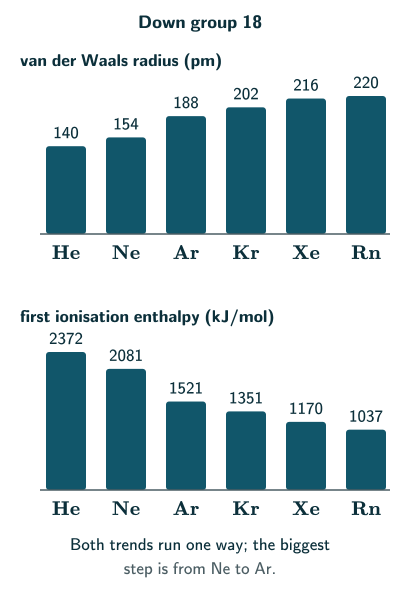
Van der Waals radius in pm, first ionisation enthalpy ΔiH1 in kJ mol−1, and electron gain enthalpy ΔegH in kJ mol−1:
| Element | Radius | ΔiH1 | ΔegH |
|---|---|---|---|
| He | 140 | 2372 | +48 |
| Ne | 154 | 2081 | +116 |
| Ar | 188 | 1521 | +96 |
| Kr | 202 | 1351 | +96 |
| Xe | 216 | 1170 | +77 |
| Rn | 220 | 1037 | +68 |
Radii and ionisation enthalpies from the Wikipedia data pages (“Atomic radii of the elements”, van der Waals column; “Molar ionization energies of the elements”, rounded); electron gain enthalpies from NCERT Class 11 Chemistry, Table 3.7, page 90.
- Atomic radius. The table uses van der Waals radii appropriate to nonbonded atoms. Covalent radii can also be defined from bonded compounds, particularly for xenon; “only van der Waals radii” is too absolute. These are very large and should be compared with other elements’ van der Waals radii, not their covalent radii (NCERT Class 11 Chemistry, page 86). Put in one table with covalent radii, each noble gas looks like the largest atom of its period: neon’s 154 pm (data page) against fluorine’s covalent 64 pm (NCERT Class 11 Chemistry, Table 3.6(a), page 86). The radius increases down the group (Wikipedia, “Noble gas”).
- Ionisation enthalpy. The graph of first ionisation enthalpies shows maxima at the noble gases, which have closed shells and very stable configurations (NCERT Class 11 Chemistry, page 88). Down the group it falls as the atoms grow (Wikipedia, “Noble gas”). Helium’s, 2372 kJ mol−1, is the highest of any element (data page).
- Electron gain enthalpy is positive: an added electron would have to enter the next principal shell, giving a very unstable configuration (NCERT Class 11 Chemistry, page 90). The noble gases form no stable anions (Wikipedia, “Noble gas”). NCERT’s values are estimates: the Wikipedia “Electron affinity (data page)” lists the same six, marked as estimated, to about ±20 kJ mol−1. Neon’s is the most positive and helium’s the least. In an exam, use NCERT’s.
- Electronegativity is not usually given for the lighter noble gases, which form almost no compounds; on the Pauling scale the data page lists only krypton (3.0) and xenon (2.6).
Physical properties
Melting and boiling points in K, density in g L−1 at 0 °C and 1 atm:
| Element | m.p. | b.p. | Density |
|---|---|---|---|
| He | – | 4.2 | 0.1786 |
| Ne | 25 | 27 | 0.9002 |
| Ar | 84 | 87 | 1.784 |
| Kr | 116 | 120 | 3.749 |
| Xe | 161 | 165 | 5.894 |
| Rn | 202 | 211 | 9.73 |
Values from the Wikipedia data pages for melting points, boiling points (CRC values) and densities; helium does not solidify at 1 atm (Wikipedia, “Noble gas”).
- Monatomic gases. All are monatomic gases at room conditions, even those heavier than many solid elements (Wikipedia, “Noble gas”).
- Very low melting and boiling points. The only forces between the atoms are weak London dispersion (van der Waals) forces (Wikipedia, “Noble gas”), so all boil far below room temperature, from 4.2 K for helium to 211 K for radon (data page).
- Down the group these forces grow with the size of the atom, so melting point, boiling point and enthalpy of vaporisation increase; density increases with atomic mass (Wikipedia, “Noble gas”).
- They are colourless, odourless, tasteless and non-flammable (Wikipedia, “Noble gas”). Argon makes up about 0.94% of air by volume (Wikipedia, “Noble gas”).
Chemical properties: low reactivity, and the xenon fluorides and oxides
-
Low reactivity. With full valence shells the noble gases have little tendency to gain or lose electrons, and only a few hundred of their compounds are known. No neutral compound of helium or neon is stable under ordinary conditions (Wikipedia, “Noble gas”).
-
The first compound. In 1962 Neil Bartlett made the first noble gas compound, a xenon–platinum fluoride product initially formulated as xenon hexafluoroplatinate, XePtF; later work showed more complex products. He tried xenon because its ionisation enthalpy is close to that of the oxygen molecule, which platinum hexafluoride was known to oxidise (Wikipedia, “Noble gas”).
-
Xenon fluorides. Xenon reacts with fluorine to give three fluorides (Wikipedia, “Noble gas”):
Xe + F2 → XeF2; Xe + 2F2 → XeF4; Xe + 3F2 → XeF6
- Conditions. The three fluorides are in equilibrium with one another: the product depends jointly on fluorine pressure, composition and temperature. A simple “hotter means the higher fluoride” rule is unreliable. XeF2 forms from the two gases with heat, ultraviolet light or an electric discharge (Wikipedia, “Xenon difluoride”); XeF4 from a 1 : 5 mixture of xenon and fluorine at 400 °C (Wikipedia, “Xenon tetrafluoride”); XeF6 by heating XeF2 to about 300 °C under 60 atm of fluorine (Wikipedia, “Xenon hexafluoride”).
- XeF2 is linear (Wikipedia, “Xenon difluoride”), XeF4 square planar (Wikipedia, “Xenon tetrafluoride”), and XeF6 lacks perfect octahedral symmetry, because of its lone pair (Wikipedia, “Xenon hexafluoride”). VSEPR theory explains all three (NCERT Class 11 Chemistry, Unit 4); our Example 1 below works through each of them.
- Hybridisation. The traditional school labels for the 5, 6 and 7 electron domains are XeF2 sp3d, XeF4 sp3d2 and XeF6 sp3d3 (reasoned from NCERT Class 11 Chemistry, Section 4.6.3, page 124; see hybridisation). These labels organise exam geometry; modern bonding does not require substantial xenon d-orbital participation (Reed and Schleyer, JACS, 1990). NCERT Table 4.7, page 115, gives XeF4 as AB4E2, square planar. Page 124 lists square planar ions as dsp2; XeF4 is not, as two of its six pairs are lone pairs.
- XeF2 passes fluorine readily to other substances, yet keeps well: it is among xenon’s most stable compounds (Wikipedia, “Xenon difluoride”).
-
Xenon oxides and oxofluorides. Water replaces the fluorines of XeF6 two at a time, XeF6 → XeOF4 → XeO2F2 → XeO3, each step taking one H2O and giving 2HF; overall XeF6 + 3H2O → XeO3 + 6HF (Wikipedia, “Xenon hexafluoride”). XeF4 also gives XeO3 with water: 6XeF4 + 12H2O → 4Xe + 2XeO3 + 3O2 + 24HF (Wikipedia, “Xenon tetrafluoride”). XeO3 is a strong oxidant, and the solid can explode violently (Wikipedia, “Xenon trioxide”). Xenon also forms XeO4, with xenon at +8 (Wikipedia, “Noble gas”). By VSEPR, XeO2F2 is see-saw and XeO4 tetrahedral (reasoned); XeOF4 is worked out in Q3. XeF6 also takes up fluoride ions, XeF6 + F− → XeF7− (Wikipedia, “Xenon hexafluoride”).
-
Other noble gases. Krypton forms KrF2; radon is more reactive than xenon but very radioactive (Wikipedia, “Noble gas”). NCERT names XeF2, KrF2 and XeOF2 among the compounds that show the limits of the octet rule (NCERT Class 11 Chemistry, page 106).
-
Down the group reactivity grows: the outer electrons of the heavier noble gases are held less firmly and are easier to remove (Wikipedia, “Noble gas”).
Helium, the first element
Helium differs from the other noble gases in its configuration and in some remarkable physical properties.
- An s-block element in the p-block. In NCERT’s words:
Strictly, helium belongs to the s-block but its positioning in the p-block along with other group 18 elements is justified because it has a completely filled valence shell (1s2) and as a result, exhibits properties characteristic of other noble gases.
NCERT Chemistry Part I (Class 11), Section 3.6, page 82
- A duplet, not an octet. Its full shell holds two electrons, while the other noble gases have eight (NCERT Class 11 Chemistry, page 101).
- The lowest boiling point of any element, 4.2 K, and it does not solidify at atmospheric pressure, however far it is cooled: about 25 atm is needed (Wikipedia, “Noble gas” and “Helium”).
- Superfluidity. Liquid helium is the familiar bulk example of superfluidity, flow with remarkable absence of dissipative resistance under suitable conditions. It is not the only elemental system: superfluidity has also been observed in ultracold lithium-6 atomic gases (Zwierlein and colleagues, Nature, 2005).
- No stable compounds. No neutral helium compound is stable under ordinary conditions (Wikipedia, “Noble gas”): its ionisation enthalpy, the highest of all, and its positive electron gain enthalpy leave it almost nothing to bond with (data page; NCERT Class 11 Chemistry, Table 3.7, page 90). Only exotic species are known, such as the ion HeH+, and Na2He above about 113 GPa (Wikipedia, “Helium”).
Solved examples
Example 1: Shapes of the xenon fluorides
Use VSEPR theory to predict the shapes of XeF2, XeF4 and XeF6.
Answer: Xenon has 8 valence electrons. In XeF2 two are used in bonds, leaving 3 lone pairs: 5 pairs, trigonal bipyramidal, with the lone pairs at the equator, so the molecule is linear. In XeF4, 4 bond pairs and 2 lone pairs: 6 pairs, octahedral, with the lone pairs opposite, so it is square planar. In XeF6, 6 bond pairs and 1 lone pair: 7 pairs, the usual school description is distorted octahedral, but XeF is fluxional rather than one rigid ideal geometry (reasoned from VSEPR theory, NCERT Class 11 Chemistry, Unit 4; shapes confirmed by Wikipedia, “Xenon difluoride”, “Xenon tetrafluoride” and “Xenon hexafluoride”).
Example 2: Oxidation states of xenon
Find the oxidation state of xenon in XeF2, XeF4, XeF6, XeO3 and XeO4.
Answer: With F −1 and O −2: XeF2 +2, XeF4 +4, XeF6 +6, XeO3 +6, XeO4 +8 (reasoned; rules for oxidation numbers). These are the states Wikipedia’s “Noble gas” lists for xenon.
Example 3: Hydrolysis of XeF
What mass of XeO3 forms when 24.53 g of XeF6 is hydrolysed, and how many moles of HF? (Xe = 131.29, F = 19.00, O = 16.00 g mol−1.)
Answer: M(XeF6) = 131.29 + 6 × 19.00 = 245.29 g mol−1, so 24.53 g is 0.1000 mol. XeF6 + 3H2O → XeO3 + 6HF gives 0.1000 mol XeO3, 0.1000 × 179.29 = 17.93 g, and 0.6000 mol HF (reasoned; mole concept).
Example 4: Why xenon and not helium?
Explain why xenon forms compounds with fluorine but helium does not.
Answer: Xenon’s first ionisation enthalpy, 1170 kJ mol−1, is about half of helium’s, 2372 kJ mol−1 (data page). Its outer electrons are far from the nucleus and held less firmly, so a very electronegative element such as fluorine can draw them into bonds (Wikipedia, “Noble gas”). Helium holds its two electrons too tightly to share them (reasoned).
Common mistakes to avoid
Common mistake
Saying the noble gases form no compounds
They are very unreactive, not completely inert. Xenon forms XeF2, XeF4, XeF6, XeO3 and others, and krypton forms KrF2.
Common mistake
Giving the noble gases a negative electron gain enthalpy
Their electron gain enthalpies are positive: an added electron must start a new shell.
Common mistake
Drawing XeF as tetrahedral, or calling it dsp
XeF4 has 4 bond pairs and 2 lone pairs on xenon; the six pairs point to the corners of an octahedron, and the lone pairs sit opposite each other, so the molecule is square planar. The traditional exam label is spd; it does not establish substantial d-orbital bonding.
Common mistake
Calling helium a p-block element by its configuration
Helium is 1s: strictly an s-block element. It is placed in group 18 because its shell is full and it behaves like the noble gases.
Quick revision summary
- Group 18 (noble gases): He, Ne, Ar, Kr, Xe, Rn and Og; He–Rn are monatomic, colourless gases, with ns np except helium 1s.
- Highest ionisation enthalpy in each period (He highest of all); positive electron gain enthalpy; van der Waals radius rises down the group.
- Melting and boiling points very low (London forces) and rising down the group; He boils at 4.2 K and does not solidify at 1 atm.
- Xenon forms XeF (linear), XeF (square planar), XeF (fluxional, conventionally distorted octahedral), XeOF and XeO; first compound by Bartlett, 1962.
- Helium is strictly an s-block element, placed in group 18 for its full shell.
Formula sheet
- Valence configuration: ns np (He: 1s)
- Xe + F → XeF
- Xe + 2F → XeF
- Xe + 3F → XeF
- XeF + 3HO → XeO + 6HF
- Oxidation states of Xe: +2, +4, +6, +8
Questions students ask
Why are group 18 elements called noble gases, and are noble gases the same as inert gases?
Group 18 elements are called noble gases because they react so little, the “very low chemical reactivity” NCERT notes (NCERT Class 11 Chemistry, Unit 3, page 84): beyond the NCERT text, the name translates the German Edelgas, first used by Hugo Erdmann in 1900 by analogy with the unreactive noble metals (Wikipedia, “Noble gas”). In IUPAC’s terminology, “noble gas” names a periodic-table group; “inert gas” describes low reactivity in a particular setting and can include nitrogen. The older group name “inert gases” is misleading because noble gas compounds are known, such as the xenon fluorides; “rare gases” is inaccurate too, since argon, formed in the crust from potassium-40, makes up 0.94% of air by volume, and the name “aerogens” is sometimes used (same article).
What are the uses of noble gases?
Noble gases are used for their unreactivity, very low boiling points, glow in discharges and, for helium, low solubility: NCERT gives helium-containing diving mixtures as an application of gas solubility (Class 12 Chemistry Part I, Unit 1, page 9; Henry’s law). Helium can reduce nitrogen narcosis and breathing-gas density, but it also dissolves under pressure and does not eliminate decompression sickness. Beyond the NCERT text, liquid helium cools MRI magnets, helium replaced hydrogen in balloons because it cannot burn, and argon shields welding arcs and fills incandescent bulbs (Wikipedia, “Noble gas”). Neon and the others glow in discharge lamps, krypton and xenon fill bright lamps, xenon is an anaesthetic and ion-engine propellant, and radon was historically used in radiotherapy (same article).
What is the difference between noble gases and halogens?
Noble gases (group 18, ns np, helium 1s) have full valence shells and react very little, while halogens (group 17, ns np) are one electron short and react readily: NCERT gives the noble gases positive electron gain enthalpies and the halogens highly negative ones (NCERT Class 11 Chemistry, Unit 3, pages 84 and 90). So the halogens are strong oxidising agents, −1 in their halides, while a noble gas is normally 0. Beyond the NCERT text, xenon shows +2, +4, +6 and +8, mostly with fluorine or oxygen (xenon fluorides), and the noble gases are monatomic, the halogens X2 (Wikipedia, “Noble gas”, “Halogen”).
What is the valency of group 18 elements?
The valency of group 18 elements is normally zero, because their valence shells are full, but NCERT lists 0 and 8 for the group (NCERT Class 11 Chemistry, Unit 3, page 92). Beyond the NCERT text, xenon forms the most noble gas compounds, mostly with fluorine or oxygen, and reaches valency 8 in XeO4 (Wikipedia, “Noble gas”), whose Lewis representation contains four Xe=O double bonds. Here valency 8 counts bond order; the coordination number is 4 and the oxidation state is +8 (reasoned; chemical properties). The noble gases form no stable anions (same article), so a non-zero valency comes only from sharing or losing electrons.
Why are noble gases monatomic?
At ordinary conditions the noble gases are monatomic because their closed shells make ordinary covalent bonding energetically unfavourable: in molecular orbital terms He2 and Ne2 would fill their antibonding orbitals as fully as their bonding ones, a bond order of zero, so that simple model predicts no ordinary covalent bond (NCERT Class 11 Chemistry, Unit 4, pages 130–131; He2). Very weak dispersion-bound dimers do exist under special conditions: helium dimers were measured by Grisenti and colleagues (Physical Review Letters, 2000). Only weak dispersion forces act between the separate atoms, which is why all six natural noble gases boil far below room temperature (physical properties).
What are xenon fluorides used for?
Xenon fluorides are used mainly as fluorinating agents: beyond the NCERT text, XeF2 is a strong fluorinating and oxidising agent, and as a gas it etches silicon in making microelectromechanical systems (MEMS), 2XeF2 + Si → 2Xe + SiF4, with no need for ion bombardment (Wikipedia, “Xenon difluoride”). In that reaction each xenon falls from +2 to 0 while silicon rises from 0 to +4, and both products, xenon and SiF4, leave as gases (reasoned). XeF4 has few uses: it turns silicone rubber into gaseous products, leaving any trace metal impurities behind for analysis (Wikipedia, “Xenon tetrafluoride”).
Practice questions
Try each question first, then open the answer to check your working.
-
Q1. Why are the noble gases so unreactive?
Show answerHide answer
Their valence shells are completely filled, ns np (helium 1s), a very stable arrangement that is hard to alter by adding or removing electrons; their ionisation enthalpies are very high and their electron gain enthalpies positive (NCERT Class 11 Chemistry, pages 84, 88 and 90).
-
Q2. Why do the boiling points of the noble gases rise from helium to radon?
Show answerHide answer
The only attraction between the atoms is the weak London dispersion force, which grows with the size of the atom. Larger atoms attract each other more, so more energy is needed to separate them (Wikipedia, “Noble gas”).
-
Q3. Predict the hybridisation and shape of XeOF4.
Show answerHide answer
Of xenon’s 8 valence electrons, 2 go into the Xe=O bond and 4 into the four Xe–F bonds, leaving one lone pair. Five bonding directions and one lone pair make six electron domains; the double bond counts as one domain, not one electron pair. The traditional exam label is sp3d2, giving a square pyramid, like BrF5 (reasoned; NCERT Class 11 Chemistry, Table 4.7, page 115).