Group 13 elements: the boron family
Beyond NCERT In the JEE Main and NEET syllabus; the Class 12 book has no section for it.
Quick answer
Group 13, the boron family, contains boron, aluminium, gallium, indium, thallium and nihonium, with three valence electrons. The familiar members show mainly the plus-three state, while the plus-one state becomes more stable towards thallium through the inert pair effect. Boron differs in its small size, predominantly covalent bonding and acidic oxide.
What are the group 13 elements?
Group 13: the boron family
Group 13 is the first group of the p-block: boron (B), aluminium (Al), gallium (Ga), indium (In), thallium (Tl) and the synthetic nihonium (Nh). Each atom has three valence electrons, ns np (Wikipedia, “Boron group”). NCERT introduces the block in Class 11:
The p-Block Elements comprise those belonging to Group 13 to 18 and these together with the s-Block Elements are called the Representative Elements or Main Group Elements.
NCERT Chemistry Part I (Class 11), Section 3.6.2, page 84
- NCERT counts boron among the non-metals: it names boron and carbon as exceptions to the low melting and boiling points of non-metals (NCERT Class 11 Chemistry, page 85). NCERT Figure 3.3 (page 83) also shades boron as a non-metal, and aluminium, gallium, indium and thallium as metals. Beyond the NCERT text, many books call boron a metalloid (Wikipedia, “Boron group”). The Class 11 page on metals, non-metals and metalloids weighs the two views in its answer to “Is boron a metalloid?”
- The usual oxidation state is +3. Down the group +1 becomes more stable, and for thallium it is the most stable state: the inert pair effect (Wikipedia, “Inert-pair effect”).
- Boron behaves differently from the rest because it is small, with a large charge/radius ratio and a high electronegativity, and has only four valence orbitals, 2s and 2p (NCERT Class 11 Chemistry, page 93).
In plain words: the group starts with boron, a hard non-metal in NCERT’s classification (a metalloid in many other books), and turns into soft metals as you go down. The five familiar members B–Tl have three valence electrons, but the heavy ones become unwilling to use the two s electrons, so thallium prefers to give just one.
Scope: the trends below concern B–Tl. Nihonium is a short-lived synthetic element; its predicted chemistry should not be treated as measured bulk behaviour. Oxidation states are formal electron bookkeeping, not necessarily charges on free ions.
No 2026–27 NCERT textbook has a chapter on the p-block; the JEE Main 2027 and NEET (UG) 2026 syllabuses list it in Unit 10, as the electronic configuration, the trends in physical and chemical properties down the groups, and the unique behaviour of the first element. This page covers those for group 13. NCERT Class 11 Chemistry, Unit 3 gives the periodic trends it builds on; facts and data from beyond the NCERT books are labelled with their source.
Electronic configuration ns np and oxidation states
| Element | Z | Electronic configuration |
|---|---|---|
| B | 5 | [He] 2s2 2p1 |
| Al | 13 | [Ne] 3s2 3p1 |
| Ga | 31 | [Ar] 3d10 4s2 4p1 |
| In | 49 | [Kr] 4d10 5s2 5p1 |
| Tl | 81 | [Xe] 4f14 5d10 6s2 6p1 |
- The configurations follow the aufbau order (NCERT Class 11 Chemistry, Unit 2). From gallium on, a filled d10 shell, and in thallium a filled 4f14 shell as well, lies under the valence electrons (reasoned).
- Oxidation states. With three valence electrons the group valence is 3, so the formulas are B2O3, Al2O3, AlH3 and so on (NCERT Class 11 Chemistry, Table 3.9, page 93). In p-block groups the oxidation states usually differ by two (NCERT Class 12 Chemistry Part I, page 97), so the other state here is +1.
- Down the group the +1 state grows more stable, in the order Al+ < Ga+ < In+ < Tl+. In thallium +1 is the most stable state and +3 compounds are comparatively rare (Wikipedia, “Inert-pair effect”). In NCERT’s words:
Although in the p–block the lower oxidation states are favoured by the heavier members (due to inert pair effect), the opposite is true in the groups of d-block.
NCERT Chemistry Part I (Class 12), Section 4.3.4, page 97
Atomic radius, ionisation enthalpy and electronegativity down the group
Covalent radius in pm, first ionisation enthalpy ΔiH1 in kJ mol−1, and electronegativity (EN) on the Pauling scale:
| Element | Radius | ΔiH1 | EN |
|---|---|---|---|
| B | 85 | 801 | 2.04 |
| Al | 126 | 578 | 1.61 |
| Ga | 124 | 579 | 1.81 |
| In | 142 | 558 | 1.78 |
| Tl | 144 | 589 | 1.62 |
The radii follow Pyykkö and Atsumi’s molecular single-bond scale (Chemistry—A European Journal, 2009); radii depend on the bonding definition. Ionisation enthalpies are rounded (NIST Atomic Spectra Database); Pauling electronegativities are the stated data-table values. All three are as tabulated in the Wikipedia data pages “Atomic radii of the elements”, “Molar ionization energies of the elements” and “Electronegativities of the elements”, the data pages cited below. NCERT’s Class 11 tables use different tabulated values for the first two members, B 88 pm and 2.0, Al 143 pm and 1.5; 143 pm, NCERT’s atomic radius for a metal, is a metallic radius (NCERT Class 11 Chemistry, Tables 3.6 and 3.8, pages 86 and 91).
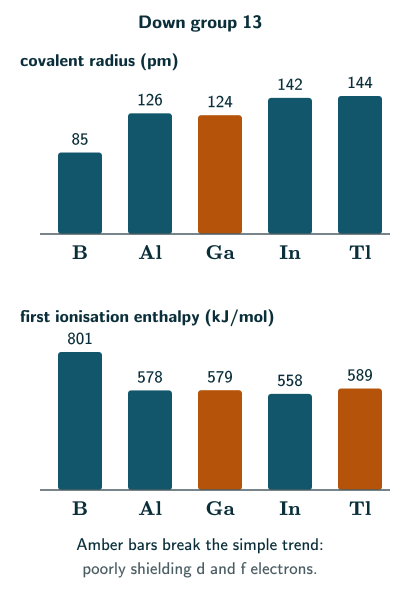
- Atomic radius. It rises from B to Al, as a new shell is added (NCERT Class 11 Chemistry, page 86). But gallium is no bigger than aluminium: 124 pm against 126 pm as covalent radii, and 135 pm against 143 pm as metallic radii (Wikipedia data page). Ten of gallium’s 18 extra protons come with ten 3d electrons, which shield the nucleus poorly, so its valence shell is pulled in (reasoned from NCERT Class 11 Chemistry, page 89, on shielding). From In to Tl the radius grows only a little: the 4f electrons filled in between shield poorly too, the lanthanoid contraction (reasoned from NCERT Class 12 Chemistry Part I, Unit 4, page 93).
- Ionisation enthalpy. ΔiH1 falls sharply from B to Al, then stays nearly level. It is not a smooth fall: Ga is a little above Al, and Tl is above In (data page). The d and f electrons in between shield poorly (reasoned; Wikipedia, “Inert-pair effect”, gives this reason for the same rise in the second plus third ionisation enthalpies).
- The sum of the first three ionisation enthalpies is large for every member: 6887 kJ mol−1 for B and 5139 for Al (reasoned from the data page). That is one reason boron favours covalent bonding rather than simple B3+ cations in ordinary compounds (reasoned).
- Electronegativity. It falls from B to Al, rises at Ga, then stays close to 1.6–1.8 (Wikipedia data page). The heavier atoms’ poorly shielded nuclei hold electrons more firmly than their size suggests (reasoned).
Physical properties
Melting and boiling points in K, density in g cm−3:
| Element | m.p. | b.p. | Density |
|---|---|---|---|
| B | 2349 | 4273 | 2.34 |
| Al | 933 | 2792 | 2.70 |
| Ga | 303 | 2477 | 5.91 |
| In | 430 | 2345 | 7.31 |
| Tl | 577 | 1746 | 11.85 |
Values from the Wikipedia data pages for melting points, boiling points (CRC values) and densities.
- Metallic character increases down the group (NCERT Class 11 Chemistry, page 84). Boron, at the top, is a non-metal in NCERT (quoted below); beyond the NCERT text, many books class it as a metalloid. It is a hard, black solid, second only to diamond in hardness among the elements, and a poor conductor of electricity at room temperature. The others are soft metals and good conductors (Wikipedia, “Boron group” and “Boron”).
- Melting point. Boron melts far higher than the rest, 2349 K against aluminium’s 933 K (Wikipedia, “Boron group”). The fall is not smooth: the order is B > Al > Tl > In > Ga (data pages). Gallium melts at 303 K, so it melts in the hand. Solid gallium is built of Ga2 pairs, which explains its low melting point beside aluminium and indium. Yet it does not boil until 2477 K (CRC value; the article gives 2676 K), one of the largest liquid ranges of any metal (Wikipedia, “Gallium”).
- Boiling point falls down the group and density rises (Wikipedia, “Boron group”).
NCERT names boron as an exception when it describes the non-metals:
Non-metals are usually solids or gases at room temperature with low melting and boiling points (boron and carbon are exceptions).
NCERT Chemistry Part I (Class 11), Section 3.6.5, page 85
So in an answer based on NCERT, call boron a non-metal; NCERT’s examples of metalloids are silicon, germanium, arsenic, antimony and tellurium (NCERT Class 11 Chemistry, page 85).
Chemical properties: reactivity towards air, acids, alkalies and halogens; the inert pair effect
- Air. Crystalline boron is unreactive, but at high temperature boron burns: 4B + 3O2 → 2B2O3 (Wikipedia, “Boron”). At ordinary temperature aluminium is covered with a thin oxide layer that protects it (NCERT Class 10 Science, Chapter 3, page 42); heated in air, it gives 4Al + 3O2 → 2Al2O3 (NCERT Class 10 Science, page 41). The heavier members are more reactive at moderate temperatures than boron (Wikipedia, “Boron group”).
- Oxides. All form M2O3. B2O3 is slightly acidic, Al2O3 and Ga2O3 are amphoteric, In2O3 is nearly amphoteric, and Tl2O3 is basic: it dissolves in acids to form salts (Wikipedia, “Boron group”). So the oxides grow more basic down the group, as metallic character grows (reasoned).
- Acids. Crystalline boron resists even boiling hydrochloric and hydrofluoric acids; when finely divided, it is attacked slowly by hot concentrated nitric or sulphuric acid (Wikipedia, “Boron”). Aluminium, like other reactive metals, gives a salt and hydrogen with dilute hydrochloric acid (NCERT Class 10 Science, pages 43–44): 2Al + 6HCl → 2AlCl3 + 3H2. Cold concentrated nitric acid can passivate aluminium: a protective oxide layer inhibits attack. This is a conditional chemical property, not a claim that aluminium suits every oxidising-acid concentration and temperature (Wikipedia, “Aluminium”).
- Alkalies. Aluminium also dissolves in sodium hydroxide solution, giving an aluminate (Wikipedia, “Aluminium”); the electrons it loses reduce water to hydrogen (reasoned): 2Al + 2NaOH + 6H2O → 2Na[Al(OH)4] + 3H2. Its oxide does the same without hydrogen: Al2O3 + 2NaOH → 2NaAlO2 + H2O (NCERT Class 10 Science, page 41); NaAlO2 and aqueous [Al(OH)4]− are different representations for different conditions; subtracting water balances formulas but does not make their physical species identical (reasoned). Gallium also dissolves in alkali, giving a gallate (Wikipedia, “Gallium”).
- Halogens. The elements form halides, usually trihalides MX3 (Wikipedia, “Boron group”): 2E + 3X2 → 2EX3. Thallium is the exception the inert pair effect predicts: TlCl3 and TlBr3 break down just above room temperature to the monohalides, and “TlI3” is thallium(I) triiodide, Tl+I3− (Wikipedia, “Thallium”). The boron trihalides are planar and short of an octet, so they are Lewis acids: BF3 takes up F− to give [BF4]− (Wikipedia, “Boron”). Beyond the NCERT text: towards common Lewis bases the usual order is BF3 < BCl3 < BBr3, and its explanation is debated (Wikipedia, “Boron trifluoride”). It holds for strong donor bases such as ammonia but is not universal: weak bases can give another trend. Bonding and the energy required to distort the planar acid into an adduct both matter; a simple back-bonding slogan is incomplete (“Ligand Close-Packing and the Lewis Acidity of BF3 and BCl3”, Inorganic Chemistry, 1999).
- The inert pair effect. Down the group the balance between using the ns pair and the bonding energy gained increasingly favours the lower state. Poor shielding contributes, while relativistic stabilisation of the 6s pair is important for thallium; the outcome is not determined by shielding alone (Wikipedia, “Inert-pair effect”). For thallium, Tl3+ + 3e− → Tl has E⊖ = +0.73 V and Tl+ + e− → Tl has E⊖ = −0.336 V, and the reduction of Tl3+ to Tl+ is spontaneous under standard conditions (Wikipedia, “Thallium”). So thallium(III) compounds are good oxidising agents (reasoned; see Example 1).
Anomalous behaviour of boron
The first element of each group differs from the rest because it is small, with a large charge/radius ratio and a high electronegativity (NCERT Class 11 Chemistry, page 93). NCERT adds:
In addition, the first member of group has only four valence orbitals (2s and 2p) available for bonding, whereas the second member of the groups have nine valence orbitals (3s, 3p, 3d).
NCERT Chemistry Part I (Class 11), Section 3.7.2, page 93
Give NCERT’s valence-orbital reason in an exam. Beyond the NCERT text: the 3d orbitals in that quotation are the classical explanation; higher coordination in heavier main-group compounds does not require substantial d-orbital hybridisation (Reed and Schleyer, JACS, 1990; Wikipedia, “Hypervalent molecule”).
- Maximum covalency 4 in the usual electron-pair model. Boron can form [BF4]− but not [BF6]3−, while aluminium forms [AlF6]3− (NCERT Class 11 Chemistry, page 93).
- No simple B3+ cation in ordinary compounds. Removing three electrons is costly (see the trends above), so ordinary boron bonding is predominantly covalent. Ionic salts containing covalently bonded borate or borohydride anions still exist; the statement does not forbid gas-phase multiply ionised boron (reasoned from the data page and Wikipedia, “Boron”).
- A non-metal in a group of metals. NCERT counts boron among the non-metals (NCERT Class 11 Chemistry, page 85). It is very hard, melts at 2349 K and is a poor conductor at room temperature (Wikipedia, “Boron group”).
- An acidic oxide. B2O3 is acidic, while the other members’ oxides are amphoteric or basic (Wikipedia, “Boron group”).
- Many hydrides. Boron forms a whole family of boranes, the simplest being diborane, B2H6; aluminium and gallium form few stable hydrides, and no stable thallium hydride is known (Wikipedia, “Boron group”; NCERT Class 11 Chemistry, Table 3.9, page 93, lists B2H6 and AlH3).
Solved examples
Example 1: Why Tl(III) is an oxidising agent
Use E⊖(Tl3+/Tl) = +0.73 V and E⊖(Tl+/Tl) = −0.336 V to find E⊖ for Tl3+ + 2e− → Tl+.
Answer: Potentials do not add, but Gibbs energies, ΔG⊖ = −nFE⊖, do. For Tl3+ + 3e− → Tl, ΔG⊖ = −3F(0.73) = −2.19F. Tl → Tl+ + e− is the reverse of Tl+ + e− → Tl, so its ΔG⊖ = +F(−0.336) = −0.336F. Adding, −2FE⊖ = −2.526F, so E⊖ = 2.526/2 = +1.26 V (reasoned from Wikipedia, “Thallium”). This large positive value means Tl3+ readily takes two electrons to become Tl+: the inert pair effect in numbers.
Example 2: Hydrogen from aluminium and alkali
What volume of hydrogen, at 273.15 K and 1 bar, does 5.4 g of aluminium give with excess sodium hydroxide solution? (Al = 27 g mol−1; molar volume 22.7 L mol−1.)
Answer: 5.4/27 = 0.20 mol Al. From 2Al + 2NaOH + 6H2O → 2Na[Al(OH)4] + 3H2, 2 mol Al give 3 mol H2, so 0.20 mol gives 0.30 mol H2, and 0.30 × 22.7 = 6.81 L (reasoned; mole concept).
Example 3: Why [AlF] but not [BF]?
Explain why aluminium forms [AlF6]3− but boron stops at [BF4]−.
Answer: Boron, in period 2, has only four valence orbitals, 2s and three 2p, so it can hold at most four electron pairs: its maximum covalency is 4. Aluminium, in period 3, has nine valence orbitals, 3s, 3p and 3d, so it can expand its valence shell and hold six pairs, as in [AlF6]3− (NCERT Class 11 Chemistry, page 93); give that reason in an exam. Beyond the NCERT text: modern bonding analyses find little d-orbital participation, and aluminium’s larger centre accommodates six fluoride ligands through the overall, largely ionic, bonding (Reed and Schleyer, JACS, 1990; Wikipedia, “Hypervalent molecule”).
Example 4: Reading the ionisation enthalpies
ΔiH1 is 578 kJ mol−1 for Al, 579 for Ga, 558 for In and 589 for Tl. Explain the two places where the value rises down the group.
Answer: Ga follows the first d series and Tl the 4f and 5d series. Those d and f electrons shield the nucleus poorly, so the valence electron of Ga feels the extra protons and is held a little more firmly than that of Al; the same happens for Tl against In (reasoned from Wikipedia, “Inert-pair effect”, on the second plus third ionisation enthalpies). The measured pattern reflects both shielding and relativistic effects; it is not a prediction from nuclear charge alone.
Common mistakes to avoid
Common mistake
Expecting a smooth fall in ionisation enthalpy
Down group 13 the first ionisation enthalpy does not fall steadily: Ga is slightly above Al and Tl is above In, because d and f electrons shield poorly.
Common mistake
Saying the inert pair effect stabilises Tl
It does the opposite. The 6s electrons stay unshared, so Tl+ is the stable ion and Tl3+ is easily reduced to it.
Common mistake
Writing boron as B
Ordinary boron compounds do not contain simple B3+ cations; BF3 and boranes have covalent bonding. This does not exclude salts containing covalently bonded boron-containing anions.
Common mistake
Expecting aluminium to dissolve in concentrated nitric acid
Cold concentrated nitric acid makes aluminium passive: the oxide layer protects it. Aluminium dissolves in dilute hydrochloric acid and in sodium hydroxide solution.
Quick revision summary
- Group 13: B, Al, Ga, In, Tl (and Nh); valence configuration ns np; B is a non-metal in NCERT (a metalloid in many other books), the rest are metals.
- Oxidation states +3 and +1; +1 grows more stable down the group (inert pair effect) and is the most stable for Tl.
- Radius rises down the group, but Ga is no bigger than Al; ionisation enthalpy falls from B to Al, with Ga above Al and Tl above In.
- Oxides go from acidic (BO) through amphoteric (AlO, GaO) to basic (TlO).
- Boron is anomalous: maximum covalency 4, predominantly covalent boron bonding, very high melting point, acidic oxide.
Formula sheet
- Valence configuration: ns np
- 4Al + 3O → 2AlO
- 2Al + 6HCl → 2AlCl + 3H
- 2Al + 2NaOH + 6HO → 2Na[Al(OH)] + 3H
- Stability of +1: Al < Ga < In < Tl
- Maximum covalency of B: 4 ([BF])
Questions students ask
What is the inert pair effect, and why does it increase down the group?
The inert pair effect is why the heavier members of a p-block group favour its lower oxidation state: in NCERT’s words, “the lower oxidation states are favoured by the heavier members” (NCERT Class 12 Chemistry Part I, Unit 4, page 97). Beyond the NCERT text, the outer ns2 pair stays unshared, leaving thallium most stable as +1, lead as +2 and bismuth as +3 (Wikipedia, “Inert-pair effect”). It grows down a group because the d and f electrons added on the way shield that pair poorly, relativistic effects hold the 6s pair tighter in period 6, and bonds weaken as atoms grow, so two extra bonds no longer repay using the pair (Wikipedia, “Inert-pair effect” and “Lead”).
What is the electronegativity order of group 13 elements?
On the Pauling values in the page’s table (Wikipedia data), the electronegativity order of group 13 elements is B > Ga > In > Tl > Al, at 2.04, 1.81, 1.78, 1.62 and 1.61. The order below boron is not agreed: the CRC and Lange handbooks give thallium 1.8, and the Allen scale puts thallium second (Wikipedia, “Electronegativities of the elements”), while NCERT’s Table 3.8(a) gives only B 2.0 and Al 1.5 (NCERT Class 11 Chemistry, Unit 3, page 91). Every scale there makes boron the most electronegative member and aluminium the least, which is the safe statement in an exam.
Why does the first element of each p-block group differ from the rest of its group?
The first element of each p-block group, boron to fluorine, differs from the rest because it is small and highly electronegative and has only four valence orbitals (2s, 2p), so its covalency stops at 4 and it forms pπ–pπ multiple bonds more readily (NCERT Class 11 Chemistry, Unit 3, page 93; periodic trends). On Wikipedia’s Pauling values, electronegativity drops 0.43 from B to Al, 0.65 from C to Si and 0.85 from N to P, but the next step changes it by 0.20 or less. See nitrogen.
What is the diagonal relationship between boron and silicon?
Beyond the NCERT text, the diagonal relationship between boron and silicon is the likeness of boron, in group 13, to silicon, one period down in group 14 (Wikipedia, “Diagonal relationship”); NCERT gives only the pairs Li–Mg and Be–Al (NCERT Class 11 Chemistry, Unit 3, page 93). Both have acidic oxides, B2O3 and SiO2, where aluminium’s is amphoteric, and halides that water hydrolyses (same article; “Boron group”). A step right and a step down have opposite effects on size and electronegativity, which roughly cancel (same article): boron’s electronegativity, 2.04, is close to silicon’s 1.90 and well above aluminium’s 1.61 (Wikipedia data page).
Is the inert pair effect the same as the shielding effect or the lanthanoid contraction?
The inert pair effect is not the same as the shielding effect or the lanthanoid contraction: it is about which oxidation state is stable, not size. Shielding is inner electrons screening valence electrons from the nucleus (NCERT Class 11 Chemistry, Unit 3, page 89), and the lanthanoid contraction is the decrease in atomic and ionic radii from La to Lu (NCERT Class 12 Chemistry Part I, Unit 4, page 109). Beyond the NCERT text, poor d and f shielding of the ns2 pair is one cause of the effect (Wikipedia, “Inert-pair effect”), but +1 already grows more stable from Al to In, before any 4f electrons (reasoned).
Are the p-block elements in the JEE Main 2027 and NEET (UG) 2026 syllabus?
Yes, the p-block elements are Unit 10, p-Block Elements, of the JEE Main 2027 and NEET (UG) 2026 syllabuses, groups 13 to 18: “Electronic configuration and general trends in physical and chemical properties of elements across the periods and down the groups, unique behaviour of the first element in each group” (NEET (UG) 2026 has a semicolon before “unique”). Unit 10 names no compound, while Unit 20 (practical chemistry) names potash alum and, for salt analysis, Pb2+, Al3+ and p-block anions. No 2026–27 NCERT book has a p-block chapter: NCERT Class 11 Chemistry leaves the inert pair effect and diagonal relationships to “later units” (Unit 3, page 92) it no longer has.
Why is group 13 called the boron family, and what are its other names?
Group 13 is called the boron family after its first member, boron, as groups 14 and 15 are the carbon and nitrogen families, and NCERT’s periodic table marks it IIIA, the older notation that IUPAC’s numbering of groups 1 to 18 replaced (NCERT Class 11 Chemistry, Unit 3, pages 78–79). Beyond the NCERT text, its members are also called the triels, from the Latin tri-, three, for their three valence electrons, and sometimes the earth metals; the old European label was IIIB (Wikipedia, “Boron group”). For school work, “group 13” and “boron family” are the clearest names.
Practice questions
Try each question first, then open the answer to check your working.
-
Q1. Write the electronic configuration of thallium and explain why its +1 oxidation state is more stable than +3.
Show answerHide answer
Tl: [Xe] 4f14 5d10 6s2 6p1. Poor shielding and relativistic stabilisation of the 6s pair contribute to the balance favouring Tl(I); using the s pair often gains too little bonding energy to offset the cost, giving Tl+ (the inert pair effect; Wikipedia, “Inert-pair effect”).
-
Q2. Arrange B2O3, Al2O3 and Tl2O3 in order of increasing basic character, and say what Al2O3 does with both acids and bases.
Show answerHide answer
B2O3 < Al2O3 < Tl2O3. Al2O3 is amphoteric: Al2O3 + 6HCl → 2AlCl3 + 3H2O and Al2O3 + 2NaOH → 2NaAlO2 + H2O (NCERT Class 10 Science, page 41).
-
Q3. Why is BF3 a Lewis acid?
Show answerHide answer
In BF3 boron has only six electrons in its valence shell: three bond pairs and no lone pair. It can accept an electron pair, for example from F−, giving [BF4]− with a full octet (Wikipedia, “Boron”).