Group 16 elements: the oxygen family
Beyond NCERT In the JEE Main and NEET syllabus; the Class 12 book has no section for it.
Quick answer
Group 16, the oxygen family or chalcogens, has six valence electrons and includes oxygen, sulphur, selenium, tellurium, polonium and livermorium. Across the familiar members, common oxidation states include minus two and positive states up to plus six. Oxygen differs in its high electronegativity, octet limit and hydrogen bonding in water; sulphur supports higher coordination in compounds such as sulphur hexafluoride.
What are the group 16 elements?
Group 16: the oxygen family (chalcogens)
Group 16 is the fourth group of the p-block: oxygen (O), sulphur (S), selenium (Se), tellurium (Te), the radioactive polonium (Po) and the synthetic livermorium (Lv). They are called the chalcogens, “ore-formers”. Each atom has six valence electrons, ns np, two short of an octet (Wikipedia, “Chalcogen”). NCERT describes them, with the halogens, in Class 11:
These two groups of elements have highly negative electron gain enthalpies and readily add one or two electrons respectively to attain the stable noble gas configuration.
NCERT Chemistry Part I (Class 11), Section 3.6.2, page 84
- Oxygen, sulphur (IUPAC spelling: “sulfur”) and selenium are non-metals and tellurium is a metalloid (NCERT Class 11 Chemistry, page 85; Wikipedia, “Chalcogen”). NCERT Figure 3.3 (page 83) also shades polonium as a metalloid; beyond the NCERT text, it is usually classed as a metal (Wikipedia, “Polonium”).
- The common oxidation states are −2, +2, +4 and +6. The −2 state becomes less common down the group (Wikipedia, “Chalcogen”), and polonium is comparatively stable as +4, two below the group valence: the inert pair effect (Wikipedia, “Inert-pair effect”).
- Oxygen is unlike the rest: it is far more electronegative and has no d orbitals (Wikipedia, “Chalcogen”; NCERT Class 11 Chemistry, page 93), and water is held together by strong hydrogen bonds (Wikipedia, “Hydrogen chalcogenide”).
In plain words: the family runs from oxygen, the gas we breathe, through yellow sulphur and the semiconductors selenium and tellurium, to radioactive polonium. Each atom wants two more electrons, so with metals they form oxides, sulphides and so on, but the heavier ones can also use their electrons to show +4 and +6.
Scope: measured trends below concern O–Po; livermorium has no established bulk chemistry. Adding the second electron to an isolated chalcogen atom is endothermic. Stable X2− salts depend on lattice or solvation energies, so the quoted octet description is not a claim that both gas-phase electron additions release energy (reasoned).
No 2026–27 NCERT textbook has a chapter on the p-block; the JEE Main 2027 and NEET (UG) 2026 syllabuses list it in Unit 10. This page covers group 16: configuration, oxidation states, trends, properties and the anomaly of oxygen. Facts and data from beyond the NCERT books are labelled with their source.
Electronic configuration ns np and oxidation states
| Element | Z | Electronic configuration |
|---|---|---|
| O | 8 | [He] 2s2 2p4 |
| S | 16 | [Ne] 3s2 3p4 |
| Se | 34 | [Ar] 3d10 4s2 4p4 |
| Te | 52 | [Kr] 4d10 5s2 5p4 |
| Po | 84 | [Xe] 4f14 5d10 6s2 6p4 |
(Wikipedia, “Chalcogen”; the aufbau order, NCERT Class 11 Chemistry, Unit 2.)
- −2. With metals the chalcogens form X2− ions, and −2 is the commonest state in their compounds with metals (Wikipedia, “Chalcogen”). The hydrides H2O, H2S, H2Se and H2Te show it too (NCERT Class 11 Chemistry, Table 3.9, page 93).
- Positive states. Sulphur shows −2, +2, +4 and +6; selenium −2, +4 and +6; tellurium −2, +2, +4 and +6; polonium mainly +2 and +4 (Wikipedia, “Chalcogen”), with −2 also found in polonides such as Na2Po. Reports of +6 polonium chemistry need caution: the volatile fluoride reported by Weinstock and Chernick in 1960 was assigned tentatively to PoF6, rather than fully characterised. The highest, +6, appears in sulphates, selenates and tellurates and their acids, such as sulphuric acid (Wikipedia, “Chalcogen”), and in the trioxides SO3, SeO3 and TeO3 (NCERT Class 11 Chemistry, Table 3.9, page 93).
- Oxygen is −2 in nearly all its compounds and −1 in peroxides (Wikipedia, “Chalcogen”); in superoxides such as KO2 each oxygen is −½. In the usual binary compounds it is positive with fluorine: +2 in OF2 and +1 in O2F2 (NCERT Class 11 Chemistry, pages 92 and 240).
Atomic radius, ionisation enthalpy and electronegativity down the group
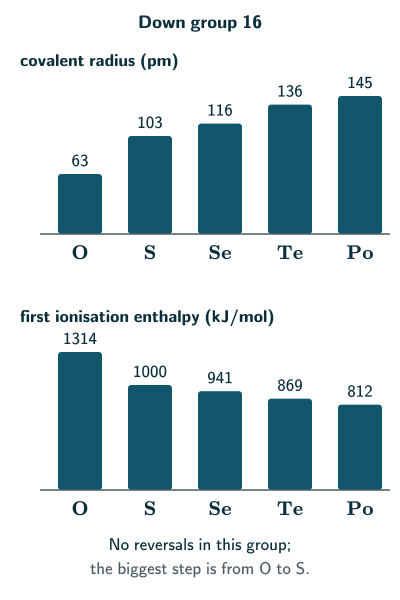
Covalent radius in pm, first ionisation enthalpy ΔiH1 in kJ mol−1, and electronegativity (EN) on the Pauling scale:
| Element | Radius | ΔiH1 | EN |
|---|---|---|---|
| O | 63 | 1314 | 3.44 |
| S | 103 | 1000 | 2.58 |
| Se | 116 | 941 | 2.55 |
| Te | 136 | 869 | 2.10 |
| Po | 145 | 812 | 2.0 |
Radii follow the Pyykkö–Atsumi molecular single-bond scale (2009); ionisation enthalpies are rounded atomic values (NIST), and electronegativities use the stated Pauling scale. All three are as tabulated in the Wikipedia data pages “Atomic radii of the elements”, “Molar ionization energies of the elements” and “Electronegativities of the elements”, the data pages cited below. NCERT’s Class 11 tables use different tabulated values for the first two members: O 66 pm and 3.5, S 104 pm and 2.5 (NCERT Class 11 Chemistry, Tables 3.6 and 3.8, pages 86 and 91).
- Atomic radius rises down the group (NCERT Class 11 Chemistry, page 86; Wikipedia, “Chalcogen”).
- Ionisation enthalpy falls steadily down the group (data page). For O, S and Se each value is lower than that of the group 15 element before it, because the fourth p electron shares an orbital and is repelled, as NCERT explains for O and N (NCERT Class 11 Chemistry, page 89); for Te and Po the order reverses (data page).
- Electronegativity decreases down the group (Wikipedia, “Chalcogen”). Oxygen is the most electronegative element after fluorine (Wikipedia, “Chalcogen”).
- Electron gain enthalpy is large and negative, but not most negative for oxygen (NCERT Class 11 Chemistry, Table 3.7, page 90), in kJ mol−1:
| Element | ΔegH |
|---|---|
| O | −141 |
| S | −200 |
| Se | −195 |
| Te | −190 |
| Po | −174 |
An electron added to the small 2p shell of oxygen is strongly repelled by the electrons already there; in the larger 3p shell of sulphur it is repelled much less (NCERT Class 11 Chemistry, page 90).
Polonium’s −174 is NCERT’s value. The Wikipedia “Electron affinity (data page)” gives polonium a calculated electron affinity of 136 kJ mol−1, which would put it just below oxygen (141 on the same page). In an exam, use NCERT’s order.
Physical properties
Melting and boiling points in K, density in g cm−3 (oxygen: g L−1 at 0 °C and 1 atm):
| Element | m.p. | b.p. | Density |
|---|---|---|---|
| O | 54 | 90 | 1.429 g L−1 |
| S | 388 | 718 | 2.08 |
| Se (grey) | 494 | 958 | 4.81 |
| Te | 723 | 1261 | 6.24 |
| Po | 527 | 1235 | 9.196 |
Values from the Wikipedia data pages for melting points, boiling points (CRC values) and densities. Sulphur’s density is for rhombic sulphur, the stable form at room temperature. Rhombic sulphur turns monoclinic at 368 K, and the table uses the approximately 388 K melting point listed by the Royal Society of Chemistry (115.21 °C). Sulphur melting data depend on allotrope and thermal history; some school tables use approximately 392 K for monoclinic sulphur.
- Metallic character increases down the group (NCERT Class 11 Chemistry, page 84): non-metals O, S and Se; metalloid Te (NCERT Class 11 Chemistry, page 85); Po shaded as a metalloid in NCERT Figure 3.3 (page 83), and usually classed as a metal beyond the NCERT text (Wikipedia, “Polonium”).
- Density increases down the group (Wikipedia, “Chalcogen”). Melting and boiling points rise to tellurium, then fall at polonium (data pages).
- State. Oxygen is a gas of O2 molecules; the rest are solids (data pages).
- Allotropes. Oxygen exists as O2, a paramagnetic molecule (NCERT Class 11 Chemistry, page 130), and as ozone, O3. Ozone’s two O–O bonds are equal, 128 pm, between a single bond (148 pm) and a double bond (121 pm), so it is drawn as a resonance hybrid (NCERT Class 11 Chemistry, Section 4.3.5, page 109). It is a pale blue, bent, weakly diamagnetic gas and a far stronger oxidising agent than O2 (Wikipedia, “Ozone”). Sulphur has over 20 allotropes, more than any element except carbon; the commonest are eight-atom rings, S8, in the rhombic form, the more stable, and the monoclinic form (Wikipedia, “Chalcogen”).
Chemical properties: hydrides, oxides and halides; the inert pair effect
- Hydrides, H2X. All are bent, polar molecules. Apart from water they are usually extremely toxic, with strong, unpleasant smells (Wikipedia, “Hydrogen chalcogenide”). H2S, H2Se and H2Te are gases at room temperature (boiling points below), whereas the properties of the extremely unstable polonium hydride are much less securely established and should not be treated as routine measured trends.
- Acid strength in water increases down the group, H2S < H2Se < H2Te (Wikipedia, “Hydrogen chalcogenide”). NCERT gives the reason: down a group the H–A bond weakens, so the acid strength increases, and H2S is a stronger acid than H2O (NCERT Class 11 Chemistry, Section 6.11.7, page 200).
- Thermal stability falls: H2O, H2S and H2Se can be made by heating the elements together, but H2Te decomposes above 0 °C (Wikipedia, “Hydrogen chalcogenide”).
- Water is a liquid because of strong hydrogen bonding, which gives it high melting and boiling points; hydrogen sulphide shows no significant hydrogen bonding (Wikipedia, “Hydrogen chalcogenide”).
- Boiling points, in °C: H2S −59.55 < H2Se −41.25 < H2Te −2.2, rising with the size of the molecule (Wikipedia, the infoboxes of “Hydrogen sulfide”, “Hydrogen selenide” and “Hydrogen telluride”; reasoned). Water, a liquid at room temperature, boils far above all three because of its hydrogen bonds.
- Bond angle closes from 104.5° in H2O (NCERT Class 11 Chemistry, Table 4.8, page 116) to 91° in H2Se (Wikipedia, “Hydrogen selenide”) and about 90° in H2Te (Wikipedia, “Hydrogen telluride”).
- Reducing power rises down the group, H2O < H2S < H2Se < H2Te, as the H–X bond weakens: H–O 464 and H–S 339 kJ mol−1 (NCERT Class 11 Chemistry, Table 5.3(a), page 154; reasoned).
- Oxides. The oxides include SO2 and SO3, SeO3, and TeO2 and TeO3 (NCERT Class 11 Chemistry, Table 3.9, page 93, for the trioxides; Wikipedia, “Chalcogen”, for the others).
- SO2 and SO3 are acidic, as most non-metal oxides are (NCERT Class 10 Science, Chapter 3, page 40); aqueous SO2 is acidic through equilibria involving dissolved SO2 and hydrogen sulphite. “H2SO3” is a useful formal acid formula, not a claim that neutral H2SO3 is the dominant dissolved species. SO3, with sulphur in the higher state, is the more acidic (reasoned). SO2 is a bent molecule, with an O–S–O angle of 119.5° (NCERT Class 11 Chemistry, Table 4.8, page 116).
- TeO2 is amphoteric: it dissolves in strong acids and in alkali hydroxides (Wikipedia, “Tellurium dioxide”).
- So, as in the other groups, the oxides grow more basic down the group (reasoned).
- Halides. Among the sulphur fluorides, sulphur hexafluoride, SF6, an octahedral, hypervalent molecule, is stable and well known, and so is SF4; sulphur fluorides with low valences are fairly unstable (Wikipedia, “Chalcogen” and “Sulfur hexafluoride”). SF6 is a non-flammable, chemically unreactive gas (Wikipedia, “Sulfur hexafluoride”).
- SF6 is octahedral: six bonding directions point to the corners of a regular octahedron. NCERT labels this sp3d2 (NCERT Class 11 Chemistry, page 125, Figure 4.18); give that in an exam. Beyond the NCERT text: modern bonding does not require substantial d-orbital hybridisation (Reed and Schleyer, JACS, 1990; Wikipedia, “Hypervalent molecule”). A main contribution to its chemical inertness is steric hindrance: the six fluorine atoms shield the sulphur atom (Wikipedia, “Sulfur hexafluoride”).
- SF4 has four bond pairs and one lone pair; with the lone pair in an equatorial position it is see-saw shaped (NCERT Class 11 Chemistry, Table 4.8, page 116).
- In alkali sulphur, in the intermediate state 0, disproportionates into sulphide (−2) and thiosulphate (+2, as NCERT marks it; strictly an average of +5 and −1 for the two sulphur atoms, reasoned): S8 + 12OH− → 4S2− + 2S2O32− + 6H2O (NCERT Class 11 Chemistry, page 244).
- The inert pair effect. Down the group the lower states become more stable: polonium is comparatively stable as +4, rather than +6 (Wikipedia, “Inert-pair effect”); its positive states are mainly +2 and +4 (Wikipedia, “Chalcogen”), while +6 is rare and the PoF6 assignment is tentative (Weinstock and Chernick, JACS, 1960).
Anomalous behaviour of oxygen
Oxygen differs from the rest because it is small, highly electronegative and has only four valence orbitals, 2s and 2p, whereas sulphur, the second member, has nine, 3s, 3p and 3d, and the members after oxygen can expand their valence shell (NCERT Class 11 Chemistry, page 93); give that reason in an exam. Beyond the NCERT text: they are larger and support higher coordination without substantial d-orbital bonding (Reed and Schleyer, JACS, 1990; Wikipedia, “Hypervalent molecule”).
- Maximum covalency 4. Oxygen cannot expand its valence shell, so there is no OF6, while sulphur forms SF6 (NCERT Class 11 Chemistry, page 93; Wikipedia, “Sulfur hexafluoride”). Four electron pairs fit around oxygen, and its common neutral compounds have two bonds (reasoned).
- Oxidation states. Oxygen is almost always −2; in the usual binary compounds it is positive with fluorine, +2 in OF2 and +1 in O2F2 (NCERT Class 11 Chemistry, pages 92 and 240). OF2 is a powerful oxidiser (Wikipedia, “Oxygen difluoride”).
- Hydrogen bonding. Water is a liquid with high melting and boiling points because of hydrogen bonding; H2S is a gas (Wikipedia, “Hydrogen chalcogenide”).
- A diatomic gas. Oxygen forms O=O double bonds, so it is O2; sulphur–sulphur double bonds are far weaker, while S–S single bonds are stronger than O–O single bonds, so sulphur forms S8 rings and chains (Wikipedia, “Chalcogen” and “Sulfur”). In NCERT’s table of bond enthalpies S–S is 213 kJ mol−1 against 138 for O–O, while O=O is 498 (NCERT Class 11 Chemistry, Table 5.3, page 154).
- Electron gain enthalpy is less negative for oxygen than for sulphur, because of crowding in the small 2p shell (NCERT Class 11 Chemistry, page 90).
Solved examples
Example 1: Oxidation states of sulphur
Find the oxidation state of sulphur in H2S, S8, SO2, H2SO4 and SF6.
Answer: H2S: 2(+1) + x = 0, −2. S8: an element, 0. SO2: x + 2(−2) = 0, +4. H2SO4: 2 + x − 8 = 0, +6. SF6: x + 6(−1) = 0, +6 (reasoned; rules for oxidation numbers).
Example 2: The electron gain enthalpy order
Arrange O, S, Se and Te by electron gain enthalpy, most negative first, and explain the place of oxygen.
Answer: S (−200) → Se (−195) → Te (−190) → O (−141 kJ mol−1), from most to least negative (NCERT Class 11 Chemistry, Table 3.7, page 90). Down the group from S the values become less negative as the atoms grow. Oxygen breaks the pattern: an extra electron in its small 2p shell is strongly repelled, so less energy is released (NCERT Class 11 Chemistry, page 90).
Example 3: Why SF but no OF?
Explain why sulphur forms SF6 while oxygen forms only OF2.
Answer: Oxygen, in period 2, has only four valence orbitals, so its maximum covalency is 4, and with fluorine it forms just two bonds, in OF2. Sulphur, in period 3, has nine valence orbitals, 3s, 3p and 3d, so it can expand its valence shell and hold six bond pairs (NCERT Class 11 Chemistry, page 93); NCERT describes SF6 as sp3d2 hybridised (page 125). Give that reason in an exam. Beyond the NCERT text: larger sulphur supports six-coordinate bonding without substantial d-orbital mixing (Reed and Schleyer, JACS, 1990; Wikipedia, “Hypervalent molecule”). SF6 is octahedral, as six bond pairs and no lone pair require (VSEPR theory, NCERT Class 11 Chemistry, Unit 4; Wikipedia, “Sulfur hexafluoride”).
Example 4: Acid strength of the hydrides
Which is the strongest acid in water: H2O, H2S, H2Se or H2Te? Explain.
Answer: H2Te. Acid strength rises down the group (Wikipedia, “Hydrogen chalcogenide”). The H–X bond grows longer and weaker as X grows, so H+ is lost more easily, even though X is less electronegative (NCERT Class 11 Chemistry, Section 6.11.7, page 200).
Common mistakes to avoid
Common mistake
Giving oxygen the most negative electron gain enthalpy
Sulphur’s is the most negative in the group, −200 against −141 kJ mol−1 for oxygen. The small 2p shell of oxygen repels the added electron.
Common mistake
Expecting the hydrides to grow less acidic down the group
Acid strength increases from H2S to H2Te, because the H–X bond weakens. Thermal stability, by contrast, falls.
Common mistake
Giving oxygen +4 or +6 states
Oxygen cannot expand its octet; in the usual binary compounds it is positive with fluorine, +2 in OF2 and +1 in O2F2. Sulphur, selenium and tellurium reach +6.
Quick revision summary
- Group 16 (chalcogens): O, S, Se, Te, Po (and Lv); valence configuration ns np.
- Oxidation states −2, +2, +4, +6; −2 grows less common and lower positive states more stable down the group; Po shows mainly +2 and +4.
- Radius rises, ionisation enthalpy and electronegativity fall; electron gain enthalpy is most negative for S, not O.
- Hydrides HX grow more acidic and more reducing but less stable down the group; only water has strong hydrogen bonding.
- Oxides grow more basic: SO and SO acidic, TeO amphoteric.
- Oxygen is anomalous: maximum covalency 4, positive in binary fluorides (OF +2, OF +1), hydrogen bonding, O a gas.
Formula sheet
- Valence configuration: ns np
- Oxidation states: −2, +2, +4, +6
- Acid strength: HO < HS < HSe < HTe
- Electron gain enthalpy (NCERT): S → Se → Te → Po → O, most negative first
- SO(aq) + HO ⇌ H + HSO
- Maximum covalency of O: 4
Questions students ask
Why are group 16 elements called chalcogens?
Group 16 elements are called chalcogens, a name NCERT also uses for the group (NCERT Class 11 Chemistry, Unit 3, page 84); beyond the NCERT text, it means “ore-formers”, from the Greek chalkos, copper and more loosely any metal or ore, and genes, born or produced, because most metal ores are chalcogenides, compounds of these elements (Wikipedia, “Chalcogen”). Werner Fischer, of Wilhelm Biltz’s group in Hannover, proposed the name in 1932, and it caught on in Germany because it echoed “halogen” (same article). The group is also called the oxygen family, after its first member, though some chemists leave oxygen out of the term because it behaves so differently (same article).
What is the difference between a chalcogen and a chalcogenide?
A chalcogen is an element of group 16 (O, S, Se, Te, Po, Lv), while, beyond the NCERT text, a chalcogenide is a compound of a chalcogen, as the negative partner, with a more electropositive element (Wikipedia, “Chalcogenide”), much as a halide is a compound of a halogen. The name is usually kept for sulphides, selenides, tellurides and polonides rather than oxides; many metal ores are chalcogenides; and cadmium sulphide, CdS, is a yellow pigment and molybdenum disulphide, MoS2, a solid lubricant (same article). The chalcogen is counted as S2−, Se2− or Te2− in them, though the transition metal chalcogenides are largely covalent (same article).
What is the difference between chalcogens and halogens?
Chalcogens (group 16, ns np) are two electrons short of a noble gas configuration and halogens (group 17, ns np) one short, so the chalcogens gain two electrons and the halogens one (NCERT Class 11 Chemistry, Unit 3, page 84). So the chalcogens’ typical state is −2 and the halogens’ −1, and a halogen is more electronegative than the chalcogen beside it: F 4.0 against O 3.5, Cl 3.0 against S 2.5 (NCERT Table 3.8(a), page 91). Beyond the NCERT text, the stable halogens all form X2 molecules, but among the chalcogens only oxygen is a diatomic gas (Wikipedia, “Halogen”, “Chalcogen”).
What is the valency of group 16 elements?
The valency of group 16 elements is 2 or 6: NCERT lists both for the group, which has six valence electrons, and gives sulphur a valence of 2 in Al2S3 (NCERT Class 11 Chemistry, Unit 3, page 92, Problem 3.8). Sulphur forms two bonds in H2S, four in SF4 and six in SF6, but oxygen’s covalency stops at 4 (NCERT page 93; anomalous behaviour). Valency counts bonds, not charge: each oxygen in H2O2 has valency 2, one O–H and one O–O bond, but oxidation state −1 (reasoned; oxidation number).
Why does the bond angle decrease from H2O to H2Te?
The bond angle falls from H2O to H2Te because the central atom grows larger and less electronegative: water’s is 104.5° (NCERT Class 11 Chemistry, Table 4.8, page 116), and beyond the NCERT text H2S has 92.1°, H2Se 91° and H2Te 90° (Wikipedia, “Hydrogen chalcogenide”). Oxygen holds the bond pairs close, so they repel strongly and keep the angle near 109.5°; on S, Se and Te the bonds have more p character, so the angle nears the 90° between p orbitals (reasoned; VSEPR theory gives the bent shape, not the angle), as in group 15.
Which group 16 elements are radioactive?
Beyond the NCERT text, polonium and the synthetic livermorium have no stable isotopes, and livermorium is too rare and short-lived for any use (Wikipedia, “Chalcogen”). All known isotopes of polonium are radioactive: the Curies found it in 1898 in pitchblende, a uranium ore, the first element discovered by its radioactivity, and named it after Poland; polonium-210, its most abundant natural isotope, is an alpha emitter with a half-life of 138 days (Wikipedia, “Polonium”). This does not mean every isotope of the other members is stable: selenium-82 and tellurium-128 and tellurium-130 undergo very slow radioactive decay; but tellurium-128’s half-life, 2.2 × 10 years, is so long that tellurium behaves as a stable element (Wikipedia, “Tellurium”; reasoned).
Practice questions
Try each question first, then open the answer to check your working.
-
Q1. Why is water a liquid at room temperature while hydrogen sulphide is a gas?
Show answerHide answer
Oxygen is small and highly electronegative, so water molecules are held together by strong hydrogen bonds. Sulphur is larger and less electronegative, and H2S shows no significant hydrogen bonding, so only weak forces hold its molecules (Wikipedia, “Hydrogen chalcogenide”).
-
Q2. What is the oxidation state of oxygen in OF2, and why is it unusual?
Show answerHide answer
+2. Fluorine is the only element more electronegative than oxygen, so in OF2 oxygen gives up its share of electrons: 2(−1) + x = 0. It is also positive, +1, in O2F2; in almost all its other compounds oxygen is negative (NCERT Class 11 Chemistry, pages 92 and 240).
-
Q3. Which group 16 element does NCERT’s text name as a metalloid, and what are the main oxidation states of polonium?
Show answerHide answer
Tellurium (NCERT Class 11 Chemistry, page 85). NCERT Figure 3.3 (page 83) also shades polonium as a metalloid, though beyond the NCERT text it is usually classed as a metal (Wikipedia, “Polonium”). Polonium shows mainly +2 and +4 (Wikipedia, “Chalcogen”); in its polonides, such as Na2Po, it is −2 (Wikipedia, “Polonium”).