Group 14 elements: the carbon family
Beyond NCERT In the JEE Main and NEET syllabus; the Class 12 book has no section for it.
Quick answer
Group 14, the carbon family, has four valence electrons and includes carbon, silicon, germanium, tin, lead and flerovium. The plus-four state is common, while the plus-two state becomes more stable down the familiar members. Carbon stands out for strong multiple bonds and catenation; its oxidation state in methane is minus four.
What are the group 14 elements?
Group 14: the carbon family
Group 14 is the second group of the p-block: carbon (C), silicon (Si), germanium (Ge), tin (Sn), lead (Pb) and the synthetic flerovium (Fl). Each atom has four valence electrons, ns np (Wikipedia, “Carbon group”).
- Carbon is a non-metal (NCERT Class 11 Chemistry, page 85), silicon and germanium are metalloids (NCERT Class 11 Chemistry, page 85; Wikipedia, “Carbon group”), and tin and lead are metals (Wikipedia, “Carbon group”).
- The oxidation states are +4 and +2. Down the group +2 becomes more stable: lead is usually +2, a result of the inert pair effect (Wikipedia, “Lead”). In NCERT’s words:
In PbO2, lead is present in +4 oxidation state, whereas the stable oxidation state of lead in PbO is +2.
NCERT Chemistry Part II (Class 11), Section 7.3.1, page 246
- Carbon is unlike the rest: it forms multiple bonds and cannot have more than four bonds (NCERT Class 11 Chemistry, page 93), and it forms chains of its own atoms more readily than any other element (Wikipedia, “Catenation”).
In plain words: the group runs from carbon, the backbone of every living thing, through the silicon of rocks and computer chips, to the soft metals tin and lead. All have four outer electrons. The light ones share all four; lead, at the bottom, prefers to use only two.
Scope: measured trends below concern C–Pb, not the little-studied synthetic flerovium. Oxidation state is formal bookkeeping and must be distinguished from valency and coordination number.
No 2026–27 NCERT textbook has a chapter on the p-block; the JEE Main 2027 and NEET (UG) 2026 syllabuses list it in Unit 10. This page covers group 14: configuration, oxidation states, trends, properties and the anomaly of carbon. Facts and data from beyond the NCERT books are labelled with their source.
Electronic configuration ns np and oxidation states
| Element | Z | Electronic configuration |
|---|---|---|
| C | 6 | [He] 2s2 2p2 |
| Si | 14 | [Ne] 3s2 3p2 |
| Ge | 32 | [Ar] 3d10 4s2 4p2 |
| Sn | 50 | [Kr] 4d10 5s2 5p2 |
| Pb | 82 | [Xe] 4f14 5d10 6s2 6p2 |
- The configurations follow the aufbau order (NCERT Class 11 Chemistry, Unit 2).
- +4, the group valence. With four valence electrons the group shows +4, as in SiCl4 (NCERT Class 11 Chemistry, page 241) and in the dioxides CO2 to PbO2. The group also forms tetrahydrides CH4, SiH4, GeH4 and SnH4, but their formula alone does not fix oxidation state: carbon is −4 in CH4, whereas silicon is +4 in SiH4 under the usual electronegativity assignment (formulas: NCERT Class 11 Chemistry, Table 3.9, page 93; oxidation states reasoned from Pauling electronegativities).
- +2 grows more stable down the group. Germanium is mostly +4, though many +2 compounds are known (Wikipedia, “Germanium”). Tin has two main states, +2 and the slightly more stable +4 (Wikipedia, “Tin”). Lead compounds are usually +2; few inorganic lead(IV) compounds are known, though organolead compounds are mostly lead(IV), and even fluorine and chlorine give only PbF2 and PbCl2 with the metal (Wikipedia, “Lead”).
- So tin(II) is a reducing agent, turning into tin(IV): 2HgCl2 + SnCl2 → Hg2Cl2 + SnCl4 (NCERT Class 11 Chemistry, page 236). Lead(IV) is an oxidising agent, turning into lead(II): PbO2 oxidises the Cl− of hydrochloric acid to chlorine (NCERT Class 11 Chemistry, page 246).
- Carbon can be −4, as in methane and in the methanide carbides: carbon alone forms monatomic anions, C4−, while the other members form Zintl ions with electropositive metals such as magnesium (Wikipedia, “Carbon group”). So the group is not restricted to +2 and +4 (reasoned).
Atomic radius, ionisation enthalpy and electronegativity down the group
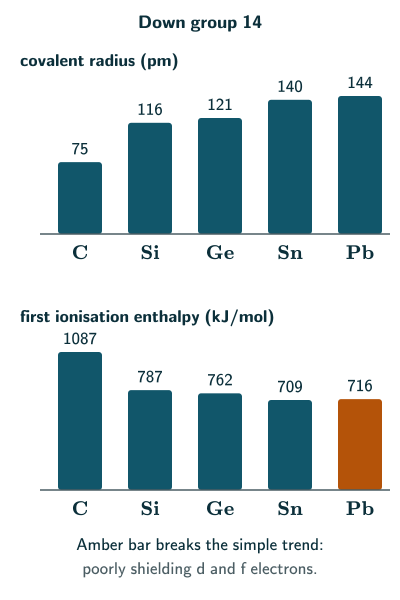
Covalent radius in pm, first ionisation enthalpy ΔiH1 in kJ mol−1, and electronegativity (EN) on the Pauling scale:
| Element | Radius | ΔiH1 | EN |
|---|---|---|---|
| C | 75 | 1087 | 2.55 |
| Si | 116 | 787 | 1.90 |
| Ge | 121 | 762 | 2.01 |
| Sn | 140 | 709 | 1.96 |
| Pb | 144 | 716 | 2.33 |
Radii follow the Pyykkö–Atsumi molecular single-bond scale (2009), and ionisation enthalpies are rounded atomic data; electronegativities use the stated Pauling table. All three are as tabulated in the Wikipedia data pages “Atomic radii of the elements”, “Molar ionization energies of the elements” and “Electronegativities of the elements”, the data pages cited below. NCERT’s Class 11 tables give C 77 pm and 2.5, Si 117 pm and 1.8 (NCERT Class 11 Chemistry, Tables 3.6 and 3.8, pages 86 and 91).
- Atomic radius rises down the group, as each member adds a shell (NCERT Class 11 Chemistry, page 86). The rise is small from Si to Ge, where ten 3d electrons are added, and from Sn to Pb, where fourteen 4f electrons are added: these inner electrons shield the nucleus poorly (reasoned; the lanthanoid contraction, NCERT Class 12 Chemistry Part I, Unit 4, page 93).
- Ionisation enthalpy falls sharply from C to Si, then slowly, but lead’s is a little above tin’s: 716 against 709 kJ mol−1 (data page). The poorly shielding 4f electrons and relativistic effects, which contract lead’s 6s and 6p orbitals, are the cause (Wikipedia, “Lead”).
- Electronegativity falls from C to Si and then changes little. The values for lead depend on the table and on its oxidation state: the data page gives 2.33, while its Lange column gives 1.8 (Wikipedia data page); 2.33 is lead(IV)’s value and lead(II)’s is 1.87 (Wikipedia, “Lead”). In an exam, the safe trend is: carbon is the most electronegative member.
Physical properties
Melting and boiling points in K, density in g cm−3:
| Element | m.p. | b.p. | Density |
|---|---|---|---|
| C (graphite) | sublimes at 4098 | – | 2.267 |
| Si | 1687 | 3538 | 2.33 |
| Ge | 1211 | 3106 | 5.323 |
| Sn (white, β) | 505 | 2875 | 7.265 |
| Pb | 601 | 2022 | 11.34 |
Values from the Wikipedia data pages for melting points, boiling points (CRC values) and densities; at standard pressure carbon sublimes, near 3825 °C (Wikipedia, “Carbon group”).
- Metallic character increases down the group (NCERT Class 11 Chemistry, page 84): non-metal C and metalloids Si and Ge (NCERT Class 11 Chemistry, page 85), metals Sn and Pb (Wikipedia, “Carbon group”).
- Melting and boiling points fall down the group, though lead melts a little higher than tin (Wikipedia, “Carbon group”). Carbon, silicon and germanium are giant covalent networks with diamond-type or layered structures (Wikipedia, “Carbon group”), held by strong bonds, which is why they melt so high (reasoned).
- Density increases down the group (Wikipedia, “Carbon group”).
- Allotropes. Carbon has several: graphite, diamond, fullerenes, graphene and amorphous carbon. Tin has two: silvery β-tin, and grey, powdery α-tin, which forms below 13.2 °C; the conversion can be slow, but tin objects in the cold can eventually crumble, “tin pest” (Wikipedia, “Carbon group”).
Chemical properties: oxides, reactivity towards water, and halides; the inert pair effect
- Oxides. All form dioxides, MO2 (NCERT Class 11 Chemistry, Table 3.9, page 93); carbon, germanium, tin and lead also form monoxides (Wikipedia, “Carbon group”, “Germanium” and “Lead(II) oxide”).
- CO2 and SiO2, oxides of a non-metal and a metalloid, are acidic: most non-metals give acidic oxides (NCERT Class 10 Science, Chapter 3, page 40). Silicon dioxide reacts with bases under some conditions (Wikipedia, “Silicon dioxide”).
- CO is a neutral oxide, with neither acidic nor basic properties (NCERT Class 11 Chemistry, page 94), and a reducing agent: hot CO reduces tin ore, SnO2 + 2CO → Sn + 2CO2 (Wikipedia, “Tin(IV) oxide”).
- SnO2 is amphoteric in Wikipedia’s “Tin” and in the opening of “Tin(IV) oxide”, though slow to react: it dissolves in sulphuric acid and in molten sodium hydroxide, while solutions of acid or base hardly attack it (Wikipedia, “Tin(IV) oxide”, which in its Reactions section also says it is not amphoteric). Amphoterism describes reaction types, not rapid dissolution in every solution (reasoned). In an exam, call SnO2 amphoteric.
- PbO is amphoteric: it reacts with both acids and bases (Wikipedia, “Lead(II) oxide”). In its problem on Pb3O4, NCERT calls PbO a basic oxide, which is how it behaves towards acids (NCERT Class 11 Chemistry, page 246). PbO2, like PbO, can form plumbate anions with bases (Wikipedia, “Lead”).
- So the oxides grow less acidic and more basic down the group (reasoned).
- Water. Hot carbon (coke) reacts with steam to give water gas, a mixture of CO and H2 (Wikipedia, “Water gas”): C + H2O → CO + H2. Silicon is relatively unreactive (Wikipedia, “Silicon”), and germanium is not attacked by dilute acids or alkalis (Wikipedia, “Germanium”). Tin resists corrosion by water (Wikipedia, “Tin”); NCERT gives it as a metal that does not react with steam but does give hydrogen with acids (NCERT Class 11 Chemistry, page 243). NCERT Class 10 Science says lead does “not react with water at all” (page 43); give that in an exam. Beyond the NCERT text: in moist air it can gain a protective surface layer, but its corrosion and dissolution in water depend on oxygen, pH and other dissolved species (Wikipedia, “Lead”).
- Halides. Carbon and silicon form tetrahalides with all the halogens. Germanium and tin form both dihalides and tetrahalides; lead forms dihalides, but its tetrabromide and tetraiodide are unstable (Wikipedia, “Carbon group”). The lead(IV) halides grow less stable from fluoride to iodide: PbF4 is stable, though less so than PbF2; PbCl4, a yellow oil, decomposes at room temperature; PbBr4 is less stable still; and PbI4 may not exist. PbO2 oxidises chloride in hydrochloric acid while Pb(IV) is reduced to Pb(II); the net equation does not establish a PbCl4 intermediate (Wikipedia, “Lead”).
- Hydrolysis of the tetrachlorides. SiCl4 fumes in moist air and reacts readily with water: SiCl4 + 2H2O → SiO2 + 4HCl. Carbon tetrachloride is not readily hydrolysed (Wikipedia, “Silicon tetrachloride”). In an exam, give the reason from NCERT page 93: silicon can expand its valence shell to take a lone pair from water, carbon cannot (reasoned from NCERT Class 11 Chemistry, page 93). Beyond the NCERT text: SiCl4 reacts in two steps through a five-coordinate silicon intermediate, while CCl4 could react only in one step with a very large activation energy, so it is kinetically resistant (International Chemistry Olympiad 2021, preparatory problem 14); the bonding involves little d-orbital participation (Reed and Schleyer, JACS, 1990; Wikipedia, “Hypervalent molecule”).
- The inert pair effect. Down the group the two ns electrons, poorly shielded by the d and f electrons in between, take less part in bonding, so +2 grows more stable (Wikipedia, “Inert-pair effect”; NCERT Class 12 Chemistry Part I, Section 4.3.4, page 97). This explains why lead(IV) is oxidising and tin(II) is reducing, and why PbI4 and PbBr4 are unstable (reasoned).
Anomalous behaviour of carbon
Carbon differs from the rest of the group because it is small, has a high electronegativity and has only four valence orbitals (NCERT Class 11 Chemistry, page 93).
- Maximum covalency 4. With only 2s and 2p orbitals, carbon can form at most four bonds, while silicon, with nine valence orbitals including 3d, can expand its valence shell (NCERT Class 11 Chemistry, page 93); give that reason in an exam. Beyond the NCERT text: modern bonding analyses find little d-orbital participation in such compounds (Reed and Schleyer, JACS, 1990; Wikipedia, “Hypervalent molecule”). Silicon gives [SiF6]2−, as hexafluorosilicic acid, H2SiF6, when HF attacks silica (Wikipedia, “Silicon dioxide”).
- Multiple bonds. Carbon readily forms pπ–pπ multiple bonds, to itself (C=C, C≡C) and to other period 2 elements (C=O, C≡N) (NCERT Class 11 Chemistry, page 93). So CO2 is a small linear molecule and a gas, while SiO2 is a three-dimensional network solid in which each silicon is bonded to four oxygens (Wikipedia, “Silicon dioxide”).
- Catenation. Carbon links to itself in long chains and rings far more readily than any other element, which is why there are so many organic compounds. The tendency falls down the group, as the bonds between like atoms grow weaker (Wikipedia, “Catenation”).
- Inert halides. CCl4 is not readily hydrolysed, while SiCl4 is (Wikipedia, “Silicon tetrachloride”).
- Carbon forms methanide carbides and has the highest ionisation enthalpy and electronegativity in the group (data table above).
Solved examples
Example 1: PbO with two acids (NCERT Problem 7.7)
Pb3O4 + 8HCl → 3PbCl2 + Cl2 + 4H2O, but Pb3O4 + 4HNO3 → 2Pb(NO3)2 + PbO2 + 2H2O. Explain.
Answer: Pb3O4 behaves as 2PbO·PbO2. PbO, with the stable +2 state, simply neutralises either acid. PbO2 holds lead in the less stable +4 state, so it is an oxidising agent: it oxidises Cl− to Cl2, PbO2 + 4HCl → PbCl2 + Cl2 + 2H2O. HNO3 is itself an oxidising agent, so PbO2 is left unchanged (NCERT Problem 7.7, Class 11 Chemistry, page 246).
Example 2: The 6s pair of lead in numbers
The third and fourth ionisation enthalpies are 2943.0 and 3930.3 kJ mol−1 for tin, and 3081.5 and 4083 kJ mol−1 for lead. Compare the energy needed to remove the ns2 pair from M2+.
Answer: Sn: 2943.0 + 3930.3 = 6873.3 kJ mol−1. Pb: 3081.5 + 4083 = 7164.5 kJ mol−1, about 291 kJ mol−1 more, although lead is the bigger atom. This greater gas-phase removal cost contributes to the inert pair effect; compound stability also depends on bonding and lattice or solvation energies (data from Wikipedia, “Molar ionization energies of the elements”; reasoned).
Example 3: Hydrolysing silicon tetrachloride
17.0 g of SiCl4 is added to excess water. What mass of SiO2 forms, and how many moles of HCl? (Si = 28.09, Cl = 35.45, O = 16.00 g mol−1.)
Answer: M(SiCl4) = 28.09 + 4 × 35.45 = 169.89 g mol−1, so 17.0/169.89 = 0.100 mol. From SiCl4 + 2H2O → SiO2 + 4HCl, this gives 0.100 mol SiO2, 0.100 × 60.09 = 6.01 g, and 0.400 mol HCl (reasoned; mole concept).
Example 4: Tin(II) as a reducing agent
In 2HgCl2 + SnCl2 → Hg2Cl2 + SnCl4, find the change in oxidation number of tin and of mercury.
Answer: Tin goes from +2 in SnCl2 to +4 in SnCl4: it is oxidised, losing 2 electrons. Each mercury goes from +2 in HgCl2 to +1 in Hg2Cl2; two Hg atoms gain 1 electron each. SnCl2 is the reducing agent (reaction from NCERT Class 11 Chemistry, page 236).
Common mistakes to avoid
Common mistake
Giving lead the +4 state of carbon
Down group 14 the +2 state grows more stable. Lead compounds are usually +2, and PbO2 is a strong oxidising agent because Pb(IV) readily becomes Pb(II).
Common mistake
Expecting CCl to hydrolyse like SiCl
CCl4 is not readily hydrolysed: carbon cannot expand its valence shell to take a lone pair from water (reasoned from NCERT Class 11 Chemistry, page 93); strictly, it is kinetically resistant, its one-step reaction having a very large activation energy (International Chemistry Olympiad 2021, preparatory problem 14). SiCl4 reacts readily, giving SiO2 and HCl.
Common mistake
Drawing SiO like CO
CO2 is a linear molecule with C=O double bonds. SiO2 is a giant network of SiO4 tetrahedra with single Si–O bonds, which is why it is a hard, high-melting solid.
Common mistake
Expecting ionisation enthalpy to fall all the way down
Lead’s first ionisation enthalpy is slightly higher than tin’s, because of poorly shielding 4f electrons and relativistic effects that contract its 6s and 6p orbitals.
Quick revision summary
- Group 14: C, Si, Ge, Sn, Pb (and Fl); valence configuration ns np; C non-metal, Si and Ge metalloids, Sn and Pb metals.
- Oxidation states +4 and +2; +2 grows more stable down the group (inert pair effect): Pb(IV) oxidises, Sn(II) reduces.
- Radius rises down the group, only a little from Si to Ge and from Sn to Pb; ionisation enthalpy falls, but Pb is above Sn.
- Oxides grow more basic down the group: CO and SiO are acidic, SnO and PbO amphoteric; CO is a neutral oxide.
- Carbon is anomalous: maximum covalency 4, multiple bonds, catenation, CO a molecule, CCl not hydrolysed.
Formula sheet
- Valence configuration: ns np
- SiCl + 2HO → SiO + 4HCl
- PbO + 4HCl → PbCl + Cl + 2HO
- 2HgCl + SnCl → HgCl + SnCl
- Stability of +2: Ge < Sn < Pb
- Maximum covalency of C: 4
Questions students ask
What is the oxidation state of lead in Pb3O4?
Lead in Pb3O4 has an average oxidation state of +8/3, from 3x + 4(−2) = 0, but NCERT lists Pb3O4 among the mixed oxides whose fractional oxidation numbers are averages over atoms in different states (NCERT Class 11 Chemistry, Unit 7, page 245). This red lead behaves as 2PbO·PbO2 (page 246; Example 1), two Pb(II) to one Pb(IV), and (2 × 2 + 4)/3 = 8/3. Beyond the NCERT text, its structure is lead(II) orthoplumbate(IV), (Pb2+)2[PbO4]4− (Wikipedia, “Lead(II,IV) oxide”).
Why are group 14 elements called the carbon family, and what are their other names?
Group 14 is called the carbon family after its first member, carbon, as groups 13 and 15 are the boron and nitrogen families (reasoned). NCERT’s periodic table also marks it IVA, the older notation that IUPAC’s numbering of groups 1 to 18 replaced (NCERT Class 11 Chemistry, Unit 3, pages 78–79). Beyond the NCERT text, it is also called the tetrels, from the Greek tetra, four, for its four valence electrons and the numeral IV, and sometimes the crystallogens; the old European label was IVB, and semiconductor physics still speaks of group IV (Wikipedia, “Carbon group”).
What is the order of ionisation enthalpy and electronegativity in group 14?
On the Wikipedia data in the page’s table, the first ionisation enthalpy order in group 14 is C > Si > Ge > Pb > Sn (1087, 787, 762, 716 and 709 kJ mol), lead edging above tin because the filled 4f shell and relativistic effects hold its 6p electrons more tightly (Wikipedia, “Lead”). Electronegativity has no agreed order below carbon: the table’s Pauling values give C > Pb > Ge > Sn > Si (2.55, 2.33, 2.01, 1.96, 1.90), with lead’s 2.33 being its value as lead(IV), while the Allen scale gives C > Ge > Si > Pb > Sn (Wikipedia, “Electronegativities of the elements” and “Lead”). Carbon comes first on every scale.
Why is SnCl4 a liquid while SnCl2 is a solid?
SnCl4 is a liquid and SnCl2 a solid because tin(IV), twice as charged as tin(II), polarises chloride more and bonds covalently: by Fajans’ rules, “the greater the charge on the cation, the greater the covalent character” (NCERT Class 11 Chemistry, Unit 4, page 112). Beyond the NCERT text, SnCl4 is made of separate molecules, boiling at 114 °C, while solid SnCl2, melting at 247 °C, forms chloride-bridged chains (Wikipedia, “Tin(IV) chloride”, “Tin(II) chloride”). Lead too: PbCl4 is a yellow oil, PbCl2 melts at 501 °C (Wikipedia, “Lead(IV) chloride”, “Lead(II) chloride”).
Are the allotropes of carbon in the JEE Main 2027 and NEET (UG) 2026 syllabus?
The allotropes of carbon are not named in the JEE Main 2027 or the NEET (UG) 2026 syllabus: Unit 10, p-Block Elements, gives groups 13 to 18 only a general introduction (configuration, trends and the first element’s unique behaviour), and no unit of either names diamond, graphite or fullerenes. The hybridisation of carbon in diamond and graphite is answered on the tetravalence of carbon page, and the p-block syllabus as a whole on the group 13 page.
Practice questions
Try each question first, then open the answer to check your working.
-
Q1. Why is SnCl2 a reducing agent while PbO2 is an oxidising agent?
Show answerHide answer
Down group 14 the +2 state grows more stable (inert pair effect). Tin is slightly more stable as +4, so Sn(II) is readily oxidised to Sn(IV): SnCl2 reduces. Lead is more stable as +2, so Pb(IV) is readily reduced to Pb(II): PbO2 oxidises (Wikipedia, “Tin” and “Lead”; NCERT Class 11 Chemistry, page 246).
-
Q2. Why is CO2 a gas while SiO2 is a high-melting solid?
Show answerHide answer
Carbon forms strong pπ–pπ double bonds with oxygen, so CO2 is a small separate molecule held to its neighbours only by weak forces. Ordinary bulk silica favours a network rather than separate SiO2 molecules; each Si is singly bonded to four O atoms in a giant network, so melting SiO2 means breaking strong covalent bonds (NCERT Class 11 Chemistry, page 93; Wikipedia, “Silicon dioxide”).
-
Q3. Write the electronic configuration of lead and its usual oxidation state.
Show answerHide answer
Pb: [Xe] 4f14 5d10 6s2 6p2. Its usual oxidation state is +2: only the two 6p electrons are used, while the 6s pair stays unshared (Wikipedia, “Lead”).