Tetravalence of carbon: shapes of organic compounds
NCERT Class 11 Chemistry Chapter 8 Section 8.2
Quick answer
Carbon normally has total bond order four in ordinary neutral organic compounds. Hybridisation describes three common local bonding geometries: tetrahedral for four bonding directions, trigonal planar for three and linear for two. Charge, lone pairs and conjugation must also be considered when assigning the model.
With your textbook
NCERT Chemistry Part II (Class 11), Chapter 8 “Organic Chemistry – Some Basic Principles and Techniques”, Section 8.2 “Tetravalence of Carbon: Shapes of Organic Compounds”, page 257.
Open the official NCERT chapter (PDF, 4.5 MB, ncert.nic.in) (opens in a new tab)
Checked against the 2026-27 reprint on .
How does tetravalent carbon shape organic molecules?
Tetravalence and the shapes of carbon compounds
Carbon normally forms four covalent bonds in the neutral, closed-shell compounds considered here. Hybridisation is a bonding model used to describe the local orbital geometry around carbon (NCERT Section 8.2, page 257). The ideal angles, from Unit 4, are:
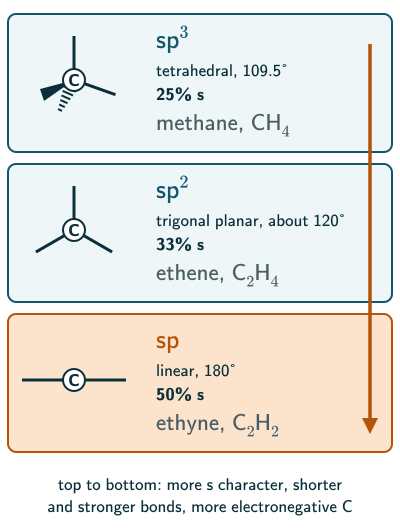
- sp3 (four single bonds): tetrahedral, bond angle 109.5°, as in methane, CH4;
- sp2 (one double bond): trigonal planar, about 120°, as in ethene, C2H4 (there H–C–H is 117.6° and H–C–C 121°);
- sp (a triple bond or two double bonds): linear, 180°, as in ethyne, C2H2.
For comparable bonds, such as the C–H bonds of ethane, ethene and ethyne, increasing s character generally gives shorter, stronger bonds and greater effective electronegativity of carbon.
In plain words: ordinary neutral carbon compounds usually show total bond order four, arranged in three common local geometries. Four single bonds point to the corners of a tetrahedron; with one double bond, the three directions lie flat at 120°; with a triple bond, the atom and its two neighbours sit in a straight line. Counting bonding directions helps assign the model, provided charge, lone pairs and conjugation are considered too.
The shapes of carbon compounds
The tetravalence of carbon and its covalent bonds are explained by its electronic configuration and the hybridisation of its s and p orbitals, as in hybridisation of carbon in Unit 4. Methane, ethene and ethyne use sp3, sp2 and sp hybrid orbitals respectively (NCERT Section 8.2.1, page 257).
Hybridisation changes the bonds (page 257):
- An sp hybrid orbital has 50% s character, sp2 one-third and sp3 one-quarter.
- An s orbital is held closer to the nucleus than a p orbital, so the more s character, the closer the hybrid orbital stays to the nucleus. For comparable C–H bonds this gives the trend shorter and stronger from sp3 through sp2 to sp; it is not a ranking of every bond between unlike atoms.
- For the same reason, the more s character, the more electronegative the carbon: an sp carbon is more electronegative than an sp2 or sp3 carbon. This shows up in many physical and chemical properties met in later units.
Finding the hybridisation quickly. For ordinary localised bonding, count the σ bonds a carbon forms (each single, double or triple bond to a neighbour counts as one σ bond) and add any lone pair on it: 4 means sp3, 3 means sp2, 2 means sp. The neutral worked examples below have no lone pair on carbon. A carbanion such as CH3− has three σ bonds and a lone pair, so its localised model is sp3 (NCERT Section 8.7.1, page 272). A conjugated carbanion can instead be approximately planar, with its lone pair in a p orbital; the shortcut must not override conjugation.
Some characteristic features of π bonds
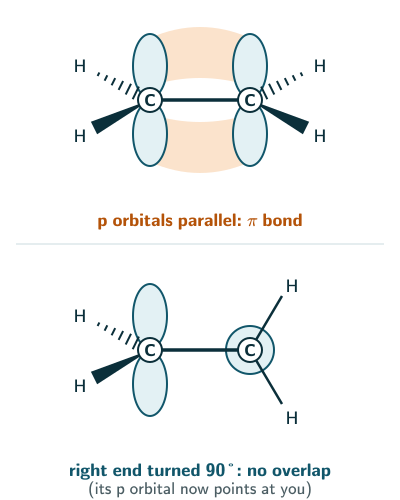
A π bond forms by the sideways overlap of two p orbitals on neighbouring atoms, and this needs the two p orbitals to be parallel (NCERT Section 8.2.2, page 257). This has three consequences:
- Planarity. In ethene, H2C=CH2, all six atoms lie in one plane. The two p orbitals are parallel to each other and perpendicular to that plane.
- Restricted rotation. Turning one CH2 group about the C=C axis would twist the p orbitals out of line and destroy their overlap, so rotation about a carbon–carbon double bond is restricted, which makes cis–trans isomers possible. Rotation about a C–C single bond (a σ bond, symmetrical about the axis) is almost free: only a small energy barrier, about 12.5 kJ mol−1 in ethane, opposes it (NCERT Unit 9; see conformations of ethane).
- Reactivity. The π electron cloud lies above and below the plane of the bonded atoms, where attacking reagents can reach it easily. So π bonds are usually the most reactive centres in molecules with multiple bonds.
Solved examples
Example 1: Counting σ and π bonds (NCERT Problem 8.1, page 257)
How many σ and π bonds are there in (a) HC≡C–CH=CH–CH3; (b) CH2=C=CH–CH3?
Every bond between two atoms has one σ bond; a double bond adds one π and a triple bond two.
(a) C–C σ: 4 (one in each of the four carbon–carbon links); C–H σ: 1 + 1 + 1 + 3 = 6; π: 1 in C=C and 2 in C≡C.
(b) C–C σ: 3; C–H σ: 2 + 1 + 3 = 6; π: 2 (one in each C=C).
Answer: (a) 10 σ (4 C–C, 6 C–H) and 3 π; (b) 9 σ (3 C–C, 6 C–H) and 2 π.
Example 2: Hybridisation of each carbon (NCERT Problem 8.2, page 257)
Give the hybridisation of each carbon in (a) CH3Cl; (b) (CH3)2CO; (c) CH3CN; (d) HCONH2; (e) CH3CH=CHCN.
Count σ bonds on each carbon: four gives sp3, three sp2, two sp.
Answer: (a) sp3; (b) CH3 carbons sp3, C=O carbon sp2; (c) CH3 sp3, C≡N carbon sp; (d) sp2; (e) sp3, sp2, sp2, sp from left to right.
Example 3: Hybridisation and shape (NCERT Problem 8.3, page 257)
Give the hybridisation of carbon and the shape of (a) H2C=O; (b) CH3F; (c) HC≡N.
Answer: (a) sp2, trigonal planar; (b) sp3, tetrahedral; (c) sp, linear.
Example 4: Which C–H bond is shortest?
Arrange the C–H bonds of ethane, ethene and ethyne in order of increasing length.
Carbon is sp3 in ethane (25% s), sp2 in ethene (33%) and sp in ethyne (50%). More s character gives a shorter bond.
Answer: ethyne < ethene < ethane. The C–H bond of ethyne is also the most polar, since its sp carbon is the most electronegative.
Common mistakes to avoid
Common mistake
Counting a double bond as two σ bonds
A double bond is one σ + one π; a triple bond is one σ + two π. Only the first bond between two atoms is σ.
Common mistake
Taking hybridisation from the formula, not the bonds
In CH3CN the two carbons differ: CH3 is sp3, the C≡N carbon is sp. Decide carbon by carbon.
Common mistake
Assuming every molecule with C=C is flat
Ethene is planar, but in allene, CH2=C=CH2, the two π bonds at the central sp carbon are at right angles, so the two CH2 groups lie in perpendicular planes.
Quick revision summary
- Carbon is tetravalent; hybridisation describes its local bonding geometry: sp3 tetrahedral 109.5°, sp2 trigonal planar 120°, sp linear 180°.
- s character: sp 50%, sp2 33%, sp3 25%; more s generally gives shorter, stronger comparable C–H bonds and a more electronegative carbon.
- π bond: sideways overlap of parallel p orbitals; atoms around C=C coplanar; rotation about C=C restricted.
- π electrons lie above and below the plane, so π bonds are reactive centres.
Formula sheet
- σ bonds around carbon: 4 → sp (109.5°), 3 → sp (120°), 2 → sp (180°)
- s character: sp 50% > sp 33% > sp 25%
- Single bond = 1 σ; double = 1 σ + 1 π; triple = 1 σ + 2 π
Questions students ask
Why is carbon tetravalent?
Carbon is tetravalent because it has four valence electrons, 2s2 2p2, and reaches an octet most easily by sharing four electron pairs, that is, by forming four covalent bonds, as in CH4: gaining or losing four electrons to make C4− or C4+ ions would cost far too much energy. Ground-state carbon has only two unpaired electrons, but promoting one 2s electron into the empty 2p orbital gives four, and the energy needed is more than repaid by the two extra bonds. This promotion is valence-bond bookkeeping, not a literal preliminary event that an isolated atom must undergo before every reaction. Four ordinary two-centre, two-electron bonds give carbon an octet; more advanced multicentre species do not follow that simple bond-count picture.
What is the hybridisation of carbon in benzene?
Every carbon atom in benzene, C6H6, is sp2 hybridised: it forms three σ bonds, to two ring carbons and one hydrogen, at 120° to one another, so the ring is a flat regular hexagon with all twelve atoms in one plane. The unhybridised 2p orbital left on each carbon stands perpendicular to the ring, and the six p orbitals overlap sideways all the way round, so the six π electrons are shared by the whole ring rather than fixed in three double bonds; this is why all six C–C bonds have the same length.
What is the hybridisation of carbon in diamond and graphite?
Carbon is sp3 hybridised in diamond and sp2 hybridised in graphite. In diamond each atom is bonded tetrahedrally, at 109.5°, to four others in a rigid three-dimensional network, so diamond is very hard and, with all its valence electrons held in σ bonds, does not conduct electricity. In graphite each atom is bonded to three others at 120° in flat sheets of hexagons; the fourth electron, in the unhybridised p orbital, is delocalised over the sheet, so graphite conducts electricity, and the sheets, held together only by weak forces, slide over one another.
Is carbon always tetravalent?
Carbon is tetravalent in almost every stable organic compound, but not in the short-lived intermediates of reactions. A carbocation such as CH3+ has only three bonds and six valence electrons, a carbanion such as CH3− three bonds and a lone pair, and a methyl radical, CH3•, three bonds and one unpaired electron. All three can form when a covalent bond breaks, and they react quickly, usually by regaining a fourth bond.
Practice questions
Try each question first, then open the answer to check your working.
-
Q1. How many σ and π bonds are there in buta-1,3-diene, CH2=CH–CH=CH2?
Show answerHide answer
C–C σ: 3; C–H σ: 2 + 1 + 1 + 2 = 6; so 9 σ. π: 2 (one in each C=C).
-
Q2. Give the hybridisation of each carbon in allene, CH2=C=CH2.
Show answerHide answer
The end carbons form three σ bonds each, so they are sp2; the central carbon forms two σ bonds, so it is sp (linear C=C=C).
-
Q3. Why can the two CH3 groups of ethane rotate almost freely about the C–C bond, while the CH2 groups of ethene cannot?
Show answerHide answer
The C–C bond of ethane is a σ bond, symmetrical about the bond axis, so turning one end does not change the overlap. In ethene the π bond needs the two p orbitals to stay parallel; turning one CH2 group would break that overlap. In ethane only a small barrier (about 12.5 kJ mol−1), associated with the changing electronic interactions between C–H bonds during rotation, remains.