Classification of organic compounds
NCERT Class 11 Chemistry Chapter 8 Section 8.4
Quick answer
Organic compounds can be classified by chain or ring structure, aromaticity and functional group. Aliphatic means non-aromatic in IUPAC terminology, while alicyclic specifically describes non-aromatic carbon rings and heterocyclic describes rings containing a heteroatom. Homologous series have a common structural pattern and successive carbon-number members differing by a methylene unit.
With your textbook
NCERT Chemistry Part II (Class 11), Chapter 8 “Organic Chemistry – Some Basic Principles and Techniques”, Section 8.4 “Classification of Organic Compounds”, pages 261–262.
Open the official NCERT chapter (PDF, 4.5 MB, ncert.nic.in) (opens in a new tab)
Checked against the 2026-27 reprint on .
How are organic compounds classified?
Classification of organic compounds
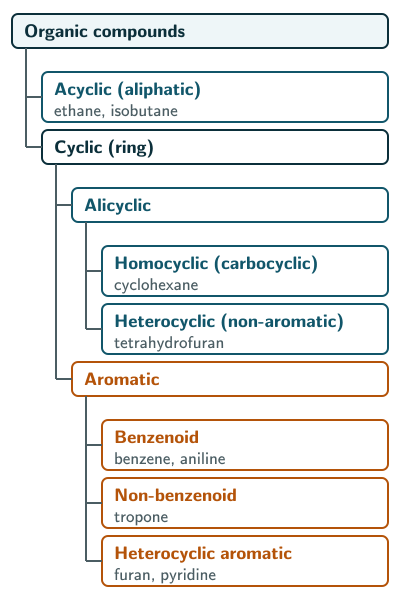
Organic compounds are so many that they are sorted by structure (NCERT Section 8.4, pages 261–262):
- acyclic (open-chain) compounds, called aliphatic in NCERT’s introductory chart: straight or branched chains, such as ethane and isobutane;
- cyclic compounds, which may be non-aromatic or aromatic, and may have all-carbon or heteroatom-containing rings;
- by functional group and structural family, including homologous series, in which successive carbon-number members differ by a CH2 unit.
In plain words: first ask whether the carbon atoms form a chain or a ring. If a ring, ask whether it is an ordinary ring or a special aromatic one like benzene, and whether any atom in the ring is not carbon. Then look at the functional group, the reactive part of the molecule, which puts the compound into a family with predictable chemistry.
Chains and rings
Acyclic or open-chain compounds have straight or branched chains. NCERT calls these aliphatic here; IUPAC uses aliphatic more broadly for non-aromatic carbon compounds, including cyclic ones. NCERT’s examples are ethane (CH3CH3), isobutane ((CH3)2CHCH3), acetaldehyde (CH3CHO) and acetic acid (CH3COOH) (page 261).
Cyclic, closed-chain or ring compounds come in two kinds (page 261):
- Alicyclic compounds, in IUPAC terminology, are non-aromatic carbocyclic compounds: their rings contain only carbon, as in cyclopropane, cyclohexane and cyclohexene. A ring containing a heteroatom is heterocyclic. Tetrahydrofuran is a saturated, non-aromatic heterocycle; NCERT groups it with alicyclic examples, but the more precise term avoids confusing ring composition with aromaticity.
- Aromatic compounds are special ring compounds, studied in detail in the unit on hydrocarbons, under aromatic hydrocarbons. They include benzene and related rings (benzenoid: benzene, aniline, naphthalene) and compounds without a benzene ring (non-benzenoid, such as tropone). Aromatic rings that contain an atom other than carbon are heterocyclic aromatic compounds: furan (O), thiophene (S) and pyridine (N) (pages 261–262).
Functional groups
A functional group is an atom or group of atoms joined to the carbon chain that is responsible for the characteristic chemical properties of the compound, for example the hydroxyl group (–OH), the aldehyde group (–CHO) and the carboxylic acid group (–COOH) (NCERT Section 8.4.1, page 262). Compounds with the same functional group react in broadly similar ways, although the rest of the molecule can modify this (–OH on a benzene ring, in phenol, does not behave like the –OH of ethanol). Some common families (for how each is named, see IUPAC nomenclature):
| Family | Group | Example |
|---|---|---|
| Alkene | C=C | CH2=CH2 |
| Alkyne | C≡C | HC≡CH |
| Haloalkane | –X (halogen) | CH3Cl |
| Alcohol | –OH on saturated carbon | CH3CH2OH |
| Ether | C–O–C | CH3OCH3 |
| Aldehyde | –CHO | CH3CHO |
| Ketone | >C=O | CH3COCH3 |
| Carboxylic acid | –COOH | CH3COOH |
| Primary amine | –NH2 | CH3NH2 |
A compound can carry two or more functional groups, alike or different; it is then a polyfunctional compound (page 262). Lactic acid, CH3CH(OH)COOH, is both an alcohol and a carboxylic acid.
Homologous series
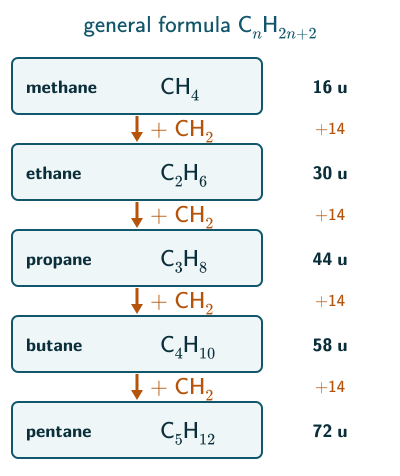
A homologous series is a structural family with a common general formula and successive carbon-number members differing by CH2; most such families share a characteristic functional group, while alkanes have none. Its members are homologues (NCERT Section 8.4.2, page 262). The members:
- can be written with one general formula, such as CnH2n+2 for alkanes;
- differ from the next member by a –CH2– unit, which adds 14 u to the molecular mass (12 + 2 × 1, see molecular mass).
NCERT names alkanes, alkenes, alkynes, haloalkanes, alkanols, alkanals, alkanones, alkanoic acids and amines as examples (page 262). Because they share a structural family, homologues show broadly similar chemical properties, while physical properties such as boiling point change gradually along the series.
The following formulas apply to acyclic families: one double bond for the alkenes, one triple bond for the alkynes, and one OH group with no other unsaturation for the alkanols.
| Series | General formula | First member |
|---|---|---|
| Alkanes | CnH2n+2 | CH4 (n = 1) |
| Alkenes | CnH2n | C2H4 (n = 2) |
| Alkynes | CnH2n−2 | C2H2 (n = 2) |
| Alkanols | CnH2n+1OH | CH3OH (n = 1) |
Solved examples
Example 1: Placing compounds in the scheme
Classify: (a) ethane; (b) cyclohexane; (c) tetrahydrofuran; (d) benzene; (e) pyridine; (f) tropone.
Ask, in turn: chain or ring? If a ring, aromatic or not? Any atom in the ring other than carbon?
Answer: (a) acyclic (aliphatic); (b) alicyclic, homocyclic; (c) non-aromatic heterocyclic (grouped with alicyclic compounds in NCERT); (d) aromatic, benzenoid; (e) aromatic, heterocyclic; (f) aromatic, non-benzenoid.
Example 2: Naming functional groups
Name the functional groups in (a) CH3CHO; (b) CH3COOH; (c) CH3CH(OH)COOH.
Answer: (a) aldehyde, –CHO; (b) carboxylic acid, –COOH; (c) two groups, hydroxyl (–OH) and carboxylic acid (–COOH): a polyfunctional compound.
Example 3: The next homologue
Write the next higher homologue of ethanol, C2H5OH, and find how much its molecular mass increases (C = 12, H = 1, O = 16).
Add one CH2: C3H7OH (propanol). Molecular masses: C2H5OH = 24 + 6 + 16 = 46 u; C3H7OH = 36 + 8 + 16 = 60 u.
Answer: C3H7OH; the molecular mass rises by 14 u, the mass of one CH2.
Example 4: Using a general formula
Find the molecular formula and molecular mass of the alkane with eight carbon atoms.
CnH2n+2 with n = 8 gives C8H18. Molecular mass = 8 × 12 + 18 × 1 = 114 u.
Answer: C8H18 (octane), 114 u.
Common mistakes to avoid
Common mistake
Calling every ring compound aromatic
Cyclohexane and tetrahydrofuran are non-aromatic rings: cyclohexane is alicyclic, while tetrahydrofuran is a non-aromatic heterocycle. Aromatic compounds are a special class such as benzene, furan and pyridine. Pyridine has a six-membered ring like benzene, but its nitrogen makes it heterocyclic aromatic, not benzenoid.
Common mistake
Thinking homologues differ by CH<sub>3</sub>
Successive members differ by CH2, 14 u, not CH3. Methane CH4 to ethane C2H6 adds one C and two H.
Common mistake
Using the alkane formula for alkenes
Compared with the alkane of the same carbon count, one C=C removes two hydrogens and one C≡C removes four, so open-chain alkenes with one C=C are CnH2n and alkynes with one C≡C are CnH2n−2. A ring also removes two hydrogens: cyclohexane, C6H12, fits CnH2n and cyclohexene, C6H10, fits CnH2n−2, yet both are alicyclic. The structure, not the formula, decides the family.
Common mistake
Calling every oxygen compound an alcohol
An alcohol has –OH attached to a saturated carbon; an ether has an oxygen between two carbons, C–O–C. Ethanol, C2H5OH, and dimethyl ether, CH3OCH3, share the formula C2H6O but are in different families, so they are not homologues.
Quick revision summary
- Acyclic means open-chain. Aliphatic in IUPAC usage means non-aromatic, including cyclic compounds. Carbocyclic rings contain only carbon; heterocyclic rings contain a heteroatom. Non-aromatic carbocyclic compounds are alicyclic.
- Functional group: the atom or group that gives a compound its characteristic chemical properties (–OH, –CHO, –COOH…).
- Homologous series: same functional group, one general formula, successive members differ by CH2 (14 u).
- Polyfunctional compounds carry two or more functional groups.
Formula sheet
- Alkanes: CnH2n+2; alkenes: CnH2n; alkynes: CnH2n−2
- Successive homologues differ by CH = 14 u
Questions students ask
What is the difference between aliphatic and aromatic compounds?
Aliphatic compounds are non-aromatic carbon compounds, including open-chain hexane and ethanol and alicyclic cyclohexane, while aromatic compounds contain a benzene ring or a related ring, such as pyridine’s, in which a cloud of delocalised π electrons runs all round a flat ring. That cloud makes aromatic rings unusually stable, so benzene usually takes part in substitution reactions that keep the ring intact, whereas hex-1-ene, an unsaturated aliphatic compound, adds reagents across its C=C bond. The name ‘aromatic’ first referred to the smell of many such compounds (Greek aroma); it now means this kind of ring.
How do you identify an aromatic compound?
For a simple monocyclic conjugated system, Hückel’s rule predicts aromaticity when the ring is planar, has a p orbital on every ring atom so that its π electrons are delocalised all round the ring, and holds (4n + 2) π electrons, where n = 0, 1, 2…; NCERT gives the rule in Section 9.5.3 of Unit 9, Hydrocarbons; see aromaticity and Hückel’s rule. Benzene, pyridine and furan each have 6 π electrons (n = 1); in furan two of them are a lone pair on the oxygen atom. Cyclohexane has no continuous ring of available parallel p orbitals, and cycloocta-1,3,5,7-tetraene, with 8 π electrons in a ring that is not flat, is not aromatic either.
What is the difference between a functional group and a substituent?
A functional group is the atom or group that gives a compound its characteristic reactions and so decides its family, such as –OH in alcohols or –COOH in carboxylic acids, while a substituent is any atom or group that replaces a hydrogen atom on the parent chain or ring. Many substituents are functional groups, such as –Cl, –NO2 or a second –OH, but an alkyl group such as –CH3 only extends the skeleton and gives no family. In an IUPAC name the principal functional group usually gives the suffix and other substituents become prefixes; halogens and –NO2 always do.
Which homologous series does benzene belong to?
Benzene, C6H6, is the first member of the benzene series, the aromatic hydrocarbons with one benzene ring and only saturated side chains (benzene and the alkylbenzenes), whose general formula is CnH2n−6 (n ≥ 6). The next members are methylbenzene (toluene), C7H8, and the C8H10 compounds, ethylbenzene and the three dimethylbenzenes (xylenes). Each member is one CH2, 14 u, heavier than the one before, so their molecular masses run 78, 92 and 106 u.
What is the difference between homologues and isomers?
Homologues are members of one homologous series whose molecular formulas differ by one or more CH2 units, while isomers have the same molecular formula but different structures and may even belong to different families. Butan-1-ol, C4H9OH (74 u), and pentan-1-ol, C5H11OH (88 u), are homologues with similar chemical properties. Butan-1-ol and ethoxyethane, C2H5OC2H5, are isomers, both C4H10O and both 74 u, but one is an alcohol and the other an ether, so they are functional group isomers.
Practice questions
Try each question first, then open the answer to check your working.
-
Q1. Give the molecular formula of the alkene with four carbon atoms and of the alkyne with five.
Show answerHide answer
Alkene CnH2n, n = 4: C4H8. Alkyne CnH2n−2, n = 5: C5H8.
-
Q2. Classify furan, cyclohexene and naphthalene using the scheme on this page.
Show answerHide answer
Furan: aromatic, heterocyclic (an oxygen in the ring). Cyclohexene: alicyclic, homocyclic. Naphthalene: aromatic, benzenoid (two fused benzene rings).
-
Q3. What is a functional group? Give two examples with the family each defines.
Show answerHide answer
An atom or group of atoms joined to the carbon chain that is responsible for the characteristic chemical properties of the compound. For example –OH (alcohols) and –COOH (carboxylic acids).