Classification of haloalkanes and haloarenes
NCERT Class 12 Chemistry Chapter 6 Section 6.1
Quick answer
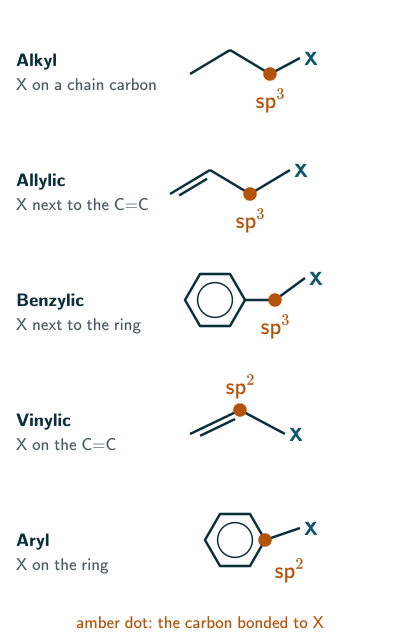
Haloalkanes and haloarenes are classified first by the number of halogen atoms (mono-, di- or polyhalogen compounds) and then by the carbon that carries the halogen. With an sp carbon they are alkyl halides, primary, secondary or tertiary by how many carbons that carbon carries, allylic halides (next to a C=C) or benzylic halides (next to an aromatic ring). With an sp carbon they are vinylic halides (on the C=C itself) or aryl halides (on the ring).
With your textbook
NCERT Chemistry Part II (Class 12), Chapter 6 “Haloalkanes and Haloarenes”, Section 6.1 “Classification”, pages 160–161.
Open the official NCERT chapter (PDF, 4.3 MB, ncert.nic.in) (opens in a new tab)
Checked against the 2026-27 reprint on .
How are haloalkanes and haloarenes classified?
Haloalkanes and haloarenes
Replacing hydrogen atoms of an aliphatic or aromatic hydrocarbon by halogen atoms gives an alkyl halide (haloalkane) or an aryl halide (haloarene). In a haloalkane the halogen is attached to an sp3 carbon of an alkyl group; in a haloarene, to an sp2 carbon of an aryl group (NCERT Unit 6, Introduction, page 159). Haloalkanes are graded further by the carbon that carries the halogen:
If halogen is attached to a primary carbon atom in an alkyl halide, the alkyl halide is called primary alkyl halide or 1° alkyl halide.
NCERT Chemistry Part II (Class 12), Section 6.1, page 160
In plain words: classify by counting the halogens, then by the carbon that holds the halogen: an sp3 carbon (alkyl, allylic or benzylic) or an sp2 carbon (vinylic or aryl). The second split matters most, because it decides how easily the halogen can be replaced (NCERT pages 174 and 181).
On the basis of number of halogen atoms
- Compounds with one, two or more halogen atoms are mono-, di- or polyhalogen (tri-, tetra- and so on) compounds (NCERT Section 6.1.1, page 160).
- NCERT’s examples: C2H5X (a monohaloalkane), XCH2CH2X (a dihaloalkane), XCH2CHXCH2X (a trihaloalkane), and benzene rings carrying one, two or three halogen atoms (mono-, di- and trihaloarenes) (NCERT page 160).
- Monohalogen compounds are classified further by the hybridisation of the carbon bonded to the halogen (NCERT page 160).
Compounds containing sp C–X bond (X = F, Cl, Br, I)
- Alkyl halides, R–X. The halogen is bonded to an alkyl group. They form a homologous series, CnH2n+1X, and are primary (1°), secondary (2°) or tertiary (3°) according to the carbon that carries the halogen (NCERT page 160).
- Allylic halides. The halogen is on an sp3 carbon next to a C=C double bond, an allylic carbon: for example CH2=CH–CH2X (NCERT page 160).
- Benzylic halides. The halogen is on an sp3 carbon attached to an aromatic ring: C6H5CH2X is 1°; replacing one or both hydrogens of the CH2 by CH3 gives 2° and 3° benzylic halides (NCERT pages 160–161).
| Class of alkyl halide | Halogen carbon carries | Example |
|---|---|---|
| Primary (1°) | one other carbon | CH3CH2Br |
| Secondary (2°) | two other carbons | (CH3)2CHCl |
| Tertiary (3°) | three other carbons | (CH3)3CBr |
CH3X has no other carbon on the halogen carbon; NCERT treats methyl halides apart from 1°, as the fastest in SN2 (NCERT page 172).
Compounds containing sp C–X bond
- Vinylic halides. The halogen is bonded to an sp2 carbon of a C=C double bond: for example CH2=CH–X (NCERT Section 6.1.3, page 161).
- Aryl halides. The halogen is bonded directly to an sp2 carbon of an aromatic ring: C6H5X, or a ring that also carries other groups, such as CH3C6H4X (NCERT page 161).
- Allylic against vinylic. In CH2=CH–CH2Cl the chlorine is on the sp3 carbon next to the double bond (allylic); in CH2=CHCl it is on a carbon of the double bond itself (vinylic) (reasoned from NCERT pages 160–161).
Solved examples
Example 1: Primary, secondary or tertiary?
Classify (i) CH3CH2CH2Br, (ii) CH3CHBrCH3 and (iii) (CH3)3CCl.
Answer: Count the carbons bonded to the carbon that carries the halogen. (i) One: 1°. (ii) Two: 2°. (iii) Three: 3° (NCERT page 160; reasoned).
Example 2: Allylic, benzylic, vinylic or aryl?
Classify (i) CH2=CHCH2Cl, (ii) C6H5CH2Cl, (iii) CH2=CHCl and (iv) C6H5Cl.
Answer: (i) Cl on an sp3 carbon next to C=C: allylic. (ii) Cl on an sp3 carbon next to the ring: benzylic (1°). (iii) Cl on an sp2 carbon of C=C: vinylic. (iv) Cl on a ring carbon: aryl (NCERT pages 160–161; reasoned).
Common mistakes to avoid
Common mistake
Confusing allylic with vinylic
Allylic means next to the double bond (an sp3 carbon); vinylic means on the double bond (an sp2 carbon).
Common mistake
Calling neo-pentyl bromide tertiary
In (CH3)3CCH2Br the bromine is on the CH2 carbon, which is bonded to one carbon: 1°. The quaternary carbon next to it does not count (NCERT Example 6.1, page 163).
Common mistake
Calling benzyl chloride an aryl halide
In C6H5CH2Cl the chlorine is on the CH2 carbon, which is sp3: it is a benzylic halide, not an aryl halide.
Quick revision summary
- By number of halogens: mono-, di-, polyhalogen compounds.
- sp C–X: alkyl (1°, 2°, 3°; CHX), allylic (next to C=C), benzylic (next to a ring).
- sp C–X: vinylic (on C=C), aryl (on the ring).
Formula sheet
- Alkyl halides: CHX
- 1°, 2°, 3°: the halogen carbon carries one, two or three other carbons
Questions students ask
What is the difference between haloalkanes and haloarenes?
Haloalkanes (alkyl halides) have the halogen on an sp3 carbon of an alkyl group, R–X, while haloarenes (aryl halides) have it on an sp2 carbon of an aromatic ring, Ar–X (NCERT pages 159–161): 2-iodobutane is a haloalkane and bromobenzene a haloarene. The two behave differently: haloalkanes are made from alcohols and readily undergo nucleophilic substitution, while haloarenes cannot be made from phenols that way, are made from arenes or aromatic amines, and resist nucleophilic substitution (NCERT pages 164, 166, 170 and 181).
What is the difference between allylic and benzylic halides?
Allylic and benzylic halides both have the halogen on an sp3 carbon next to a π system: in an allylic halide that carbon is next to a C=C double bond, CH2=CH–CH2X, and in a benzylic halide it is attached to an aromatic ring, C6H5CH2X (NCERT page 160). Both are graded 1°, 2° or 3° by the carbons bonded to that carbon, the C=C or ring carbon included: (CH3)2C(Cl)CH=CH2 is a 3° allylic chloride (reasoned). Both also react fast by SN1 (NCERT page 174).
What is the difference between vinylic and aryl halides?
Vinylic and aryl halides both have the halogen on an sp2 carbon, but in a vinylic halide it is a carbon of a C=C double bond, CH2=CH–X, and in an aryl halide a carbon of an aromatic ring, C6H5X (NCERT page 161). The rest differs too: a vinylic halide’s C=C can still add bromine like an alkene, while an aryl halide’s ring keeps its aromatic stability and undergoes electrophilic substitution (reasoned). What they share is a C–X bond with partial double bond character, so neither gives up its halogen easily to nucleophiles (reasoned from NCERT pages 181–182).
Is a vinyl halide the same as a vinylic halide?
Strictly, a vinyl halide is CH2=CH–X, as in vinyl chloride (chloroethene), while vinylic halide is the whole class with the halogen on a doubly bonded carbon (NCERT page 161; Table 6.1, page 162). NCERT also uses the short names for whole classes: its Exercise 6.1 (page 189) asks for halides to be classed as alkyl, allyl, benzyl, vinyl or aryl, so 2-chloropropene, CH2=C(Cl)CH3, is vinylic and a vinyl halide only in that loose sense (reasoned). Likewise allyl bromide, CH2=CHCH2Br, is one of many allylic halides, which include 3-chlorobut-1-ene, CH2=CHCH(Cl)CH3, a 2° allylic chloride (reasoned).
Which chapter is haloalkanes and haloarenes, and is classification in the JEE Main 2027 and NEET (UG) 2026 syllabuses?
Haloalkanes and haloarenes is Unit 6 of NCERT Class 12 Chemistry Part II, the book’s first unit in the 2026–27 reprint, and Unit 16, Organic Compounds Containing Halogens, of both JEE Main 2027 and NEET (UG) 2026. Unit 16 lists preparation, properties and reactions, the nature of the C–X bond, substitution mechanisms, and the uses and environmental effects of chloroform, iodoform, freons and DDT, but not classification. The nearest line is in Unit 14 of both: “classification of organic compounds based on functional groups and those containing halogens, oxygen, nitrogen and sulphur” (JEE Main 2027 wording); neither syllabus names the 1°, 2°, 3°, allylic, benzylic, vinylic or aryl classes.
Practice questions
Try each question first, then open the answer to check your working.
-
Q1. Classify (i) (CH3)2CHCH2Cl and (ii) CH3CH2C(CH3)2Br as 1°, 2° or 3°.
Show answerHide answer
(i) The CH2Cl carbon carries one other carbon: 1°. (ii) The carbon with Br carries three other carbons: 3° (reasoned).
-
Q2. Is CH2=CHCH2CH2Br allylic?
Show answerHide answer
No. The bromine is on the second carbon from the double bond, not the one next to it, so it is not allylic: its sp3 carbon carries one other carbon, so it is classed as 1°, like an alkyl halide (reasoned from NCERT page 160).