Preparation of haloarenes
NCERT Class 12 Chemistry Chapter 6 Section 6.5
Quick answer
Aryl chlorides and bromides are made by electrophilic substitution of an arene with chlorine or bromine in the presence of a Lewis acid such as iron or iron(III) chloride; toluene gives ortho and para isomers, which are separated by their melting points. Iodination is reversible and needs an oxidising agent such as HNO or HIO, and fluorine is too reactive for this method. In Sandmeyer’s reaction a primary aromatic amine is diazotised with NaNO in cold mineral acid (273–278 K); cuprous chloride or bromide then replaces the diazonium group by Cl or Br, and KI alone gives the iodide.
With your textbook
NCERT Chemistry Part II (Class 12), Chapter 6 “Haloalkanes and Haloarenes”, Section 6.5 “Preparation of Haloarenes”, pages 166–167.
Open the official NCERT chapter (PDF, 4.3 MB, ncert.nic.in) (opens in a new tab)
Checked against the 2026-27 reprint on .
How are haloarenes prepared?
Preparation of haloarenes
Haloarenes are made in two ways: by electrophilic substitution of a hydrogen on the ring with chlorine or bromine, and from aromatic amines through a diazonium salt (Sandmeyer’s reaction). NCERT describes the first:
Aryl chlorides and bromides can be easily prepared by electrophilic substitution of arenes with chlorine and bromine respectively in the presence of Lewis acid catalysts like iron or iron(III) chloride.
NCERT Chemistry Part II (Class 12), Section 6.5, page 166
In plain words: you cannot make chlorobenzene from phenol the way you make chloroethane from ethanol, so a halogen is put on the ring directly with a Lewis acid catalyst, or an –NH2 group is first turned into a diazonium group, which then leaves as nitrogen gas and is replaced by the halogen.
Why not from phenols: the C–O bond of a phenol has partial double bond character and is too strong to break with HX, PCl5 or SOCl2 (NCERT Section 6.4.1, page 164).
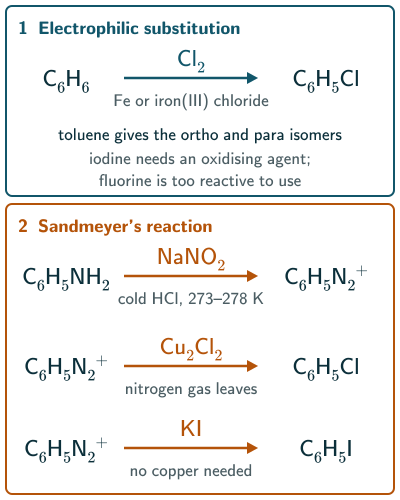
Electrophilic substitution in arenes
- Chlorination and bromination. An arene reacts with Cl2 or Br2 in the presence of iron or iron(III) chloride, a Lewis acid (NCERT page 166); for benzene, C6H6 + Cl2 → C6H5Cl + HCl. The Lewis acid helps form the electrophile that attacks the ring, as in the electrophilic substitution of benzene in Class 11 (NCERT Class 11 Chemistry, Unit 9, Hydrocarbons).
- Toluene gives two isomers. Toluene with X2, iron and in the dark gives o-halotoluene and p-halotoluene (NCERT page 166): the CH3 group is ortho and para directing (NCERT Class 11 Chemistry, Unit 9). The dark keeps chlorine off the CH3 group, which in light would be substituted by free radicals (reasoned).
- Separating them. The ortho and para isomers are easily separated because their melting points differ widely (NCERT page 166). The para isomer melts higher: its symmetry fits the crystal lattice better (NCERT Section 6.6, page 168).
- Iodine. Iodination is reversible, so an oxidising agent such as HNO3 or HIO4 is added to oxidise the HI formed (NCERT page 166). Removing HI stops the reverse reaction (reasoned).
- Fluorine. Fluoro compounds are not prepared this way, because fluorine is too reactive (NCERT page 166).
Sandmeyer’s reaction
Step 1: the diazonium salt. A primary aromatic amine, dissolved or suspended in cold aqueous mineral acid, is treated with sodium nitrite, at 273–278 K (NCERT page 166):
- C6H5NH2 + NaNO2 + 2HCl → C6H5N2+Cl− + NaCl + 2H2O, giving benzenediazonium chloride (NCERT Unit 9, Amines, Section 9.7, page 274).
- The solution must be cold and used fresh: arenediazonium salts are stable only for a short time in solution at 273–278 K, so the salt is used immediately after it is made (NCERT Unit 9, Amines, page 274).
Step 2: replacing the diazonium group. In NCERT’s words:
Mixing the solution of freshly prepared diazonium salt with cuprous chloride or cuprous bromide results in the replacement of the diazonium group by –Cl or –Br.
NCERT Chemistry Part II (Class 12), Section 6.5, page 166
- C6H5N2+Cl− with Cu2Cl2 gives C6H5Cl + N2; the diazonium bromide with Cu2Br2 gives C6H5Br + N2. NCERT writes the cuprous halide as Cu2X2 (page 166).
- Iodine needs no copper. Shaking the diazonium salt with potassium iodide gives iodobenzene and N2 (NCERT page 166).
- Related routes in NCERT’s Unit 9, Amines (page 275). Chlorine or bromine can also be introduced with the halogen acid and copper powder (the Gattermann reaction; NCERT prints both “Gatterman” and “Gattermann” on page 275), though Sandmeyer’s reaction gives the better yield. A fluoride comes from the diazonium fluoroborate, precipitated with fluoroboric acid and then heated.
| Halogen wanted | Reagent with the diazonium salt |
|---|---|
| Cl | Cu2Cl2 (Sandmeyer) |
| Br | Cu2Br2 (Sandmeyer) |
| I | KI, no copper |
| F | HBF4, then heat (Unit 9, Amines) |
Solved examples
Example 1: Bromobenzene from aniline
How much bromobenzene can be made from 9.31 g of aniline (93.1 g mol−1) by Sandmeyer’s reaction, (i) at most and (ii) at a 70% yield? (Bromobenzene, 157 g mol−1.)
Answer: 9.31/93.1 = 0.100 mol of aniline gives at most 0.100 mol of C6H5Br, one for one through the diazonium salt. (i) 0.100 × 157 = 15.7 g. (ii) 0.70 × 15.7 = 10.99, about 11.0 g (reasoned from NCERT page 166).
Example 2: Choosing the reagent
Starting from benzenediazonium chloride, which reagent gives (i) chlorobenzene, (ii) iodobenzene?
Answer: (i) Cuprous chloride, Cu2Cl2 (Sandmeyer’s reaction). (ii) Potassium iodide; no cuprous halide is needed (NCERT page 166).
Example 3: Chlorinating toluene
Toluene is treated with chlorine in the presence of iron in the dark. Name the products and say how they are separated.
Answer: 2-Chlorotoluene (o-chlorotoluene) and 4-chlorotoluene (p-chlorotoluene), because CH3 directs to the ortho and para positions. They are separated by their very different melting points; the para isomer melts higher (NCERT pages 166 and 168).
Example 4: Why not iodine or fluorine directly?
Why is benzene not iodinated with I2 alone, and not fluorinated with F2?
Answer: Iodination is reversible (NCERT page 166): the HI formed can turn the iodoarene back into benzene, so an oxidising agent (HNO3 or HIO4) is added to remove it (reasoned). Fluorine is too reactive for this method (NCERT page 166).
Common mistakes to avoid
Common mistake
Making chlorobenzene from phenol with HCl
The alcohol methods fail for phenols because the C–O bond has partial double bond character (NCERT page 164). Use direct chlorination or Sandmeyer’s reaction.
Common mistake
Adding cuprous iodide to make iodobenzene
For –I, potassium iodide alone is shaken with the diazonium salt; Cu2Cl2 or Cu2Br2 is used only for –Cl and –Br.
Common mistake
Diazotising at room temperature
The diazonium salt is made at 273–278 K and used at once: it is stable only for a short time even in the cold.
Common mistake
Chlorinating toluene in sunlight
With iron in the dark the ring is chlorinated, giving o- and p-chlorotoluene (NCERT page 166). In light and without the catalyst, chlorine attacks the CH3 group by free radicals instead: NCERT notes that “side chain chlorination of toluene gives benzal chloride” (Unit 8, Aldehydes, Ketones and Carboxylic Acids, page 233). Its Intext Question 6.5 (ii) (page 167) also brominates an alkyl side chain with Br2 under heat or UV light.
Quick revision summary
- Aryl chlorides and bromides: arene + Cl2 or Br2 with Fe or FeCl3 (a Lewis acid); toluene gives o- and p-isomers, separated by their melting points.
- Iodination is reversible and needs an oxidising agent (HNO3, HIO4); fluorination is not used, as fluorine is too reactive.
- Sandmeyer: ArNH2 + NaNO2 + mineral acid at 273–278 K gives ArN2+X−; with Cu2Cl2 or Cu2Br2 it gives ArCl or ArBr and N2; KI alone gives ArI.
- Phenols do not give aryl halides with HX, PCl5 or SOCl2.
Formula sheet
- CH + Cl (Fe or FeCl) → CHCl + HCl
- CHNH + NaNO + 2HCl (273–278 K) → CHNCl + NaCl + 2HO
- CHNCl (CuCl) → CHCl + N
- CHNCl + KI → CHI + KCl + N
Questions students ask
What is the difference between the Sandmeyer and Gattermann reactions?
The Sandmeyer and Gattermann reactions both replace the diazonium group of a diazonium salt by –Cl or –Br, but Sandmeyer’s reaction uses a copper(I) halide, while the Gattermann reaction uses HCl or HBr with copper powder (NCERT Unit 9, page 275). NCERT adds that Sandmeyer’s reaction gives the better yield and, with Cu(I), can also bring in –CN (page 275). Neither is the Gattermann–Koch reaction (Gatterman–Koch in NCERT, page 233), which turns benzene, CO and HCl, with anhydrous AlCl3 or CuCl, into benzaldehyde and puts no halogen on the ring.
What type of reaction is the Sandmeyer reaction, and what does the copper do?
The Sandmeyer reaction is a substitution on the aromatic ring in which a halide replaces the diazonium group, a very good leaving group, in the presence of Cu(I) (NCERT Unit 9, page 275). Beyond the NCERT text, copper(I) gives one electron to the diazonium ion, which loses N2 to leave an aryl radical; this radical is thought to take a halogen atom from the copper(II) halide, giving the haloarene and returning copper(I) (Wikipedia, “Sandmeyer reaction”). So it is a radical-nucleophilic aromatic substitution, not the SN1 or SN2 substitution of haloalkanes, which aryl halides resist.
What is the difference between diazotisation and the Sandmeyer reaction?
Diazotisation is the first stage of the route, turning a primary aromatic amine into its diazonium salt with nitrous acid (NCERT Unit 9, Amines, page 274), while the Sandmeyer reaction, strictly, is the second, replacing the diazonium group by –Cl, –Br or –CN with copper(I) (page 275). NCERT uses the name in two ways: Section 6.5 (page 166) calls the whole route from amines Sandmeyer’s reaction, iodination with KI included, while Unit 9 keeps it for the copper(I) replacements and lists the iodide (with KI) and the fluoride (through the fluoroborate) separately (page 275). Beyond the NCERT text, the fluoroborate route is the Balz–Schiemann reaction (Wikipedia, “Sandmeyer reaction”).
Why is the Sandmeyer reaction useful when arenes can be halogenated directly?
The Sandmeyer reaction is useful because the halogen goes exactly where the –NH2 group was, so it gives a single isomer, with no ortho–para mixture to separate, and it can put a halogen where direct substitution will not, such as meta to a methyl group, which directs ortho and para (reasoned from NCERT page 166). NCERT makes the same point about diazonium salts in Unit 9 (Section 9.10, pages 276–277). Its line on page 276 that aryl iodides cannot be made by direct halogenation is best read as “not easily”, page 275’s words, since Section 6.5 (page 166) does iodinate arenes when an oxidising agent removes the HI formed.
Which chapter has the Sandmeyer reaction, and is it in the JEE Main 2027 and NEET (UG) 2026 syllabuses?
The Sandmeyer reaction is in NCERT Class 12 Chemistry Part II twice: in Unit 6, Haloalkanes and Haloarenes, as a way to prepare haloarenes (Section 6.5, page 166), and in Unit 9, Amines, among the reactions of diazonium salts (page 275); the Class 11 books do not have it. JEE Main 2027 and NEET (UG) 2026 do not name it, but it falls under two of their lines: Unit 16, Organic Compounds Containing Halogens, lists “General methods of preparation”, and Unit 18, Organic Compounds Containing Nitrogen, lists “Diazonium Salts: Importance in synthetic organic chemistry”.
Practice questions
Try each question first, then open the answer to check your working.
-
Q1. Write the two steps that convert aniline into chlorobenzene, with conditions.
Show answerHide answer
(1) Aniline in cold dilute HCl with NaNO2 at 273–278 K gives benzenediazonium chloride. (2) The fresh solution mixed with cuprous chloride gives chlorobenzene and N2 (NCERT page 166).
-
Q2. Why is an oxidising agent such as HNO3 needed when benzene is iodinated?
Show answerHide answer
Iodination is reversible; the oxidising agent oxidises the HI formed, which drives the reaction forward (NCERT page 166).
-
Q3. Which haloarene cannot be prepared by direct halogenation with the X2/Fe method, and why?
Show answerHide answer
Fluorobenzene: fluorine is too reactive for this method (NCERT page 166). (Iodobenzene needs an oxidising agent as well.)
-
Q4. Name the catalyst used in the bromination of benzene, and the type of reaction.
Show answerHide answer
Iron or iron(III) chloride, a Lewis acid; the reaction is electrophilic substitution (NCERT page 166).