Preparation of haloalkanes
NCERT Class 12 Chemistry Chapter 6 Section 6.4
Quick answer
Haloalkanes are made mainly from alcohols, whose –OH group is replaced by a halogen using a concentrated halogen acid (with ZnCl for primary and secondary alcohols with HCl), PX, PCl or thionyl chloride; SOCl is preferred because its by-products SO and HCl escape as gases. Free radical halogenation of alkanes gives a mixture of isomers, while alkenes add HX by Markovnikov’s rule or add Br to give a vic-dibromide. Iodides are made by the Finkelstein reaction (NaI in dry acetone) and fluorides by the Swarts reaction (AgF, HgF, CoF or SbF).
With your textbook
NCERT Chemistry Part II (Class 12), Chapter 6 “Haloalkanes and Haloarenes”, Section 6.4 “Methods of Preparation of Haloalkanes”, pages 164–166.
Open the official NCERT chapter (PDF, 4.3 MB, ncert.nic.in) (opens in a new tab)
Checked against the 2026-27 reprint on .
How are haloalkanes prepared?
Methods of preparing haloalkanes
Haloalkanes are made in three main ways: from alcohols, by replacing the –OH group with a halogen; from hydrocarbons, by halogenating alkanes or adding hydrogen halides or halogens to alkenes; and by exchanging one halogen for another. NCERT names the reagents for the first route:
The hydroxyl group of an alcohol is replaced by halogen on reaction with concentrated halogen acids, phosphorus halides or thionyl chloride.
NCERT Chemistry Part II (Class 12), Section 6.4.1, page 164
In plain words: alkyl halides are best prepared from alcohols, which are easily accessible (NCERT prints this line on page 163, just before Section 6.4), and the reagent decides which halide you get and how clean it is. Alkanes give messy mixtures; alkenes give a predictable product; and an iodide or a fluoride is usually made from a chloride or bromide already in hand, because direct fluorination is too violent and direct iodination slow and reversible (NCERT Class 11 Chemistry, Unit 9, page 303).
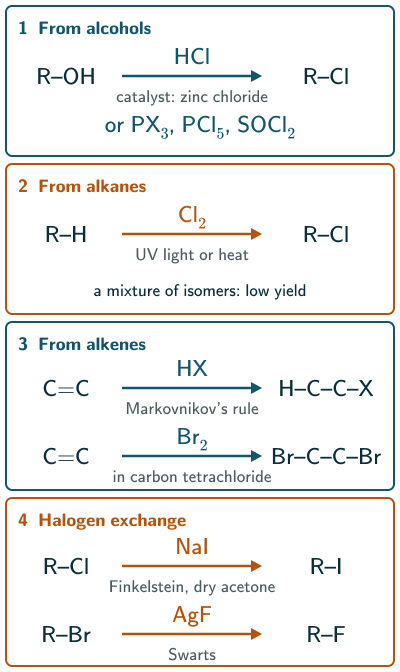
From alcohols
NCERT gives six ways of turning R–OH into R–X (page 164):
- R–OH + HCl → R–Cl + H2O, with ZnCl2 as catalyst for primary and secondary alcohols. A tertiary alcohol reacts just by shaking it with concentrated HCl at room temperature.
- R–OH + NaBr + H2SO4 → R–Br + NaHSO4 + H2O. NCERT also uses constant boiling HBr (48%) for alkyl bromides.
- 3R–OH + PX3 → 3R–X + H3PO3 (X = Cl, Br).
- R–OH + PCl5 → R–Cl + POCl3 + HCl.
- R–OH with red phosphorus and bromine or iodine gives R–Br or R–I: the PBr3 or PI3 is made in situ, in the reaction mixture.
- R–OH + SOCl2 → R–Cl + SO2 + HCl.
Why thionyl chloride is preferred. Both by-products, SO2 and HCl, are gases and escape, so the alkyl chloride is left pure (NCERT page 164). With PCl5 or PCl3 the product has to be separated from POCl3 or H3PO3 (reasoned).
Other details from NCERT (page 164).
- Alkyl chlorides are also made by passing dry HCl gas through a solution of the alcohol, or by heating the alcohol with concentrated aqueous halogen acid.
- Good yields of R–I come from heating the alcohol with sodium or potassium iodide in 95% orthophosphoric acid. NCERT Intext Question 6.2 (page 167) asks why sulphuric acid is not used: it is an oxidising acid and would oxidise the HI formed to iodine (reasoned).
- With a given halogen acid the order of reactivity of alcohols is 3° > 2° > 1°. A tertiary alcohol reacts fastest because it forms the most stable carbocation (reasoned from the SN1 mechanism, NCERT Section 6.7.1, pages 173–174).
Not for aryl halides. These methods cannot make an aryl halide from a phenol. In NCERT’s words:
The above methods are not applicable for the preparation of aryl halides because the carbon-oxygen bond in phenols has a partial double bond character and is difficult to break being stronger than a single bond.
NCERT Chemistry Part II (Class 12), Section 6.4.1, page 164
From hydrocarbons: free radical halogenation of alkanes
- An alkane reacts with chlorine or bromine in ultraviolet light or on heating, by the free radical chain met in Class 11 (NCERT Class 11 Chemistry, Unit 9).
- Every kind of hydrogen in the molecule can be replaced (reasoned), so the product is a complex mixture of isomeric mono- and polyhaloalkanes that is difficult to separate. The yield of any one compound is low (NCERT pages 164–165).
- NCERT’s example: butane with Cl2 in UV light or heat gives both 1-chlorobutane, CH3CH2CH2CH2Cl, and 2-chlorobutane, CH3CH2CHClCH3 (page 165).
- Counting the monochloro isomers. Group the hydrogens into sets that are alike by symmetry; each set gives one structural isomer. NCERT Example 6.3 (page 165) finds four sets in (CH3)2CHCH2CH3, so four monochloro isomers: (CH3)2CHCH2CH2Cl, 1-chloro-3-methylbutane; (CH3)2CHCH(Cl)CH3, 2-chloro-3-methylbutane; (CH3)2C(Cl)CH2CH3, 2-chloro-2-methylbutane; and CH3CH(CH2Cl)CH2CH3, 1-chloro-2-methylbutane (NCERT draws the structures; the names are ours).
From hydrocarbons: addition of hydrogen halides and halogens to alkenes
- Hydrogen halides. An alkene adds HCl, HBr or HI to give the alkyl halide (NCERT page 165). With an unsymmetrical alkene, two products are possible, and one predominates by Markovnikov’s rule: propene and HI give mainly 2-iodopropane, CH3CHICH3, with 1-iodopropane, CH3CH2CH2I, as the minor product (NCERT page 165).
- The peroxide effect. With HBr in the presence of a peroxide the addition runs the other way, giving 1-bromopropane from propene. Only HBr does this: with HCl or HI a peroxide changes nothing (NCERT Class 11 Chemistry, Unit 9, page 312; see the peroxide effect).
- NCERT Example 6.4 (page 167) uses both rules: styrene, C6H5CH=CH2, with HBr gives C6H5CHBrCH3; but-1-ene with HCl gives 2-chlorobutane, CH3CH2CHClCH3; and C6H5CH2CH=CH2 with HBr and a peroxide gives C6H5CH2CH2CH2Br.
- Halogens. Bromine in CCl4 adds across the double bond to give a colourless vic-dibromide: CH2=CH2 + Br2 → BrCH2–CH2Br. The reddish brown colour of bromine disappears, which is an important laboratory test for a double bond (NCERT page 165; NCERT Class 11 Chemistry, page 311, calls it reddish orange). The conditions matter: NCERT’s addition test uses Br2 in CCl4, and its Intext Question 6.5 (vi) (page 167) uses heat or UV light instead.
- NCERT slip (page 165): NCERT sends the reader to “Unit 13, Class XI” for Markovnikov’s rule. In the 2026–27 Class 11 book, hydrocarbons are Unit 9 and the rule is in its Section 9.3.5 (page 311). Page 165 itself says “Unit 9, Class XI” a few lines later, for the bromine test. In an exam, the rule is the same; only NCERT’s cross-reference is wrong.
Halogen exchange: Finkelstein and Swarts reactions
Finkelstein reaction: iodides. Alkyl iodides are often made from alkyl chlorides or bromides with NaI in dry acetone: R–X + NaI → R–I + NaX (X = Cl, Br) (NCERT page 165). NCERT explains why it goes well:
NaCl or NaBr thus formed is precipitated in dry acetone. It facilitates the forward reaction according to Le Chatelier’s Principle.
NCERT Chemistry Part II (Class 12), Section 6.4.3, page 165
- Removing a product pulls the reaction forward, as Le Chatelier’s principle predicts (reasoned).
Swarts reaction: fluorides. An alkyl chloride or bromide is heated with a metallic fluoride such as AgF, Hg2F2, CoF2 or SbF3: H3C–Br + AgF → H3C–F + AgBr. NCERT calls this the best way to make alkyl fluorides (pages 165–166).
| Reaction | Reagent | Product |
|---|---|---|
| Finkelstein | NaI in dry acetone | alkyl iodide |
| Swarts | AgF, Hg2F2, CoF2, SbF3 | alkyl fluoride |
Solved examples
Example 1: Gases from thionyl chloride
0.25 mol of butan-1-ol is converted completely into 1-chlorobutane with thionyl chloride. How many moles of gas are given off, and what volume do they fill at 273.15 K and 1 bar? (Molar volume 22.7 L mol−1.)
Answer: CH3CH2CH2CH2OH + SOCl2 → CH3CH2CH2CH2Cl + SO2 + HCl. Each mole of alcohol gives 1 mol SO2 and 1 mol HCl, so 0.25 mol gives 0.50 mol of gas, and 0.50 × 22.7 = 11.35 L, about 11.4 L. Both gases escape and leave the liquid 1-chlorobutane pure (NCERT pages 164 and 168; reasoned). Ethanol would be a poor choice: its product, ethyl chloride, is itself a gas at room temperature (NCERT page 168).
Example 2: How much phosphorus trichloride?
How many moles of PCl3 are needed to convert 0.60 mol of propan-1-ol into 1-chloropropane?
Answer: 3R–OH + PCl3 → 3R–Cl + H3PO3, so one PCl3 serves three alcohol molecules: 0.60/3 = 0.20 mol PCl3 (NCERT page 164; reasoned).
Example 3: Counting monochloro isomers
How many monochloro structural isomers does free radical chlorination of (i) pentane, CH3CH2CH2CH2CH3, and (ii) 2,2-dimethylbutane, (CH3)3CCH2CH3, give?
Answer: (i) Pentane has three sets of alike hydrogens: the two end CH3 groups, the two CH2 groups next to them, and the middle CH2. So 3 isomers: 1-, 2- and 3-chloropentane. (ii) The three CH3 groups on C2 are alike; then the CH2 and the end CH3; C2 has no hydrogen. So 3 isomers: 1-chloro-2,2-dimethylbutane, 3-chloro-2,2-dimethylbutane and 1-chloro-3,3-dimethylbutane (reasoned, by the method of NCERT Example 6.3, page 165; part (i) also answers NCERT Intext Question 6.4 (ii), page 167). (Counting stereoisomers as well, pentane gives 4 and 2,2-dimethylbutane 4: 2-chloropentane and 3-chloro-2,2-dimethylbutane each have a chiral carbon and exist as two enantiomers; NCERT pages 176–177.)
Example 4: Choosing the reaction
Name the reaction and the reagent that convert (i) 1-bromobutane into 1-iodobutane and (ii) 1-chloropropane into 1-fluoropropane.
Answer: (i) The Finkelstein reaction: NaI in dry acetone; NaBr precipitates and drives the reaction forward. (ii) The Swarts reaction: heat with a metallic fluoride such as AgF, Hg2F2, CoF2 or SbF3 (NCERT pages 165–166).
Common mistakes to avoid
Common mistake
Replacing a ring –OH along with an alcoholic –OH
In HOC6H4CH2OH (NCERT Intext Question 6.5 (iii), page 167, drawn as the para compound), HCl replaces only the –OH of the CH2OH group, giving HOC6H4CH2Cl. The ring –OH stays, because its C–O bond has partial double bond character (reasoned from NCERT page 164).
Common mistake
Expecting one product from free radical chlorination
Every set of alike hydrogens can be replaced, and further substitution gives polyhalides too, so the product is a mixture and the yield of any one compound is low.
Common mistake
Swapping Finkelstein and Swarts
Finkelstein makes iodides with NaI in dry acetone; Swarts makes fluorides with a metallic fluoride such as AgF or SbF3.
Common mistake
Using the peroxide effect with HCl or HI
Only HBr adds against Markovnikov’s rule when a peroxide is present. Propene with HI still gives mainly 2-iodopropane, peroxide or not (NCERT page 165; NCERT Class 11 Chemistry, Unit 9, page 312).
Common mistake
Putting primary alcohols first
With a halogen acid the order is 3° > 2° > 1°: tertiary alcohols react fastest, even without ZnCl2.
Quick revision summary
- Alcohols: HX (ZnCl2 for 1° and 2° alcohols with HCl), NaBr with H2SO4, PX3, PCl5, red P with Br2 or I2, or SOCl2; SOCl2 gives a pure product because SO2 and HCl escape.
- Reactivity of alcohols with a halogen acid: 3° > 2° > 1°. Phenols do not give aryl halides this way.
- Alkanes: free radical chlorination or bromination gives a mixture of isomers, so the yield of any one is low.
- Alkenes: HX adds by Markovnikov’s rule (against it only for HBr with a peroxide); Br2 in CCl4 gives a colourless vic-dibromide (test for C=C).
- Halogen exchange: Finkelstein (NaI, dry acetone) for iodides; Swarts (AgF, Hg2F2, CoF2, SbF3) for fluorides.
Formula sheet
- R–OH + HCl (ZnCl) → R–Cl + HO
- R–OH + SOCl → R–Cl + SO + HCl
- 3R–OH + PX → 3R–X + HPO
- R–OH + PCl → R–Cl + POCl + HCl
- R–X + NaI → R–I + NaX (dry acetone)
- HC–Br + AgF → HC–F + AgBr
- Reactivity of alcohols with HX: 3° > 2° > 1°
Questions students ask
Is the Finkelstein reaction SN1 or SN2?
The Finkelstein reaction is an SN2 reaction, a point beyond the NCERT text, which names it without a mechanism (page 165): the iodide ion replaces chloride or bromide in a single step, with no carbocation (Wikipedia, “Finkelstein reaction”). So it shares the SN2 order: it suits methyl and primary halides, is slower with secondary ones and hardly goes with tertiary ones, while vinylic and aryl halides, with the halogen on an sp2 carbon, do not react this way at all (reasoned from NCERT pages 172–173 and 181).
What is the role of anhydrous ZnCl2 in preparing haloalkanes from alcohols?
Zinc chloride, ZnCl2, is the catalyst that primary and secondary alcohols need to react with HCl, while a tertiary alcohol reacts with concentrated HCl alone at room temperature (NCERT page 164). Beyond the NCERT text, anhydrous zinc chloride is a Lewis acid (Wikipedia, “Zinc chloride”): it accepts a lone pair from the –OH oxygen, which weakens the C–O bond and lets that group leave more easily (reasoned). The same mixture of concentrated HCl and ZnCl2 is the Lucas reagent, which tells 1°, 2° and 3° alcohols apart by how fast they react.
What is constant boiling HBr, used for preparing alkyl bromides?
Constant boiling HBr is the hydrobromic acid that distils without changing its composition, the 48% acid NCERT names for preparing alkyl bromides (page 164). Beyond the NCERT text, it holds 47.63% HBr by mass and boils at 124.3 °C at atmospheric pressure (PubChem, Hazardous Substances Data Bank), above both water and hydrogen bromide, so it is a maximum boiling azeotrope, like nitric acid and water (reasoned). Boiling a weaker or a stronger solution leaves this mixture behind, so at a given pressure its strength is fixed and reproducible (reasoned).
Which chapter of Class 12 has the Finkelstein and Swarts reactions?
The Finkelstein and Swarts reactions are in Unit 6, Haloalkanes and Haloarenes, of NCERT Class 12 Chemistry Part II, as the halogen exchange methods of Section 6.4.3 (pages 165–166). The unit names five more: Sandmeyer’s reaction (page 166), the Wurtz reaction (page 181), the Friedel–Crafts reaction of haloarenes (page 185), and the Wurtz–Fittig and Fittig reactions (page 186). Unit 16 of the JEE Main 2027 and NEET (UG) 2026 syllabuses names none of them, covering them as general methods of preparation, properties and reactions.
Practice questions
Try each question first, then open the answer to check your working.
-
Q1. Write the equation for the reaction of an alcohol with PCl5, and say why SOCl2 is usually preferred.
Show answerHide answer
R–OH + PCl5 → R–Cl + POCl3 + HCl. With SOCl2 both by-products, SO2 and HCl, are gases that escape, so the alkyl chloride is obtained pure (NCERT page 164).
-
Q2. Arrange (CH3)3COH, CH3CH2OH and (CH3)2CHOH in order of increasing reactivity with HCl.
Show answerHide answer
CH3CH2OH (1°) < (CH3)2CHOH (2°) < (CH3)3COH (3°), since the order with a halogen acid is 3° > 2° > 1° (NCERT page 164).
-
Q3. What is the main product when 2-methylpropene, (CH3)2C=CH2, reacts with HBr in the absence of peroxide?
Show answerHide answer
2-Bromo-2-methylpropane, (CH3)3CBr: by Markovnikov’s rule the Br goes to the carbon with fewer hydrogens, the central carbon (reasoned from NCERT page 165 and Class 11 Unit 9).
-
Q4. Why does adding NaI in dry acetone to 2-chloropropane give a good yield of 2-iodopropane?
Show answerHide answer
NaCl is insoluble in dry acetone and precipitates. Removing a product favours the forward reaction (Le Chatelier’s principle), so the exchange gives a good yield (NCERT page 165).