Nature of the C–X bond in haloalkanes
NCERT Class 12 Chemistry Chapter 6 Section 6.3
Quick answer
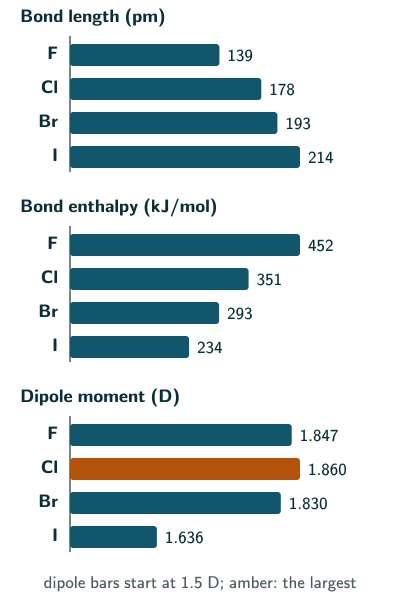
Halogens are more electronegative than carbon, so the carbon–halogen bond is polar, with a partial positive charge on carbon and a partial negative charge on the halogen. Down the group the halogen atom grows, so the C–X bond lengthens from C–F (139 pm) to C–I (214 pm) while its bond enthalpy falls from 452 to 234 kJ mol. The dipole moment is largest for CHCl (1.860 D), not CHF, because the C–F bond is so much shorter that it outweighs the larger partial charges on C–F.
With your textbook
NCERT Chemistry Part II (Class 12), Chapter 6 “Haloalkanes and Haloarenes”, Section 6.3 “Nature of C–X Bond”, pages 163–164.
Open the official NCERT chapter (PDF, 4.3 MB, ncert.nic.in) (opens in a new tab)
Checked against the 2026-27 reprint on .
What is the nature of the C–X bond?
The carbon–halogen bond
In a haloalkane the carbon–halogen bond is polar: the halogen pulls the shared electrons towards itself. NCERT states it directly:
Halogen atoms are more electronegative than carbon, therefore, carbon-halogen bond of alkyl halide is polarised; the carbon atom bears a partial positive charge whereas the halogen atom bears a partial negative charge.
NCERT Chemistry Part II (Class 12), Section 6.3, page 163
In plain words: the carbon attached to the halogen is slightly positive, Cδ+–Xδ−. That positive carbon is where electron-rich reagents (nucleophiles) attack (NCERT page 169), which is why so much of haloalkane chemistry is substitution at that carbon.
Polarity of the carbon–halogen bond
- Halogens are more electronegative than carbon, so the C–X bond is polarised, with δ+ on carbon and δ− on the halogen (NCERT page 163).
- The polar bond makes haloalkanes polar molecules with dipole moments of about 1.6 to 1.9 D for the methyl halides (NCERT Table 6.2, page 164).
Bond length, bond enthalpy and dipole moment
Down the group, the halogen atom gets larger, from fluorine (smallest) to iodine (largest), so the C–X bond gets longer from C–F to C–I (NCERT page 163). NCERT Table 6.2 (page 164) gives three columns for the four methyl halides; here they are split into two tables so that they fit a phone screen. Bond lengths and bond enthalpies:
| Bond | Bond length/pm | C–X bond enthalpy/kJ mol−1 |
|---|---|---|
| CH3–F | 139 | 452 |
| CH3–Cl | 178 | 351 |
| CH3–Br | 193 | 293 |
| CH3–I | 214 | 234 |
Dipole moments, from the same table:
| Bond | Dipole moment/Debye |
|---|---|
| CH3–F | 1.847 |
| CH3–Cl | 1.860 |
| CH3–Br | 1.830 |
| CH3–I | 1.636 |
- Length rises, strength falls. From C–F to C–I the bond lengthens by 75 pm and its enthalpy falls by 218 kJ mol−1: the longer bond is the weaker one (NCERT Table 6.2).
- The dipole moment peaks at Cl. CH3Cl, not CH3F, has the largest dipole moment. A dipole moment is charge × distance, μ = Q × r (NCERT Class 11 Chemistry, Unit 4, page 111). In C–F the partial charges are larger but closer together; in C–Cl they are smaller but 39 pm farther apart, and the longer bond wins (reasoned from the bond lengths in NCERT Table 6.2).
Solved examples
Example 1: Which bond breaks most easily?
Arrange C–F, C–Cl, C–Br and C–I in order of increasing bond enthalpy, and say which haloalkane should lose its halogen most easily when the C–X bond has to break.
Answer: C–I (234) < C–Br (293) < C–Cl (351) < C–F (452 kJ mol−1) (NCERT Table 6.2). The weakest bond, C–I, breaks most easily, so iodoalkanes react fastest when the bond to the halogen breaks (NCERT page 174 gives the same order, R–I > R–Br > R–Cl ≫ R–F, for both SN1 and SN2).
Example 2: Reading the dipole moments
Why is the dipole moment of CH3Cl (1.860 D) larger than that of CH3F (1.847 D)?
Answer: Fluorine is more electronegative, so the charges on C–F are larger, but the C–F bond (139 pm) is much shorter than C–Cl (178 pm). The dipole moment grows with both charge and distance, and here the longer bond more than makes up for the smaller charges (reasoned from NCERT Table 6.2).
Common mistakes to avoid
Common mistake
Expecting CH<sub>3</sub>F to have the largest dipole moment
Fluorine is the most electronegative, but the C–F bond is short; CH3Cl has the largest dipole moment of the four (NCERT Table 6.2).
Common mistake
Thinking the strongest bond is the longest
Bond length and bond enthalpy run opposite ways: C–F is the shortest and the strongest, C–I the longest and the weakest.
Common mistake
Thinking the more polar bond reacts faster
C–F carries the largest partial charges, since fluorine is the most electronegative halogen, yet CH3F is the least reactive methyl halide. In substitution the C–X bond must break, and C–F is the strongest (452 kJ mol−1). NCERT gives the order R–I > R–Br > R–Cl ≫ R–F for both SN1 and SN2 (NCERT page 174).
Quick revision summary
- The C–X bond is polar: Cδ+–Xδ−, because halogens are more electronegative than carbon.
- Down the group: bond length rises (139 → 214 pm), bond enthalpy falls (452 → 234 kJ mol).
- Dipole moments: CH3Cl 1.860 > CH3F 1.847 > CH3Br 1.830 > CH3I 1.636 D.
Formula sheet
- Bond length: C–F < C–Cl < C–Br < C–I
- Bond enthalpy: C–F > C–Cl > C–Br > C–I
- Dipole moment: CHCl > CHF > CHBr > CHI
Questions students ask
Is the C–X bond in haloalkanes ionic or covalent?
The C–X bond in a haloalkane is covalent but polar: carbon and the halogen share an electron pair unequally, so the halogen carries only a partial negative charge, δ−, not a full one (NCERT page 163). So a haloalkane does not give halide ions in water as a salt does, which is why carbon tetrachloride gives no silver chloride with silver nitrate. To test an organic compound for a halogen, the halogen is first turned into a halide ion by fusing the compound with sodium, as in Lassaigne’s test (NCERT Class 11 Chemistry, pages 284–285).
Is the C–I bond polar?
The C–I bond is polar, but it is the least polar carbon–halogen bond, because iodine is only slightly more electronegative than carbon. Beyond the NCERT text, PubChem gives Pauling electronegativities of 2.55 for carbon, 2.66 for iodine and 3.98 for fluorine, so iodine’s lead over carbon is less than a tenth of fluorine’s. NCERT Class 11 Chemistry’s older one-decimal values give carbon and iodine both 2.5 (Tables 3.8(a) and (b), page 91), which would suggest no polarity, so finer Pauling values are needed. Methyl iodide still has a dipole moment, 1.636 D, the smallest of the four methyl halides (NCERT Table 6.2, page 164).
Why is the C–F bond so strong?
The C–F bond is strong because fluorine is the smallest and most electronegative halogen: the bond is short, 139 pm in CH3F (NCERT Table 6.2, page 164), so the orbitals overlap well (reasoned), and, beyond the NCERT text, a bond between atoms of very different electronegativity is stronger than a purely covalent one, the extra energy from which Pauling built his electronegativity scale (Pauling, 1932). In NCERT Class 11 Chemistry’s table of mean bond enthalpies, C–F, at 439 kJ mol, beats even C–H, at 414 kJ mol (Table 5.3(a), page 154), which helps explain why the freons are so stable (reasoned).
How does the C–X bond in haloarenes differ from that in haloalkanes?
In haloarenes the C–X bond is shorter and harder to break than in haloalkanes: NCERT gives the C–Cl bond as 169 pm in a haloarene against 177 pm in a haloalkane (page 182; its Table 6.2 lists 178 pm for CH3–Cl). The carbon that carries the halogen is an sp2 ring carbon rather than an sp3 one, and the bond has partial double bond character (NCERT pages 181–182). Why these features make haloarenes so unreactive towards nucleophiles is explained under low reactivity of haloarenes.
Is the nature of the C–X bond in the JEE Main 2027 and NEET (UG) 2026 syllabuses?
Yes, the nature of the C–X bond is named in both syllabuses: Unit 16, Organic Compounds Containing Halogens, of JEE Main 2027 lists “General methods of preparation, properties and reactions, nature of C-X bond, mechanisms of substitution reactions”, and Unit 16 of NEET (UG) 2026 lists “Nature of C-X bond” among the same items, separated by semicolons. In NCERT it is Section 6.3 of Class 12 Chemistry Part II (pages 163–164): the polarity of the bond, and the bond lengths, bond enthalpies and dipole moments of the methyl halides in Table 6.2.
Practice questions
Try each question first, then open the answer to check your working.
-
Q1. Which carbon–halogen bond is the longest, and which has the highest bond enthalpy?
Show answerHide answer
C–I is the longest (214 pm); C–F has the highest bond enthalpy (452 kJ mol−1) (NCERT Table 6.2, page 164).
-
Q2. Which atom of the C–Br bond carries δ−, and which way does the chemists’ crossed arrow for its dipole point?
Show answerHide answer
Bromine carries δ− and carbon δ+, because bromine is more electronegative than carbon (NCERT page 163). The crossed arrow has its cross at carbon and its head at bromine, showing the shift of electron density. The dipole moment vector of physics runs the other way, from δ− (Br) to δ+ (C) (NCERT Class 11 Chemistry, Unit 4, page 111).