Bond parameters, resonance and polarity
NCERT Class 11 Chemistry Chapter 4 Section 4.3
Quick answer
Bond parameters describe bond length, angle, enthalpy and order; for comparable bonds, higher order usually means a shorter, stronger bond. Resonance represents one real structure using multiple Lewis contributors, while molecular polarity depends on the overall charge distribution and shape. CO has zero dipole moment, whereas bent HO has 1.85 D.
With your textbook
NCERT Chemistry Part I (Class 11), Chapter 4 “Chemical Bonding and Molecular Structure”, Section 4.3 “Bond Parameters”, pages 107–112.
Open the official NCERT chapter (PDF, 4.5 MB, ncert.nic.in) (opens in a new tab)
Checked against the 2026-27 reprint on .
What are bond parameters?
Bond parameters
Covalent bonds are described by a few measurable or derived quantities (NCERT Section 4.3, pages 107–112):
- bond length: the equilibrium distance between the nuclei of two bonded atoms;
- bond angle: the angle between two bond directions joining three nuclei;
- bond enthalpy: the energy needed to break one mole of a given bond in the gas phase;
- bond order: the number of bonds between two atoms (1, 2 or 3 in Lewis structures).
Two further ideas complete the picture: resonance, for molecules that no single Lewis structure describes, and polarity, the unequal sharing of electrons that gives bonds and molecules a dipole moment.
In plain words: once you know which atoms are bonded, you can ask how far apart they sit, at what angles, how hard the bond is to break and how many electron pairs it holds. For comparable bonds between the same kinds of atoms, higher bond order usually means a shorter, stronger bond. And when two atoms share electrons unequally, one end of the bond becomes slightly negative and the other slightly positive.
Bond length
Bond length is defined as the equilibrium distance between the nuclei of two bonded atoms in a molecule.
NCERT Chemistry Part I (Class 11), Section 4.3.1, page 107
Bond lengths are measured by spectroscopic, X-ray diffraction and electron diffraction methods. Each atom contributes to the bond length: for a covalent bond A–B, approximately R = rA + rB, where rA and rB are the covalent radii (NCERT Fig. 4.1, page 107). The covalent radius is half the distance between two similar atoms joined by a covalent bond. The van der Waals radius is the overall size of an atom, including its valence shell, when it is not bonded: half the distance between two similar atoms in separate molecules in a solid (page 107). For chlorine, the covalent radius is 99 pm and the van der Waals radius 180 pm (NCERT Fig. 4.2).
| Bond | Length (pm) | Bond | Length (pm) |
|---|---|---|---|
| C–C | 154 | C–O | 143 |
| C=C | 133 | C=O | 121 |
| C≡C | 120 | C≡N | 116 |
(Average values from NCERT Table 4.2, page 108. Molecules: H2 74, F2 144, Cl2 199, N2 109, O2 121, HCl 127 pm, from NCERT Table 4.3. NCERT’s 144 pm for F2 is high: the measured equilibrium bond length is 141 pm.)
Bond angle
The bond angle is the angle between the lines joining a central nucleus to two bonded nuclei in a molecule or complex ion. It is measured in degrees by spectroscopic methods and indicates how the orbitals are arranged, and so the shape of the molecule (NCERT Section 4.3.2, page 108). The H–O–H angle in water is 104.5°.
Bond enthalpy
Bond enthalpy is the energy needed to break one mole of bonds of a particular type between two atoms in the gaseous state, in kJ mol−1 (NCERT Section 4.3.3, page 108). The larger the bond dissociation enthalpy, the stronger the bond:
| Bond broken | ΔaH⊖ (kJ mol−1) |
|---|---|
| H–H in H2 | 435.8 |
| O=O in O2 | 498 |
| N≡N in N2 | 946.0 |
| H–Cl in HCl | 431.0 |
In a polyatomic molecule, equal bonds need different energies to break one after another, because the chemical environment changes. In water (page 109):
Breaking the two O–H bonds of water
H2O(g) → H(g) + OH(g): 502 kJ mol−1; OH(g) → H(g) + O(g): 427 kJ mol−1
So the mean (average) bond enthalpy is used: the total dissociation enthalpy divided by the number of bonds broken, (502 + 427) ÷ 2 = 464.5 kJ mol−1 for O–H in water. The same O–H bond also differs slightly between molecules, such as water and ethanol (page 109). Mean bond enthalpies are used to estimate reaction enthalpies (see bond enthalpy in thermodynamics).
Bond order
In the Lewis description of covalent bond, the Bond Order is given by the number of bonds between the two atoms in a molecule.
NCERT Chemistry Part I (Class 11), Section 4.3.4, page 109
H2, O2 and N2 have bond orders 1, 2 and 3; CO (a triple bond) has 3. N2, with bond order 3, has a dissociation enthalpy of 946 kJ mol−1, one of the highest for a diatomic molecule (page 109). The following isoelectronic diatomic examples have the same elementary bond order: F2 and O22− have 1; N2, CO and NO+ have 3.
A general correlation useful for understanding the stablities of molecules is that: with increase in bond order, bond enthalpy increases and bond length decreases.
NCERT Chemistry Part I (Class 11), Section 4.3.4, page 109
Carbon–carbon bonds show it: C–C 154 pm, C=C 133 pm, C≡C 120 pm.
Resonance structures
Sometimes no single Lewis structure matches the measured properties. Ozone can be drawn as structure I or II, each with one O–O single bond (normally 148 pm) and one O=O double bond (normally 121 pm). But both O–O bonds in O3 are measured at 128 pm: in between, and equal (NCERT Section 4.3.5, page 109).
According to the concept of resonance, whenever a single Lewis structure cannot describe a molecule accurately, a number of structures with similar energy, positions of nuclei, bonding and non-bonding pairs of electrons are taken as the canonical structures of the hybrid which describes the molecule accurately.
NCERT Chemistry Part I (Class 11), Section 4.3.5, page 109
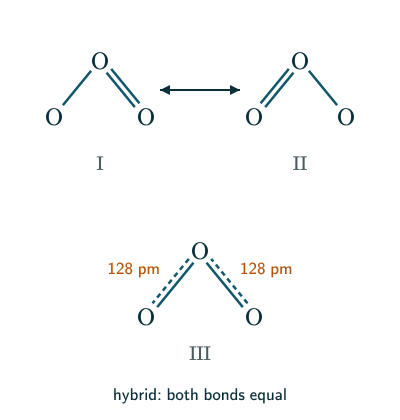
The real structure, the resonance hybrid, is more stable than any canonical form, and resonance averages out the bond properties (page 110). Other examples are the carbonate ion and carbon dioxide (Examples 2 and 3). NCERT lists common misconceptions to avoid (page 110):
- the canonical forms have no real existence;
- the molecule does not spend part of its time in one form and part in another;
- there is no equilibrium between canonical forms, unlike the keto and enol forms of tautomerism;
- the molecule has a single structure, the hybrid, which no single Lewis structure can show.
Polarity of bonds and dipole moment
Ionic and covalent descriptions are limiting models, and many bonds have mixed character (NCERT Section 4.3.6, page 110). When two identical atoms share a pair, as in H2, Cl2 or N2, the electron density is shared symmetrically: a nonpolar covalent bond. In HF, fluorine is far more electronegative than hydrogen, so the shared pair shifts towards fluorine: a polar covalent bond (page 111).
The polarity gives the molecule a dipole moment, μ, the product of the charge and the distance between the centres of positive and negative charge (page 111):
Dipole moment
μ = Q × r; 1 D = 3.33564 × 10⁻³⁰ C m
Dipole moments are usually given in debye (D), after Peter Debye. A dipole moment is a vector. In chemistry it is drawn as a crossed arrow (+→) on the Lewis structure: the cross at the positive end, the head at the negative end, showing the shift of electron density (page 111). This is opposite to the conventional dipole-moment vector, which runs from the negative to the positive centre (NCERT page 111).
In a useful approximate decomposition, the molecular dipole is the vector sum of bond and lone-pair contributions; bond dipoles alone often suffice for symmetric examples, so it depends on the shape (pages 111–112):
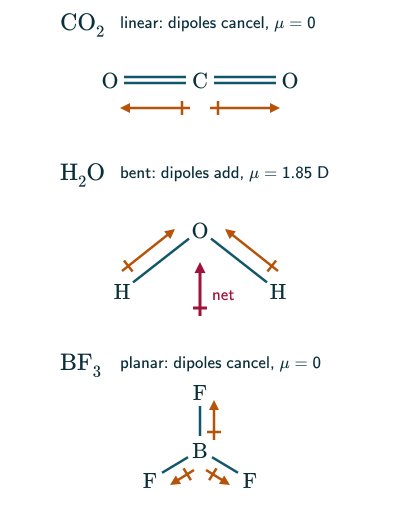
- H2O, bent at 104.5°: the two O–H dipoles add to 1.85 D = 1.85 × 3.33564 × 10−30 = 6.17 × 10⁻³⁰ C m.
- BeF2 (linear) and BF3 (trigonal planar, bonds at 120°): the bond dipoles cancel, so μ = 0.
- NH3 and NF3 are both pyramidal with a lone pair on N. In NH3 the lone-pair (orbital) dipole points the same way as the resultant of the N–H bond dipoles, so the moment is large: 1.47 D (4.90 × 10⁻³⁰ C m). In NF3 it points the opposite way and largely cancels the N–F resultant, though F is more electronegative than N: 0.23 D (page 112).
NCERT’s Table 4.5 (page 112) lists, among others, HF 1.78, HCl 1.07, HBr 0.79, HI 0.38, H2S 0.95 and CHCl3 1.04 D, and zero for H2, CO2, BF3, CH4 and CCl4. (Its text and figure give NF3 as 0.8 × 10⁻³⁰ C m, which is 0.24 D; the table’s 0.23 D is 0.77 × 10⁻³⁰ C m.)
Fajans’ rules: covalent character of ionic bonds
Just as all the covalent bonds have some partial ionic character, the ionic bonds also have partial covalent character.
NCERT Chemistry Part I (Class 11), Section 4.3.6, page 112
Fajans explained this partial covalent character with three rules (page 112):
- the smaller the cation and the larger the anion, the greater the covalent character;
- the greater the charge on the cation, the greater the covalent character;
- for cations of the same size and charge, one with an (n − 1)dn ns0 configuration, typical of transition metals, polarises more than one with a noble gas configuration, ns2 np6, typical of the alkali and alkaline earth metals.
So LiI is more covalent than LiF, AlCl3 more than MgCl2 and MgCl2 more than NaCl, and CuCl (Cu+, 3d10) more than NaCl (Na+, 2s2 2p6), though the two cations are similar in size.
The cation polarises the anion, pulling its electron cloud towards itself and building up electron density between the nuclei, as in a covalent bond. The polarising power of the cation, the polarisability of the anion and the extent of distortion decide the percentage of covalent character (page 112).
Solved examples
Example 1: Bond order with resonance
Find the C–O bond orders in CO, CO2 and CO32−, and the N–O bond orders in NO2− and NO3−. Arrange the C–O bonds by length.
For equivalent resonance contributors, a formal average bond order is the total bond count divided by the number of equivalent links; it is a model, not a direct measurement. CO: 3. CO2: 2 (each C=O). CO32−: 4 bonds over 3 links = 4/3. NO2−: 3 over 2 = 3/2. NO3−: 4 over 3 = 4/3. (By the same rule, SO42− drawn with two S=O and two S–O bonds gives the formal Lewis average 6/4 = 1.5; this does not prove localised S=O bonds.)
Answer: higher bond order means a shorter bond, so C–O length increases CO < CO2 < CO32−, and the N–O bond is longer in NO3− (4/3) than in NO2− (3/2).
Example 2: The carbonate ion (NCERT Problem 4.3, page 110)
Explain the structure of CO32− in terms of resonance.
A single Lewis structure with one C=O and two C–O bonds shows unequal bonds, but experiment shows all three C–O bonds are equivalent. So CO32− is a resonance hybrid of three canonical forms, with the double bond to a different oxygen in each.
Answer: a hybrid of three equivalent canonical forms; all three C–O bonds are identical (bond order 1⅓).
Example 3: Carbon dioxide (NCERT Problem 4.4, page 110)
The C–O bond length in CO2 is 115 pm, between a normal C=O (121 pm) and C≡O (110 pm). Explain.
No single Lewis structure gives this length, so CO2 is described as a hybrid of three canonical forms: O=C=O, and two forms with one C≡O and one C–O (with formal charges).
Answer: CO2 can be represented by these resonance contributors, as NCERT describes, but their total C–O bond count is four in every form, giving formal average order 2 per bond. Its short C–O length cannot be converted into an order between 2 and 3 by simple averaging: bond lengths also depend on the molecular environment.
Example 4: Dipole moments of isomers
Which of the dichlorobenzenes, and which form of 1,2-dichloroethene, has zero dipole moment?
The molecular moment is the vector sum of the C–Cl bond dipoles. In para-dichlorobenzene the two point in opposite directions and cancel; in ortho (60° apart) they add more than in meta (120° apart). In trans-1,2-dichloroethene the C–Cl dipoles are opposite and cancel; in cis they add.
Answer: para-dichlorobenzene and trans-1,2-dichloroethene have μ = 0; among the dichlorobenzenes, ortho > meta > para.
Example 5: Percentage ionic character of HCl (beyond the NCERT text)
HCl has a bond length of 127 pm and a dipole moment of 1.07 D. What dipole moment would it have if it were fully ionic, and what is its percentage ionic character?
Fully ionic: charges ±e at 127 pm, μ = 1.602 × 10−19 C × 127 × 10−12 m = 2.035 × 10⁻²⁹ C m = 6.10 D. Percentage ionic character = 1.07 ÷ 6.10 × 100 = 17.5%.
Answer: about 6.10 D for charges ±e; the dipole-based estimate of ionic character is 17.5%. This model-dependent percentage is not a unique decomposition of the quantum bond.
Common mistakes to avoid
Common mistake
Taking the N–O bond order in NO<sub>3</sub><sup>−</sup> as 2
One canonical form has an N=O bond, but in the hybrid all three N–O bonds are equal, with bond order 4/3.
Common mistake
Equating polar bonds with a polar molecule
CO2, BF3 and CCl4 have polar bonds, but their shapes make the bond dipoles cancel, so the molecules have zero dipole moment.
Common mistake
Expecting NF<sub>3</sub> to have the larger dipole moment
Fluorine is more electronegative, but in NF3 the lone-pair dipole opposes the N–F resultant, while in NH3 it adds. NH3 (1.47 D) beats NF3 (0.23 D).
Common mistake
Reading the crossed arrow backwards
In chemistry the cross marks the positive end and the head points to the negative end (H→F in HF). The physics dipole vector points the other way.
Quick revision summary
- Bond length R = rA + rB (covalent radii); van der Waals radius is larger (Cl: 99 and 180 pm).
- Bond angle: H–O–H in water 104.5°. Bond enthalpy: energy to break one mole of bonds in the gas phase; use the mean for polyatomic molecules (O–H in water 464.5 kJ mol−1).
- Bond order = number of bonds; higher bond order, higher bond enthalpy and shorter bond (C–C 154, C=C 133, C≡C 120 pm). Comparable valence-isoelectronic diatomics often have the same elementary bond-order count.
- Resonance: the hybrid of canonical forms is the real, more stable structure (O3, CO32−, CO2).
- Polar bonds and dipole moment μ = Q × r (1 D = 3.33564 × 10⁻³⁰ C m); the molecular moment is the vector sum of bond dipoles (CO2, BF3 zero; H2O 1.85 D; NH3 > NF3).
- Fajans’ rules: small, highly charged cations and large anions give ionic bonds more covalent character.
Formula sheet
- Approximate bond length R ≈ rA + rB
- Mean bond enthalpy = total dissociation enthalpy ÷ number of bonds
- μ = Q × r; 1 D = 3.33564 × 10 C m
- % ionic character = μ(observed) ÷ μ(fully ionic) × 100
- For comparable bonds, bond order ↑ usually means bond enthalpy ↑ and bond length ↓
Questions students ask
What is the SI unit of dipole moment?
The SI unit of dipole moment is the coulomb metre (C m), but molecular dipole moments are usually given in debye (D), where 1 D = 3.33564 × 10 C m. The debye suits molecules because their moments are tiny: charges of ±e (1.602 × 10 C) just 100 pm apart would give μ = 1.602 × 10 C m, or 4.80 D. Measured values are usually smaller, such as 1.85 D for water, because the charges on bonded atoms are only partial.
What is the difference between resonance and tautomerism?
Resonance structures differ only in the arrangement of electrons, have no separate existence and together describe one real molecule, the resonance hybrid, while tautomers are real isomers that differ in the position of an atom, usually hydrogen, and exist together in equilibrium. Propanone, CH3COCH3 (the keto form), is in equilibrium with a tiny amount of its enol, CH2=C(OH)CH3, a different compound with the hydrogen on oxygen; the canonical forms of ozone are not separate compounds at all. Resonance is shown with a double-headed arrow (↔) and tautomerism with equilibrium arrows (⇌).
What is the difference between dipole moment and polarisability?
Dipole moment measures a permanent separation of charge in a molecule (μ = Q × r), while polarisability measures how easily an electron cloud is distorted by an electric field or a nearby ion, which creates an induced dipole. HF has a permanent dipole moment of 1.78 D; an argon atom has none, but its electron cloud can still be polarised. In Fajans’ rules the polarisability of the anion works together with the polarising power of the cation: the large I− ion is far more polarisable than F−, which is why AgI is much more covalent, and much less soluble in water, than AgF.
Are Fajans’ rules in the JEE Main 2027 and NEET (UG) 2026 syllabuses?
Yes, Fajans’ rules are in both syllabuses: JEE Main 2027 and NEET (UG) 2026 list ‘Fajan’s rule’ under Unit 3, Chemical Bonding and Molecular Structure, next to electronegativity and dipole moment. In the NCERT Class 11 book they are a short passage at the end of Section 4.3.6 (Polarity of bonds, page 112) rather than a section of their own; they are named after Kazimierz Fajans, so ‘Fajans’ rules’ is the correct spelling. The rules compare covalent character, for example SnCl4 against SnCl2 or LiCl against KCl (the first of each pair is more covalent).
Practice questions
Try each question first, then open the answer to check your working.
-
Q1. How do you express the bond strength in terms of bond order (NCERT Exercise 4.9, page 134)?
Show answerHide answer
The higher the bond order, the stronger the bond: bond enthalpy increases and bond length decreases. N≡N (order 3, 946 kJ mol−1) is stronger than O=O (order 2, 498 kJ mol−1).
-
Q2. Although CO2 and H2O are both triatomic, H2O is bent and CO2 linear. Explain this on the basis of dipole moment (NCERT Exercise 4.15, page 134).
Show answerHide answer
CO2 has zero dipole moment although its C=O bonds are polar, so the two bond dipoles must cancel: the molecule is linear. H2O has a dipole moment of 1.85 D, so its O–H dipoles do not cancel: the molecule is bent.
-
Q3. Which of NH3 and NF3 has the higher dipole moment, and why (NCERT Exercise 4.23, page 134)?
Show answerHide answer
NH3 (1.47 D against 0.23 D). In NH3 the lone-pair dipole on N points the same way as the resultant of the N–H bond dipoles and adds to it; in NF3 it points opposite to the N–F resultant and largely cancels it.