Alkenes
NCERT Class 11 Chemistry Chapter 9 Section 9.3
Quick answer
Alkenes are unsaturated hydrocarbons with at least one C=C (CnH2n when there is one); the double bond is one σ bond plus one weaker π bond, so alkenes undergo electrophilic addition. HBr adds by Markovnikov’s rule, Br going to the carbon with fewer hydrogens, except with peroxide, when it adds the other way. Restricted rotation gives cis and trans isomers, and ozonolysis cuts the C=C into carbonyl compounds that show where it was.
With your textbook
NCERT Chemistry Part II (Class 11), Chapter 9 “Hydrocarbons”, Section 9.3 “Alkenes”, pages 306–314.
Open the official NCERT chapter (PDF, 3.3 MB, ncert.nic.in) (opens in a new tab)
Checked against the 2026-27 reprint on .
What are alkenes?
Alkenes
Alkenes are unsaturated hydrocarbons containing at least one double bond.
NCERT Chemistry Part II (Class 11), Section 9.3, page 306
- One C=C means two hydrogen atoms fewer than the alkane, so the general formula is CnH2n (NCERT page 306).
- The first stable member is ethene (ethylene), C2H4.
- Alkenes are also called olefins (oil forming), because ethene forms an oily liquid with chlorine.
In plain words: an alkene has one carbon–carbon bond that is double. Its second bond, the π bond, is weak and its electrons sit above and below the molecule, exposed. Reagents that want electrons attack it, and the π bond opens so that two new groups can add, one on each carbon. Almost every reaction of alkenes is an addition of this kind.
NCERT page 307 calls CH2 (CnH2n with n = 1) “methene”, the first member of the series with a very short life. That is misleading: an alkene needs a C=C, so it needs at least two carbons. CH2 is methylene (a carbene), a short-lived reactive species with no double bond, not an alkene.
Structure of the double bond
The C=C double bond consists of one strong σ bond and one weak π bond (NCERT Section 9.3.1, page 306):
- the σ bond (bond enthalpy about 397 kJ mol−1) forms by head-on overlap of sp2 hybrid orbitals;
- the π bond (about 284 kJ mol−1) forms by sideways overlap of the two 2p orbitals;
- the double bond is shorter (134 pm) than the C–C single bond (154 pm), and stronger as a whole (681 kJ mol−1, against 348 kJ mol−1 for the C–C bond of ethane), but its π part is the weaker of its two bonds.
Each doubly bonded carbon is sp2 hybridised, so the two carbons and the four atoms on them lie in one plane. In ethene the H–C=C angle is 121.7° and the H–C–H angle 116.6° (NCERT Fig. 9.5, page 307); the three angles at each carbon add to 360°. The same figure gives the C–H bond as 110 pm, while NCERT’s Unit 4 gives 108 pm, with angles of 117.6° and 121° (page 123). The measured values are about 109 pm, 117° (H–C–H) and 121° (H–C=C); both NCERT sets are within 2 pm and 1° of them.
Because the π electrons are loosely held, alkenes act as a source of mobile electrons and are easily attacked by reagents in search of electrons, the electrophilic reagents. This makes alkenes less stable, and far more reactive, than alkanes: by adding an electrophile they become single-bonded compounds.
Nomenclature
For IUPAC names, choose the longest chain that contains the double bond, number it from the end nearer the double bond, and replace the ending -ane of the alkane by -ene; the locant of the double bond is its lower-numbered carbon (NCERT Section 9.3.2, pages 306–307). The other IUPAC rules for substituents still apply.
| Structure | IUPAC name |
|---|---|
| CH3–CH=CH2 | Propene |
| CH3–CH2–CH=CH2 | But-1-ene |
| CH3–CH=CH–CH3 | But-2-ene |
| CH2=CH–CH=CH2 | Buta-1,3-diene |
| CH2=C(CH3)–CH3 | 2-Methylprop-1-ene |
| CH2=CH–CH(CH3)–CH3 | 3-Methylbut-1-ene |
With two or more double bonds, an a is added to the root and the number is given by di, tri, tetra: buta-1,3-diene, octa-1,3,5,7-tetraene. NCERT’s answers to Problem 9.7 use an older style (“2,8-Dimethyl-3, 6-decadiene”, “1,3,5,7 Octatetraene”, “2-n-Propylpent-1-ene”); the current forms are 2,8-dimethyldeca-3,6-diene, octa-1,3,5,7-tetraene and 2-propylpent-1-ene (Example 1).
Counting σ and π bonds. In an open-chain molecule every pair of bonded atoms is joined by exactly one σ bond, so the number of σ bonds is the number of atoms minus one. Each double bond adds one π bond (NCERT Problem 9.8).
Isomerism
Alkenes show both structural isomerism and geometrical isomerism (NCERT Section 9.3.3, pages 307–309).
Structural isomerism. Ethene and propene have only one structure each. C4H8 has three alkene structures: but-1-ene, CH2=CH–CH2–CH3; but-2-ene, CH3–CH=CH–CH3; and 2-methylprop-1-ene, CH2=C(CH3)–CH3. The first two differ only in the position of the double bond (position isomers); each of them and 2-methylprop-1-ene differ in the carbon chain (chain isomers). C5H10 has five structural alkenes (NCERT Problem 9.9; Example 2).
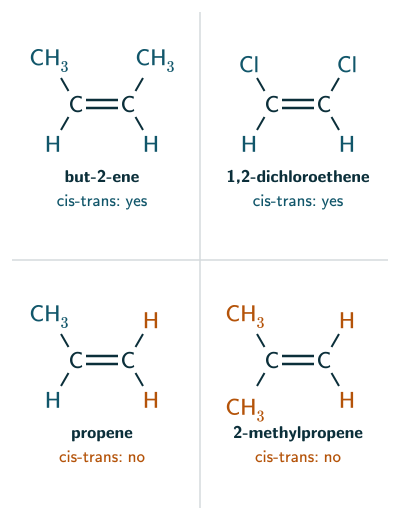
Geometrical isomerism. Each doubly bonded carbon joins two more atoms or groups. If the two on each carbon are different, as in XYC=CXY, the molecule can exist in two forms that differ in the arrangement of the groups in space, because rotation about the C=C bond is restricted (NCERT page 308): turning one carbon would twist the p orbitals apart and break the π bond.
Geometrical isomers
The stereoisomers of this type are called geometrical isomers.
NCERT Chemistry Part II (Class 11), Section 9.3.3, page 308
- cis isomer: the two identical atoms or groups lie on the same side of the double bond;
- trans isomer: they lie on opposite sides.
NCERT illustrates the restricted rotation with two pieces of cardboard joined by two nails: one cannot be turned against the other. Cis and trans isomers have the same structure but a different configuration, the arrangement of atoms in space, so they differ in melting point, boiling point, dipole moment and solubility.
But-2-ene. cis-But-2-ene boils at 277 K and trans-but-2-ene at 274 K (NCERT page 308). The cis form is more polar: its dipole moment is 0.33 D, while in the trans form the two C–CH3 bond dipoles point in opposite directions and cancel, so its dipole moment is almost zero (page 309). For solids, the trans isomer has the higher melting point, because its more symmetrical molecules pack better.
When is cis-trans isomerism possible? Alkenes of the types XYC=CXY, XYC=CXZ and XYC=CZW show it (NCERT page 309). It is impossible if either doubly bonded carbon carries two identical groups: propene, CH3CH=CH2, has two hydrogens on its CH2 carbon and so has no geometrical isomers.
Preparation
Alkenes are made by partial reduction of alkynes and by elimination reactions (NCERT Section 9.3.4, pages 309–310).
1. From alkynes. With a calculated amount of dihydrogen over palladised charcoal partially deactivated with poisons such as sulphur compounds or quinoline (Lindlar’s catalyst), alkynes stop at the alkene stage and give cis alkenes. This is NCERT’s description; the catalyst usually meant by the name is palladium on calcium carbonate (or barium sulphate) poisoned with lead acetate and quinoline. Reduction with sodium in liquid ammonia gives trans alkenes.
- RC≡CR′ + H2 → cis-RCH=CHR′ (Lindlar’s catalyst)
- RC≡CR′ → trans-RCH=CHR′ (Na in liquid NH3)
- HC≡CH + H2 → CH2=CH2; CH3C≡CH + H2 → CH3CH=CH2
NCERT asks whether the propene made this way shows geometrical isomerism: it does not, because its terminal carbon carries two hydrogens.
2. From alkyl halides: dehydrohalogenation. Heated with alcoholic potash (KOH dissolved in ethanol), an alkyl halide loses a molecule of halogen acid, HX, to form an alkene. The hydrogen leaves from the β-carbon, the carbon next to the one carrying the halogen, so this is a β-elimination reaction: CH3CH2X → CH2=CH2 + HX (alc. KOH, heat; X = Cl, Br, I). The rate depends on the halogen, iodine > bromine > chlorine, and on the alkyl group, tertiary > secondary > primary.
3. From vicinal dihalides: dehalogenation. Dihalides with the two halogens on adjacent carbons (vicinal dihalides) lose ZnX2 when treated with zinc:
- CH2BrCH2Br + Zn → CH2=CH2 + ZnBr2
- CH3CHBrCH2Br + Zn → CH3CH=CH2 + ZnBr2
4. From alcohols: acidic dehydration. Alcohols heated with concentrated sulphuric acid lose a water molecule. The –OH group takes a hydrogen from the β-carbon, so this is also a β-elimination: CH3CH2OH → CH2=CH2 + H2O (conc. H2SO4, heat). NCERT page 310 refers here to alcohols met “in Unit 12”; in the current book that is Unit 8.
Physical properties
Alkenes resemble alkanes in physical properties, apart from their types of isomerism and their slight polarity (NCERT Section 9.3.5, page 310):
- the first three members (C2 to C4) are gases, the next fourteen are liquids and the higher ones are solids;
- ethene is a colourless gas with a faint sweet smell; the other alkenes are colourless and odourless;
- they are insoluble in water but fairly soluble in non-polar solvents such as benzene and petroleum ether;
- the boiling point rises regularly with size, by 20–30 K for every –CH2 group, and straight-chain alkenes boil higher than their branched isomers.
Chemical properties
Alkenes are a rich source of loosely held π electrons, so they undergo addition reactions in which electrophiles add to the C=C. Some reagents add by a free radical mechanism, and oxidation and ozonolysis are also important (NCERT pages 310–314).
Addition of dihydrogen and halogens
Dihydrogen. With finely divided nickel, palladium or platinum, alkenes add one molecule of H2 to give alkanes (the hydrogenation described under the preparation of alkanes, NCERT Section 9.2.2).
Halogens. Bromine and chlorine add to form vicinal dihalides; iodine does not add under normal conditions:
- CH2=CH2 + Br2 → CH2Br–CH2Br (in CCl4; 1,2-dibromoethane)
- CH3CH=CH2 + Cl2 → CH3CHCl–CH2Cl (1,2-dichloropropane)
The reddish orange colour of bromine in carbon tetrachloride disappears as the bromine adds, which is used as a test for unsaturation. The addition is electrophilic and goes through a cyclic halonium ion, which NCERT leaves to higher classes.
Addition of hydrogen halides: Markovnikov’s rule
HCl, HBr and HI add to alkenes to form alkyl halides, with reactivity HI > HBr > HCl, again by electrophilic addition. A symmetrical alkene gives only one product: CH2=CH2 + HBr → CH3CH2Br, and but-2-ene gives 2-bromobutane.
An unsymmetrical alkene such as propene could give two products, 2-bromopropane or 1-bromopropane. In 1869 the Russian chemist Markovnikov generalised the result (NCERT page 311):
Markovnikov’s rule
The rule states that negative part of the addendum (adding molecule) gets attached to that carbon atom which possesses lesser number of hydrogen atoms.
NCERT Chemistry Part II (Class 11), Section 9.3.5, page 311
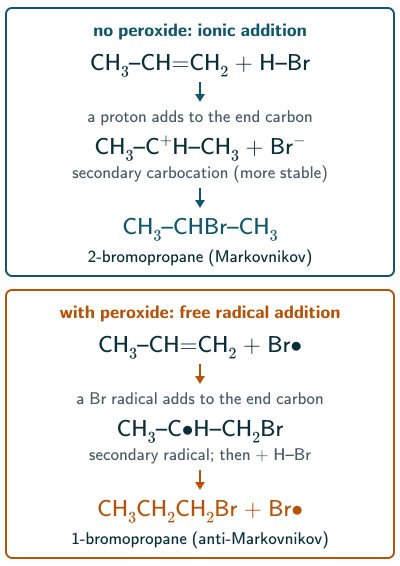
So propene and HBr give mainly 2-bromopropane, CH3CHBrCH3: the Br (the negative part) goes to the middle carbon, which has one hydrogen, not to the end carbon, which has two.
Mechanism. HBr provides the electrophile H+, which attacks the double bond to form a carbocation. Added to the end carbon, H+ leaves the positive charge on the middle carbon: a secondary carbocation, CH3C+HCH3. Added to the middle carbon, it leaves a primary carbocation, CH3CH2C+H2. The secondary carbocation is more stable (its alkyl groups release electrons by the inductive effect and hyperconjugation), so it forms faster and predominates. Br− then attacks it to give 2-bromopropane.
The peroxide effect
In the presence of a peroxide such as benzoyl peroxide, HBr adds to an unsymmetrical alkene against Markovnikov’s rule: propene gives 1-bromopropane, CH3CH2CH2Br (NCERT page 312). This is the peroxide effect, or Kharasch effect, observed by M. S. Kharasch and F. R. Mayo in 1933 at the University of Chicago (NCERT spells the name “Kharash”).
The mechanism is a free radical chain (NCERT page 312):
- benzoyl peroxide splits by homolysis, and the radicals formed lose CO2 to give phenyl radicals, C6H5•;
- C6H5• + H–Br → C6H6 + Br•;
- Br• adds to the end carbon of propene, giving the more stable secondary radical, CH3C•HCH2Br (adding to the middle carbon would give a less stable primary radical);
- CH3C•HCH2Br + H–Br → CH3CH2CH2Br + Br•, and the new Br• continues the chain.
In both mechanisms the more stable secondary intermediate forms. The products differ because H+ adds first in the ionic route and Br• adds first in the radical route.
Only HBr shows the peroxide effect. The H–Cl bond (430.5 kJ mol−1) is stronger than the H–Br bond (363.7 kJ mol−1) and is not broken by the free radical. The H–I bond is weaker (296.8 kJ mol−1), but iodine radicals combine to form I2 instead of adding to the double bond (NCERT page 312).
Addition of sulphuric acid and water
Cold concentrated sulphuric acid adds by electrophilic addition, following Markovnikov’s rule, to give alkyl hydrogen sulphates (NCERT pages 312–313):
- CH2=CH2 + H2SO4 → CH3CH2OSO2OH (ethyl hydrogen sulphate)
- CH3CH=CH2 + H2SO4 → CH3CH(OSO2OH)CH3
NCERT labels the second product “Propyl hydrogen sulphate”, but its structure has the –OSO2OH group on the middle carbon, as the rule requires: it is isopropyl (propan-2-yl) hydrogen sulphate.
With water and a few drops of concentrated sulphuric acid, alkenes form alcohols, again by Markovnikov’s rule: (CH3)2C=CH2 + H2O → (CH3)3COH (2-methylpropene to 2-methylpropan-2-ol).
Oxidation
- Cold, dilute, aqueous KMnO4, usually made slightly alkaline (Baeyer’s reagent) converts alkenes into vicinal glycols (diols): ethene gives ethane-1,2-diol (glycol) and propene gives propane-1,2-diol, CH3CH(OH)CH2OH. The purple colour of the permanganate disappears, which is a second test for unsaturation.
- Acidic KMnO4 or acidic K2Cr2O7 breaks the double bond and gives ketones and/or acids, depending on the alkene and the conditions: 2-methylpropene gives propanone, (CH3)2C=O, with CO2 and water; but-2-ene gives two molecules of ethanoic acid, CH3COOH (NCERT page 313). As a rule, a =CH2 end gives CO2 and water, a =CHR carbon gives the acid RCOOH, and a =CR2 carbon gives the ketone R2C=O.
Ozonolysis
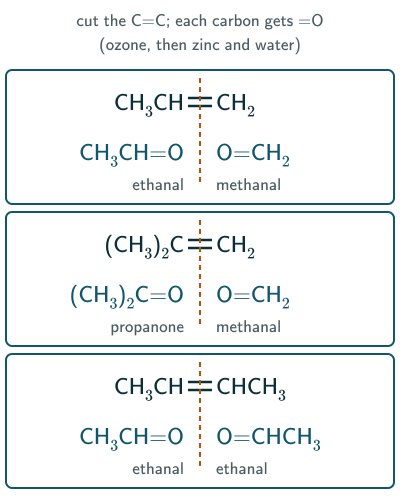
Ozone adds to an alkene to form an ozonide, which is then split by zinc and water (Zn–H2O) into smaller molecules (NCERT page 313). In effect the C=C is cut and each of its carbons becomes C=O, so the products show where the double bond was:
- propene, CH3CH=CH2 → CH3CHO (ethanal) + HCHO (methanal);
- 2-methylpropene, (CH3)2C=CH2 → (CH3)2C=O (propanone) + HCHO (methanal).
A carbon with two alkyl groups gives a ketone; a carbon with one hydrogen gives an aldehyde; a =CH2 end gives methanal.
Polymerisation
Polythene is made by joining a large number of ethene molecules at high temperature and pressure in the presence of a catalyst. The large molecules formed are polymers, the process is polymerisation, and the simple compounds they are made from are monomers (NCERT pages 313–314):
- n CH2=CH2 → –(CH2–CH2)n– (polythene)
- n CH3CH=CH2 → –(CH(CH3)–CH2)n– (polypropene)
NCERT lists plastic bags, squeeze bottles, refrigerator dishes, toys, pipes, and radio and TV cabinets among the uses of such polymers; polypropene is used for milk crates, plastic buckets and other moulded articles. NCERT adds that excessive use of polythene and polypropylene is a matter of great concern.
Solved examples
Example 1: Naming and counting bonds (NCERT Problems 9.7 and 9.8)
Name (a) (CH3)2CH–CH=CH–CH2–CH=CH–CH(C2H5)–CH3 and (b) CH2=C(CH2CH2CH3)2, and count their σ and π bonds.
(a) The longest chain containing both double bonds runs from a methyl of the isopropyl group through the ethyl group: ten carbons, double bonds at 3 and 6, methyls at 2 and 8. Formula C12H22: 34 atoms, so 33 σ bonds, and 2 π bonds.
(b) The chain must contain the double bond: CH2=C plus one propyl group, five carbons, with the other propyl group on carbon 2. Formula C8H16: 24 atoms, 23 σ bonds, 1 π bond.
Answer: (a) 2,8-dimethyldeca-3,6-diene, 33 σ and 2 π; (b) 2-propylpent-1-ene, 23 σ and 1 π.
Example 2: Alkene isomers of C<sub>5</sub>H<sub>10</sub> (NCERT Problem 9.9)
Write all the alkenes C5H10, including geometrical isomers.
Straight chain: pent-1-ene, CH2=CHCH2CH2CH3, and pent-2-ene, CH3CH=CHCH2CH3. Branched (a 2-methylbutane skeleton): 2-methylbut-1-ene, CH2=C(CH3)CH2CH3; 2-methylbut-2-ene, (CH3)2C=CHCH3; 3-methylbut-1-ene, CH2=CHCH(CH3)2. The 2,2-dimethylpropane skeleton has no C–C bond that can be double, because its central carbon already has four carbons. Only pent-2-ene has two different groups on each doubly bonded carbon.
Answer: five structural isomers; with cis- and trans-pent-2-ene, six alkenes in all.
Example 3: Which show cis-trans isomerism? (NCERT Problems 9.10 and 9.11)
(CH3)2C=CH–C2H5, CH2=CBr2, C6H5CH=CH–CH3, CH3CH=CClCH3, CHCl=CHCl.
Check each doubly bonded carbon: the first has two CH3 on one carbon, and CH2=CBr2 has two H on one carbon and two Br on the other. In the other three, every doubly bonded carbon carries two different groups.
Answer: C6H5CH=CHCH3, CH3CH=CClCH3 and CHCl=CHCl (cis- and trans-1,2-dichloroethene) show it; the first two do not.
Example 4: HBr with and without peroxide (NCERT Problem 9.12)
Name the products of HBr with hex-1-ene, CH2=CHCH2CH2CH2CH3, (a) without and (b) with a peroxide.
(a) Ionic addition, Markovnikov’s rule: Br goes to carbon 2, which has fewer hydrogens. (b) Peroxide effect: Br• adds to carbon 1 to give the secondary radical, so Br ends on carbon 1.
Answer: (a) 2-bromohexane, CH3CHBr(CH2)3CH3; (b) 1-bromohexane, BrCH2(CH2)4CH3.
Example 5: Working back from ozonolysis
An alkene C5H10 gives propanone and ethanal on ozonolysis. Identify it.
Join the two carbonyl carbons by a double bond and remove the oxygens: (CH3)2C=O and O=CHCH3 give (CH3)2C=CHCH3. Check: C3 + C2 = C5, and C5H10 fits one C=C.
Answer: 2-methylbut-2-ene.
Example 6: Choosing a preparation
Give a reagent that turns (a) (CH3)3CBr, (b) CH3CHBrCH2Br and (c) but-2-yne, CH3C≡CCH3, into an alkene, and name the alkene.
(a) Alcoholic KOH removes HBr (β-elimination): every β-hydrogen is on a CH3 group, so only (CH3)2C=CH2 forms. (b) Zinc removes ZnBr2 from the vicinal dibromide. (c) H2 over Lindlar’s catalyst gives the cis alkene; sodium in liquid ammonia would give the trans one.
Answer: (a) 2-methylpropene; (b) propene; (c) cis-but-2-ene.
Example 7: Telling an alkene from an alkane
How would you distinguish hexane from hex-1-ene?
Add a few drops of bromine in CCl4, or of cold, dilute alkaline KMnO4: hex-1-ene adds Br2 (or is oxidised to a diol), so the colour disappears; hexane has no π bond and the colour stays.
Answer: the reddish orange bromine colour (or the purple permanganate colour) disappears with hex-1-ene but not with hexane.
Common mistakes to avoid
Common mistake
Reading Markovnikov’s rule backwards
The negative part of the reagent (Br in HBr, OH in water, OSO2OH in H2SO4) goes to the carbon with fewer hydrogens; equivalently, the H goes to the carbon that already has more H.
Common mistake
Expecting a peroxide effect with HCl or HI
Only HBr adds against Markovnikov’s rule in the presence of peroxide. H–Cl is too strong to be broken by the radical; with HI the iodine radicals combine to I2.
Common mistake
Calling every disubstituted alkene a cis-trans pair
Test each doubly bonded carbon on its own: if either carries two identical groups (CH2=, (CH3)2C=, =CBr2), there are no geometrical isomers.
Common mistake
Mixing up Lindlar’s catalyst and sodium in liquid ammonia
Lindlar’s catalyst (poisoned palladium) gives the cis alkene; sodium in liquid ammonia gives the trans alkene.
Common mistake
Forgetting that a carbocation can rearrange
Beyond the NCERT text: a hydride or methyl shift can turn the carbocation into a more stable one. 3-Methylbut-1-ene with HBr gives 2-bromo-2-methylbutane as well as the expected 2-bromo-3-methylbutane, because the secondary carbocation rearranges to a tertiary one.
Common mistake
Writing “propyl hydrogen sulphate” for the product from propene
The group adds to the middle carbon (Markovnikov), so the product is isopropyl (propan-2-yl) hydrogen sulphate; NCERT’s label on page 313 says “Propyl”.
Quick revision summary
- Alkenes: CnH2n, at least one C=C; olefins. C=C = σ (sp2–sp2, 397 kJ mol−1) + π (sideways 2p, 284 kJ mol−1); 134 pm; planar, angles about 120°.
- Naming: longest chain with the C=C, lowest locant to the double bond, -ene; σ bonds = atoms − 1 in an open chain.
- Isomerism: chain and position isomers; geometrical (cis-trans) when each doubly bonded carbon has two different groups; cis-but-2-ene b.p. 277 K, μ = 0.33 D; trans 274 K, μ ≈ 0.
- Preparation: Lindlar (cis) or Na/liquid NH3 (trans) from alkynes; alc. KOH on RX (β-elimination; I > Br > Cl, 3° > 2° > 1°); Zn on vicinal dihalides; conc. H2SO4 on alcohols.
- Addition: H2 over Ni, Pd or Pt (catalytic, not electrophilic); electrophilic addition: X2 (bromine test), HX (HI > HBr > HCl), H2SO4, H2O/H+; Markovnikov’s rule through the more stable carbocation.
- Peroxide (Kharasch) effect: HBr only, free radical chain, anti-Markovnikov.
- Oxidation: Baeyer’s reagent → diols (test); acidic KMnO4 or K2Cr2O7 → ketones and acids; ozonolysis → aldehydes and ketones, locating the C=C; polymerisation → polythene, polypropene.
Formula sheet
- Alkenes CnH2n (one C=C); C=C = one σ bond + one π bond
- Open chain: σ bonds = number of atoms − 1; π bonds = number of double bonds
- Markovnikov: CH3CH=CH2 + HBr → CH3CHBrCH3; with peroxide → CH3CH2CH2Br
- Reactivity HI > HBr > HCl; dehydrohalogenation rate I > Br > Cl and 3° > 2° > 1°
- Ozonolysis: R2C=CHR′ → R2C=O + R′CHO
Questions students ask
Why are alkenes more reactive than alkanes?
Alkenes are more reactive than alkanes because their C=C bond contains a π bond, which is weaker than a σ bond (about 284 against 397 kJ mol in NCERT’s figures) and whose electrons lie above and below the plane of the molecule, open to attack. Electron-seeking reagents such as HBr and Br2 therefore add across the double bond under mild conditions, and turning one π bond into two new σ bonds releases energy. An alkane has only strong σ bonds, with its electrons held between the nuclei, so it reacts only under special conditions, such as light or a high temperature for halogenation, or a flame for burning.
What is the difference between Markovnikov and anti-Markovnikov addition?
In Markovnikov addition the negative part of the reagent goes to the doubly bonded carbon with fewer hydrogens, while in anti-Markovnikov addition it goes to the one with more; in the Class 11 book the only anti-Markovnikov case is HBr with a peroxide (the peroxide or Kharasch effect). 2-Methylpropene, (CH3)2C=CH2, and HBr give 2-bromo-2-methylpropane, (CH3)3CBr, through the tertiary carbocation, but with benzoyl peroxide they give 1-bromo-2-methylpropane, (CH3)2CHCH2Br, by a free radical chain in which Br• adds first. With a symmetrical alkene the two agree: hex-3-ene gives 3-bromohexane either way.
What is the difference between Markovnikov’s rule and Saytzeff’s rule?
Markovnikov’s rule predicts the main product when a reagent such as HBr adds to an unsymmetrical alkene, while Saytzeff’s (Zaitsev’s) rule predicts the main alkene formed when HX or water is eliminated: it is the more substituted alkene, with more alkyl groups on the doubly bonded carbons. So 3-bromo-2-methylpentane heated with alcoholic KOH gives mainly 2-methylpent-2-ene, with three alkyl groups on its C=C, and less 4-methylpent-2-ene, with two, because the hydrogen leaves mostly from the β-carbon that has fewer hydrogens. NCERT states Saytzeff’s rule only in Class 12, in the unit on haloalkanes, but it already applies to the dehydrohalogenation of alkyl halides in Class 11.
What is the difference between ozonolysis and the oxidation of alkenes by KMnO4?
Ozonolysis and oxidation by acidic KMnO4 both cut the C=C bond, but ozonolysis (with zinc and water) stops at aldehydes and ketones, while acidic KMnO4 turns each =CHR carbon into a carboxylic acid and a =CH2 end into CO2; a =CR2 carbon gives a ketone either way. Hex-3-ene, CH3CH2CH=CHCH2CH3, gives two molecules of propanal on ozonolysis but two of propanoic acid with acidic KMnO4, while cold, dilute alkaline KMnO4 (Baeyer’s reagent) does not cut it and gives hexane-3,4-diol. Ozonolysis also keeps methanal from a =CH2 end, so it locates a double bond better.
Why are alkenes called olefins?
Alkenes are called olefins, meaning ‘oil forming’, because ethene, the first alkene, was once known as olefiant (oil-making) gas: with chlorine it gives an oily liquid, 1,2-dichloroethane, CH2Cl–CH2Cl. The name spread from ethene to the whole family, just as alkanes are called paraffins (Latin parum affinis, ‘little affinity’) for their low reactivity. Industry still uses it: polythene and polypropene are known as polyolefins.
Which chapter of Class 11 has Markovnikov’s rule, and is it in the JEE Main 2027 and NEET (UG) 2026 syllabuses?
Markovnikov’s rule is in NCERT Class 11 Chemistry Part II, Unit 9 (Hydrocarbons), Section 9.3.5, page 311, where it explains the addition of HBr to propene and is followed by the peroxide effect. It is in both exam syllabuses: JEE Main 2027 (NTA) and NEET (UG) 2026 (NMC) name Markovnikov’s rule (spelt ‘Markownikoff’) and the peroxide effect under Alkenes in Unit 15, Hydrocarbons, together with geometrical isomerism, the mechanism of electrophilic addition, ozonolysis and polymerisation.
Practice questions
Try each question first, then open the answer to check your working.
-
Q1. Write the molecular formula of the alkene with six carbon atoms and say how many hydrogens fewer it has than hexane.
Show answerHide answer
C6H12 (CnH2n), two hydrogens fewer than hexane, C6H14.
-
Q2. Give the IUPAC name of CH3–CH(CH2CH2CH2CH3)–CH=C(CH2CH3)–CH2–CH(CH3)–CH3 and count its σ and π bonds.
Show answerHide answer
4-Ethyl-2,6-dimethyldec-4-ene (NCERT Problem 9.7 (iv)). The chain through the butyl group has ten carbons; numbering from the isopropyl end puts the double bond at 4, not 6. Formula C14H28: 42 atoms, so 41 σ bonds and 1 π bond.
-
Q3. Why does but-2-ene show geometrical isomerism but but-1-ene does not?
Show answerHide answer
In but-2-ene each doubly bonded carbon carries H and CH3, two different groups, so the two CH3 groups can be on the same side (cis) or opposite sides (trans). In but-1-ene, CH2=CHCH2CH3, carbon 1 carries two hydrogens, so swapping sides gives the same molecule.
-
Q4. Which is more polar, cis- or trans-but-2-ene? Explain.
Show answerHide answer
The cis form (μ = 0.33 D). In the trans form the two C–CH3 bond dipoles point in opposite directions and cancel, so its dipole moment is almost zero (NCERT page 309).
-
Q5. Write the main product of (a) propene + HCl, (b) propene + HBr with benzoyl peroxide, (c) 2-methylpropene + H2O (H+).
Show answerHide answer
(a) 2-Chloropropane, CH3CHClCH3 (Markovnikov). (b) 1-Bromopropane, CH3CH2CH2Br (peroxide effect). (c) 2-Methylpropan-2-ol, (CH3)3COH (Markovnikov).
-
Q6. Why does the addition of HBr to propene give mainly 2-bromopropane?
Show answerHide answer
H+ adds first. Adding to the end carbon gives the secondary carbocation CH3C+HCH3, which is more stable than the primary CH3CH2C+H2 and so forms faster. Br− then bonds to the positive middle carbon.
-
Q7. What are the products of ozonolysis of but-1-ene and of but-2-ene?
Show answerHide answer
But-1-ene, CH2=CHCH2CH3: methanal, HCHO, and propanal, CH3CH2CHO. But-2-ene, CH3CH=CHCH3: two molecules of ethanal, CH3CHO. The different products tell the two isomers apart.
-
Q8. Write the equation for the dehalogenation of 1,2-dibromoethane and name the reagent.
Show answerHide answer
CH2BrCH2Br + Zn → CH2=CH2 + ZnBr2; the reagent is zinc metal.
-
Q9. What is Baeyer’s reagent, and what does it give with ethene?
Show answerHide answer
A cold, dilute, aqueous (usually slightly alkaline) solution of potassium permanganate. With ethene it gives ethane-1,2-diol (glycol), HOCH2CH2OH, and its purple colour disappears, a test for unsaturation.
-
Q10. Write the equation for the formation of polypropene and name its monomer.
Show answerHide answer
n CH3CH=CH2 → –(CH(CH3)–CH2)n– (high temperature and pressure, catalyst). The monomer is propene.