Isomerism
NCERT Class 11 Chemistry Chapter 8 Section 8.6
Quick answer
Isomers have the same molecular formula but different connectivity or spatial arrangement. Structural isomerism includes chain, position, functional-group and metameric relationships; stereoisomerism includes geometrical forms and enantiomers. Chirality belongs to the molecular structure, while an equal mixture of enantiomers has no net optical rotation.
With your textbook
NCERT Chemistry Part II (Class 11), Chapter 8 “Organic Chemistry – Some Basic Principles and Techniques”, Section 8.6 “Isomerism”, pages 270–271.
Open the official NCERT chapter (PDF, 4.5 MB, ncert.nic.in) (opens in a new tab)
Checked against the 2026-27 reprint on .
What is isomerism?
Isomerism
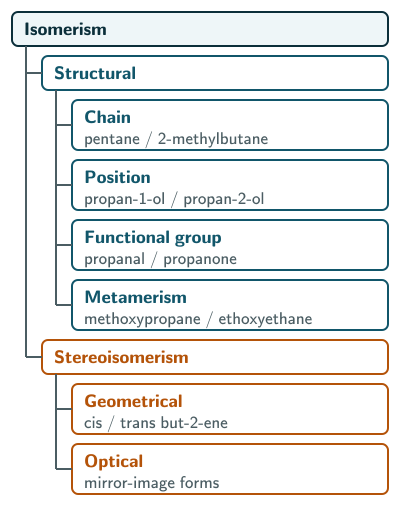
Two or more compounds possessing the same molecular formula but different properties are isomers, and the phenomenon is isomerism (NCERT Section 8.6, page 270); give this definition in an exam. The difference lies in their structure: different connectivity or a different spatial arrangement of the same atoms, and some physical properties can coincide (reasoned). There are two broad kinds:
- structural isomerism: the atoms are linked in different ways: chain, position, functional group isomerism and metamerism;
- stereoisomerism: the atoms are linked in the same way but differ in their arrangement in space: geometrical and optical isomerism.
In plain words: the same set of atoms can be put together in more than one way, just as the same letters can spell different words. Butane and 2-methylpropane are both C4H10, but one is a straight chain and the other branched, so they boil at different temperatures. The molecular formula alone does not tell you which compound you have; the structure does.
Structural isomerism
Compounds with the same molecular formula but different structures, that is, different ways in which the atoms are linked, are structural isomers (NCERT Section 8.6.1, pages 270–271):
- Chain isomerism: different carbon skeletons. C5H12 is three compounds: pentane, CH3CH2CH2CH2CH3; isopentane (2-methylbutane), CH3CH(CH3)CH2CH3; and neopentane (2,2-dimethylpropane), C(CH3)4.
- Position isomerism: the same skeleton, but a substituent atom or functional group at a different position. C3H8O gives two alcohols: propan-1-ol, CH3CH2CH2OH, and propan-2-ol, CH3CH(OH)CH3.
- Functional group isomerism: different functional groups. C3H6O can be an aldehyde, propanal (CH3CH2CHO), or a ketone, propanone (CH3COCH3).
- Metamerism: different alkyl groups on either side of the functional group. Two of the ethers of formula C4H10O are 1-methoxypropane (CH3OCH2CH2CH3) and ethoxyethane (C2H5OC2H5).
Each isomer has its own IUPAC name, because each has its own structure.
Stereoisomerism
Stereoisomers have the same constitution and the same sequence of covalent bonds but differ in the relative positions of their atoms or groups in space. NCERT names two kinds, geometrical and optical isomerism (NCERT Section 8.6.2, page 271), and treats them in later units; a brief preview:
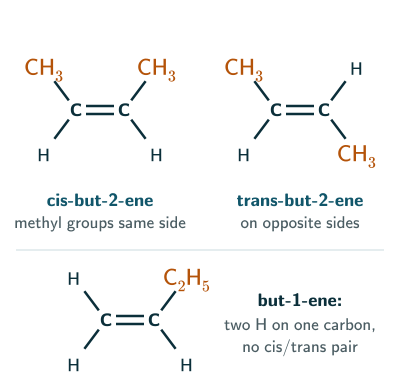
- Geometrical isomerism about a C=C bond needs two things: rotation must be restricted, as about a C=C bond, whose π bond keeps the two p orbitals parallel; and each doubly bonded carbon must carry two different groups. But-2-ene, CH3CH=CHCH3, exists as cis-but-2-ene (both CH3 on the same side) and trans-but-2-ene (on opposite sides). But-1-ene, CH2=CHCH2CH3, has none, because its end carbon carries two identical hydrogens (more in isomerism of alkenes).
- Optical isomerism occurs when a molecule cannot be superimposed on its mirror image, typically because a carbon carries four different groups (a chiral carbon); the two forms are enantiomers. Butan-2-ol, CH3CH(OH)CH2CH3, has two enantiomers with the same boiling point and density in achiral surroundings. Pure samples rotate plane-polarised light equally and oppositely under identical conditions; their equal mixture is a racemate with zero net rotation. A chiral molecule and an optically active sample are therefore different ideas.
Solved examples
Example 1: Chain isomers of C<sub>4</sub>H<sub>10</sub>
Write the structures and IUPAC names of the isomers of C4H10.
Four carbons can form a straight chain, or a chain of three with one branch in the middle.
Answer: butane, CH3CH2CH2CH3, and 2-methylpropane (isobutane), (CH3)2CHCH3: two chain isomers.
Example 2: Position isomers
Write the position isomers of C3H7Cl.
The chain of three carbons is fixed; chlorine can be on an end carbon or the middle carbon.
Answer: 1-chloropropane, CH3CH2CH2Cl, and 2-chloropropane, CH3CHClCH3.
Example 3: Naming the type
What type of isomers are (a) ethanol, C2H5OH, and methoxymethane, CH3OCH3; (b) 1-methoxypropane and ethoxyethane; (c) propanal and propanone?
(a) An alcohol and an ether, both C2H6O. (b) Both ethers, C4H10O, with different alkyl groups on either side of the oxygen. (c) An aldehyde and a ketone, both C3H6O.
Answer: (a) functional group isomers; (b) metamers; (c) functional group isomers.
Example 4: Which alkenes show geometrical isomerism?
Which of but-1-ene, but-2-ene and 2-methylpropene, CH2=C(CH3)2, show geometrical isomerism?
Each carbon of the C=C must carry two different groups. But-1-ene: C1 has H and H. 2-Methylpropene: C1 has H and H, and C2 has CH3 and CH3. But-2-ene: each carbon has H and CH3.
Answer: only but-2-ene (cis and trans).
Example 5: How many alkane isomers?
How many structural isomers do C5H12 and C6H14 have?
C5H12: pentane, 2-methylbutane, 2,2-dimethylpropane (NCERT page 270). C6H14: hexane, 2-methylpentane, 3-methylpentane, 2,2-dimethylbutane and 2,3-dimethylbutane.
Answer: 3 and 5. The number grows quickly with the chain: C7H16 already has 9 structural isomers (11 counting the mirror-image forms of 3-methylhexane and 2,3-dimethylpentane).
Common mistakes to avoid
Common mistake
Counting the same molecule twice
CH3CH2CH2CH3 drawn bent, or written backwards, is still butane. Name each structure: two drawings with the same IUPAC name are the same structural isomer. Then check the arrangement in space: cis- and trans-but-2-ene, or the two mirror-image forms of butan-2-ol, share a name apart from the stereo prefix.
Common mistake
Giving every alkene cis and trans forms
An alkene shows geometrical isomerism only if both doubly bonded carbons carry two different groups. But-1-ene and 2-methylpropene have none.
Common mistake
Mixing up metamerism and position isomerism
In metamers the functional group stays the same but the alkyl groups around it change (1-methoxypropane, ethoxyethane). In position isomers the same group sits on a different carbon of the same skeleton (propan-1-ol, propan-2-ol). When the group is bonded to carbon on both sides (–O–, –S–, –NH–, a ketone’s C=O), moving it changes both alkyl groups; the pair can also be described as metamers: pentan-2-one (CH3COC3H7) and pentan-3-one (C2H5COC2H5) are both position isomers (same carbon chain, different carbonyl position) and metamers in the usual school classification. These labels can overlap. Groups such as –OH and –Cl give position isomers, never metamers.
Quick revision summary
- Isomers: same molecular formula, different properties (NCERT); structurally, different connectivity or spatial arrangement, and some physical properties can coincide.
- Structural: chain (C5H12: 3 isomers), position (propan-1-ol, propan-2-ol), functional group (propanal, propanone), metamerism (1-methoxypropane, ethoxyethane).
- Stereoisomers: same bonds, different arrangement in space: geometrical (cis/trans, needs restricted rotation and two different groups on each carbon) and optical (non-superimposable mirror images).
Formula sheet
- Isomers: same molecular formula, different structure or arrangement in space
- Alkane structural isomers: CH 2, CH 3, CH 5, CH 9 (11 with mirror-image forms)
Questions students ask
What is the difference between isomers, isotopes and allotropes?
Isomers are different compounds with the same molecular formula, isotopes are atoms of the same element with different numbers of neutrons, and allotropes are different forms of the same element. Ethanoic acid, CH3COOH, and methyl methanoate, HCOOCH3, both C2H4O2, are isomers; carbon-12 and carbon-14, with 6 and 8 neutrons, are isotopes; diamond and graphite, both pure carbon, are allotropes. Isobars, a fourth term, are atoms of different elements with the same mass number, such as carbon-14 and nitrogen-14.
What is the difference between geometrical and optical isomerism?
Geometrical and optical isomers are both stereoisomers, with the same bonds arranged differently in space: geometrical (cis–trans) isomers arise because rotation about a C=C bond (or in a ring) is restricted, and they are not mirror images, while optical isomers (enantiomers) are non-superimposable mirror images, usually of a molecule with a carbon bearing four different groups. Geometrical isomers differ in physical properties: cis-but-2-ene boils at about 4 °C and has a dipole moment of 0.33 D, while trans-but-2-ene boils at about 1 °C and is non-polar. Pure enantiomers share these ordinary physical properties in achiral surroundings and have equal, opposite rotations under the same conditions; a racemic mixture has no net rotation.
Can ring compounds show geometrical isomerism?
Yes, ring compounds can show geometrical isomerism, because ring closure restricts the configurations that can interconvert by ordinary bond rotations: in 1,2-dimethylcyclopropane the two CH3 groups lie on the same face of the ring in the cis isomer and on opposite faces in the trans isomer, and ordinary ring motion cannot change one into the other. Configurational interconversion requires a chemical or sufficiently energetic process; breaking a ring bond is not the only conceivable mechanism. As with alkenes, each of the two carbons must carry two different groups, so 1,1-dimethylcyclopropane, with both CH3 groups on one carbon, has no cis and trans forms.
How many isomers does C4H8 have?
C4H8 has five structural isomers, or six if the cis and trans forms of but-2-ene are counted separately: three open-chain alkenes, but-1-ene, but-2-ene and 2-methylpropene, and two ring compounds, cyclobutane and methylcyclopropane. A ring takes away two hydrogens just as a C=C bond does, so an alkene and a cycloalkane with the same number of carbons share the formula CnH2n; such pairs, one with a chain and one with a ring, are often called ring–chain isomers.
What is the difference between geometrical isomers and conformations?
The alkene geometrical isomers studied here are usually separately isolable, because their interconversion requires a high-energy rearrangement of the π bonding, while ordinary conformations interconvert by rotation about single bonds. Some hindered single-bond rotations are slow enough to produce isolable atropisomers, so “all conformers interconvert freely” is not universal. In ethane that rotation is opposed by a barrier of only about 12.5 kJ mol, so at room temperature its staggered and eclipsed forms interconvert too fast to be separated: cis- and trans-but-2-ene are two compounds, but ethane is one. Conformations, drawn as sawhorse and Newman projections, are studied in NCERT Unit 9, Hydrocarbons.
Are geometrical and optical isomerism in the JEE Main 2027 and NEET (UG) 2026 syllabuses?
Yes, stereoisomerism, which includes geometrical and optical isomerism, is in both syllabuses: Unit 14 of JEE Main 2027 and of NEET (UG) 2026 lists ‘Isomerism – structural and stereoisomerism’, and Unit 15, Hydrocarbons, names the geometrical isomerism of alkenes. Optical isomerism is not named on its own; NCERT introduces it in Class 11 (Section 8.6.2) and returns to it in Class 12 organic chemistry.
Is there a shortcut to count the number of isomers?
There is no simple formula for the number of structural isomers: they are counted by drawing each carbon skeleton once, rings included, and then every position and kind of functional group, and the count soon runs high, with 18 alkanes for C8H18 and 75 for C10H22. Stereoisomers do have a rule: with no other stereogenic elements, n tetrahedral stereogenic centres give at most 2n configurational stereoisomers, and n independent double bonds that can each have two geometrical configurations give at most 2n geometrical isomers. Both rules go beyond NCERT and overcount symmetrical molecules: tartaric acid, with two chiral carbons, has 3 stereoisomers, not 4, one of them an optically inactive meso form.
Practice questions
Try each question first, then open the answer to check your working.
-
Q1. Write two isomers of C3H6O that differ in their functional group.
Show answerHide answer
Propanal, CH3CH2CHO (an aldehyde), and propanone, CH3COCH3 (a ketone).
-
Q2. Are pentane and 2,2-dimethylpropane isomers? What kind?
Show answerHide answer
Yes: both are C5H12. They differ in their carbon skeleton, so they are chain isomers.
-
Q3. Does propene, CH2=CHCH3, show geometrical isomerism? Explain.
Show answerHide answer
No. Its first carbon carries two identical hydrogen atoms, so swapping the groups on that carbon gives the same molecule.