Aromatic hydrocarbons
NCERT Class 11 Chemistry Chapter 9 Section 9.5
Quick answer
Aromatic hydrocarbons (arenes) such as benzene have planar rings with (4n + 2) delocalised π electrons; in benzene all six C–C bonds are 139 pm, between single and double. Because of this extra stability benzene reacts mainly by electrophilic substitution (nitration, halogenation, sulphonation, Friedel–Crafts alkylation and acylation) through an arenium ion. A group already on the ring decides where the next one goes: ortho and para, or meta.
With your textbook
NCERT Chemistry Part II (Class 11), Chapter 9 “Hydrocarbons”, Section 9.5 “Aromatic Hydrocarbon”, pages 318–325.
Open the official NCERT chapter (PDF, 3.3 MB, ncert.nic.in) (opens in a new tab)
Checked against the 2026-27 reprint on .
What are aromatic hydrocarbons?
Aromatic hydrocarbons (arenes)
Aromatic hydrocarbons, also called arenes, were named for the pleasant smell of many of them (Greek aroma, pleasant smelling), and most were found to contain a benzene ring (NCERT Section 9.5, page 318). The benzene ring is highly unsaturated, yet in most of its reactions the unsaturation of the ring is kept.
Aromatic compounds containing benzene ring are known as benzenoids and those not containing a benzene ring are known as non-benzenoids.
NCERT Chemistry Part II (Class 11), Section 9.5, page 318
In plain words: benzene, C6H6, looks as if it has three double bonds, but it does not behave like an alkene. It does not add bromine as alkenes do, and it prefers to swap a hydrogen for another group (substitution) rather than add across a double bond. The reason is that its six π electrons are spread evenly round the whole ring, which makes the ring unusually stable; any reaction that keeps the ring intact is favoured.
Examples of arenes are benzene, toluene (methylbenzene), naphthalene and biphenyl (NCERT page 318).
Nomenclature and isomerism
The naming of benzene compounds was met in Unit 8, under substituted benzenes (NCERT Section 9.5.1, page 318):
- all six hydrogens of benzene are equivalent, so there is only one monosubstituted product of each kind, for example one methylbenzene (toluene);
- when two hydrogens are replaced, by the same or by different groups, three position isomers are possible: 1,2 (or 1,6) is ortho (o-), 1,3 (or 1,5) is meta (m-) and 1,4 is para (p-).
The dimethylbenzenes are 1,2-dimethylbenzene (o-xylene), 1,3-dimethylbenzene (m-xylene) and 1,4-dimethylbenzene (p-xylene).
Structure of benzene
Benzene was isolated by Michael Faraday in 1825. Its formula, C6H6, shows a high degree of unsaturation, yet it is a stable molecule (NCERT Section 9.5.2, pages 319–321). Three observations guided the search for its structure:
- it forms a triozonide, which points to three double bonds;
- it gives only one monosubstituted derivative, so all six carbons and all six hydrogens are alike;
- it gives only one ortho disubstituted product.
Kekulé’s structure. In 1865 August Kekulé proposed a ring of six carbons with alternate single and double bonds and one hydrogen on each carbon. This structure predicts two 1,2-dibromobenzenes, one with the bromines on a double bond and one with them on a single bond, but only one exists. Kekulé answered this with the idea that the double bonds oscillate between the two positions. Even so, his structure could not explain benzene’s unusual stability or its preference for substitution over addition.
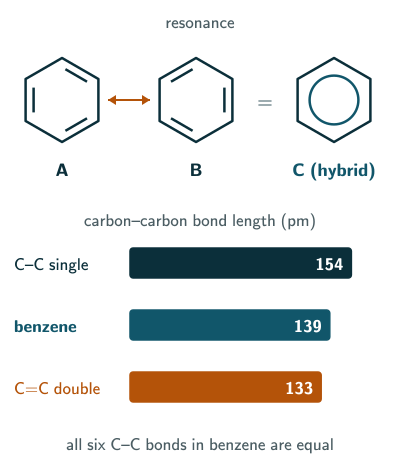
Resonance. By valence bond theory, benzene is a resonance hybrid: the two Kekulé structures (A and B) are the main contributors, and the hybrid is drawn as a hexagon with a circle (or dotted circle) in it, the circle standing for six electrons delocalised over the six carbons.
Orbital picture. All six carbons are sp2 hybridised. Two sp2 orbitals of each carbon overlap with those of its neighbours to form six C–C σ bonds in the plane of the hexagon, and the third overlaps with the s orbital of a hydrogen to form a C–H σ bond. Each carbon keeps one unhybridised p orbital perpendicular to the ring. These could pair up as C1–C2, C3–C4, C5–C6 or as C2–C3, C4–C5, C6–C1, which are the two Kekulé structures (NCERT Fig. 9.7 (a) and (b)). But X-ray diffraction shows that all the C–C distances are equal, so each p orbital overlaps equally with both neighbours: the π electrons form two ring-shaped clouds, like doughnuts, one above and one below the plane of the ring (Fig. 9.7 (c), (d)).
The delocalised π electron cloud is held more strongly by the carbon nuclei than a cloud localised between two carbons, so benzene is more stable than the hypothetical cyclohexatriene. NCERT page 321 says the six π electrons move freely about the six carbon nuclei “instead of any two as shown in Fig. 9.6 (a) or (b)”; the figures meant are 9.7 (a) and (b), since Fig. 9.6 is the orbital picture of ethyne.
Bond lengths. X-ray data show that benzene is planar and that all six C–C bonds are the same length, 139 pm, between the C–C single bond (154 pm) and the C=C double bond (133 pm in NCERT here; 134 pm in Section 9.3.1). If structure A or B were right, there would be two different bond lengths. The absence of pure double bonds explains why benzene is reluctant to add reagents under normal conditions.
Aromaticity and Hückel’s rule
Benzene was taken as the parent “aromatic” compound. Today the name is given to any ring system, with or without a benzene ring, that has these characteristics (NCERT Section 9.5.3, page 321):
- planarity;
- complete delocalisation of the π electrons in the ring;
- (4n + 2) π electrons in the ring, where n is an integer (n = 0, 1, 2, …). This is Hückel’s rule.
NCERT’s examples:
| Ring system | π electrons | n |
|---|---|---|
| Benzene, C6H6 | 6 | 1 |
| Cyclopentadienyl anion, C5H5− | 6 | 1 |
| Cycloheptatrienyl cation, C7H7+ | 6 | 1 |
| Naphthalene, C10H8 | 10 | 2 |
| Anthracene and phenanthrene, C14H10 | 14 | 3 |
In the cyclopentadienyl anion, the lone pair on the negative carbon joins the four π electrons of the two double bonds; in the cycloheptatrienyl cation, the positive carbon has an empty p orbital, and the six π electrons of the three double bonds spread over all seven carbons. A ring that has a carbon with no p orbital in it (an sp3 CH2, as in cyclopentadiene) cannot be completely delocalised, and a ring with 4 or 8 π electrons fails the 4n + 2 count (Example 3).
Preparation of benzene
Benzene is commercially isolated from coal tar. In the laboratory it can be prepared by the following methods (NCERT Section 9.5.4, pages 321–322):
- cyclic polymerisation of ethyne: 3HC≡CH → C6H6 (red hot iron tube, 873 K; NCERT Section 9.4.4);
- decarboxylation of an aromatic acid: sodium benzoate heated with soda lime, C6H5COONa + NaOH → C6H6 + Na2CO3 (CaO, heat), the same decarboxylation that gives alkanes from the sodium salts of acids (NCERT Section 9.2.2);
- reduction of phenol: phenol vapour passed over heated zinc dust, C6H5OH + Zn → C6H6 + ZnO.
Physical properties
Aromatic hydrocarbons are non-polar and are usually colourless liquids or solids with a characteristic aroma. Naphthalene balls are used in toilets and to preserve clothes because of their smell and their moth-repellent property. Arenes are immiscible with water but readily miscible with organic solvents, and they burn with a sooty flame (NCERT Section 9.5.5, page 322).
Electrophilic substitution
Arenes are characterised by electrophilic substitution reactions; under special conditions they also undergo addition and oxidation (NCERT page 322). In each substitution an electrophile, E+, replaces a hydrogen of the ring.
1. Nitration. Heating benzene with a mixture of concentrated nitric and sulphuric acids (the nitrating mixture) at 323–333 K introduces a nitro group: C6H6 + HNO3 → C6H5NO2 + H2O (nitrobenzene; conc. H2SO4).
2. Halogenation. Arenes react with halogens in the presence of a Lewis acid such as anhydrous FeCl3, FeBr3 or AlCl3 to give haloarenes: C6H6 + Cl2 → C6H5Cl + HCl (chlorobenzene; anhydrous AlCl3). With excess chlorine, in the dark and cold, all six hydrogens are replaced in turn: C6H6 + 6Cl2 → C6Cl6 + 6HCl (hexachlorobenzene).
3. Sulphonation. Heating benzene with fuming sulphuric acid (oleum, H2SO4 containing SO3) replaces a hydrogen by a sulphonic acid group: C6H6 + H2SO4 → C6H5SO3H + H2O (benzenesulphonic acid).
4. Friedel–Crafts alkylation. An alkyl halide with anhydrous aluminium chloride gives an alkylbenzene: C6H6 + CH3Cl → C6H5CH3 + HCl (toluene), and C6H6 + C2H5Cl → C6H5C2H5 + HCl (ethylbenzene). NCERT asks why 1-chloropropane gives isopropylbenzene, not n-propylbenzene: the primary carbocation CH3CH2CH2+ rearranges, by a hydride shift, to the more stable secondary carbocation (CH3)2CH+, which then attacks the ring (Example 5).
5. Friedel–Crafts acylation. An acyl halide or acid anhydride with a Lewis acid (AlCl3) gives an acylbenzene (a ketone):
- C6H6 + CH3COCl → C6H5COCH3 + HCl (acetophenone)
- C6H6 + (CH3CO)2O → C6H5COCH3 + CH3COOH
NCERT spells the reaction “Friedel Craft’s” once on page 322; the names are those of Charles Friedel and James Crafts, so it is Friedel–Crafts.
The mechanism
Electrophilic substitution (SE) is believed to go in three steps (NCERT pages 323–324):
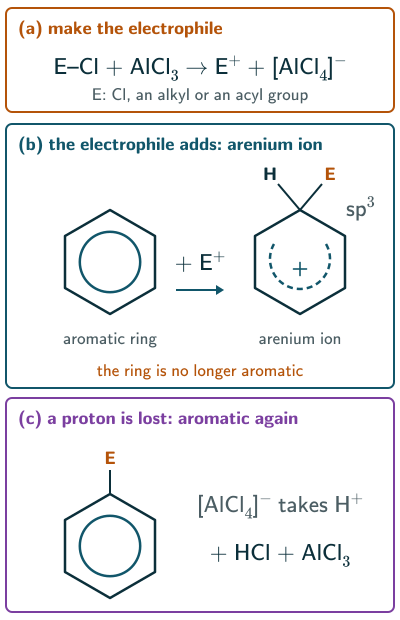
(a) Generation of the electrophile. Anhydrous AlCl3, a Lewis acid, takes a chloride from the reagent:
- Cl–Cl + AlCl3 → Cl+ + [AlCl4]− (NCERT calls Cl+ the “chloronium ion”, but that name properly belongs to ions such as R2Cl+; free Cl+ does not really form: AlCl3 polarises Cl–Cl so that the outer chlorine acts as Cl+);
- CH3–Cl + AlCl3 → CH3+ + [AlCl4]−;
- CH3COCl + AlCl3 → CH3CO+ + [AlCl4]− (the acylium ion);
- in sulphonation the electrophile is SO3 from oleum; unlike the others, sulphonation is reversible (beyond the NCERT text).
In nitration the electrophile is the nitronium ion, NO2+, made by proton transfer from sulphuric acid to nitric acid:
- H2SO4 + HNO3 ⇌ H2O+–NO2 + HSO4− (protonated nitric acid);
- H2O+–NO2 ⇌ H2O + NO2+.
It is interesting to note that in the process of generation of nitronium ion, sulphuric acid serves as an acid and nitric acid as a base.
NCERT Chemistry Part II (Class 11), Section 9.5.5, page 323
(b) Formation of the carbocation (arenium ion). The electrophile attacks the π cloud and bonds to one carbon, which becomes sp3 hybridised. The result is the σ-complex or arenium ion, stabilised by resonance over the other five carbons; but it has lost its aromatic character, because delocalisation stops at the sp3 carbon.
(c) Removal of a proton. To get the aromatic character back, the σ-complex loses H+ from the sp3 carbon to [AlCl4]− (in halogenation, alkylation and acylation) or to HSO4− (in nitration). This releases HCl and regenerates AlCl3, or regenerates H2SO4, so both act as catalysts (in acylation the ketone product binds AlCl3, so a full equivalent is used).
Addition, combustion and the general combustion equation
Under vigorous conditions benzene does add (NCERT page 324):
- hydrogen, at high temperature and/or pressure over nickel: C6H6 + 3H2 → C6H12 (cyclohexane);
- chlorine, under ultraviolet light at 500 K: C6H6 + 3Cl2 → C6H6Cl6, benzene hexachloride (BHC), a mixture of stereoisomers; NCERT calls it gammaxane, a name that strictly belongs to its γ isomer (lindane).
Note the contrast: with Cl2 and AlCl3 in the dark, benzene gives C6H5Cl or C6Cl6 by substitution; with Cl2 in UV light it gives C6H6Cl6 by addition.
Combustion. Benzene burns in air with a sooty flame: C6H6 + 15/2 O2 → 6CO2 + 3H2O. For any hydrocarbon (NCERT equation 9.83, page 324):
Combustion of a hydrocarbon C<sub>x</sub>H<sub>y</sub>
CxHy + (x + y/4) O2 → xCO2 + (y/2) H2O
Each carbon takes one O2 and every four hydrogens take one O2. For an alkane CnH2n+2 this gives n + (2n + 2)/4 = (3n + 1)/2, the same as the alkane equation. NCERT’s equation 9.83 ends with a stray “n” after H2O, which is a printing slip.
Directive influence of a group
When a monosubstituted benzene is substituted again, the three possible disubstituted products are not formed in equal amounts: either the ortho and para products, or the meta product, are formed mainly (NCERT Section 9.5.6, pages 324–325).
It has also been observed that this behaviour depends on the nature of the substituent already present in the benzene ring and not on the nature of the entering group.
NCERT Chemistry Part II (Class 11), Section 9.5.6, page 324
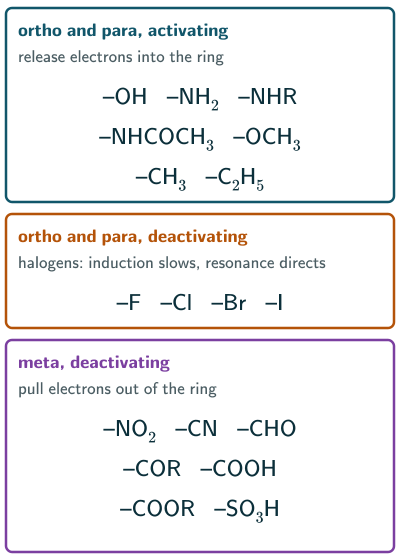
Ortho and para directing, activating groups. The –OH group of phenol donates a lone pair into the ring by resonance; the resonance structures put a negative charge on the ortho and para carbons, so the electron density is higher there and substitution takes place mainly at those positions. The –I effect of oxygen slightly reduces the electron density, but the overall effect of resonance is to raise it, so –OH activates the ring. Other activating groups: –NH2, –NHR, –NHCOCH3, –OCH3, –CH3, –C2H5 (alkyl groups have no lone pair; they release electrons by their +I effect and hyperconjugation).
Halogens: ortho and para directing but deactivating. In aryl halides the strong –I effect of the halogen lowers the overall electron density of the ring, so further substitution is harder; but resonance still makes the ortho and para positions richer than the meta position. So halogens are deactivating but ortho/para directing.
Meta directing, deactivating groups. –NO2, –CN, –CHO, –COR, –COOH, –COOR and –SO3H withdraw electrons. The nitro group, for example, lowers the electron density of the ring by its strong –I effect, and its resonance structures put positive charges on the ortho and para carbons. The meta positions are then the least electron-poor, and the electrophile attacks there.
Solved examples
Example 1: Counting isomers
How many isomers are there of (a) C6H5Cl, (b) C6H4Cl2, (c) C6H3Cl3?
All six positions of benzene are equivalent, so the count depends only on the pattern. (a) One position: one compound. (b) Two positions can be 1,2, 1,3 or 1,4. (c) Three positions can be 1,2,3, 1,2,4 or 1,3,5.
Answer: (a) 1; (b) 3, ortho, meta and para; (c) 3, 1,2,3-, 1,2,4- and 1,3,5-trichlorobenzene.
Example 2: Why benzene prefers substitution
Adding Br2 across one C=C of benzene would give a product with two sp3 carbons. Why does benzene substitute instead?
Addition would destroy the continuous ring of six p orbitals, and with it the extra stability of the delocalised π system. In substitution, the arenium ion loses that stability only briefly; losing H+ restores the aromatic ring.
Answer: substitution keeps the aromatic ring; addition would destroy it, so substitution is strongly favoured.
Example 3: Aromatic or not? (NCERT Exercises 9.11 and 9.12)
Which of these are aromatic: cyclopentadiene, C5H6; the cyclopentadienyl anion, C5H5−; cyclooctatetraene, C8H8; and the compound of NCERT Exercise 9.12 (i), a six-membered ring with two C=C bonds in the ring and an exocyclic C=CH2 (methylene) group?
Check the three conditions. Cyclopentadiene has a CH2 (sp3) in the ring, so the π electrons cannot be delocalised all round. Its anion has 4 + 2 = 6 π electrons over five sp2 carbons. Cyclooctatetraene has 8 π electrons, not 4n + 2 (and it is not planar). The methylene compound has a ring CH2 (sp3), so complete delocalisation round the ring is impossible.
Answer: only the cyclopentadienyl anion is aromatic.
Example 4: Choosing the order of steps (NCERT Exercise 9.13)
How will you convert benzene into (i) p-nitrobromobenzene, (ii) m-nitrochlorobenzene, (iii) p-nitrotoluene and (iv) acetophenone?
(i) Brominate first (Br2, FeBr3): Br is o/p directing, so nitration then gives o- and p-nitrobromobenzene, and the p isomer is separated. (ii) Nitrate first: –NO2 is meta directing, so chlorination (Cl2, anhydrous AlCl3) then gives m-nitrochlorobenzene. (iii) Friedel–Crafts methylation (CH3Cl, anhydrous AlCl3) gives toluene; –CH3 is o/p directing, so nitration gives o- and p-nitrotoluene, and the p isomer is separated. (iv) Friedel–Crafts acylation: C6H6 + CH3COCl → C6H5COCH3 + HCl (anhydrous AlCl3).
Answer: the first group put in must be the one that directs the second group to the wanted position.
Example 5: Friedel–Crafts with 1-chloropropane
Why does benzene with 1-chloropropane and AlCl3 give mainly isopropylbenzene?
AlCl3 takes the chloride and leaves the primary carbocation CH3CH2CH2+. A hydrogen moves with its electron pair (a hydride shift) from the middle carbon to the end carbon, giving the more stable secondary carbocation CH3C+HCH3, which then attacks the ring.
Answer: the carbocation rearranges from primary to secondary before it reacts, so the product is C6H5CH(CH3)2, isopropylbenzene (cumene).
Example 6: Ozonolysis of o-xylene (NCERT Exercise 9.17)
What are the products of ozonolysis of o-xylene, 1,2-dimethylbenzene, and how do they support the Kekulé structure?
Each Kekulé structure has three C=C bonds in different places. In one, the two methyl-bearing carbons are joined by a double bond; in the other, by a single bond. Ozonolysis cuts every C=C and leaves each single bond as a two-carbon fragment. In the first structure the two methyl-bearing carbons are separated, each staying with a neighbour: two methylglyoxal (CH3COCHO) and one glyoxal (OHC–CHO). In the second they stay together: one dimethylglyoxal (CH3COCOCH3) and two glyoxal.
Answer: glyoxal, methylglyoxal and dimethylglyoxal, in the mole ratio 3 : 2 : 1. A single fixed Kekulé structure could not give all three; the mixture shows that both Kekulé structures contribute.
Common mistakes to avoid
Common mistake
Treating benzene like an alkene
Benzene does not add bromine or hydrogen under normal conditions. It reacts by electrophilic substitution and adds only under vigorous conditions (H2/Ni with heat; Cl2 in UV light).
Common mistake
Thinking halogens activate the ring
Halogens direct ortho and para, but they deactivate the ring: their –I effect outweighs their resonance donation. Only the orientation follows the resonance effect.
Common mistake
Counting π electrons from every ring atom
An sp3 CH2 has no p orbital: it adds no π electrons and breaks the delocalisation. So cyclopentadiene, with 4 π electrons, is not aromatic; its anion, where that carbon is sp2 and carries a lone pair, has 6.
Common mistake
Running Friedel–Crafts on a deactivated ring
Beyond the NCERT text: Friedel–Crafts alkylation and acylation fail on a ring carrying a strongly deactivating group such as –NO2 (nitrobenzene is even used as their solvent), so put the alkyl or acyl group in first.
Common mistake
Forgetting the Lewis acid
Halogenation, Friedel–Crafts alkylation and acylation all need an anhydrous Lewis acid (AlCl3, FeCl3 or FeBr3) to make the electrophile. Without it, Cl2 does not substitute benzene in the dark.
Common mistake
Thinking nitric acid is the acid in the nitrating mixture
In the nitrating mixture, sulphuric acid is the acid and nitric acid acts as the base: it accepts a proton and then loses water to give NO2+.
Quick revision summary
- Arenes: benzene and related rings; benzenoid (with a benzene ring) and non-benzenoid. One monosubstituted benzene; three disubstituted (o 1,2, m 1,3, p 1,4).
- Structure: Kekulé (1865) with oscillating double bonds; now a resonance hybrid; six sp2 carbons, delocalised π cloud above and below the ring; all C–C 139 pm (C–C 154, C=C 133 pm); planar.
- Hückel: planar, completely delocalised, (4n + 2) π electrons: benzene 6, C5H5− 6, C7H7+ 6, naphthalene 10, anthracene 14.
- Preparation: 3C2H2 (873 K); C6H5COONa + NaOH (CaO); phenol + Zn dust. Commercially from coal tar.
- Substitution: nitration (conc. HNO3 + H2SO4, NO2+), halogenation (X2 + FeX3/AlCl3), sulphonation (oleum), Friedel–Crafts alkylation and acylation (AlCl3); mechanism: E+, arenium ion, loss of H+.
- Addition: 3H2/Ni → cyclohexane; 3Cl2/UV, 500 K → BHC. Combustion with a sooty flame.
- Directing: –OH, –NH2, –OCH3, –CH3: activating, o/p; halogens: deactivating, o/p; –NO2, –CN, –CHO, –COR, –COOH, –SO3H: deactivating, meta.
Formula sheet
- Hückel’s rule: aromatic if planar, fully delocalised and with (4n + 2) π electrons (n = 0, 1, 2, …)
- CxHy + (x + y/4) O2 → xCO2 + (y/2) H2O
- Benzene C–C 139 pm, between C–C 154 pm and C=C 133 pm
Questions students ask
What is the difference between Friedel–Crafts alkylation and acylation?
Friedel–Crafts alkylation puts an alkyl group on a benzene ring, from an alkyl halide, while acylation puts on an acyl group, RCO–, from an acyl chloride or anhydride and gives a ketone; both need a Lewis acid, usually anhydrous AlCl3. Acylation is usually cleaner: the acylium ion, RC≡O+, is stabilised by resonance and does not rearrange, and the C=O group deactivates the ring, so the reaction stops after one substitution. In alkylation the carbocation can rearrange and the alkyl group activates the ring, so di- and trialkylbenzenes form too. So butylbenzene is made by acylation with butanoyl chloride, then reduction of the C=O to CH2 (Clemmensen, Class 12).
Why does aniline not undergo the Friedel–Crafts reaction?
Aniline does not undergo Friedel–Crafts alkylation or acylation because its –NH2 group is a Lewis base: the nitrogen lone pair bonds to the catalyst, the Lewis acid AlCl3, forming a salt-like adduct, C6H5NH2·AlCl3, in which the nitrogen carries a positive charge. That positive nitrogen withdraws electrons strongly, so the ring is deactivated much as in nitrobenzene, and the catalyst is used up. NCERT meets this case in Class 12, under amines; phenol gives poor yields for a similar reason, as its –OH oxygen also binds AlCl3.
What is the difference between electrophilic addition and electrophilic substitution?
Electrophilic addition and electrophilic substitution both begin with an electrophile attacking π electrons to form a positively charged intermediate, but in addition that intermediate takes up a nucleophile, so two groups add across a double bond, while in substitution it loses H+, so a hydrogen is replaced. Cyclohexene adds bromine at room temperature with no catalyst, giving 1,2-dibromocyclohexane. Benzene needs a Lewis acid such as FeBr3 and gives bromobenzene, C6H5Br, and HBr, keeping its aromatic ring, so on its own it does not decolourise bromine in CCl4 as cyclohexene does.
What is the difference between benzene and cyclohexatriene?
Cyclohexatriene is the hypothetical molecule of a single Kekulé structure, a C6H6 ring with three fixed C=C bonds alternating with C–C bonds, while real benzene has six equal C–C bonds of 139 pm and is about 150 kJ mol more stable. The figure comes from enthalpies of hydrogenation: cyclohexene, with one C=C, releases about 120 kJ mol on hydrogenation to cyclohexane, so three C=C bonds should release about 360 kJ mol, but benzene releases only about 208 kJ mol. The difference is benzene’s resonance energy, the extra stability that makes it prefer substitution to addition.
What is the difference between aromatic, antiaromatic and non-aromatic compounds?
An aromatic compound has a cyclic, planar, fully conjugated ring with (4n + 2) π electrons, n = 0, 1, 2 … (not the number of rings), and is unusually stable; an antiaromatic one is also cyclic, planar and fully conjugated but has 4n π electrons, n = 1, 2 …, which makes it unusually unstable; a non-aromatic one lacks at least one of the three features. The cyclopropenyl cation, C3H3+, with 2 π electrons (n = 0), is aromatic; cyclobutadiene, C4H4, with 4, is antiaromatic and highly unstable; cyclohexa-1,3-diene, with two sp3 CH2 groups in its ring, is non-aromatic. Antiaromaticity is beyond the NCERT text.
What is the difference between benzene, phenyl and benzyl?
Benzene is the compound C6H6, while phenyl and benzyl are groups: phenyl, C6H5–, is benzene less one hydrogen, joined through a ring carbon, and benzyl, C6H5CH2–, is joined through a CH2 outside the ring. So chlorobenzene, C6H5Cl, has its chlorine on the ring, but benzyl chloride, C6H5CH2Cl, has it on the side chain and, unlike chlorobenzene, undergoes nucleophilic substitution readily, like an alkyl halide. Any arene group joined through a ring carbon is an aryl group, Ar–.
Practice questions
Try each question first, then open the answer to check your working.
-
Q1. Why does benzene give only one monosubstituted product but three disubstituted products?
Show answerHide answer
All six hydrogens are equivalent, so replacing any one gives the same compound. With two substituents, their relative positions can be 1,2 (ortho), 1,3 (meta) or 1,4 (para).
-
Q2. Why is benzene extraordinarily stable though it appears to contain three double bonds (NCERT Exercise 9.10)?
Show answerHide answer
Its six π electrons are delocalised over all six carbons, in clouds above and below the ring; the delocalised cloud is held more strongly by the nuclei than localised double bonds would be. Benzene is a resonance hybrid, more stable than either Kekulé structure or the hypothetical cyclohexatriene.
-
Q3. What are the necessary conditions for a system to be aromatic (NCERT Exercise 9.11)?
Show answerHide answer
It must be a planar ring, its π electrons must be completely delocalised round the ring, and it must contain (4n + 2) π electrons, where n = 0, 1, 2, … (Hückel’s rule).
-
Q4. Write the equations for the preparation of benzene from (a) sodium benzoate and (b) phenol.
Show answerHide answer
(a) C6H5COONa + NaOH → C6H6 + Na2CO3 (soda lime, heat). (b) C6H5OH + Zn → C6H6 + ZnO (heated zinc dust).
-
Q5. Name the electrophile in (a) nitration, (b) chlorination with AlCl3, (c) Friedel–Crafts acylation with CH3COCl.
Show answerHide answer
(a) The nitronium ion, NO2+. (b) Cl+ (NCERT: chloronium ion), with [AlCl4]−. (c) The acylium ion, CH3CO+.
-
Q6. Why does the arenium ion lose a proton instead of adding a nucleophile?
Show answerHide answer
The arenium ion has lost its aromatic character, because delocalisation stops at the sp3 carbon. Losing H+ from that carbon restores the aromatic ring; adding a nucleophile would not.
-
Q7. Out of benzene, m-dinitrobenzene and toluene, which undergoes nitration most easily, and why (NCERT Exercise 9.23)?
Show answerHide answer
Toluene: the –CH3 group releases electrons and activates the ring. Benzene comes next; m-dinitrobenzene, with two strongly deactivating –NO2 groups, reacts least easily.
-
Q8. Arrange in decreasing order of reactivity towards an electrophile: chlorobenzene, 2,4-dinitrochlorobenzene, p-nitrochlorobenzene (NCERT Exercise 9.22 (a)).
Show answerHide answer
Chlorobenzene > p-nitrochlorobenzene > 2,4-dinitrochlorobenzene. Each –NO2 group withdraws more electron density from the ring.
-
Q9. What is formed when benzene reacts with chlorine (a) with anhydrous AlCl3 in the dark and (b) in ultraviolet light at 500 K?
Show answerHide answer
(a) Substitution: chlorobenzene, C6H5Cl (and, with excess chlorine, hexachlorobenzene, C6Cl6). (b) Addition: benzene hexachloride, C6H6Cl6 (BHC).
-
Q10. Write the balanced equation for the combustion of toluene (NCERT Exercise 9.8 (iv)).
Show answerHide answer
C7H8 + 9O2 → 7CO2 + 4H2O; from the general equation, x + y/4 = 7 + 2 = 9.