Structures of the alcohol, phenol and ether groups
NCERT Class 12 Chemistry Chapter 7 Section 7.3
Quick answer
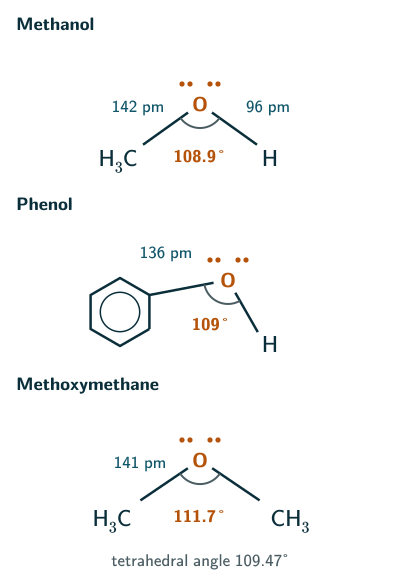
In methanol the C–O bond is 142 pm and the C–O–H angle 108.9°, slightly less than the tetrahedral 109° 28′ because the two lone pairs on oxygen repel the bonds. In phenol the C–O bond is shorter, 136 pm, because the oxygen’s lone pair is conjugated with the ring, giving partial double bond character, and the carbon is sp hybridised. In methoxymethane the C–O–C angle is 111.7°, slightly more than tetrahedral, because the two bulky alkyl groups repel each other, while the C–O bond, 141 pm, is almost as in alcohols.
With your textbook
NCERT Chemistry Part II (Class 12), Chapter 7 “Alcohols, Phenols and Ethers”, Section 7.3 “Structures of Functional Groups”, pages 198–199.
Open the official NCERT chapter (PDF, 4.6 MB, ncert.nic.in) (opens in a new tab)
Checked against the 2026-27 reprint on .
What are the structures of the alcohol, phenol and ether groups?
Structures of the C–O functional groups
In all three classes the oxygen carries two bonds and two lone pairs. In alcohols the C–O bond is a σ bond from an sp3 orbital of carbon and an sp3 orbital of oxygen; in phenols the –OH is on an sp2 carbon of the ring, and a lone pair of oxygen is in conjugation with the ring (NCERT pages 198–199). For ethers NCERT says:
In ethers, the four electron pairs, i.e., the two bond pairs and two lone pairs of electrons on oxygen are arranged approximately in a tetrahedral arrangement.
NCERT Chemistry Part II (Class 12), Section 7.3, page 199
In plain words: the oxygen in methanol and in methoxymethane sits at the centre of a near-tetrahedron, like the oxygen in water. Lone pairs push the bonds slightly closer in alcohols; two bulky groups push them slightly apart in ethers; and in phenol the C–O bond is a little shorter because the oxygen shares a lone pair with the ring and the ring carbon is sp2.
Structures of methanol, phenol and methoxymethane
NCERT Fig. 7.1 (page 198) gives the bond lengths and angles:
| Compound | C–O bond | Angle at O |
|---|---|---|
| Methanol, CH3OH | 142 pm | C–O–H 108.9° |
| Phenol, C6H5OH | 136 pm | C–O–H 109° |
| Methoxymethane, CH3OCH3 | 141 pm | C–O–C 111.7° |
- Alcohols. The C–O–H angle is slightly less than the tetrahedral angle, 109° 28′, because of repulsion from the two unshared electron pairs of oxygen (NCERT page 199). Methanol’s O–H bond is 96 pm (NCERT Fig. 7.1). This is the same lone-pair effect that closes the angle in water, as VSEPR theory explains (reasoned).
- Ethers. The C–O–C angle is slightly greater than the tetrahedral angle, because the two bulky alkyl groups repel each other; the C–O bond, 141 pm, is almost the same as in alcohols (NCERT page 199).
C–O bond length in phenol
The C–O bond in phenol, 136 pm, is slightly shorter than in methanol, 142 pm, for two reasons (NCERT page 199):
- Partial double bond character. The unshared electron pair of oxygen is in conjugation with the aromatic ring, as the resonance structures of phenol show (NCERT Section 7.4.4).
- sp2 carbon. The ring carbon bonded to oxygen is sp2 hybridised; with more s-character it holds the bonding pair closer (reasoned, as for the C–Cl bond of haloarenes, NCERT Unit 6, page 182).
Solved examples
Example 1: How far from tetrahedral?
Using NCERT Fig. 7.1, by how many degrees do the angles at oxygen in methanol and methoxymethane differ from the tetrahedral angle, 109° 28′?
Answer: 109° 28′ = 109 + 28/60 = 109.47°. Methanol: 108.9 − 109.47 = −0.57°, slightly less (lone-pair repulsion). Methoxymethane: 111.7 − 109.47 = +2.23°, slightly more (repulsion between the two methyl groups) (NCERT pages 198–199; reasoned).
Example 2: Comparing C–O bonds
Arrange the C–O bonds of methanol, phenol and methoxymethane in order of increasing length, and say what the difference between the shortest and the longest shows.
Answer: Phenol (136 pm) < methoxymethane (141 pm) < methanol (142 pm). The 6 pm shortening in phenol comes from its partial double bond character and its sp2 carbon; methoxymethane and methanol, both with sp3 carbons, differ by only 1 pm (NCERT pages 198–199).
Common mistakes to avoid
Common mistake
Giving every C–O–H angle as exactly 109.5°
Methanol’s C–O–H angle is 108.9°, slightly less than tetrahedral, because oxygen’s two lone pairs repel the bond pairs more strongly.
Common mistake
Explaining the wide ether angle by lone pairs
Lone pairs would close the angle. The C–O–C angle of an ether, 111.7° in methoxymethane, is wider because the two bulky alkyl groups repel each other.
Quick revision summary
- Alcohols: C–O is an sp–sp σ bond; C–O–H angle slightly below 109° 28′ (108.9° in methanol) because of lone-pair repulsion; C–O 142 pm, O–H 96 pm.
- Phenols: –OH on an sp ring carbon; C–O 136 pm, shorter than in methanol (partial double bond character and sp carbon).
- Ethers: four electron pairs on O roughly tetrahedral; C–O–C angle slightly above tetrahedral (111.7° in methoxymethane) because of bulky groups; C–O 141 pm.
Formula sheet
- C–O: phenol 136 pm < methoxymethane 141 pm < methanol 142 pm
- Angle at O: methanol C–O–H 108.9°; phenol C–O–H 109°; methoxymethane C–O–C 111.7°
- Tetrahedral angle: 109° 28′ (109.47°)
Questions students ask
What is the order of bond angles at oxygen in water, alcohols, phenols and ethers?
The bond angle at oxygen rises in the order water < alcohol ≈ phenol < ether: H–O–H is 104.5° in water (NCERT Class 11 Chemistry, Unit 4, page 122), C–O–H is 108.9° in methanol and 109° in phenol, and C–O–C is 111.7° in methoxymethane (NCERT Fig. 7.1, page 198). In each, oxygen’s two bond pairs and two lone pairs are arranged roughly tetrahedrally, and the lone pairs push the bonds together, most of all in water, whose two small hydrogens do not push back (reasoned). In an ether the repulsion between the two bulky alkyl groups wins and opens the angle slightly beyond the tetrahedral 109° 28′ (NCERT page 199).
How does phenol’s C–O bond compare with a C–O single bond and a C=O double bond?
Phenol’s C–O bond, 136 pm, lies between the average C–O single bond, 143 pm, and the C=O double bond, 121 pm (NCERT page 199; NCERT Class 11 Chemistry, Unit 4, Table 4.2, page 108). It is still essentially a single bond: it is only 7 pm shorter than a typical C–O bond, under a third of the 22 pm by which C=O is shorter, and NCERT puts part of that shortening down to the sp2 carbon (NCERT page 199; reasoned). Even so, it is hard to break, which is why aryl halides are not made from phenols as alkyl halides are from alcohols (NCERT Unit 6, page 164).
Are the structures of alcohols, phenols and ethers in the JEE Main 2027 and NEET (UG) 2026 syllabuses?
The structure of ethers is named in both syllabuses: Unit 17, Organic Compounds Containing Oxygen, of JEE Main 2027 and of NEET (UG) 2026 ends its alcohols, phenols and ethers list with “Ethers: Structure.” For alcohols and phenols Unit 17 names identification, dehydration, acidity and ring substitution but not structure, while Unit 14 of both covers “shapes of simple molecules - hybridization (s and p)” (JEE Main 2027 wording), which can be read to take in the sp3 oxygen and the angles at it (reasoned). The detail to learn is NCERT Section 7.3 (pages 198–199): the C–O bond lengths and the angles at oxygen in methanol, phenol and methoxymethane in NCERT Fig. 7.1.
Practice questions
Try each question first, then open the answer to check your working.
-
Q1. Why is the C–O bond in phenol shorter than in methanol?
Show answerHide answer
The lone pair of oxygen is conjugated with the ring, giving the C–O bond partial double bond character, and the carbon is sp2 hybridised (NCERT page 199).
-
Q2. By how many pm is the C–O bond of methoxymethane longer than that of phenol (NCERT Fig. 7.1), and which of NCERT’s two reasons for phenol’s short bond does methoxymethane lack?
Show answerHide answer
141 − 136 = 5 pm. Methoxymethane lacks both: its carbons are sp3, and its oxygen’s lone pairs are not conjugated with a ring (NCERT pages 198–199).