Atomic and molecular masses
NCERT Class 11 Chemistry Chapter 1 Section 1.7
Quick answer
Atomic masses are measured relative to carbon-12, whose atom is defined as exactly 12 u, so one atomic mass unit is one-twelfth of the mass of a carbon-12 atom. Because most elements are mixtures of isotopes, the atomic masses in the periodic table are averages weighted by natural abundance. The molecular mass of a molecule, or the formula mass of an ionic solid such as NaCl, is the sum of the atomic masses of its atoms.
With your textbook
NCERT Chemistry Part I (Class 11), Chapter 1 “Some Basic Concepts of Chemistry”, Section 1.7 “Atomic and Molecular Masses”, pages 16–18.
Open the official NCERT chapter (PDF, 4.0 MB, ncert.nic.in) (opens in a new tab)
Checked against the 2026-27 reprint on .
What are atomic and molecular masses?
Atomic, molecular and formula masses
- The atomic mass of an element is the mass of its atom relative to the carbon-12 standard. One atomic mass unit, 1 u, is exactly one-twelfth of the mass of a carbon-12 atom. The ratio itself, a pure number, is the relative atomic mass, Ar: Ar(O) = 16.00, while the average mass of oxygen atoms in a sample is about 16.00 u.
- Most elements are mixtures of isotopes, so the atomic mass used in calculations is the average atomic mass, weighted by the natural abundance of each isotope.
- The molecular mass of a molecule is the sum of the atomic masses of all its atoms.
- For ionic substances such as NaCl, which have no separate molecules, the same sum over the formula unit is called the formula mass.
(NCERT Section 1.7, pages 16–18.)
In plain words: atoms are far too light to weigh in grams one at a time, so chemists compare them with a standard atom. On this scale carbon-12 is exactly 12, hydrogen is about 1 and oxygen about 16. Adding up these numbers gives the mass of any molecule on the same scale.
Atomic mass and the carbon-12 scale
Atoms are extremely small, and an atom’s mass is tiny (NCERT Section 1.7.1, page 16). Today mass spectrometry measures atomic masses accurately. In the nineteenth century, chemists could only find the mass of one atom relative to another. Hydrogen, the lightest atom, was given a mass of 1 (with no unit) and other elements were measured against it. Since 1961 the standard has been carbon-12, C, one of the isotopes of carbon, which is given a mass of exactly 12 (page 16).
One atomic mass unit is defined as a mass exactly equal to one-twelfth of the mass of one carbon – 12 atom.
NCERT Chemistry Part I (Class 11), Section 1.7.1, page 16
NCERT gives 1 amu = 1.66056 × 10 g and the mass of a hydrogen atom as 1.6736 × 10 g (page 17). So a hydrogen atom is (1.6736 × 10 g)/
At present, ‘amu’ has been replaced by ‘u’, which is known as unified mass.
NCERT Chemistry Part I (Class 11), Section 1.7.1, page 17
Its full name is the unified atomic mass unit; it is also called the dalton (Da), the name used for the masses of proteins in biology.
Average atomic mass
Many elements occur naturally as a mixture of isotopes, atoms of the same element with different masses (their discovery changed postulate 2 of Dalton’s theory). The atomic mass used in calculations is the average over the isotopes, each weighted by its relative abundance (NCERT Section 1.7.2, page 17).
Average atomic mass
Here xi is the fractional abundance of isotope i (its per cent abundance divided by 100) and mi its mass. NCERT’s carbon data (page 17):
| Isotope | Abundance (%) | Mass (u) |
|---|---|---|
| C | 98.892 | 12 |
| C | 1.108 | 13.00335 |
| C | 2 × 10 | 14.00317 |
Average = (0.98892)(12 u) + (0.01108)(13.00335 u) + (2 × 10)(14.00317 u)
= 11.86704 u + 0.14408 u + 2.8 × 10 u
= 12.01112 u ≈ 12.011 u.
Note that 2 × 10 per cent is the fraction 2 × 10; C is far too rare to change the answer. Isotopes have the same proton number but different neutron numbers and masses; the mass difference can be used to separate them: see Example 3 in kinetic theory of an ideal gas.
In the periodic table of elements, the atomic masses mentioned for different elements actually represent their average atomic masses.
NCERT Chemistry Part I (Class 11), Section 1.7.2, page 17
Molecular mass
Molecular mass is the sum of atomic masses of the elements present in a molecule.
NCERT Chemistry Part I (Class 11), Section 1.7.3, page 17
Multiply the atomic mass of each element by the number of its atoms in the molecule, and add (page 17). For example:
- methane, CH4: 12.011 u + 4 × 1.008 u = 16.043 u;
- water, H2O: 2 × 1.008 u + 16.00 u = 18.02 u.
Formula mass
Some substances, such as sodium chloride, do not consist of separate molecules (NCERT Section 1.7.4, page 17). In solid NaCl, sodium ions Na and chloride ions Cl are packed in a three-dimensional pattern, each Na surrounded by six Cl and each Cl by six Na (NCERT page 17, Fig. 1.10). There is no single NaCl molecule, so the formula NaCl stands for the simplest ratio of ions, and its mass is the formula mass:
formula mass of NaCl = 23.0 u + 35.5 u = 58.5 u (page 18).
The arithmetic is the same as for a molecular mass; only the name differs. The idea that ordinary matter is made of such tiny particles is set out in physics in the molecular nature of matter.
Solved examples
Example 1: Molecular mass of glucose (NCERT Problem 1.1, page 18)
Calculate the molecular mass of glucose, C6H12O6, using C = 12.011 u, H = 1.008 u and O = 16.00 u.
6 × 12.011 u + 12 × 1.008 u + 6 × 16.00 u = 72.066 u + 12.096 u + 96.00 u = 180.162 u.
Answer: 180.162 u, about 180.16 u.
Example 2: Average atomic mass of chlorine (NCERT Exercise 1.9, page 26)
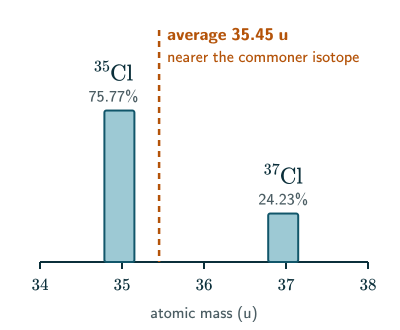
Chlorine is 75.77% Cl (34.9689 u) and 24.23% Cl (36.9659 u). Find its average atomic mass.
Average = 0.7577 × 34.9689 + 0.2423 × 36.9659 = 26.4959 + 8.9568 ≈ 35.453 u.
Answer: about 35.45 u. It is nearer 35 than 37 because three atoms in four are Cl.
Example 3: Average atomic mass of argon (NCERT Exercise 1.32, page 28)
Natural argon is 0.337% Ar (35.96755 g mol), 0.063% Ar (37.96272 g mol) and 99.600% Ar (39.9624 g mol). Find its average molar mass.
0.00337 × 35.96755 + 0.00063 × 37.96272 + 0.99600 × 39.9624
= 0.12121 + 0.02392 + 39.80255
= 39.94768 g mol.
Answer: about 39.95 g mol. NCERT’s exercise gives molar masses in g mol, which are numerically equal to the atomic masses in u.
Example 4: Finding the abundances from the average
Boron has two isotopes, B (10.013 u) and B (11.009 u), and an average atomic mass of 10.81 u. Find the percentage of each isotope.
Let the fraction of B be x; then the fraction of B is 1 − x:
10.013x + 11.009(1 − x) = 10.81
11.009 − 0.996x = 10.81, so x = 0.199/0.996 ≈ 0.200.
Answer: about 20.0% B and 80.0% B. Check: 0.200 × 10.013 + 0.800 × 11.009 = 10.81 u.
Common mistakes to avoid
Common mistake
Using per cent abundances as fractions
Divide each percentage by 100 before multiplying: 75.77% is 0.7577. With the percentages as they stand, chlorine would come out as 3545 u.
Common mistake
Expecting an atom to have the average mass
No chlorine atom has a mass of 35.45 u; each is about 35 u or about 37 u. The average describes a large natural sample.
Common mistake
Calling 58.5 u the molecular mass of NaCl
Solid sodium chloride has no discrete molecules, so 58.5 u is its formula mass. The arithmetic is the same; the name tells you there are no discrete molecules (as in ionic solids, or network solids such as SiO2).
Common mistake
Abundances given as a ratio
If the abundances do not add up to 100, or are given as a ratio, divide by their total: average = Σ(pimi)/Σpi. Chlorine as Cl : Cl = 3 : 1 gives (3 × 35 + 37)/4 = 35.5.
Common mistake
Thinking a new standard changes real masses
If 1 u were defined as 1/6 of a C atom instead of 1/12, every relative atomic and molecular mass would halve (H2O would be 9.01). The real mass of any sample would not change; only the numbers on the scale would.
Common mistake
Thinking 1 u is the mass of a hydrogen atom
1 u is one-twelfth of a carbon-12 atom. A hydrogen atom is slightly heavier, about 1.008 u.
Quick revision summary
- Atomic masses are relative to carbon-12, which is exactly 12 u; 1 u = 1/12 of the mass of a C atom = 1.66056 × 10 g (NCERT value). ‘amu’ is now written ‘u’.
- Average atomic mass = Σ (fractional abundance × isotopic mass); the periodic table lists these averages.
- Molecular mass = sum of the atomic masses of all the atoms in a molecule (CH4 16.043 u, H2O 18.02 u, glucose 180.162 u).
- Ionic solids such as NaCl have formula masses (58.5 u), worked out the same way.
Formula sheet
- 1 u = (1/12) × mass of one C atom = 1.66056 × 10 g
- Average atomic mass = Σ (fractional abundance × isotopic mass)
- Molecular mass = Σ (number of atoms × atomic mass)
- Formula mass of NaCl = 23.0 u + 35.5 u = 58.5 u
- CH = 16.043 u; HO = 18.02 u; CHO = 180.162 u
Questions students ask
What is the difference between atomic mass and mass number?
Mass number, A, is the number of protons plus neutrons in a nucleus, a whole number with no unit, while atomic mass is the actual mass of an atom in u, which is generally not a whole number; carbon-12 is the defining exception (exactly 12 u by definition). An iron-56 atom has mass number 56 but an atomic mass of 55.935 u, and natural iron, a mixture of isotopes, has an average atomic mass of 55.85 u. The mass number identifies an isotope; the average atomic mass is used for ordinary samples; isotopically enriched samples require their own composition.
Is atomic mass the same as atomic weight?
In everyday chemistry atomic mass and atomic weight mean the same periodic-table number: ‘atomic weight’ is the traditional name for the relative atomic mass, Ar, such as 16.00 for oxygen, and many books use the two terms interchangeably. Strictly, atomic weight (relative atomic mass; a standard atomic weight is a recommended value or interval for normal terrestrial materials) is a pure number, the average mass of an element’s atoms in natural samples divided by one-twelfth of the mass of a carbon-12 atom, while an atomic mass is a mass in u. The word ‘weight’ survives from history: the quantity is a ratio of masses, not a force.
What is the difference between amu and u?
Today amu and u name the same unit, one-twelfth of the mass of a carbon-12 atom (about 1.6605 × 10 g), and NCERT now writes u, the unified atomic mass unit. Before 1961 ‘amu’ had two slightly different meanings: physicists used one-sixteenth of the mass of an oxygen-16 atom, and chemists one-sixteenth of the average mass of the atoms in natural oxygen. The carbon-12 unit unified the two scales, which is why it is called ‘unified’, and it changed the chemists’ atomic masses by only about 0.004%.
Why are atomic masses not whole numbers?
Atomic masses are not whole numbers because most elements are mixtures of isotopes, and because even a single isotope’s mass is not exactly its mass number. Bromine, for example, is about 50.7% bromine-79 (78.918 u) and 49.3% bromine-81 (80.916 u), so its average atomic mass is 79.90 u. A single isotope’s mass (except carbon-12’s, exactly 12 u by definition) is not a whole number because a proton (1.00728 u) and a neutron (1.00866 u) each have a mass a little more than 1 u, and some mass is lost as binding energy when the nucleus forms: an oxygen-16 atom is 15.995 u, about 0.137 u less than its 8 protons, 8 neutrons and 8 electrons taken separately.
Practice questions
Try each question first, then open the answer to check your working.
-
Q1. Calculate the molecular masses of (i) H2O, (ii) CO2, (iii) CH4, using H = 1.008, C = 12.01 and O = 16.00 u (NCERT Exercise 1.1, page 25).
Show answerHide answer
(i) 2 × 1.008 + 16.00 = 18.02 u. (ii) 12.01 + 2 × 16.00 = 44.01 u. (iii) 12.01 + 4 × 1.008 = 16.04 u (with C = 12.011 u, as in the text, it is 16.043 u). (NCERT asks for molar masses; these are the same numbers in g mol.)
-
Q2. Find the formula mass of calcium carbonate, CaCO3 (Ca = 40.08, C = 12.01, O = 16.00 u).
Show answerHide answer
40.08 + 12.01 + 3 × 16.00 = 100.09 u.
-
Q3. Copper is 69.15% Cu (62.93 u) and 30.85% Cu (64.93 u). Find its average atomic mass.
Show answerHide answer
0.6915 × 62.93 + 0.3085 × 64.93 = 43.516 + 20.031 ≈ 63.55 u.