Atomic models
NCERT Class 11 Chemistry Chapter 2 Section 2.2
Quick answer
Thomson pictured the atom as a sphere of evenly spread positive charge with electrons embedded in it. Rutherford’s gold foil experiment showed instead that nearly all the mass and all the positive charge sit in a tiny nucleus, with electrons orbiting it. The nucleus holds Z protons (Z is the atomic number) and A − Z neutrons (A, the mass number, is the total of protons and neutrons), and atoms of one element with different numbers of neutrons are isotopes.
With your textbook
NCERT Chemistry Part I (Class 11), Chapter 2 “Structure of Atom”, Section 2.2 “Atomic Models”, pages 32–37.
Open the official NCERT chapter (PDF, 5.5 MB, ncert.nic.in) (opens in a new tab)
Checked against the 2026-27 reprint on .
What do the atomic models say?
Thomson’s and Rutherford’s models of the atom
- Thomson’s model (1898): the atom is a sphere, about 10 m in radius, of evenly spread positive charge with electrons embedded in it, like plums in a pudding. Its mass is spread evenly over the atom.
- Rutherford’s nuclear model (from his α-particle scattering experiment): almost all the mass and all the positive charge of the atom are in a tiny central nucleus, about 10 m in radius. Electrons move round it in circular orbits, held by electrostatic attraction, and most of the atom is empty space.
- The nucleus contains protons (their number is the atomic number, Z, which orders the modern periodic table) and neutrons. Protons and neutrons together are nucleons; their number is the mass number, A = Z + number of neutrons.
(NCERT Section 2.2, pages 32–37.)
In plain words: once electrons were known, the question was how the positive charge and the mass are arranged around them. Thomson spread them evenly through the atom. Rutherford’s experiment showed instead that they are packed into a nucleus about 100 000 times smaller than the atom.
Thomson’s model
In 1898 J.J. Thomson proposed that an atom is a sphere of uniform positive charge in which the electrons are embedded so as to give the most stable arrangement (NCERT Section 2.2.1, page 33). It has been called the plum pudding, raisin pudding or watermelon model: a pudding of positive charge with electrons as the plums, or a watermelon with electrons as the seeds.
An important feature of this model is that the mass of the atom is assumed to be uniformly distributed over the atom.
NCERT Chemistry Part I (Class 11), Section 2.2.1, page 33
The model explained why atoms are electrically neutral, but it failed the test of later experiments. Thomson received the 1906 Nobel Prize in Physics for his work on the conduction of electricity through gases (page 33).
Two discoveries of the 1890s gave the tools for that test (pages 33–34):
-
X-rays. Wilhelm Röntgen (1845–1923) found in 1895 that electrons striking a material in a cathode ray tube produce rays that make fluorescent materials glow outside the tube. These X-rays are not bent by electric or magnetic fields, penetrate matter to a degree depending on photon energy and material thickness and have very short wavelengths, about 0.1 nm. NCERT spells his name “Wilhalm Röentgen”.
-
Radioactivity. Henri Becquerel (1852–1908) found that some elements give off radiation on their own; Marie Curie, Pierre Curie, Rutherford and Frederick Soddy developed the field. (NCERT misspells three of these names: “Becqueral”, “Piere” and “Fredrick”.) The radiation is of three kinds:
- α-rays: particles with two units of positive charge and mass 4 u, helium nuclei;
- β-rays: fast-moving electrons (the negative beta radiation described here by NCERT); some radioactive decays instead emit β particles, positrons;
- γ-rays: high-energy electromagnetic radiation like X-rays, neutral, not material particles.
For typical radioactive sources, alpha particles have the shortest range, beta particles penetrate farther, and gamma rays are more penetrating. NCERT quotes rough factors of 100 and 1000, but these are not universal constants: penetration depends on particle/photon energy, material and thickness.
Rutherford’s scattering experiment
Rutherford and his students Hans Geiger and Ernest Marsden fired a beam of high-energy α-particles from a radioactive source at a very thin gold foil, about 100 nm thick. A circular zinc sulphide screen around the foil gave a flash of light wherever an α-particle struck it (NCERT Section 2.2.2, page 34).
On Thomson’s model, the mass of each gold atom is spread evenly, so the α-particles should have passed through, slowing slightly and changing direction only by small angles. Instead (page 34):
- most α-particles passed through the foil undeflected;
- a small fraction were deflected by small angles;
- a very few, about 1 in 20 000, bounced back, deflected by nearly 180°.
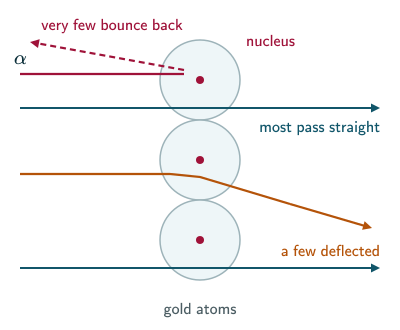
Rutherford concluded (pages 34–35):
Most of the space in the atom is empty as most of the α–particles passed through the foil undeflected.
NCERT Chemistry Part I (Class 11), Section 2.2.2, page 34
- The few large deflections need an enormous repulsive force, so the positive charge is not spread through the atom but concentrated in a very small volume.
- That volume, the nucleus, is tiny: the atom’s radius is about 10 m and the nucleus’s about 10 m. If a cricket ball were the nucleus, the atom’s radius would be a few kilometres (NCERT says about 5 km).
His nuclear model (page 35):
- the positive charge and most of the mass are concentrated in an extremely small nucleus;
- electrons move round the nucleus at very high speed in circular paths, called orbits, like planets round the sun;
- electrons and nucleus are held together by electrostatic attraction.
Atomic number and mass number
The positive charge of the nucleus is carried by its protons, each with a charge equal and opposite to an electron’s (NCERT Section 2.2.3, page 35). The neutrons add mass but no charge.
Atomic number and mass number
In a neutral atom the number of electrons equals Z: hydrogen has 1 proton and 1 electron, sodium 11 of each (page 35). An atom is written with A as a left superscript and Z as a left subscript, as in 2311Na.
For an ion, first decide whether it is neutral, a cation or an anion (NCERT note, page 36):
- number of protons = Z, always;
- number of neutrons = A − Z, always;
- number of electrons = Z for a neutral atom, Z − (charge) for a cation, Z + (size of the charge) for an anion.
Isobars and isotopes
- Isotopes are atoms of the same element, with the same Z, but different mass numbers, because they have different numbers of neutrons (NCERT Section 2.2.4, page 35).
- Isobars are atoms of different elements with the same mass number, such as 146C and 147N.
NCERT’s examples of isotopes (page 35):
- hydrogen: protium, 11H (1 proton, 99.985% of hydrogen atoms); deuterium, 21D (1 proton and 1 neutron, 0.015%); tritium, 31T (1 proton and 2 neutrons, only in traces);
- carbon: 126C, 136C and 146C, with 6, 7 and 8 neutrons;
- chlorine: 3517Cl and 3717Cl, with 18 and 20 neutrons.
Therefore, all the isotopes of a given element show same chemical behaviour.
NCERT Chemistry Part I (Class 11), Section 2.2.4, page 35
The reason for their broadly similar chemistry is their matching electron arrangements in the same charge state (page 35). The quoted statement is an approximation: different isotope masses can change reaction rates and equilibrium constants, especially for hydrogen versus deuterium (IUPAC Gold Book, isotope effect). Natural isotope mixtures are why atomic masses are averages, and why Dalton’s idea of identical atoms had to change.
Drawbacks of Rutherford’s model
Rutherford’s atom looks like a small solar system, and the electrostatic force between electron and nucleus, kq1q2/r, has the same form as gravity between the sun and a planet (NCERT Section 2.2.5, page 36). But there is a crucial difference. A body moving in a circle is accelerating even at constant speed, because its direction keeps changing, and Maxwell’s electromagnetic theory says that an accelerating charge radiates energy. Planets are uncharged; electrons are not. So the electron should lose energy, spiral inwards and fall into the nucleus.
Thus, the Rutherford model cannot explain the stability of an atom.
NCERT Chemistry Part I (Class 11), Section 2.2.5, page 36
NCERT says the fall would take only 10 s (page 36). The standard classical estimate for the hydrogen atom is shorter still, about 10 s (beyond the NCERT text); either way, atoms would not last. In exams, quote NCERT’s 10 s. A spiralling electron would also give out a continuous range of frequencies, whereas atoms give line spectra (beyond NCERT Section 2.2.5). Electrons cannot simply stand still either, since attraction would then pull them into the nucleus (page 37). The model also says nothing about how the electrons are arranged round the nucleus or what their energies are (page 37). Bohr’s model, which followed, tackled both problems.
Solved examples
Example 1: Particles in a bromine atom (NCERT Problem 2.1, page 36)
Calculate the number of protons, neutrons and electrons in 8035Br.
Z = 35 and A = 80, and the species is neutral. Protons = electrons = Z = 35. Neutrons = A − Z = 80 − 35 = 45.
Answer: 35 protons, 45 neutrons, 35 electrons.
Example 2: Naming a species (NCERT Problem 2.2, page 36)
A species has 18 electrons, 16 protons and 16 neutrons. Give its symbol.
Z = protons = 16, so the element is sulphur. A = 16 + 16 = 32. There are 2 more electrons than protons, so it is an anion with charge 2−.
Answer: 3216S2−.
Example 3: Neutrons and protons in nuclei (NCERT Exercise 2.3, page 69)
How many protons and neutrons are there in 136C, 168O, 2412Mg, 5626Fe and 8838Sr?
Protons = Z, neutrons = A − Z:
| Nucleus | Protons | Neutrons |
|---|---|---|
| C-13 | 6 | 7 |
| O-16 | 8 | 8 |
| Mg-24 | 12 | 12 |
| Fe-56 | 26 | 30 |
| Sr-88 | 38 | 50 |
Answer: as in the table.
Example 4: An ion from a percentage (NCERT Exercise 2.44, page 71)
An ion with mass number 56 carries 3 units of positive charge and has 30.4% more neutrons than electrons. Identify it.
Let the number of protons be p. The ion has charge 3+, so electrons = p − 3, and neutrons = 1.304(p − 3).
Mass number: p + 1.304(p − 3) = 56, so 2.304p = 59.912 and p = 26.0.
Z = 26 is iron; electrons = 23, neutrons = 30.
Answer: 5626Fe3+.
Example 5: A foil of light atoms (NCERT Exercise 2.40, page 71)
Rutherford used thin foils of heavy atoms such as gold or platinum. What difference would a foil of light atoms, such as aluminium, make?
An aluminium nucleus has a much smaller positive charge (13 against 79 for gold) and a much smaller mass. The repulsion on an α-particle is weaker, so fewer α-particles would be deflected through large angles, and hardly any would bounce back. A light nucleus can also recoil when struck, instead of acting as a fixed, heavy centre.
Answer: far fewer large-angle deflections and back-scattered α-particles; most would pass through with small deflections.
Common mistakes to avoid
Common mistake
Using the mass number for the number of electrons
Electrons in a neutral atom equal Z, not A. Neutrons are A − Z.
Common mistake
Forgetting the charge of an ion
In S2− there are 16 protons but 18 electrons; in Fe3+, 26 protons but 23 electrons. The number of neutrons, A − Z, does not depend on the charge.
Common mistake
Mixing up isotopes and isobars
Isotopes: same element (same Z), different A. Isobars: same A, different elements. Atoms with the same number of neutrons but different Z, such as 146C and 168O, are called isotones (beyond the NCERT text).
Common mistake
Thinking electrons could deflect the α-particles
An electron is about 7300 times lighter than an α-particle, so collisions with electrons cannot account for the observed large-angle scattering of energetic alpha particles. Concentrated nuclear charge explains those large deflections.
Common mistake
Forgetting that protium has no neutron
Ordinary hydrogen, 11H, is the only stable nuclide with no neutron: A = Z = 1.
Common mistake
Confusing similar isotope chemistry with identical reaction rates
Neutral isotopes have the same electron arrangement and broadly similar chemistry, but isotope substitution can alter reaction rates and equilibria. Their masses differ, and so do properties that depend on mass, such as density and rate of diffusion; some isotopes, such as 14C and tritium, are radioactive.
Quick revision summary
- Thomson (1898): uniform sphere of positive charge with embedded electrons; mass spread evenly.
- Rutherford’s α-scattering: most pass through, a few deflected, about 1 in 20 000 bounce back. So the atom is mostly empty, with a tiny, dense, positive nucleus (about 10 m against 10 m for the atom).
- Nuclear model: electrons orbit the nucleus, held by electrostatic attraction.
- Z = number of protons (= electrons in a neutral atom); A = Z + number of neutrons.
- Isotopes: same Z, different A, broadly similar chemistry. Isobars: same A, different Z.
- Rutherford’s model fails: an orbiting (accelerating) electron should radiate and fall into the nucleus, and the model says nothing about electron energies.
Formula sheet
- Z = number of protons = number of electrons (neutral atom)
- A = Z + number of neutrons; neutrons = A − Z
- Electrons in an ion = Z − charge (cation), Z + size of charge (anion)
- Nucleus about 10 m; atom about 10 m
Questions students ask
What are the main atomic models in order?
The main atomic models, in order, are Dalton’s indivisible atom (1808), Thomson’s plum pudding model (1898 in NCERT, often dated 1904), Rutherford’s nuclear model (1911), Bohr’s model (1913) and the quantum mechanical model (1926), used today. Each earlier model fell to a result it could not explain: electrons ended the indivisible atom, α-particle scattering ended Thomson’s, atoms’ stability and line spectra ended Rutherford’s, and the electron’s wave nature ended Bohr’s.
What is the difference between Thomson’s and Rutherford’s models of the atom?
Thomson’s model spreads the atom’s positive charge and mass evenly through a sphere about 10 m in radius, with the electrons embedded in it, while Rutherford’s model packs all the positive charge and nearly all the mass into a nucleus about 10 m in radius, with the electrons moving round it through mostly empty space. Thomson’s atom could turn α-particles only slightly, so it could not explain the few that bounced back from gold foil; Rutherford’s dense nucleus could. Neither model fixed the energies of the electrons or explained line spectra, which Bohr’s model tackled in 1913.
Why did Rutherford use gold foil in his scattering experiment?
Rutherford’s team used gold because it is the most malleable metal, so it can be beaten into a foil only about 100 nm thick, a few hundred atoms, thin enough for most α-particles to pass straight through and for each large deflection to come from a single nucleus. A gold nucleus also has a large charge, +79e, and is about 50 times as heavy as an α-particle, so it can turn an α-particle through a large angle, even back, while hardly recoiling. Geiger and Marsden found that large-angle scattering grew with the atomic mass of the foil’s metal, and so with its nuclear charge, as the nuclear model predicts.
What are the limitations of Thomson’s model of the atom?
The main limitation of Thomson’s model is that it cannot explain Rutherford’s α-particle scattering: with its charge and mass spread evenly, no part of the atom could turn a fast α-particle through a large angle, yet about 1 in 20 000 bounced back from gold foil. Nor could it explain the line spectra that atoms emit. Its one success was explaining why an atom is electrically neutral.
Are Thomson’s and Rutherford’s models in the JEE Main 2027 and NEET (UG) 2026 syllabuses?
Thomson’s and Rutherford’s models are not named in the Chemistry Unit 2 (Atomic Structure) text of the JEE Main 2027 or NEET (UG) 2026 syllabus, which starts from the nature of electromagnetic radiation, but Rutherford’s model is in both Physics syllabuses: Unit 18, Atoms and Nuclei, lists the ‘alpha-particle scattering experiment’ and ‘Rutherford’s model of atom’. Thomson’s model is named in neither. Atomic number, mass number and isotopes are used all through both exams, so the basics of NCERT Section 2.2 are still needed.
Practice questions
Try each question first, then open the answer to check your working.
-
Q1. Write the complete symbol for the atom with (i) Z = 17, A = 35; (ii) Z = 92, A = 233; (iii) Z = 4, A = 9 (NCERT Exercise 2.4, page 69).
Show answerHide answer
(i) 3517Cl; (ii) 23392U; (iii) 94Be.
-
Q2. An element with mass number 81 contains 31.7% more neutrons than protons. Assign its atomic symbol (NCERT Exercise 2.42, page 71).
Show answerHide answer
Let protons = p; neutrons = 1.317p. Then p + 1.317p = 81, so p = 81/2.317 ≈ 35.0. Z = 35 is bromine: 8135Br, with 46 neutrons. The supplied 31.7% is approximate: 46 is actually about 31.4% greater than 35; the nearest consistent integer assignment is bromine-81.
-
Q3. An ion with mass number 37 carries one unit of negative charge and has 11.1% more neutrons than electrons. Find its symbol (NCERT Exercise 2.43, page 71).
Show answerHide answer
Let protons = p; electrons = p + 1; neutrons = 1.111(p + 1). Then p + 1.111(p + 1) = 37, so 2.111p = 35.889 and p = 17.0. Z = 17 is chlorine: 3717Cl−, with 18 electrons and 20 neutrons.