Discovery of sub-atomic particles
NCERT Class 11 Chemistry Chapter 2 Section 2.1
Quick answer
Cathode-ray experiments showed that all atoms contain electrons, negative particles whose charge-to-mass ratio Thomson measured in 1897 and whose charge Millikan found in his oil drop experiment. Canal rays gave the proton, the lightest positive ion, from hydrogen. Chadwick discovered the neutral neutron in 1932, slightly heavier than the proton.
With your textbook
NCERT Chemistry Part I (Class 11), Chapter 2 “Structure of Atom”, Section 2.1 “Discovery of Sub-atomic Particles”, pages 30–32.
Open the official NCERT chapter (PDF, 5.5 MB, ncert.nic.in) (opens in a new tab)
Checked against the 2026-27 reprint on .
How were the sub-atomic particles discovered?
The three sub-atomic particles
Experiments on electric discharge through gases in the late 1800s showed that atoms are not indivisible; by 1932 three kinds of particle were known (NCERT Section 2.1, pages 30–32):
- the electron, charge −1.602 × 10 C and mass 9.1094 × 10 kg, found in cathode rays;
- the proton, charge +1.602 × 10 C and mass 1.6726 × 10 kg, the lightest positive ion, from hydrogen;
- the neutron, no charge and mass 1.6749 × 10 kg, found by Chadwick in 1932.
In plain words: Dalton’s atom was a solid, unbreakable ball. Sparks through gases at low pressure showed that every atom contains tiny negative particles, electrons. Since atoms are neutral, they must also contain positive charge, which turned out to be carried by protons. The neutron, with no charge, was found last.
Cathode rays and the electron
In the early 1830s (NCERT gives 1830), Michael Faraday showed that passing electricity through a solution of an electrolyte liberates and deposits matter at the electrodes. This suggested that electricity itself is made of particles (NCERT Section 2.1.1, page 30).
A cathode ray discharge tube is a glass tube with two metal electrodes sealed in it. The gas inside is kept at a very low pressure, and a very high voltage is applied. A stream of particles then flows from the negative electrode, the cathode, to the positive one, the anode. If a hole is made in the anode and the glass behind it is coated with zinc sulphide, a bright spot appears where the rays strike (page 30). NCERT lists what was found (pages 30–31):
- the rays start at the cathode and move towards the anode;
- they are invisible, but make fluorescent or phosphorescent materials glow;
- with no electric or magnetic field, they travel in straight lines;
- in an electric or magnetic field they bend as negatively charged particles would: they are electrons;
- their properties do not depend on the material of the electrodes or the gas in the tube.
Thus, we can conclude that electrons are basic constituent of all the atoms.
NCERT Chemistry Part I (Class 11), Section 2.1.1, page 31
Charge-to-mass ratio: Thomson’s experiment
In 1897 J.J. Thomson passed a beam of electrons through an electric field and a magnetic field at right angles to each other and to the beam (NCERT Section 2.1.2, page 31).
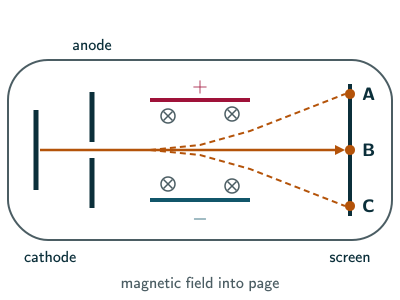
How far the electrons are deflected depends on (page 31):
- the charge on the particle: the greater the charge, the greater the deflection;
- the mass of the particle: the lighter the particle, the greater the deflection;
- the strength of the field: the deflection grows with the voltage across the plates or the strength of the magnetic field.
By balancing the two fields so that the beam reaches B undeflected, and measuring the deflections, Thomson found the charge-to-mass ratio of the electron. Its accepted value, as NCERT gives it (Eq. 2.1, page 31), is
Charge-to-mass ratio of the electron
e/me = 1.758820 × 10 C kg
The electron’s charge is −e, because it is negative.
Charge on the electron: Millikan’s oil drop
R.A. Millikan (1868–1953) measured the charge itself in his oil drop experiment (1906–14) (NCERT Section 2.1.3, page 31). A fine mist of oil drops entered the space between two charged plates through a small hole. X-rays ionised the air, and the drops picked up charge by colliding with the ions. From the rate of fall Millikan found each drop’s mass. Then, by adjusting the voltage on the plates, he could slow a drop down, speed it up or hold it still (NCERT box, page 32). In the elementary treatment a moving drop experiences gravity, electric force and viscous drag; a precise analysis also includes upward buoyancy from the displaced air (NCERT Fig. 2.3). That drag is the subject of Stokes’ law.
Millikan concluded that the magnitude of electrical charge, q, on the droplets is always an integral multiple of the electrical charge, e
NCERT Chemistry Part I (Class 11), Section 2.1.3, page 32
For the magnitude of a charged drop’s net charge, |q| = ne with n = 1, 2, 3, …; neutral drops have n = 0. The sign distinguishes excess from missing electrons. Millikan found e close to 1.6 × 10 C; the SI value is exactly 1.602176634 × 10 C. The numerical example below uses NCERT’s stated rounded input. Combining it with Thomson’s e/me gives the mass of the electron (NCERT Eq. 2.2, page 31):
Mass of the electron
Protons and neutrons
A modified discharge tube also gives canal rays, streams of positively charged particles. Unlike cathode rays (NCERT Section 2.1.4, page 32):
- their mass, and their charge-to-mass ratio, depend on the gas in the tube: they are simply positive gaseous ions;
- their charge-to-mass ratio is largest for hydrogen, whose ion is the proton: about 9.58 × 10 C kg, 1836 times smaller than the electron’s;
- some of them carry a whole-number multiple of the unit charge;
- they bend the opposite way to electrons in electric and magnetic fields.
The smallest and lightest positive ion was obtained from hydrogen and was called proton.
NCERT Chemistry Part I (Class 11), Section 2.1.4, page 32
Canal rays are made when the gas in the tube is ionised: the positive ions move towards the cathode and pass through holes (‘canals’) in it. Eugen Goldstein first saw them in 1886 (beyond the NCERT text here). They are also called anode rays, but they do not come from the anode.
The proton was characterised in 1919, by Rutherford (beyond the NCERT text). A neutral particle was still needed to account for atoms’ masses. In 1932 James Chadwick bombarded a thin sheet of beryllium with α-particles and found neutral particles slightly heavier than protons: neutrons (page 32). The reaction is 94Be + 42He → 126C + 10n.
| Particle | Relative charge | Mass (u) |
|---|---|---|
| Electron | −1 | 0.00054 |
| Proton | +1 | 1.00727 |
| Neutron | 0 | 1.00867 |
These are NCERT’s values from Table 2.1 (page 33); the charges and masses in SI units are in the definition box above. NCERT cuts the masses in u short: from its own masses in kilograms, the electron is 0.000549 u (about 1/1823 u), the proton 1.00728 u and the neutron 1.00866 u. The proton is about 1836 times as heavy as the electron, and the neutron slightly heavier than the proton.
Solved examples
Example 1: The mass of the electron
Using e = 1.602176 × 10 C and e/me = 1.758820 × 10 C kg, find the mass of the electron.
me = e ÷ (e/me) = (1.602176 × 10 C) ÷ (1.758820 × 10 C kg) = 9.1094 × 10 kg.
Answer: 9.1094 × 10 kg, as NCERT gives in Eq. 2.2.
Example 2: Counting electrons from a charge (NCERT Exercises 2.38 and 2.39, page 71)
(a) A particle carries 2.5 × 10 C of static charge. How many electrons does this represent? (b) In Millikan’s experiment an oil drop carries −1.282 × 10 C. How many electrons are on it? (e = 1.602 × 10 C.)
(a) n = (2.5 × 10 C) ÷ (1.602 × 10 C) ≈ 1.56 × 10 electrons.
(b) n = (1.282 × 10 C) ÷ (1.602 × 10 C) = 8.00, so 8 extra electrons.
Answer: (a) a charge magnitude equivalent to about 1.6 × 10 electrons (two significant figures); if the stated charge is positive, these are missing electrons. (b) 8 excess electrons, not the total number of electrons in the drop. In (b) the charge is a whole-number multiple of e, as Millikan found.
Example 3: Electrons by mass and by the mole (NCERT Exercise 2.1, page 69)
(i) How many electrons together weigh one gram? (ii) Find the mass and the charge of one mole of electrons. (me = 9.1094 × 10 kg, e = 1.602 × 10 C, NA = 6.022 × 10 mol.)
(i) 1 g = 1 × 10 kg, so the number = (10 kg) ÷ (9.1094 × 10 kg) ≈ 1.098 × 10 electrons.
(ii) Mass = 6.022 × 10 × 9.1094 × 10 kg ≈ 5.486 × 10 kg. Charge = 6.022 × 10 × 1.602 × 10 C ≈ 9.647 × 10 C (negative). This charge, about 96 500 C, is one faraday.
Answer: about 1.098 × 10 electrons; one mole of electrons has a mass of about 0.549 mg and a charge of about −9.65 × 10 C.
Example 4: Electrons in methane (NCERT Exercise 2.2(i), page 69)
How many electrons are there in one mole of methane, CH4?
A carbon atom has 6 electrons and each hydrogen atom 1, so one CH4 molecule has 6 + 4 × 1 = 10 electrons. One mole has 10 × 6.022 × 10 = 6.022 × 10 electrons.
Answer: 6.022 × 10 electrons.
Common mistakes to avoid
Common mistake
Thinking cathode rays depend on the gas
Cathode rays (electrons) are the same whatever the gas and the electrode material. It is the canal rays (positive ions) whose mass and charge-to-mass ratio change with the gas.
Common mistake
Writing the electron’s charge as +e
The electron carries −e. Thomson’s ratio e/me uses the size of the charge, but the electron’s charge is negative.
Common mistake
Calling the proton and the neutron equally heavy
They are close, but the neutron is slightly heavier: 1.00867 u against 1.00727 u (NCERT’s figures). The proton is about 1836 and the neutron about 1839 times as heavy as the electron.
Quick revision summary
- Cathode rays are streams of electrons; their properties do not depend on the gas or the electrodes, so electrons are in all atoms.
- Thomson (1897) measured e/me; today’s value is 1.758820 × 10 C kg.
- Millikan (oil drop, 1906–14): charge is always a whole-number multiple of e (he found about 1.6 × 10 C; today 1.602 × 10 C); so me = 9.1094 × 10 kg.
- Canal rays are positive ions; the lightest, from hydrogen, is the proton (characterised in 1919).
- Chadwick (1932): the neutron, neutral and slightly heavier than the proton.
Formula sheet
- e/m = 1.758820 × 10 C kg
- e = 1.602176634 × 10 C (exact); |q| = ne (n = 0, 1, 2, …)
- m = 9.1094 × 10 kg
- Proton 1.6726 × 10 kg; neutron 1.6749 × 10 kg
- Proton mass ≈ 1836 × electron mass
Questions students ask
How many sub-atomic particles are there?
The usual building blocks of atoms are electrons, protons and neutrons (ordinary hydrogen has no neutron), and these are the only ones Class 11 Chemistry needs. Physicists know of many more: the proton and neutron each contain three valence quarks bound by gluons, together with quantum fluctuations involving additional quark–antiquark pairs, while the electron has no known parts, and cosmic rays and particle accelerators produce others, such as positrons, muons, pions and neutrinos. None of these extra particles is needed to explain how atoms are built or how they react.
Who discovered the proton, Goldstein or Rutherford?
The proton’s discovery is shared: Eugen Goldstein discovered canal rays, streams of positive ions, in 1886, and Ernest Rutherford showed, in work published in 1919, that the hydrogen nucleus, the proton, is part of other nuclei. Rutherford found that α-particles fired into nitrogen gas knock hydrogen nuclei out of nitrogen nuclei, proposed that this particle is a building block of all nuclei, and named it the proton in 1920. Canal rays from hydrogen gas contain protons, which is why school books often credit Goldstein.
Why was the neutron discovered so long after the electron and the proton?
The neutron was discovered last, in 1932, because it has no charge: electric and magnetic fields do not bend it and it does not ionise a gas directly, so the discharge-tube methods that revealed electrons and protons could not detect it. Chadwick found it from its effects: the radiation from beryllium struck by α-particles knocked protons out of paraffin wax with energies that only a neutral particle about as heavy as a proton could explain. Rutherford had predicted such a particle in 1920 to account for the masses of nuclei.
What is the difference between cathode rays and X-rays?
Cathode rays are streams of electrons, particles with mass and negative charge, while X-rays are electromagnetic radiation, whose photons have zero rest mass and no electric charge, given out when fast cathode rays strike a solid target. So cathode rays are bent by electric and magnetic fields and cannot get through the glass of the tube, whereas X-rays are not deflected, travel at the speed of light, 3.0 × 10 m s, and can penetrate glass, paper and soft tissue to varying degrees, depending on photon energy and material thickness. Wilhelm Röntgen discovered X-rays in 1895 while working with a cathode ray tube, two years before Thomson showed that cathode rays are electrons.
Is Millikan’s oil drop experiment in the JEE Main 2027 and NEET (UG) 2026 syllabuses?
No, Millikan’s oil drop experiment is not named in the JEE Main 2027 or NEET (UG) 2026 syllabus: the Chemistry Unit 2 (Atomic Structure) text of both starts from the nature of electromagnetic radiation, and neither Physics syllabus lists it. It has not been deleted from NCERT, though: it is Section 2.1.3 of Structure of Atom in Class 11 Chemistry. Its results, the size of the electron’s charge, e (now 1.602 × 10 C), and charge coming only in whole-number multiples of it, q = ne, are used throughout both exams, so learn what it proved rather than the apparatus.
Practice questions
Try each question first, then open the answer to check your working.
-
Q1. Why did the cathode-ray experiments show that electrons are present in all atoms?
Show answerHide answer
The properties of cathode rays did not depend on the material of the electrodes or on the gas in the tube. Whatever atoms were present, the same negative particles came out, so electrons must be part of every atom.
-
Q2. An oil drop carries a charge of −4.806 × 10 C. How many extra electrons does it carry (e = 1.602 × 10 C)?
Show answerHide answer
(4.806 × 10 C) ÷ (1.602 × 10 C) = 3.000, so 3 electrons.
-
Q3. Give two ways in which canal rays differ from cathode rays.
Show answerHide answer
Canal rays are positively charged, so they bend the opposite way in electric and magnetic fields. Their mass and charge-to-mass ratio depend on the gas in the tube, whereas cathode rays are the same for every gas.