Stoichiometry and stoichiometric calculations
NCERT Class 11 Chemistry Chapter 1 Section 1.10
Quick answer
Stoichiometry is the calculation of the amounts of reactants and products in a reaction from its balanced equation, whose coefficients give the mole ratio. The reactant that is used up first is the limiting reagent and fixes how much product forms. In solutions, amounts are given as mass per cent, mole fraction, molarity (moles per litre of solution) or molality (moles per kilogram of solvent).
With your textbook
NCERT Chemistry Part I (Class 11), Chapter 1 “Some Basic Concepts of Chemistry”, Section 1.10 “Stoichiometry and Stoichiometric Calculations”, pages 20–24.
Open the official NCERT chapter (PDF, 4.0 MB, ncert.nic.in) (opens in a new tab)
Checked against the 2026-27 reprint on .
What is stoichiometry?
Stoichiometry
Stoichiometry is the calculation of the masses, and sometimes the volumes, of the reactants and products in a chemical reaction. The word comes from the Greek stoicheion (element) and metron (measure). Every such calculation starts from a balanced chemical equation, whose coefficients give the ratio of moles. When one reactant runs out first, it is the limiting reagent. For reactions in solution, the amount of a substance is given by a concentration: mass per cent, mole fraction, molarity or molality (NCERT Section 1.10, pages 20–24).
Stoichiometry, thus, deals with the calculation of masses (sometimes volumes also) of the reactants and the products involved in a chemical reaction.
NCERT Chemistry Part I (Class 11), Section 1.10, page 20
In plain words: a balanced equation is a recipe. It tells you how many moles of each ingredient react and how many moles of each product you get. Change everything to moles, use the recipe’s ratio, and change back to grams, litres or particles.
What a balanced equation tells you
For the combustion of methane (NCERT page 20):
CH4(g) + 2O2(g) → CO2(g) + 2H2O(g)
Methane and dioxygen are the reactants; carbon dioxide and water are the products. The letters (g), (l) and (s) give the state: gas, liquid or solid. The numbers in front, 1, 2, 1 and 2, are the stoichiometric coefficients. They give the number of molecules, and equally the number of moles, taking part (page 20). So this equation says:
- 1 mol of CH4 reacts with 2 mol of O2 to give 1 mol of CO2 and 2 mol of H2O;
- 1 molecule of CH4 reacts with 2 molecules of O2 to give 1 molecule of CO2 and 2 molecules of H2O;
- For ideal gases measured at the same temperature and pressure, the volume ratio is 1 : 2 : 1 : 2 provided water remains vapour. At 273.15 K and 1 bar, water condenses, so 45.4 L of steam is only a hypothetical ideal-gas equivalent, not the actual product volume. At 1 bar, use a temperature above water’s boiling point to compare all four gaseous volumes; the common molar volume is then RT/p, not 22.7 L;
- 16 g of CH4 reacts with 2 × 32 g of O2 to give 44 g of CO2 and 2 × 18 g of H2O.
The masses add up: 16 + 64 = 80 g on the left and 44 + 36 = 80 g on the right, as the law of conservation of mass requires. The volumes do not have to add up: 3 volumes of gas on the left give 3 on the right here only by chance.
Balancing a chemical equation
A balanced equation has the same number of atoms of each element on both sides (NCERT box, page 21). Many equations can be balanced by trial, one element at a time. NCERT’s example is the combustion of propane:
- Write the correct formulas: C3H8(g) + O2(g) → CO2(g) + H2O(l).
- Balance carbon: 3 C on the left need 3CO2.
- Balance hydrogen: 8 H on the left need 4H2O.
- Balance oxygen: the right now has 3 × 2 + 4 × 1 = 10 O atoms, so 5O2 is needed.
- Check: C3H8(g) + 5O2(g) → 3CO2(g) + 4H2O(l) has 3 C, 8 H and 10 O on each side.
Two more from the same box: 4Fe(s) + 3O2(g) → 2Fe2O3(s) and P4(s) + 5O2(g) → P4O10(s). (NCERT’s step 4 on page 21 repeats a full line by a printing error; the steps above give it in full.) Ionic redox equations that are hard to balance by trial are covered in balancing redox equations.
Always remember that subscripts in formulas of reactants and products cannot be changed to balance an equation.
NCERT Chemistry Part I (Class 11), Section 1.10, page 21
Limiting reagent
Reactions are often run with reactants in amounts different from the ratio in the equation. One reactant is then in excess, and the other is used up first. For a reaction proceeding to completion, this sets the maximum product yield, however much of the other reactant is left (NCERT Section 1.10.1, pages 20–21).
Hence, the reactant, which gets consumed first, limits the amount of product formed and is, therefore, called the limiting reagent.
NCERT Chemistry Part I (Class 11), Section 1.10.1, page 21
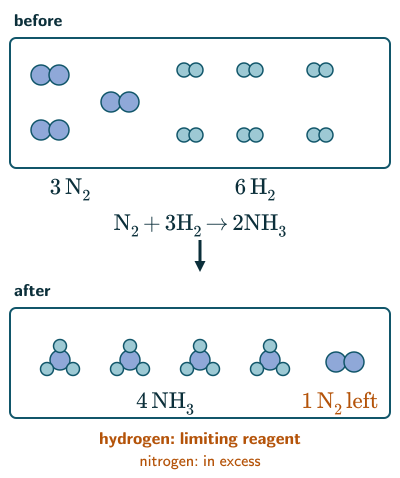
To find the limiting reagent:
- Convert every reactant to moles.
- Divide the moles of each reactant by its coefficient in the balanced equation.
- The reactant with the smallest result is the limiting reagent. Base all product amounts on it.
If two reactants give the same smallest value, they are supplied in the exact stoichiometric ratio and are both exhausted; neither is in excess. Equilibrium or side reactions can prevent complete consumption. Use only the pure part of an impure sample, and remember that the amount actually obtained is often less: actual yield = theoretical yield × per cent yield ÷ 100.
Reactions in solutions
Most laboratory reactions take place in solution, so the amount of a substance is given by its concentration (NCERT Section 1.10.2, pages 21–24). For a solute A in a solvent B:
- Mass per cent (w/w %) = (mass of solute ÷ mass of solution) × 100. NCERT Problem 1.6: 2 g of A in 18 g of water is 2/20 × 100 = 10%; divide by the mass of the solution, 20 g, not of the water.
- Mole fraction of A, xA = nA/(nA + nB); likewise xB = nB/(nA + nB), so xA + xB = 1.
- Molarity, M = moles of solute ÷ volume of solution in litres; its unit is mol L, written M.
- Molality, m = moles of solute ÷ mass of solvent in kilograms; its unit is mol kg, written m.
Note that molarity of a solution depends upon temperature because volume of a solution is temperature dependent.
NCERT Chemistry Part I (Class 11), Section 1.10.2, page 24
Molality uses masses, which do not change with temperature, so molality does not change with temperature (page 24). Mass per cent, mole fraction and mass-based ppm also remain unchanged when composition is unchanged (no reaction or evaporation); volume-based concentrations can change with temperature. Note the two denominators: molarity divides by the volume of the solution, molality by the mass of the solvent alone.
Dilution. Adding water changes the volume but not the number of moles of solute. NCERT’s example (page 23): to make 1 L of 0.2 M NaOH from 1 M NaOH, take the volume of 1 M solution that contains 0.2 mol, that is, 200 mL, and add water up to 1 L. In general:
Dilution
For two solutions of the same non-reacting solute, M = (M1V1 + M2V2)/Vfinal. Only when volumes are assumed additive may Vfinal be replaced by V1 + V2.
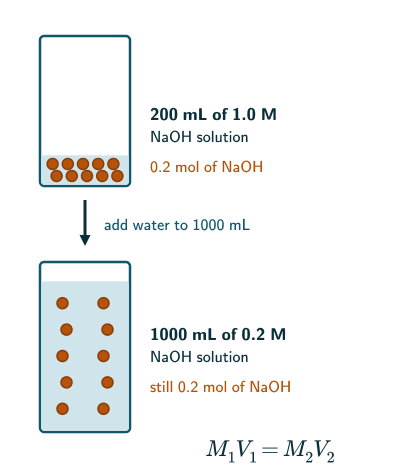
NCERT’s working for this example ends with V2 = 0.2 M × 1000 mL/1.0 M = 200 L (page 23). The units show it must be 200 mL: millilitres in, millilitres out.
Solved examples
Example 1: Burning methane (NCERT Problems 1.3 and 1.4, page 22)
(a) Calculate the mass of water produced by the combustion of 16 g of methane. (b) How many moles of methane are needed to produce 22 g of CO2?
CH4(g) + 2O2(g) → CO2(g) + 2H2O(g).
(a) 16 g of CH4 is 1 mol, and 1 mol of CH4 gives 2 mol of H2O: 2 mol × 18 g mol = 36 g.
(b) 22 g of CO2 is 22 ÷ 44 = 0.5 mol, and 1 mol of CO2 comes from 1 mol of CH4.
Answer: (a) 36 g of water; (b) 0.5 mol of methane.
Example 2: Ammonia and the limiting reagent (NCERT Problem 1.5, pages 22–23)
50.0 kg of N2 and 10.0 kg of H2 are mixed to produce ammonia. Calculate the amount of NH3 formed, and identify the limiting reagent (N2 = 28.0, H2 = 2.016, NH3 = 17.0 g mol).
N2(g) + 3H2(g) ⇌ 2NH3(g).
Moles of N2 = 50.0 × 10 g ÷ 28.0 g mol = 1.786 × 10 mol. Moles of H2 = 10.0 × 10 g ÷ 2.016 g mol = 4.960 × 10 mol.
H2 needed for all the N2 = 3 × 1.786 × 10 = 5.36 × 10 mol, but only 4.96 × 10 mol is present. So dihydrogen is the limiting reagent.
NH3 formed = 4.960 × 10 mol × 2/3 = 3.307 × 10 mol ≈ 3.31 × 10 mol.
Mass = 3.307 × 10 mol × 17.0 g mol ≈ 56.2 × 10 g = 56.2 kg.
Answer: dihydrogen limits the reaction; about 3.31 × 10 mol (3.307 × 10 unrounded), or 56.2 kg, is the theoretical maximum yield of ammonia. The reversible reaction need not reach that yield. NCERT cuts the moles of NH3 to 3.30 × 10 and so gets 56.1 kg (page 23); keeping the extra figure until the end, as in rounding off, gives 56.2 kg.
Example 3: Carbon dioxide from carbon (NCERT Exercise 1.4, page 25)
Calculate the amount of carbon dioxide that could be produced when (i) 1 mol of carbon is burnt in air; (ii) 1 mol of carbon is burnt in 16 g of dioxygen; (iii) 2 mol of carbon are burnt in 16 g of dioxygen. Assume all the carbon that burns forms CO2 (with so little oxygen, real burning also gives some CO).
C(s) + O2(g) → CO2(g), all in a 1 : 1 : 1 mole ratio. 16 g of O2 is 0.5 mol.
(i) Air is in excess, so 1 mol of C gives 1 mol of CO2 = 44 g.
(ii) 1 mol of C but only 0.5 mol of O2: oxygen is limiting, so 0.5 mol of CO2 = 22 g.
(iii) 2 mol of C and 0.5 mol of O2: oxygen is still limiting, so 0.5 mol of CO2 = 22 g.
Answer: 44 g; 22 g; 22 g. Extra carbon in (iii) makes no more CO2.
Example 4: Making ammonia, with the leftover (NCERT Exercise 1.24, page 27)
Dinitrogen and dihydrogen react to give ammonia. (i) Find the mass of ammonia produced when 2.00 × 10 g of N2 reacts with 1.00 × 10 g of H2. (ii) and (iii) Is either reactant left over, and what is its mass? (N2 = 28.02, H2 = 2.016, NH3 = 17.03 g mol.)
NCERT prints the equation as N2(g) + H2(g) → 2NH3(g) (page 27), which is not balanced. The balanced equation is N2(g) + 3H2(g) → 2NH3(g).
Moles: N2 = 2000/28.02 = 71.38 mol; H2 = 1000/2.016 = 496.0 mol. N2 needs 3 × 71.38 = 214.1 mol of H2, and 496.0 mol is present, so N2 is limiting.
(i) NH3 = 2 × 71.38 = 142.8 mol, that is, 142.8 × 17.03 ≈ 2.43 × 10 g.
(ii), (iii) H2 left = 496.0 − 214.1 = 281.9 mol, that is, 281.9 × 2.016 ≈ 568 g.
Answer: about 2.43 × 10 g of ammonia; about 568 g of dihydrogen is left unreacted.
Example 5: Molarity (NCERT Problem 1.7, page 24)
Calculate the molarity of NaOH in a solution made by dissolving 4 g of it in enough water to form 250 mL of solution (NaOH = 40 g mol).
Moles of NaOH = 4 g ÷ 40 g mol = 0.1 mol. Molarity = 0.1 mol ÷ 0.250 L = 0.4 mol L = 0.4 M.
Answer: 0.4 M. (NCERT’s working prints the unit as mol on page 24; it should be mol L.)
Example 6: From molarity to molality (NCERT Problem 1.8, page 24)
The density of a 3 M solution of NaCl is 1.25 g mL. Calculate its molality (NaCl = 58.5 g mol).
Take 1 L of solution. It contains 3 mol of NaCl, that is, 3 × 58.5 = 175.5 g. Mass of 1 L of solution = 1000 mL × 1.25 g mL = 1250 g.
Mass of water = 1250 − 175.5 = 1074.5 g = 1.0745 kg. Molality = 3 mol ÷ 1.0745 kg ≈ 2.79 m.
Answer: about 2.79 m. NCERT writes the subtraction as 1250 − 75.5 (page 24), a misprint for 1250 − 175.5; its result, 1074.5 g, is correct.
Common mistakes to avoid
Common mistake
Choosing the limiting reagent by mass or by raw moles
Neither the smaller mass nor the fewer moles decides it. In Example 4 the smaller mass, 1.00 × 10 g of H2, is in excess. In Example 2 hydrogen limits although it has more moles (4.96 × 10 against 1.786 × 10), because three moles of it are needed for each mole of N2. Compare moles ÷ coefficient.
Common mistake
Changing subscripts to balance an equation
Only the coefficients may change. Writing H2O2 for H2O to balance oxygen turns water into hydrogen peroxide.
Common mistake
Dividing by the volume of solvent in molarity
Molarity uses the volume of the whole solution. 4 g of NaOH “in 250 mL of water” and “in water to make 250 mL of solution” are different solutions.
Common mistake
Using the mass of the solution in molality
Molality divides by the mass of the solvent only, in kilograms. In Example 6 the solute’s 175.5 g must be subtracted first.
Common mistake
Carrying a premature rounding through a calculation
Round only the final answer. NCERT’s 56.1 kg in Problem 1.5 comes from cutting 3.307 × 10 mol to 3.30 × 10; carried unrounded, it gives 56.2 kg.
Quick revision summary
- Stoichiometry calculates amounts of reactants and products from a balanced equation; its coefficients give mole (and molecule) ratios, and for gases at the same temperature and pressure, volume ratios.
- Balance by changing coefficients, never subscripts; check every element at the end.
- The limiting reagent is the reactant with the smallest moles ÷ coefficient; it fixes the amount of product.
- Concentrations: mass per cent = (mass of solute ÷ mass of solution) × 100; mole fraction xA = nA/(nA + nB); molarity = mol of solute per litre of solution; molality = mol of solute per kg of solvent.
- For unchanged composition, molarity changes with temperature through volume; molality, mass per cent and mole fraction do not. On dilution, M1V1 = M2V2.
Formula sheet
- Mass per cent = (mass of solute ÷ mass of solution) × 100
- xA = nA/(nA + nB); xA + xB = 1
- Molarity M = moles of solute ÷ volume of solution in L
- Molality m = moles of solute ÷ mass of solvent in kg
- MV = MV (dilution)
- CH + 2O → CO + 2HO; CH + 5O → 3CO + 4HO
Questions students ask
What is the difference between molarity and molality?
Molarity is the number of moles of solute per litre of solution (mol L, written M), while molality is the number of moles of solute per kilogram of solvent (mol kg, written m), so molarity changes with temperature and molality does not. Molarity suits volumetric work at a fixed temperature, such as titrations, and molality is used where the temperature changes, as in boiling-point elevation and freezing-point depression. The two are linked through the density of the solution: molality = 1000 × molarity ÷ (1000 × density − molarity × molar mass of solute), with the density in g mL and the molar mass in g mol.
Is molality always greater than molarity?
No, molality is greater than molarity only when one litre of the solution contains less than 1 kg of solvent, because molarity divides the moles of solute by the litres of solution and molality divides them by the kilograms of solvent. A litre of a dilute solution in water at 25 °C holds a little less than 1 kg of water (water’s density is 0.997 g mL), so its molality is slightly larger. If a dissolved salt makes the solution much denser, or the solvent itself is dense, such as chloroform (1.48 g mL), a litre can hold more than 1 kg of solvent, and then the molality is smaller than the molarity.
Are the limiting reagent and the limiting reactant the same thing?
Yes, limiting reagent and limiting reactant are two names for the same thing: the reactant that is used up first and so fixes how much product forms. If one reactant uniquely limits a reaction proceeding to completion, the others are in excess. Reactants supplied in the exact required ratio can all be exhausted together. When 2.43 g of magnesium (0.100 mol) burns in 3.20 g of oxygen (0.100 mol of O2), 2Mg + O2 → 2MgO needs only 0.050 mol of O2, so magnesium is the limiting reagent, 4.03 g of MgO forms and 1.60 g of oxygen is left.
What is normality, and how is it related to molarity?
Normality is the number of gram equivalents of solute per litre of solution, and it equals molarity × n-factor, where the n-factor is the number of H+ ions an acid gives, OH− ions a base gives, or electrons a reagent gains or loses per formula unit in the reaction. So 0.10 M H2SO4 is 0.20 N when both acidic protons are neutralised, while 0.10 M HCl is 0.10 N. This chapter focuses on molarity, molality, mole fraction and percentage. Normality is reaction-dependent: always state the reaction and the equivalent being counted.
Does mole fraction have a unit?
No, mole fraction has no unit, because it is a ratio of two amounts in moles; it lies between 0 and 1, and multiplied by 100 it gives the mole per cent. It is not the same as the mass fraction: 1.00 mol of methanol (32.0 g) mixed with 4.00 mol of water (72.1 g) has a methanol mole fraction of 1.00/5.00 = 0.200 but a mass fraction of 32.0/104.1 = 0.307. For a binary mixture with both components present, the numerical mole and mass fractions are equal only when the two components have equal molar masses.
Is stoichiometry in the JEE Main 2027 and NEET (UG) 2026 syllabuses?
Yes, stoichiometry is in both: Unit 1, Some Basic Concepts in Chemistry, of the JEE Main 2027 syllabus (NTA) and of the NEET (UG) 2026 syllabus (NMC) ends with ‘chemical equations and stoichiometry’, after the mole concept, percentage composition and empirical and molecular formulae. The concentration terms on this page (molarity, molality, mole fraction and percentage) are listed not in Unit 1 but in Unit 5, Solutions, of both syllabuses.
Practice questions
Try each question first, then open the answer to check your working.
-
Q1. Calculate the mass of sodium acetate, CH3COONa, needed to make 500 mL of a 0.375 molar aqueous solution. Its molar mass is 82.0245 g mol (NCERT Exercise 1.5, page 25).
Show answerHide answer
Moles = 0.375 mol L × 0.500 L = 0.1875 mol. Mass = 0.1875 × 82.0245 ≈ 15.4 g.
-
Q2. What mass of CaCO3 reacts completely with 25 mL of 0.75 M HCl, by CaCO3(s) + 2HCl(aq) → CaCl2(aq) + CO2(g) + H2O(l)? CaCO3 = 100.09 g mol (NCERT Exercise 1.35, page 28).
Show answerHide answer
Moles of HCl = 0.025 L × 0.75 mol L = 0.01875 mol. CaCO3 needed = 0.01875/2 = 0.009375 mol, that is, 0.009375 × 100.09 ≈ 0.94 g.
-
Q3. For the reaction A + B2 → AB2, identify the limiting reagent, if any, in: (i) 300 atoms of A + 200 molecules of B2; (ii) 2 mol A + 3 mol B2; (iii) 100 atoms of A + 100 molecules of B2; (iv) 5 mol A + 2.5 mol B2; (v) 2.5 mol A + 5 mol B2 (NCERT Exercise 1.23, page 27, which writes B for the B2 molecules).
Show answerHide answer
A and B2 react 1 : 1. (i) B2 is limiting (200 < 300). (ii) A is limiting (2 < 3). (iii) Neither: they are in the exact ratio. (iv) B2 is limiting (2.5 < 5). (v) A is limiting (2.5 < 5).