Modern periodic law and the periodic table
NCERT Class 11 Chemistry Chapter 3 Section 3.3
Quick answer
The modern periodic law states that the physical and chemical properties of the elements are periodic functions of their atomic numbers. Moseley showed in 1913 that the square root of an element’s X-ray frequency plots as a straight line against atomic number but not against atomic mass, so atomic number is the more fundamental property. The long form of the periodic table arranges the elements by atomic number in 7 periods and 18 groups.
With your textbook
NCERT Chemistry Part I (Class 11), Chapter 3 “Classification of Elements and Periodicity in Properties”, Section 3.3 “Modern Periodic Law and the Present Form of the Periodic Table”, page 78.
Open the official NCERT chapter (PDF, 3.4 MB, ncert.nic.in) (opens in a new tab)
Checked against the 2026-27 reprint on .
What is the modern periodic law?
The modern periodic law
The physical and chemical properties of the elements are periodic functions of their atomic numbers (NCERT Section 3.3, page 78). The modern, long form of the periodic table arranges the elements by atomic number in 7 periods (horizontal rows) and 18 groups (vertical columns), with elements of similar outer electronic configuration in the same group.
In plain words: Mendeleev sorted the elements by mass and had to break his own order a few times to keep families together. Moseley found the right sorting key, the atomic number, the number of protons. Sorted that way, every element falls into place with no exceptions, because the atomic number fixes the number of electrons, and the electrons decide how an element behaves.
Moseley and the atomic number
When Mendeleev built his table, chemists knew nothing of the inside of the atom. In 1913 the English physicist Henry Moseley studied the characteristic X-rays given off by the elements. A plot of √ν (ν is the X-ray frequency) against atomic number Z gave a straight line; a plot against atomic mass did not (NCERT page 78). So the atomic number is a more fundamental property of an element than its atomic mass, and Mendeleev’s law was modified accordingly.
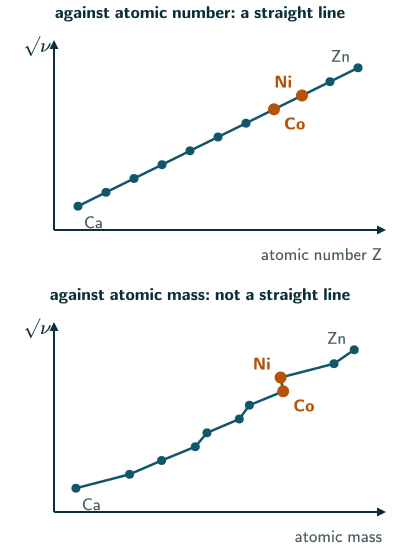
For the strongest X-ray line (called Kα), Moseley’s results fit
Moseley’s relation (K-alpha X-rays)
ν ≈ 2.47 × 10 (Z − 1) Hz, so √ν ∝ (Z − 1)
(beyond the NCERT text; the constant is ¾ of 3.29 × 10 Hz, the frequency constant of Bohr’s model). Kα X-rays are given off when an L-shell (n = 2) electron drops into a hole in the K shell (n = 1). The one K electron still there screens about one unit of nuclear charge, so ν = 3.29 × 10 (Z − 1) (1/1 − 1/2) Hz, and 1 − ¼ = ¾.
Ordering by atomic number cleared up the awkward pairs in the atomic-mass order, where the heavier element comes first:
| Pair | Atomic masses | Atomic numbers |
|---|---|---|
| Ar, K | 39.95, 39.10 | 18, 19 |
| Co, Ni | 58.93, 58.69 | 27, 28 |
| Te, I | 127.6, 126.9 | 52, 53 |
| Th, Pa | 232.04, 231.04 | 90, 91 |
It also settles isotopes: they have the same atomic number, so they share one place in the table.
The modern periodic law
The physical and chemical properties of the elements are periodic functions of their atomic numbers.
NCERT Chemistry Part I (Class 11), Section 3.3, page 78
The law revealed relationships among the 94 naturally occurring elements. NCERT notes that neptunium and plutonium, like actinium and protactinium, are found in pitchblende, an ore of uranium (page 78). The atomic number Z is the number of protons, equal to the number of electrons in a neutral atom; the nuclear charge is +Ze. Here “periodic” means recurring patterns of properties as Z increases, rather than exact repetition after one fixed interval: successive periods have different lengths. So the periodic law is really a consequence of the periodic repetition of electronic configurations, which decide the physical and chemical properties of the elements and their compounds (page 78).
Groups and periods
Many forms of the periodic table have been devised. The most convenient and most used is the long form (NCERT Fig. 3.2, page 79):
- Periods are the horizontal rows (Mendeleev called them series). There are seven. The period number is the highest principal quantum number, n, of the elements in it (palladium, [Kr] 4d10, is the odd one out: it sits in period 5 with no n = 5 electron). Why the periods hold 2, 8, 8, 18, 18, 32 and 32 elements is explained by the orbitals filled in each (NCERT Section 3.5).
- Groups, or families, are the vertical columns. Elements in a group have similar outer electronic configurations. IUPAC numbers the groups 1 to 18, replacing the older IA … VIIA, VIII, IB … VIIB and 0 (page 78).
- The 14 elements after lanthanum (the lanthanoids) and after actinium (the actinoids) sit in two separate rows at the bottom, which keeps the table to a manageable width.
| Period | n | Elements |
|---|---|---|
| 1 | 1 | 2 |
| 2 | 2 | 8 |
| 3 | 3 | 8 |
| 4 | 4 | 18 |
| 5 | 5 | 18 |
| 6 | 6 | 32 |
| 7 | 7 | 32 |
NCERT slip (page 78): NCERT calls the seventh period incomplete, with a theoretical maximum of 32 elements. Since elements up to 118 have been discovered and named, as NCERT’s own page 81 says, the seventh period is now complete: 2 + 8 + 8 + 18 + 18 + 32 + 32 = 118. If a question asks what NCERT says about the seventh period, give NCERT’s “incomplete”, with its theoretical maximum of 32; for the table as it stands, it has 32 elements.
Old and new group numbers. Two older schemes used A and B in opposite ways; NCERT’s Fig. 3.2 uses the European one, and the clash is one reason IUPAC moved to 1–18:
| New | NCERT Fig. 3.2 | American |
|---|---|---|
| 1, 2 | IA, IIA | IA, IIA |
| 3 to 7 | IIIA to VIIA | IIIB to VIIB |
| 8 to 10 | VIII | VIIIB |
| 11, 12 | IB, IIB | IB, IIB |
| 13 to 17 | IIIB to VIIB | IIIA to VIIA |
| 18 | 0 | VIIIA |
NCERT adds a note on Glenn T. Seaborg, whose work on the elements from plutonium onwards led to the actinoids being placed below the lanthanoids. He won the Nobel Prize in Chemistry in 1951, and element 106, seaborgium (Sg), is named after him (page 78).
Solved examples
Example 1: Mendeleev’s law and the modern law (NCERT Exercise 3.3, page 96)
What is the basic difference between Mendeleev’s periodic law and the modern periodic law?
Mendeleev’s law makes properties a periodic function of atomic weight; the modern law makes them a periodic function of atomic number. Ordering by atomic number removes the anomalies (Ar and K, Co and Ni, Te and I) and gives isotopes a single place.
Answer: atomic weight versus atomic number as the basis of the order.
Example 2: Finding an element from its place (NCERT Exercise 3.6, page 96)
What is the atomic number of the element in the third period and Group 17?
Period 3 begins after neon (Z = 10) and has groups 1, 2 and then 13 to 18. Group 17 is its seventh element: 10 + 7 = 17.
Answer: Z = 17, chlorine.
Example 3: Moseley’s relation for iron
Estimate the frequency and wavelength of iron’s Kα X-rays (Z = 26) from ν ≈ 2.47 × 10 (Z − 1) Hz.
ν ≈ 2.47 × 10 × 25 = 2.47 × 10 × 625 = 1.544 × 10 Hz.
λ = c/ν = (3.00 × 10 m s) ÷ (1.544 × 10 s) = 1.94 × 10 m = 0.194 nm.
Answer: about 1.54 × 10 Hz and 0.194 nm, X-rays, matching the measured 0.194 nm.
Example 4: The straight line
By how much does √ν change from one element to the next, according to Moseley’s relation?
√ν = √(2.47 × 10) × (Z − 1) = 4.97 × 10 × (Z − 1) Hz½. Each step of 1 in Z adds the same 4.97 × 10 Hz½.
Answer: a constant amount, which is why the graph against Z is a straight line.
Example 5: Counting the elements
Show that the period lengths account for all 118 elements.
2 + 8 + 8 + 18 + 18 + 32 + 32 = 118.
Answer: seven periods hold exactly 118 elements, so the table is full up to oganesson (Z = 118).
Common mistakes to avoid
Common mistake
Using atomic mass as the basis
The modern law uses atomic number. With atomic mass, argon would come after potassium and cobalt after nickel, which puts them in the wrong families.
Common mistake
Confusing period number with the number of elements
The period number is the principal quantum number of the outer shell, not the number of elements in the period. Period 4 has n = 4 but 18 elements.
Common mistake
Mixing old and new group numbers
A and B meant opposite things in the European and American schemes. NCERT Fig. 3.2 uses the European one, where group 15 is VB (American: VA). Use the 1–18 numbers; in them the p-block runs from 13 to 18.
Common mistake
Forgetting what NCERT says about period 7
NCERT (page 78) calls period 7 incomplete, and that is the answer an NCERT-based question on that sentence expects. Today all 32 places (Z = 87 to 118) are filled and named (NCERT page 81), so for any question about the table itself, use the completed seventh period.
Quick revision summary
- Moseley (1913): √ν of X-rays is a straight line against atomic number Z, not atomic mass; Z is the more fundamental property.
- Modern periodic law: properties are periodic functions of atomic numbers. It follows from the periodic repetition of electronic configurations.
- Ordering by Z fixes Ar/K, Co/Ni and Te/I and gives isotopes one place.
- Long form: 7 periods (period number usually = outermost n, with Pd an exception), 18 groups numbered 1–18 by IUPAC; lanthanoids and actinoids in separate rows.
- Period lengths 2, 8, 8, 18, 18, 32, 32, total 118.
Formula sheet
- Modern law: properties = periodic function of atomic number Z
- Moseley: √ν ∝ (Z − 1); ν ≈ 2.47 × 10 (Z − 1) Hz
- Period number = principal quantum number n of the outer shell
- Period lengths: 2, 8, 8, 18, 18, 32, 32 (total 118)
Questions students ask
What is the difference between Mendeleev’s periodic table and the modern periodic table?
Mendeleev’s periodic table orders the elements by atomic weight in Groups I to VIII (plus Group 0 in later versions), while the modern periodic table orders them by atomic number in 18 groups and 7 periods, with the lanthanoids and actinoids in two rows below. In Mendeleev’s table unlike elements shared a group as two subgroups, such as the alkali metals with copper, silver and gold in Group I; in the modern table each group has one type of outer electronic configuration, and the table divides into the s, p, d and f blocks. So the modern table also explains why the properties repeat, which Mendeleev’s could only describe.
What is Moseley’s law?
Moseley’s law states that the square root of the frequency of a given characteristic X-ray line rises linearly with the element’s atomic number: √ν = a(Z − b), where a and b are constants for that line (b ≈ 1 for the Kα line). Henry Moseley found it in 1913–14 from the X-rays of the elements aluminium to gold, and it showed that an element’s place is fixed by its atomic number, the number of protons in its nucleus, and not by its atomic mass. Gaps in his sequence showed that the elements with Z = 43, 61, 72 and 75 were still unknown: technetium (43) and promethium (61) were later made artificially, and hafnium (72) and rhenium (75) found in 1923 and 1925.
Why is the modern periodic table called the long form?
The modern periodic table is called the long form because each period is written as one row, so periods 4 and 5 run as long rows of 18 elements, with the transition elements in ten columns of their own. Mendeleev’s short form had only eight main groups, so each of these long periods was folded into two series, with the transition metals as subgroups beside the main-group elements. The lanthanoids and actinoids would widen periods 6 and 7 to 32 columns, so they are written in two rows below, keeping the long form to 18 columns.
Why is it called the periodic table?
The periodic table is called periodic because similar properties recur as the atomic number increases, in the way a periodic event repeats in time, though the length of the repeat grows down the table. The group 18 elements, for example, come at Z = 2, 10, 18, 36, 54, 86 and 118, at intervals of 8, 8, 18, 18, 32 and 32, and each of the first six is followed by a reactive alkali metal. The repeat comes from the electronic configuration: each period ends with an element whose outer s and p orbitals are full (only 1s for helium), and the next period begins a new shell.
Who was Henry Moseley, and how did he die?
Henry Moseley (1887–1915) was the English physicist who showed from X-ray spectra that the elements are ordered by atomic number, not atomic mass. He was killed in action at Gallipoli, in present-day Turkey, on 10 August 1915, aged 27, shot by a sniper while serving as a signals officer in the British Army in the First World War. His death so young is often described as one of the war’s greatest losses to science.
Practice questions
Try each question first, then open the answer to check your working.
-
Q1. In the modern periodic table, the period indicates the value of: (a) atomic number; (b) atomic mass; (c) principal quantum number; (d) azimuthal quantum number (NCERT Exercise 3.33, page 98).
Show answerHide answer
(c): the period number generally matches the principal quantum number of the outermost occupied shell; palladium is an exception.
-
Q2. Argon (39.95) is heavier than potassium (39.10). Where would strict atomic-mass order put them, and why is that wrong?
Show answerHide answer
Mass order would put potassium (a reactive alkali metal) before argon (an unreactive noble gas), placing each in the other’s family. By atomic number, argon (18) comes before potassium (19), and each lands in its proper group.
-
Q3. Write the new (1–18) group numbers for the old European/NCERT groups IIA, IB, VIII and 0.
Show answerHide answer
IIA is 2, IB is 11, VIII covers 8, 9 and 10, and 0 is 18. These are the labels in the older European/NCERT scheme; the American A/B scheme uses different labels for some groups.