Electronic configuration and the periodic table
NCERT Class 11 Chemistry Chapter 3 Section 3.5
Quick answer
Electronic configurations explain periodicity: similar valence configurations give related chemistry. A period usually matches the highest occupied principal shell (palladium is an exception), while block and group follow the subshell-filling pattern. Periods contain 2, 8, 8, 18, 18, 32 and 32 elements.
With your textbook
NCERT Chemistry Part I (Class 11), Chapter 3 “Classification of Elements and Periodicity in Properties”, Section 3.5 “Electronic Configurations of Elements and the Periodic Table”, pages 81–82.
Open the official NCERT chapter (PDF, 3.4 MB, ncert.nic.in) (opens in a new tab)
Checked against the 2026-27 reprint on .
How do electronic configurations shape the periodic table?
Configurations and the periodic table
An element’s place in the periodic table follows from its electronic configuration (NCERT Section 3.5, pages 81–82):
- the period number usually matches the principal quantum number n of the outermost occupied shell (Pd is an exception), and each period holds twice as many elements as the number of orbitals filled in it: 2, 8, 8, 18, 18, 32, 32;
- elements in the same group have similar outer electronic configurations, which is why they behave alike. Group 1, for example, is ns1 throughout.
In plain words: walk along the periodic table and you are watching electrons being added one at a time, in the aufbau order. A new row starts each time a new shell begins to fill. Every element in a column ends up with a similar pattern of outer electrons, the part of the atom that takes part in chemistry, so the elements of a column react alike.
Two NCERT sentences go further than this and need a qualification. Its Section 3.5 opens by saying an element’s location “reflects the quantum numbers of the last orbital filled” (page 81). That is true of the block, but the period comes from the outermost shell: in scandium the last electron enters 3d, yet its 4s electrons put it in period 4. Its Section 3.6 says the elements of a group have “the same number and same distribution of electrons in their outermost orbitals” (page 82). That holds in the s and p blocks, apart from helium (1s2) in group 18, but in the d block the distribution can change down a group: in group 10, nickel is 3d8 4s2, palladium 4d10 and platinum 5d9 6s1.
Configurations across the periods
The period indicates the value of n for the outermost or valence shell.
NCERT Chemistry Part I (Class 11), Section 3.5, page 81
Each new period starts when electrons begin to fill the next shell, and the orbitals fill in the aufbau order (NCERT pages 81–82):
| Period | Subshells filled | Elements |
|---|---|---|
| 1 | 1s | 2 (H, He) |
| 2 | 2s, 2p | 8 (Li to Ne) |
| 3 | 3s, 3p | 8 (Na to Ar) |
| 4 | 4s, 3d, 4p | 18 (K to Kr) |
| 5 | 5s, 4d, 5p | 18 (Rb to Xe) |
| 6 | 6s, 4f, 5d, 6p | 32 (Cs to Rn) |
| 7 | 7s, 5f, 6d, 7p | 32 (Fr to Og) |
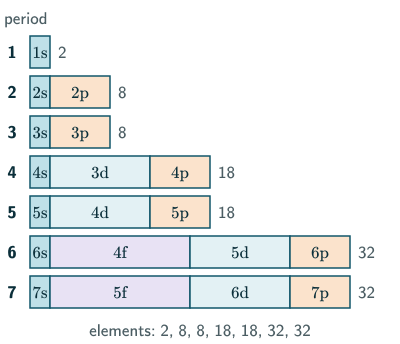
Along the way (pages 81–82):
- Period 1 fills the 1s orbital: hydrogen, 1s1, and helium, 1s2, which completes the K shell.
- Period 2 starts at lithium, whose third electron enters 2s; beryllium is 1s2 2s2; from boron the 2p orbitals fill until neon (2s2 2p6) completes the L shell.
- Period 3, sodium to argon, fills 3s and 3p: again 8 elements. The 3d orbitals belong to shell 3 but are not filled until period 4, because the neutral K and Ca ground states occupy 4s before 3d. Orbital energies depend on the atom and its occupancy; 4s is not universally below 3d.
- Period 4 starts at potassium (4s). Before 4p, the 3d orbitals fill: the 3d transition series runs from scandium (Z = 21, 3d1 4s2) to zinc (Z = 30, 3d10 4s2). The period ends at krypton when 4p is full: 18 elements.
- Period 5, from rubidium, is like period 4, with the 4d series starting at yttrium (Z = 39); it ends at xenon.
- Period 6 has 32 elements, filling 6s, 4f, 5d and 6p. The 4f orbitals fill from cerium (Z = 58) to lutetium (Z = 71): the lanthanoid series.
- Period 7 fills 7s, 5f, 6d and 7p and contains most of the man-made radioactive elements. The 5f orbitals fill after actinium (Z = 89): the actinoid series. The period ends at element 118, a member of the noble gas family.
The lanthanoids and actinoids are placed separately below the main table. This keeps the table’s shape and keeps elements with similar properties in single columns (page 82).
Configurations down a group
Elements in the same vertical column or group have similar valence shell electronic configurations, the same number of electrons in the outer orbitals, and similar properties.
NCERT Chemistry Part I (Class 11), Section 3.5, page 82
The alkali metals of Group 1 show this (NCERT page 82):
| Z | Element | Configuration |
|---|---|---|
| 3 | Li | [He] 2s1 |
| 11 | Na | [Ne] 3s1 |
| 19 | K | [Ar] 4s1 |
| 37 | Rb | [Kr] 5s1 |
| 55 | Cs | [Xe] 6s1 |
| 87 | Fr | [Rn] 7s1 |
Each has one electron outside a noble gas core, so each readily loses one electron to form an M+ ion. Their atomic numbers jump by 8, 8, 18, 18 and 32, the lengths of the periods between them. So the properties depend on atomic number, through the configuration, not on atomic mass (page 82).
Solved examples
Example 1: Why the fifth period has 18 elements (NCERT Problem 3.2, page 82)
Justify the presence of 18 elements in the fifth period.
The fifth period fills, in order of energy, 5s < 4d < 5p. These contain 1 + 5 + 3 = 9 orbitals, which hold 9 × 2 = 18 electrons, so 18 elements.
NCERT’s solution begins “When n = 5, l = 0, 1, 2, 3”. For n = 5, l can be 0, 1, 2, 3 or 4, but that is beside the point: the orbitals that fill in period 5 are 5s, 4d and 5p, not the subshells of shell 5.
Answer: 9 orbitals × 2 = 18 elements.
Example 2: Why the sixth period has 32 elements (NCERT Exercise 3.4, page 96)
Using quantum numbers, show that the sixth period should have 32 elements.
Orbitals fill in order of n + l, lower n first on a tie: 6s (6), then 4f, 5d and 6p (all 7); 7s (also 7, but higher n) starts period 7. A subshell has 2l + 1 orbitals (ml from −l to +l), and each holds two electrons (ms = +½ or −½).
Period 6 fills 6s (l = 0, 1 orbital), 4f (l = 3, 7 orbitals), 5d (l = 2, 5 orbitals) and 6p (l = 1, 3 orbitals): 1 + 7 + 5 + 3 = 16 orbitals. Each holds 2 electrons: 32.
Answer: 16 orbitals × 2 = 32 elements.
Example 3: Locating bromine
Bromine (Z = 35) is [Ar] 3d10 4s2 4p5. Find its period and group.
Highest n = 4, so period 4. It has 2 + 5 = 7 outer electrons in 4s and 4p, one short of krypton’s 4s2 4p6, so it is in the group before the noble gases, group 17.
Answer: period 4, group 17 (a halogen).
Example 4: Shell 3 and period 3
Shell 3 can hold 18 electrons. Why does period 3 have only 8 elements?
Shell 3 has 3s, 3p and 3d orbitals, but the neutral atoms K and Ca occupy 4s before 3d. Period 3 fills only 3s and 3p (4 orbitals, 8 electrons); 3d fills in period 4, after 4s.
Answer: because the 3d orbitals are filled in period 4, not period 3.
Example 5: Group 2
Write the outer configurations of beryllium (4), magnesium (12) and calcium (20), and state their common feature.
Be [He] 2s2; Mg [Ne] 3s2; Ca [Ar] 4s2.
Answer: all are ns2, two electrons outside a noble gas core, so all show the +2 oxidation state.
Common mistakes to avoid
Common mistake
Thinking a period fills one whole shell
A period does not fill shell n completely. Period 3 fills 3s and 3p only; the 3d of shell 3 waits until period 4, and 4f until period 6.
Common mistake
Taking the period number from the last electron’s orbital
The period is the highest n in the configuration. In scandium the last electron enters 3d, but the 4s electrons put it in period 4. The last orbital filled tells you the block (s, p, d or f), not the period. (One exception: palladium, [Kr] 4d10, has no 5s electron yet sits in period 5, the row in which 4d fills.)
Common mistake
Counting period lengths from 2n
The number of elements in a period is twice the number of orbitals filled in it (2, 8, 8, 18, 18, 32, 32), not 2n for the shell (2, 8, 18, 32, …). (NCERT’s “orbitals available in the energy level that is being filled”, page 81, means these orbitals, not the whole shell.)
Common mistake
Reading ns<sup>1</sup> as group 1
Cr [Ar] 3d5 4s1 and Cu [Ar] 3d10 4s1 also end in 4s1 but are in groups 6 and 11, because of the extra stability of half-filled and filled subshells. For d elements, count the (n − 1)d and ns electrons together.
Quick revision summary
- Period number usually = principal quantum number of the outermost occupied shell; Pd is an exception. A period begins with ns and ends with np (1s only for period 1).
- Period lengths are twice the orbitals filled: 2, 8, 8, 18, 18, 32, 32 (period 4: 4s, 3d, 4p; period 6: 6s, 4f, 5d, 6p).
- 3d series Sc (21) to Zn (30); 4d series from Y (39); lanthanoids Ce (58) to Lu (71); actinoids after Ac (89).
- Same group, similar outer configuration (Group 1: ns1 throughout), so similar properties.
- Lanthanoids and actinoids sit in separate rows to keep similar elements in single columns.
Formula sheet
- Period number usually = n of the outermost occupied shell (except Pd)
- Elements in a period = 2 × orbitals filled in it
- Period 4: 4s + 3d + 4p = 1 + 5 + 3 orbitals → 18
- Period 6: 6s + 4f + 5d + 6p = 1 + 7 + 5 + 3 orbitals → 32
Questions students ask
How do you find the period and group of an element from its electronic configuration?
An element’s period usually matches the highest occupied principal quantum number n (except Pd in period 5), and its group follows from the outer electrons: for the s-block it is the number of ns electrons (helium, 1s2, is the exception: group 18), for the d-block the (n − 1)d plus ns electrons, and for the p-block 10 plus the ns and np electrons. Selenium, [Ar] 3d10 4s2 4p4, is in period 4 and group 10 + 2 + 4 = 16, and manganese, [Ar] 3d5 4s2, is in period 4 and group 5 + 2 = 7. The block is the type of subshell that receives the last electron.
What is the difference between a period and a group in the periodic table?
A period is a horizontal row of the periodic table and a group is a vertical column; in electronic terms, elements in a period usually share the highest occupied shell (Pd is an exception), while main-group elements in a column have similar outer configurations. Transition-metal columns need both the outer ns and inner d electrons; their ns counts can differ. So properties change steadily across a period, broadly from metals to non-metals, but stay similar down a group, changing only gradually. The long form has 7 periods and 18 groups.
What is the difference between valence electrons and valency?
For main-group atoms, valence electrons are those in the outermost shell; transition metals can also use electrons from an incomplete (n − 1)d subshell in bonding. Valency (NCERT’s “valence”) is its combining capacity, the number of electrons it loses, gains or shares in forming compounds. For main-group elements the valency is usually the number of valence electrons or 8 minus it: magnesium has 2 valence electrons and valency 2 (MgCl2), while nitrogen has 5 valence electrons but valency 3 (NH3). The number of valence electrons is fixed, but an element can show more than one valency, as phosphorus does in PCl3 and PCl5; NCERT tabulates the valences by group.
How many elements would the 8th period of the periodic table have?
The 8th period would have 50 elements, Z = 119 to 168, if the aufbau (n + l) order simply continued: after 8s (n + l = 8) come 5g, 6f, 7d and 8p (all with n + l = 9), which have 1 + 9 + 7 + 5 + 3 = 25 orbitals and hold 25 × 2 = 50 electrons. It would be the first period to fill g orbitals (l = 4, nine orbitals). No element of period 8 has yet been made, and relativistic calculations suggest the real filling order will be less tidy, so 50 is a prediction, not a fact.
Practice questions
Try each question first, then open the answer to check your working.
-
Q1. Why do elements in the same group have similar physical and chemical properties (NCERT Exercise 3.8, page 96)?
Show answerHide answer
They have similar outer electronic configurations (for example ns1 throughout Group 1), and these valence electrons decide how an element reacts and many of its physical properties.
-
Q2. An element has the configuration [Kr] 5s2. Give its atomic number, period and group.
Show answerHide answer
Z = 36 + 2 = 38 (strontium); highest n = 5, so period 5; two outer electrons in an s orbital, so group 2.
-
Q3. Which orbitals are filled in the seventh period, and how many elements does it contain?
Show answerHide answer
7s, 5f, 6d and 7p: 1 + 7 + 5 + 3 = 16 orbitals, so 32 elements (francium to oganesson).