Group 15 elements: the nitrogen family
Beyond NCERT In the JEE Main and NEET syllabus; the Class 12 book has no section for it.
Quick answer
Group 15, the nitrogen family, contains nitrogen, phosphorus, arsenic, antimony, bismuth and moscovium, with five valence electrons. Its familiar members commonly show minus-three, plus-three and plus-five oxidation states, with plus-three increasingly stable down the group. Nitrogen differs through its small size, strong triple bond and hydrogen bonding in ammonia.
What are the group 15 elements?
Group 15: the nitrogen family
Group 15 is the third group of the p-block: nitrogen (N), phosphorus (P), arsenic (As), antimony (Sb), bismuth (Bi) and the synthetic moscovium (Mc). Each atom has five valence electrons, ns np: two in the s subshell and three unpaired in the p subshell (Wikipedia, “Pnictogen”).
The group shows the change from non-metal to metal most clearly. NCERT puts the rule this way:
The non-metallic character increases as we move from left to right across a period and metallic character increases as we go down the group.
NCERT Chemistry Part I (Class 11), Section 3.6.2, page 84
- Nitrogen is a gaseous diatomic non-metal; phosphorus and arsenic have many allotropes; antimony and bismuth form metallic structures (Wikipedia, “Pnictogen”).
- The main oxidation states are −3, +3 and +5. Down the group +3 becomes more stable than +5, and bismuth is almost always +3: the inert pair effect (Wikipedia, “Pnictogen” and “Bismuth”).
- Nitrogen is unlike the rest: it forms strong multiple bonds and cannot have more than four bonds (NCERT Class 11 Chemistry, page 93).
In plain words: the family starts with nitrogen, the unreactive gas that makes up most of the air, and ends with bismuth, a heavy silvery metal. In between, phosphorus and arsenic are solids with several forms. All five have five outer electrons; the +5 state is possible for the lighter members, while +3 is especially stable for bismuth. Nitrogen can reach formal +5 without making five ordinary electron-pair bonds.
Scope: the properties below concern N–Bi. Moscovium is synthetic and short-lived; comparable bulk chemistry is not established. Oxidation states in covalent compounds are formal assignments, not literal free-ion charges.
No 2026–27 NCERT textbook has a chapter on the p-block; the JEE Main 2027 and NEET (UG) 2026 syllabuses list it in Unit 10. This page covers group 15: configuration, oxidation states, trends, properties and the anomaly of nitrogen. Facts and data from beyond the NCERT books are labelled with their source.
Electronic configuration ns np and oxidation states
| Element | Z | Electronic configuration |
|---|---|---|
| N | 7 | [He] 2s2 2p3 |
| P | 15 | [Ne] 3s2 3p3 |
| As | 33 | [Ar] 3d10 4s2 4p3 |
| Sb | 51 | [Kr] 4d10 5s2 5p3 |
| Bi | 83 | [Xe] 4f14 5d10 6s2 6p3 |
- The configurations follow the aufbau order (NCERT Class 11 Chemistry, Unit 2). The p3 subshell is half full, and half-filled subshells are extra stable (NCERT Class 11 Chemistry, Unit 2, page 64). Nitrogen’s first ionisation enthalpy is higher than oxygen’s because two of oxygen’s four 2p electrons share an orbital and repel each other (NCERT Class 11 Chemistry, page 89).
- −3. The lighter members, N, P and As, tend to reach −3: fully reduced in solids such as calcium phosphide and sodium arsenide (Wikipedia, “Pnictogen”), and in the covalent hydrides NH3, PH3 and AsH3, counting hydrogen as +1 (NCERT Class 11 Chemistry, Table 3.9, page 93; NCERT marks P as −3 in PH3 in its Eq. (7.46), page 244). Few bismuth compounds are −3 (Wikipedia, “Bismuth”).
- +3 and +5. Formally assigning three or five valence electrons to more electronegative partners gives +3 or +5, as in the oxides N2O3 and N2O5, P4O6 and P4O10 (NCERT Class 11 Chemistry, Table 3.9, page 93). The heavier members favour +3, because their s electrons are more tightly held (Wikipedia, “Pnictogen”).
- Bismuth is +3 in almost all its compounds; a few are +5 (Wikipedia, “Bismuth”). Lead, bismuth and polonium, the heaviest members of groups 14, 15 and 16, are comparatively stable two below their group valence (Wikipedia, “Inert-pair effect”).
- Nitrogen shows many oxidation states in its oxides: besides +3 and +5, there are +2 and +4 (Wikipedia, “Pnictogen”), and an average +1 in N2O (reasoned, Example 1). Its +5 state, as in N2O5, is largely formal, because nitrogen is so electronegative (Wikipedia, “Pnictogen”); see the anomaly below for how +5 fits with a covalency of 4. See oxidation number for how these are assigned.
Atomic radius, ionisation enthalpy and electronegativity down the group
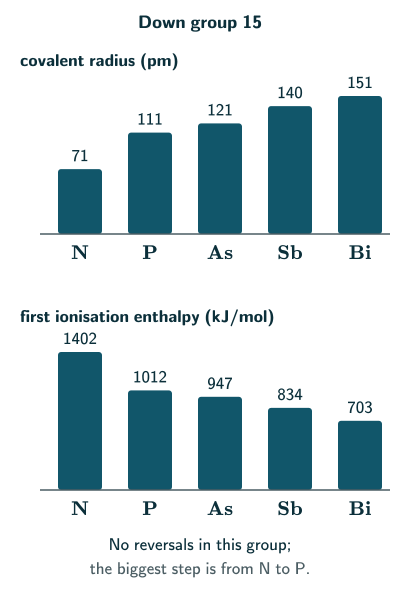
Covalent radius in pm, first ionisation enthalpy ΔiH1 in kJ mol−1, and electronegativity (EN) on the Pauling scale:
| Element | Radius | ΔiH1 | EN |
|---|---|---|---|
| N | 71 | 1402 | 3.04 |
| P | 111 | 1012 | 2.19 |
| As | 121 | 947 | 2.18 |
| Sb | 140 | 834 | 2.05 |
| Bi | 151 | 703 | 2.02 |
Radii follow the Pyykkö–Atsumi molecular single-bond scale (2009), and ionisation enthalpies are rounded atomic data (NIST); electronegativities use the stated Pauling table. All three are as tabulated in the Wikipedia data pages “Atomic radii of the elements”, “Molar ionization energies of the elements” and “Electronegativities of the elements”, the data pages cited below. NCERT’s Class 11 tables use different tabulated values for the first two members: N 74 pm and 3.0, P 110 pm and 2.1 (NCERT Class 11 Chemistry, Tables 3.6 and 3.8, pages 86 and 91).
- Atomic radius rises down the group (NCERT Class 11 Chemistry, page 86). The step from N to P is large, 71 to 111 pm; from P to As it is only 10 pm, because arsenic’s ten new 3d electrons shield poorly (reasoned from the data page, as for gallium in group 13). The steps are 40, 10, 19 and 11 pm (data page).
- Ionisation enthalpy falls steadily down the group, from 1402 to 703 kJ mol−1 (data page). Because the p3 shell is half full, N, P and As have higher values than their group 16 neighbours O, S and Se, as NCERT explains for N and O (NCERT Class 11 Chemistry, page 89); for Sb and Bi the order reverses (data page).
- Electronegativity drops sharply from N to P, then changes little (data page). Nitrogen, with 3.04, is the only member electronegative enough to form strong hydrogen bonds (reasoned; see the anomaly below).
Physical properties
Melting and boiling points in K, density in g cm−3:
| Element | m.p. | b.p. | Density |
|---|---|---|---|
| N | 63 | 77 | 1.251† |
| P (white) | 317 | 554 | 1.823 |
| As (grey)‡ | – | – | 5.727 |
| Sb | 904 | 1860 | 6.697 |
| Bi | 545 | 1837 | 9.78 |
Values from the Wikipedia data pages for melting points, boiling points (CRC values) and densities.
† Nitrogen’s density is in g L−1, at 0 °C and 1 atm.
‡ At standard pressure grey arsenic does not melt but sublimes, at 603 °C, 876 K (Wikipedia, “Pnictogen”); it melts, at 1090 K, only under pressure (data page).
- Metallic character increases down the group (NCERT Class 11 Chemistry, page 84). NCERT names arsenic and antimony among the metalloids (NCERT Class 11 Chemistry, page 85); antimony and bismuth form metallic structures in bulk (Wikipedia, “Pnictogen”).
- State. Nitrogen is the only gas; the others are solids (Wikipedia, “Pnictogen”). N2 molecules are held together only by weak van der Waals forces, so nitrogen melts and boils far lower than the rest (Wikipedia, “Nitrogen”).
- Melting and boiling points. Do not put arsenic’s high-pressure melting point on the same normal-pressure trend as the other elements. At ordinary pressure arsenic sublimes; antimony melts above white phosphorus and bismuth; boiling points rise to antimony, and bismuth’s is slightly lower (data pages).
- Density increases down the group (Wikipedia, “Pnictogen”).
- Allotropes. Phosphorus has white and red forms as its two commonest allotropes. White phosphorus is made of P4 tetrahedra; it is very toxic and catches fire in air at about 30 °C (Wikipedia, “Phosphorus”).
Chemical properties: hydrides, oxides and halides; the inert pair effect
- Hydrides, EH3. All form hydrides: ammonia, phosphine, arsine, stibine and bismuthine. Down the group their thermal stability generally decreases; several heavier hydrides are extremely toxic, but toxicity is not a simple periodic ranking (Wikipedia, “Pnictogen”). The H–E–H angle closes from 107° in NH3 (NCERT Class 11 Chemistry, page 122) through 93.5° in PH3 (Wikipedia, “Phosphine”) to 90.48° in BiH3 (Wikipedia, “Pnictogen”).
- Basic character falls sharply: ammonia is a base, while phosphine has almost no basicity, because its lone pair sits mainly in phosphorus’s 3s orbital (Wikipedia, “Ammonia” and “Phosphine”). The heavier hydrides, with still larger atoms, are weaker bases still (reasoned).
- Hydrogen bonding. Ammonia is easily liquefied because of strong hydrogen bonds between its molecules, and boils at −33 °C; phosphine forms only weak hydrogen bonds (Wikipedia, “Ammonia” and “Phosphine”).
- Boiling points, in °C: PH3 −87.7 < AsH3 −62.5 < NH3 −33.3 < SbH3 −17 < BiH3 16.8, extrapolated, as bismuthine decomposes (Wikipedia, the infoboxes of “Phosphine”, “Arsine”, “Ammonia”, “Stibine” and “Bismuthine”). From PH3 on, the values rise with the size of the molecule; NH3 stands out above PH3 and AsH3 because of its hydrogen bonds (reasoned).
- Stability and reducing power. The E–H bond weakens down the group: N–H 389 and P–H 318 kJ mol−1 (NCERT Class 11 Chemistry, Table 5.3(a), page 154). So the hydrides grow less stable and better reducing agents down the group (reasoned). Phosphine containing a trace of P2H4 catches fire in air (Wikipedia, “Phosphine”).
- Oxides. The group forms E2O3 and E2O5 type oxides, such as N2O3, N2O5, P4O6, P4O10 and Bi2O3 (NCERT Class 11 Chemistry, Table 3.9, page 93).
- N2O3, N2O5 and the phosphorus oxides are acidic, as most non-metal oxides are (NCERT Class 10 Science, Chapter 3, page 40); P4O10 is the acid anhydride of phosphoric acid (Wikipedia, “Phosphorus”). Of two oxides of one element, the one in the higher oxidation state is the more acidic, N2O5 more than N2O3 (reasoned).
- As2O3 and Sb2O3 are amphoteric (NCERT Class 11 Chemistry, page 94, names As2O3; Wikipedia, “Arsenic trioxide” and “Antimony trioxide”), and Bi2O3 is basic (Wikipedia, “Bismuth(III) oxide”).
- NO and N2O are neutral oxides, with neither acidic nor basic properties (NCERT Class 11 Chemistry, page 94).
- So, as in groups 13 and 14, the oxides grow more basic down the group (reasoned).
- Halides. The members form trihalides, EX3; isolated simple EX3 molecules are commonly trigonal pyramidal, while heavier solid halides may have bridging ligands and extended structures (Wikipedia, “Pnictogen”). NF3 is comparatively stable; NCl3, NBr3 and NI3 are explosive (Wikipedia, “Pnictogen”).
- Pentahalides. P, As and Sb form pentafluorides, and bismuth gives BiF5 (Wikipedia, “Pnictogen”). Besides PCl5, AsCl5 and SbCl5 exist (Wikipedia, “Phosphorus pentachloride”). Nitrogen forms none: NF5 is only theoretical (Wikipedia, “Pnictogen”).
- PCl5 is a trigonal bipyramidal molecule in the gas, but in the solid it is ionic, [PCl4]+[PCl6]− (Wikipedia, “Phosphorus pentachloride”). In the molecule the two axial bonds are slightly longer and weaker than the three equatorial ones, because the axial bond pairs are repelled more, which makes PCl5 reactive (NCERT Class 11 Chemistry, page 125, Figure 4.17).
- In alkali white phosphorus disproportionates: P4 + 3OH− + 3H2O → PH3 + 3H2PO2−, phosphorus going from 0 to −3 and +1 (NCERT Class 11 Chemistry, page 244).
- The inert pair effect. For bismuth the +5 state is rare, because the 6s electrons are reluctant to bond. So bismuth(V) oxide is unstable, and BiF5 is more reactive than the other pentafluorides, an extremely powerful fluorinating agent (Wikipedia, “Pnictogen”). The +5 state is easiest for P, As and Sb (Wikipedia, “Pnictogen”).
Anomalous behaviour of nitrogen
Nitrogen differs from the rest because it is small, has a high electronegativity and has only four valence orbitals, 2s and 2p (NCERT Class 11 Chemistry, page 93).
- Maximum covalency 4. Nitrogen can hold at most four bonds, as in NH4+, so there is no NCl5 or NF5 (NCERT Class 11 Chemistry, page 93; Wikipedia, “Pnictogen”). Phosphorus, with 3d orbitals among its nine valence orbitals, can expand its valence shell (same page) and forms PCl5 (Wikipedia, “Phosphorus pentachloride”). Beyond the NCERT text: its bonding does not require substantial 3d hybridisation (Reed and Schleyer, JACS, 1990; Wikipedia, “Hypervalent molecule”). Nitrogen still reaches the +5 state, as in N2O5 and HNO3, with no more than four bonds: oxidation state and covalency are different things (reasoned; NCERT Class 11 Chemistry, Problem 3.9, page 94, makes the same point for aluminium).
- Multiple bonds. Nitrogen readily forms pπ–pπ multiple bonds, to itself (N≡N) and to C and O (NCERT Class 11 Chemistry, page 93; Wikipedia, “Nitrogen”). The N≡N triple bond is exceptionally strong (Wikipedia, “Nitrogen”), which is why N2 is so unreactive.
- A gas, not a solid. So nitrogen exists as small N2 molecules held by weak forces, while white phosphorus contains P4 tetrahedra and red/black forms contain larger bonded structures (Wikipedia, “Nitrogen” and “Phosphorus”; reasoned).
- Little catenation. Unlike carbon, nitrogen does not tend to form chains of its own atoms (Wikipedia, “Nitrogen”). Phosphorus catenates more, as in its P4 tetrahedra: the P–P bond, 213 kJ mol−1, is stronger than the N–N single bond, 159 kJ mol−1 (NCERT Class 11 Chemistry, Table 5.3(a), page 154), probably because lone pairs on the small, close nitrogen atoms repel (reasoned).
- Hydrogen bonding. Only ammonia, among the group 15 hydrides, has strong hydrogen bonding (Wikipedia, “Ammonia” and “Phosphine”).
Solved examples
Example 1: Oxidation states of nitrogen in its oxides
Find the oxidation state of nitrogen in N2O, NO, N2O3, NO2 and N2O5.
Answer: With oxygen −2 and the compound neutral: N2O, 2x − 2 = 0, +1 on average (the two nitrogen atoms are not equivalent); NO, +2; N2O3, 2x = 6, +3; NO2, +4; N2O5, 2x = 10, +5 (reasoned; NCERT Class 11 Chemistry, Unit 7, rules for oxidation numbers).
Example 2: Why PCl but not NCl?
Explain why phosphorus forms PCl5 while nitrogen forms only NCl3.
Answer: In period 2, nitrogen has only four valence orbitals, 2s and three 2p, so it can hold at most four electron pairs: its maximum covalency is 4. Phosphorus, in period 3, has nine valence orbitals, 3s, 3p and 3d, so it can expand its valence shell (NCERT Class 11 Chemistry, page 93); NCERT’s Unit 4 bonds it to five chlorine atoms through five sp3d hybrid orbitals, made from one 3s, three 3p and one 3d orbital (pages 124–125). Give that reason in an exam. Beyond the NCERT text: modern accounts find no substantial d-orbital participation; phosphorus is larger and can stabilise five-coordinate bonding (Reed and Schleyer, JACS, 1990; Wikipedia, “Hypervalent molecule”). The size and bonding-energy balance differ from nitrogen (reasoned).
Example 3: The solid state of PCl
Solid PCl5 is [PCl4]+[PCl6]−. Give the shape of each ion and the oxidation state of phosphorus in it.
Answer: [PCl4]+: four bond pairs, no lone pair, so tetrahedral; [PCl6]−: six bond pairs, so octahedral (VSEPR, NCERT Class 11 Chemistry, Unit 4). In both, phosphorus is +5: x − 4 = +1 and x − 6 = −1 (reasoned; structure from Wikipedia, “Phosphorus pentachloride”).
Example 4: Bond angles in the hydrides
NH3 has an H–N–H angle of 107°, while BiH3 has 90.48°. Explain the trend.
Answer: In NH3, nitrogen is small and electronegative, so the bond pairs sit close to it and repel strongly, opening the angle towards the tetrahedral 109.5°; the lone pair squeezes it a little (reasoned from VSEPR theory, NCERT Class 11 Chemistry, Unit 4). Down the group the atom grows and the bonds lengthen, the bond pairs repel less, and the angle approaches the 90° between pure p orbitals (reasoned; angles from NCERT Class 11 Chemistry, page 122, and Wikipedia, “Pnictogen”).
Common mistakes to avoid
Common mistake
Writing NCl or NF
Nitrogen has no d orbitals in its valence shell and a maximum covalency of 4. Phosphorus can form PCl5 and PF5; nitrogen cannot.
Common mistake
Expecting the hydrides to grow more basic down the group
In the usual aqueous comparison, basic character falls: ammonia is a base, but phosphine has almost no basicity, and the hydrides also grow less stable down the group.
Common mistake
Treating solid PCl as a molecule
In the gas PCl5 is a trigonal bipyramidal molecule, but the solid is ionic, [PCl4]+[PCl6]−.
Common mistake
Giving bismuth a stable +5 state
Bismuth is almost always +3. Bismuth(V) compounds are rare and strongly oxidising; BiF5 is an extremely powerful fluorinating agent.
Quick revision summary
- Group 15: N, P, As, Sb, Bi (and Mc); valence configuration ns np, a half-filled p shell.
- Oxidation states −3, +3, +5; +3 grows more stable down the group (inert pair effect), and Bi is almost always +3.
- Radius rises and ionisation enthalpy falls steadily; electronegativity drops sharply from N to P.
- Hydrides EH grow less stable, less basic and more reducing down the group; NH alone has strong hydrogen bonding; boiling points PH < AsH < NH < SbH < BiH.
- Oxides grow more basic: NO, NO and the P oxides acidic, AsO and SbO amphoteric, BiO basic; NO and NO are neutral.
- Nitrogen is anomalous: maximum covalency 4, no pentahalides, N≡N triple bond, a gas.
Formula sheet
- Valence configuration: ns np
- Oxidation states: −3, +3, +5
- Basic character: NH > PH > AsH > SbH > BiH
- Bond angle: NH 107° > PH 93.5° > BiH 90.48°
- Solid PCl: [PCl][PCl]
- Maximum covalency of N: 4
Questions students ask
Why are group 15 elements called pnictogens?
Beyond the NCERT text, group 15 elements are called pnictogens from the Greek pnigein, to choke, after the suffocating effect of nitrogen gas; the Dutch chemist Anton Eduard van Arkel suggested the name in the early 1950s, and IUPAC accepts it (Wikipedia, “Pnictogen”). The group is also the nitrogen family, after its first member, and was once called the pentels, from the Greek pente, five (same article). NCERT’s periodic table marks it VA, the older notation that IUPAC’s numbering of groups 1 to 18 replaced (NCERT Class 11 Chemistry, Unit 3, pages 78–79), while European books used VB (Wikipedia, “Pnictogen”).
Which group 15 elements are metalloids?
Arsenic and antimony are the metalloids of group 15: NCERT names them, with silicon, germanium and tellurium, as metalloids, elements with properties of both metals and non-metals (NCERT Class 11 Chemistry, Unit 3, page 85; see metals, non-metals and metalloids). Beyond the NCERT text, nitrogen and phosphorus are non-metals, bismuth is a metal, and moscovium is probably one too (Wikipedia, “Pnictogen” and “Bismuth”). Antimony, though counted a metalloid, is metallic in its bulk solid, like bismuth (Wikipedia, “Pnictogen”).
What is the order of electron gain enthalpy in group 15?
Beyond the NCERT text, whose Table 3.7 gives no group 15 values (NCERT Class 11 Chemistry, Unit 3, page 90), the electron affinity order in group 15, the order of most negative electron gain enthalpy, is Sb > Bi > As > P > N: 101, 91, 78, 72 and −7 kJ mol, nitrogen’s negative estimate meaning energy is needed (Wikipedia, “Electron affinity (data page)”). Unlike the usual fall down a group (NCERT page 90), the values grow to antimony, and N to Sb stay below both neighbours’, phosphorus 72 against silicon 134 and sulphur 200 kJ mol, as half-filled p resists an extra electron (reasoned), most of all in nitrogen.
What is the valency of group 15 elements?
The valency of group 15 elements is 3 or 5: NCERT lists both for the group, which has five valence electrons, three short of an octet (NCERT Class 11 Chemistry, Unit 3, page 92; valence by group). Valency is 3 in NH3 and PBr3 and 5 in PF5, but nitrogen never forms five bonds: its covalency stops at 4, as in NH4+ (NCERT page 93). Valency counts bonds, so it is not the same as the oxidation states −3, +3 and +5; the difference is answered on the oxidation number page.
Practice questions
Try each question first, then open the answer to check your working.
-
Q1. Why is nitrogen a gas while phosphorus is a solid?
Show answerHide answer
Nitrogen, small and with only 2s and 2p orbitals, forms a strong N≡N triple bond, so it exists as small N2 molecules held together only by weak van der Waals forces. White phosphorus forms P4 tetrahedra that pack as a solid; other phosphorus allotropes have extended structures (NCERT Class 11 Chemistry, page 93; Wikipedia, “Nitrogen” and “Phosphorus”).
-
Q2. Arrange As2O3, Bi2O3 and P4O6 in order of increasing basic character.
Show answerHide answer
P4O6 (acidic) < As2O3 (amphoteric) < Bi2O3 (basic): metallic character, and with it the basic character of the oxides, increases down the group (Wikipedia, “Arsenic trioxide” and “Bismuth(III) oxide”; reasoned).
-
Q3. Why does ammonia have a much higher boiling point than would be expected from its small size?
Show answerHide answer
Nitrogen is small and highly electronegative, so ammonia molecules are held together by strong hydrogen bonds, which must be broken for it to boil; it boils at −33 °C. Phosphine forms only weak hydrogen bonds (Wikipedia, “Ammonia” and “Phosphine”). So NH3 boils above PH3 (−87.7 °C) and AsH3 (−62.5 °C), though SbH3, a much larger molecule, boils higher still, at −17 °C (Wikipedia, the infoboxes of “Phosphine”, “Arsine” and “Stibine”).