Nernst equation
NCERT Class 12 Chemistry Chapter 2 Section 2.3
Quick answer
The Nernst equation relates equilibrium electrode potential or reversible cell emf to temperature and the reaction quotient. Strictly it uses activities; concentration formulas are ideal-solution approximations. At reaction equilibrium the emf vanishes, allowing standard emf to be related to the equilibrium constant and reaction Gibbs energy.
With your textbook
NCERT Chemistry Part I (Class 12), Chapter 2 “Electrochemistry”, Section 2.3 “Nernst Equation”, pages 36–41.
Open the official NCERT chapter (PDF, 4.4 MB, ncert.nic.in) (opens in a new tab)
Checked against the 2026-27 reprint on .
What is the Nernst equation?
Nernst equation
Standard electrode potentials assume that every species in the electrode reaction is at unit concentration. That need not be true, and Nernst showed how an electrode potential depends on concentration (NCERT Section 2.3, page 36).
- For a whole cell with reaction quotient Q and n electrons transferred, Ecell = E⊖cell − (RT/nF) ln Q; at 298 K this is Ecell = E⊖cell − (0.059/n) log Q (NCERT Eqs. (2.12)–(2.13), page 38).
- At equilibrium the cell gives no voltage, so the same equation links E⊖cell to the equilibrium constant (NCERT Eq. (2.14), page 39).
- The emf also measures the Gibbs energy of the reaction, ΔrG⊖ = −nFE⊖cell (NCERT Eq. (2.16), page 40).
Scope of the equations: the Nernst equation gives electrode potentials and the emf, the cell potential when no current is drawn (NCERT page 34), not the terminal voltage while a substantial current flows (reasoned). Beyond the NCERT text: strictly, the equation uses activities, effective concentrations, and a gas enters as its partial pressure divided by 1 bar (Wikipedia, “Standard hydrogen electrode”). Below, as in NCERT, brackets mean concentrations in mol L−1, and liquid-junction potentials at the salt bridge are ignored (reasoned).
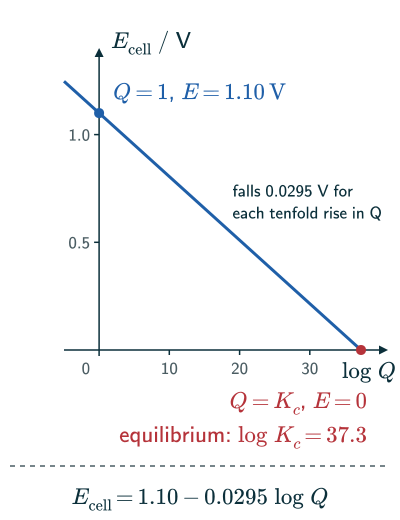
In plain words: a Daniell cell with 1 M solutions starts at 1.10 V, but as it runs, zinc ions pile up, copper ions are used up, and the voltage slowly falls. The Nernst equation gives the voltage at every stage. When it reaches zero, the reaction is at equilibrium. That is why the standard emf, read on a voltmeter, gives the equilibrium constant and the Gibbs energy of the reaction.
Nernst equation for an electrode
For the electrode reaction Mn+(aq) + ne− → M(s), the electrode potential at any concentration, measured against the standard hydrogen electrode, is E = E⊖ − (RT/nF) ln([M]/[Mn+]). The concentration of the solid M is taken as unity (strictly, a pure solid has unit activity; reasoned), which gives NCERT Eq. (2.8), page 36:
Electrode potential (NCERT Eq. 2.8)
- R is the gas constant, 8.314 J K−1 mol−1; T is the temperature in kelvin; F is the Faraday constant, the charge on one mole of electrons (NCERT pages 36 and 52).
- NCERT gives F = 96 487 C mol−1, an older value. Since 2019 it has an exact value, the elementary charge times the Avogadro constant: 96 485.33 C mol−1 to two decimals (NIST, 2022 CODATA recommended values). The difference changes no answer on this page. For rough work NCERT uses 96 500 C mol−1 (page 52).
- At 298 K, 2.303RT/F = 2.303 × 8.314 × 298/96 487 = 0.0591 V, rounded by NCERT to 0.059 V (NCERT page 38). So at 298 K, E = E⊖ + (0.059/n) log [Mn+] (reasoned from NCERT Eq. (2.8)).
- What it means. The more concentrated the metal ions, the more positive the electrode potential: more ions are pushing to be reduced. Each tenfold rise in [Mn+] adds 0.059/n V.
- The hydrogen electrode. For H+(aq) + e− → ½H2(g) with hydrogen at 1 bar, n = 1 and E⊖ = 0, so E = 0.059 log [H+] = −0.059 pH at 298 K (reasoned from NCERT Eq. (2.13); NCERT Intext Question 2.4 asks for it). If the hydrogen is not at 1 bar, each tenfold rise in its pressure lowers E by 0.0295 V (reasoned).
Nernst equation for a cell
-
The Daniell cell. Writing NCERT Eq. (2.8) for the copper cathode and the zinc anode and subtracting, Ecell = Ecathode − Eanode, gives NCERT Eq. (2.11), page 38:
Ecell = E⊖cell − (RT/2F) ln([Zn2+]/[Cu2+])
-
So Ecell increases as [Cu2+] increases and as [Zn2+] decreases (NCERT page 38).
-
At 298 K, with base-10 logarithms, this becomes Ecell = E⊖cell − (0.059/2) log([Zn2+]/[Cu2+]) (NCERT Eq. (2.12), page 38).
-
NCERT slip (page 38): in the step just before NCERT Eq. (2.11), the bracket that should enclose both logarithms is missing, so as printed RT/2F multiplies only the first one. Eq. (2.11) itself is right.
-
Balance the overall electron transfer. Each separate half-cell equation uses its own electron count. After balancing and combining half-reactions, use the total number cancelled for the whole cell: For Ni(s)|Ni2+(aq)||Ag+(aq)|Ag, the reaction is Ni + 2Ag+ → Ni2+ + 2Ag, so n = 2 and Q = [Ni2+]/[Ag+]2 (NCERT page 38).
-
In general, for aA + bB → cC + dD with n electrons transferred, NCERT Eq. (2.13), page 38, is:
Nernst equation for a cell (NCERT Eq. 2.13)
- Here Q = [C]c[D]d/([A]a[B]b), the reaction quotient, with products on top. Pure solids are left out, as their concentration is taken as unity (NCERT page 36). Water as the solvent is left out too, and a gas enters as its pressure in bar (reasoned; NCERT’s hydrogen electrode uses 1 bar, page 35; see the scope note above). Strictly, pure solids and liquids have unit activity, water can be left out only while its activity is close to one, as in dilute solution, and pressure in bar stands for the ratio to 1 bar (reasoned).
- At 298 K, 2.303RT/F = 0.059 V, so for the cell, with E = Ecell and E⊖ = E⊖cell:
Nernst equation at 298 K
Equilibrium constant from Nernst equation
- Close the circuit of a Daniell cell and the reaction Zn + Cu2+ → Zn2+ + Cu runs: [Zn2+] rises, [Cu2+] falls, and the voltmeter reading falls. After some time the concentrations stop changing and the voltmeter reads zero (NCERT page 39). Strictly, zero emf means equilibrium only for a working cell measured with no current drawn; a real cell can also stop through depletion or a failed electrode (reasoned). In NCERT’s words:
This indicates that equilibrium has been attained.
NCERT Chemistry Part I (Class 12), Section 2.3.1, page 39
- At equilibrium Ecell = 0 and Q = Kc, so the Nernst equation gives NCERT Eq. (2.14), page 39:
Standard emf and equilibrium constant (NCERT Eq. 2.14)
- For the Daniell cell at 298 K: 1.1 V = (0.059 V/2) log Kc, so log Kc = (1.1 × 2)/0.059 = 37.288 and Kc = 2 × 1037 (NCERT page 39). The reaction goes essentially to completion. With 0.0591 V, log Kc = 2.2/0.0591 = 37.225 and Kc = 1.7 × 1037: a small rounding moves K a lot, so use the constants the question gives.
- So equilibrium constants that are difficult to measure otherwise can be calculated from E⊖cell (NCERT page 39). A big K comes from only a modest emf, because E⊖ depends on log K: each 0.059/n V multiplies K by ten (reasoned).
Electrochemical cell and Gibbs energy of the reaction
- NCERT slip (page 40): the first sentence of NCERT Section 2.3.2 says the “electrical work done in one second” equals the potential multiplied by the total charge passed. That holds only if the charge is the charge passed in that one second; work per second is power, potential × current. The equation that follows, ΔrG = −nFEcell, uses the whole charge nF, so read the sentence as: the electrical work equals potential × total charge passed (reasoned). In a problem, multiply the emf by the total charge passed.
- In NCERT’s words:
If we want to obtain maximum work from a galvanic cell then charge has to be passed reversibly.
NCERT Chemistry Part I (Class 12), Section 2.3.2, page 40
- At constant temperature and pressure, the maximum (reversible) electrical work a galvanic cell can do equals the decrease in its Gibbs energy. With emf E and charge nF passed per mole of reaction, ΔrG = −nFEcell (NCERT Eq. (2.15), page 40).
- E is intensive, ΔrG is extensive. Ecell is an intensive parameter, but ΔrG is an extensive thermodynamic property, and its value depends on n (NCERT page 40). Strictly, ΔrG is Gibbs energy per mole of reaction as written: it scales when the written equation is multiplied, not when a larger sample is used, so it is not extensive in the usual sense: NCERT’s point is that its value depends on n, on how the equation is written (reasoned). In an exam, give NCERT’s pair: E intensive, ΔrG extensive. For Zn + Cu2+ → Zn2+ + Cu, ΔrG = −2FEcell; written as 2Zn + 2Cu2+ → 2Zn2+ + 2Cu, ΔrG = −4FEcell, with the same Ecell (NCERT page 40).
- If the concentration of every reacting species is unity, Ecell = E⊖cell (NCERT Eq. (2.16), page 40):
Standard Gibbs energy from the emf (NCERT Eq. 2.16)
- From ΔrG⊖ the equilibrium constant follows by ΔrG⊖ = −RT ln K (NCERT page 40). Putting the two together gives Eq. (2.14) again.
- Signs. A positive E⊖cell means a negative ΔrG⊖ and K > 1: the cell reaction is spontaneous as written under standard conditions (reasoned from NCERT Eqs. (2.14) and (2.16)).
Solved examples
Example 1: Copper electrode in dilute solution
Find the potential of a copper electrode in 0.010 M Cu2+ at 298 K. (E⊖ for Cu2+/Cu = 0.34 V, NCERT Table 2.1, page 37.)
Answer: n = 2, so E = 0.34 − (0.059/2) log(1/0.010) = 0.34 − 0.0295 × 2 = 0.281 V. The dilute solution lowers the potential (NCERT Eq. (2.8), page 36).
Example 2: Emf at given concentrations (NCERT Example 2.1)
Represent the cell in which Mg(s) + 2Ag+(0.0001 M) → Mg2+(0.130 M) + 2Ag(s) takes place, and find its emf if E⊖cell = 3.17 V.
Answer: The cell is Mg|Mg2+(0.130 M)||Ag+(0.0001 M)|Ag. With n = 2, Q = 0.130/(0.0001)2 = 1.3 × 10⁷, so Ecell = 3.17 − (0.059/2) log(1.3 × 10⁷) = 3.17 − 0.21 = 2.96 V (NCERT Example 2.1, page 39). Table 2.1’s values would give E⊖cell = 0.80 − (−2.36) = 3.16 V; NCERT’s example uses 3.17 V.
Example 3: Hydrogen electrode at pH 10 (NCERT Intext Question 2.4)
Calculate the potential of a hydrogen electrode in contact with a solution of pH 10.
Answer: [H+] = 10−10 M. With hydrogen at 1 bar and n = 1, E = 0 − 0.059 log(1/10−10) = −0.059 × 10 = −0.59 V at 298 K (NCERT Eq. (2.13), page 38).
Example 4: Equilibrium constant (NCERT Example 2.2)
Calculate the equilibrium constant of Cu(s) + 2Ag+(aq) → Cu2+(aq) + 2Ag(s), given E⊖cell = 0.46 V.
Answer: n = 2, so log Kc = (0.46 × 2)/0.059 = 15.6 and Kc = 3.92 × 10¹⁵ (NCERT Example 2.2, page 40). NCERT’s 3.92 comes from the unrounded log, 15.593; taking 15.6 gives 3.98 × 10¹⁵.
Example 5: Gibbs energy of the Daniell cell (NCERT Example 2.3)
The standard emf of the Daniell cell is 1.1 V. Calculate the standard Gibbs energy of Zn(s) + Cu2+(aq) → Zn2+(aq) + Cu(s).
Answer: ΔrG⊖ = −nFE⊖cell = −2 × 96 487 C mol−1 × 1.1 V = −212 271 J mol−1 = −212.27 kJ mol−1 (NCERT Example 2.3, page 40).
NCERT slips (page 40): the working prints −21 227 J mol−1, a digit short; the kJ value, −212.27, is right. The example also calls 1.1 V the “standard electrode potential” of the Daniell cell; it is the standard potential (emf) of the cell. In an exam, write −212 271 J mol−1 = −212.27 kJ mol−1, and call 1.1 V the standard emf.
Example 6: Gibbs energy and K together (NCERT Intext Question 2.6)
The cell reaction 2Fe3+(aq) + 2I−(aq) → 2Fe2+(aq) + I2(s) has E⊖cell = 0.236 V at 298 K. Find ΔrG⊖ and the equilibrium constant.
Answer: n = 2. ΔrG⊖ = −2 × 96 487 × 0.236 = −45 542 J mol−1 ≈ −45.5 kJ mol−1. log K = (2 × 0.236)/0.059 = 8.0, so K ≈ 1 × 10⁸ (NCERT Eqs. (2.14) and (2.16)).
Common mistakes to avoid
Common mistake
Using 0.059 with ln
0.059 V is 2.303RT/F at 298 K, so it goes with log (base 10). With ln, use RT/F = 0.0257 V (reasoned from NCERT pages 38–39).
Common mistake
Turning Q upside down or putting solids in it
Q has products on top and reactants below, each raised to its coefficient. Pure solids such as Zn, Cu and Ag are left out (NCERT pages 36–38).
Common mistake
Doubling E when the equation is doubled
Ecell is intensive and does not change; ΔrG is extensive and, for the doubled equation, doubles through n (NCERT page 40).
Common mistake
Forgetting n in ΔG = −nFE
n is the number of moles of electrons in the balanced equation as written: 2 for the Daniell cell (NCERT page 40).
Quick revision summary
- Nernst equation: E(cell) = E⊖(cell) − (RT/nF) ln Q; at 298 K, E(cell) = E⊖(cell) − (0.059/n) log Q.
- For an electrode, E = E⊖ − (RT/nF) ln(1/[Mn+]): more ions, more positive potential.
- Daniell cell: Ecell rises with [Cu2+] and falls with [Zn2+].
- At equilibrium, E(cell) = 0 and Q = Kc, so E⊖(cell) = (0.059/n) log Kc at 298 K; for the Daniell cell Kc ≈ 2 × 1037.
- Gibbs energy: ΔrG⊖ = −nFE⊖(cell); for the Daniell cell about −212 kJ mol−1.
- E is intensive, ΔrG extensive: E is unchanged by rescaling the equation; n, ΔrG and ln K scale with it.
Formula sheet
- E = E⊖ − (RT/nF) ln (1/[Mn+])
- E(cell) = E⊖(cell) − (RT/nF) ln Q
- At 298 K: E(cell) = E⊖(cell) − (0.059/n) log Q
- E⊖(cell) = (2.303RT/nF) log Kc
- ΔrG⊖ = −nFE⊖(cell) = −RT ln K
Questions students ask
How is the Nernst equation derived from Gibbs energy?
The Nernst equation follows from the Gibbs energy of a reaction mixture, ΔrG = ΔrG⊖ + RT ln Q (NCERT Class 11 Chemistry, Eq. (6.21), page 184): putting in ΔrG = −nFEcell and ΔrG⊖ = −nFE⊖cell (NCERT Eq. (2.15) and Eq. (2.16), page 40) and dividing by −nF gives Ecell = E⊖cell − (RT/nF) ln Q (reasoned). That is why the equation is logarithmic: concentrations enter the Gibbs energy through ln Q. NCERT itself states the equation without this step (NCERT page 36).
What are the applications of the Nernst equation?
The Nernst equation gives the emf or electrode potential at any concentration, the pH from a hydrogen electrode, and, at equilibrium, the equilibrium constant, ΔrG⊖ and solubility products (NCERT pages 36–40). For AgCl(s) → Ag+ + Cl−, E⊖cell = 0.22 − 0.80 = −0.58 V (NCERT Table 2.1), so log Ksp = −0.58/0.059 = −9.83 and Ksp ≈ 1.5 × 10, near the tabulated 1.8 × 10. Beyond the NCERT text, it also gives the equilibrium potential of one ion, such as K+, across a nerve-cell membrane (Wikipedia, “Nernst equation”).
How do you find n in the Nernst equation?
To find n in the Nernst equation, write the two half-reactions, multiply them so that the electrons given up at the anode equal those taken up at the cathode, and add them: n is the number of electrons that cancel (NCERT page 38). For 3Zn + 2Au3+ → 3Zn2+ + 2Au, three zinc atoms give up two electrons each and two Au3+ ions take three each, so n = 6 (half-reactions from NCERT Table 2.1). If the whole equation is doubled, n becomes 12 but Q is squared, and (0.059/12) log Q = (0.059/6) log Q, so the emf comes out the same either way (reasoned).
Does the 0.059 in the Nernst equation change with temperature?
Yes, the 0.059 V in the Nernst equation is 2.303RT/F worked out at 298 K, so it is proportional to the kelvin temperature: 0.0591 V at 298 K but 0.0615 V at 310 K, body temperature (R = 8.314 J K mol, F = 96 487 C mol, NCERT page 36; reasoned). Its unit is the volt, because RT/F is joules per mole divided by coulombs per mole, and T must be in kelvin. NCERT Table 2.1 gives E⊖ values at 298 K (NCERT page 37), so at another temperature E⊖ should also be taken for that temperature (reasoned).
Is the Nernst equation in the JEE Main and NEET syllabus?
Yes, the Nernst equation is in both syllabuses: Unit 7, Redox Reactions and Electrochemistry, of the JEE Main syllabus lists “Nernst equation and its applications, relationship between cell potential and Gibbs’ energy change”, and Unit 7 of the NEET (UG) 2026 syllabus lists “Nernst equation and its applications; Relationship between cell potential and Gibbs’ energy change”. NCERT Class 12 Chemistry Part I covers it in Section 2.3 (pages 36–41), with Examples 2.1–2.3 and Intext Questions 2.4–2.6.
Practice questions
Try each question first, then open the answer to check your working.
-
Q1. How does the emf of a Daniell cell change if [Cu2+] is increased? If [Zn2+] is increased?
Show answerHide answer
It increases with [Cu2+] and decreases with [Zn2+], since Q = [Zn2+]/[Cu2+] (NCERT page 38).
-
Q2. Calculate the emf of the cell in which Ni(s) + 2Ag+(0.002 M) → Ni2+(0.160 M) + 2Ag(s) takes place, given E⊖cell = 1.05 V (NCERT Intext Question 2.5).
Show answerHide answer
Q = 0.160/(0.002)2 = 4 × 10⁴, so Ecell = 1.05 − (0.059/2) × 4.602 = 1.05 − 0.136 = 0.914 V (NCERT Eq. (2.13)).
-
Q3. What does zero reversible emf of a functioning Daniell cell imply, and why is a zero reading under load insufficient?
Show answerHide answer
NCERT: when the concentrations stop changing and the voltmeter reads zero, equilibrium has been attained, and Q = Kc (NCERT page 39). Strictly, this needs the emf of a working cell with no current drawn; zero voltage under load, a short circuit or a failed electrode does not by itself prove chemical equilibrium (reasoned).