Corrosion
NCERT Class 12 Chemistry Chapter 2 Section 2.8
Quick answer
Corrosion is deterioration through chemical or electrochemical reaction with the environment; rusting is one example. Wet iron forms local anodic regions where iron dissolves and cathodic regions where oxygen is reduced. Protective coatings and electrically connected sacrificial metals can slow corrosion under suitable conditions.
With your textbook
NCERT Chemistry Part I (Class 12), Chapter 2 “Electrochemistry”, Section 2.8 “Corrosion”, pages 57–58.
Open the official NCERT chapter (PDF, 4.4 MB, ncert.nic.in) (opens in a new tab)
Checked against the 2026-27 reprint on .
What is corrosion?
Corrosion
Corrosion slowly coats the surfaces of metallic objects with oxides or other salts of the metal.
NCERT Chemistry Part I (Class 12), Section 2.8, page 57
- Scope: NCERT’s definition describes visible surface products. Strictly, corrosion is any deterioration of a metal by reaction with its surroundings, and a coating need not form, because some products dissolve, as when hydrogen ions oxidise zinc in acid (reasoned from NCERT page 35).
- Examples are the rusting of iron, the tarnishing of silver and the green coating on copper and bronze (NCERT page 57).
- In corrosion a metal is oxidised by loss of electrons to oxygen, forming oxides (NCERT page 57). Strictly, other oxidising agents can take the electrons too, such as hydrogen ions, which “can oxidise zinc” (NCERT page 35; reasoned).
- It does enormous damage to buildings, bridges, ships and everything made of metal, especially iron; crores of rupees are lost to it every year (NCERT page 57).
In plain words: a rusting iron gate is a battery that nobody wanted. One spot on the iron gives up electrons and dissolves, another spot hands those electrons to oxygen, and the water on the surface is the electrolyte that completes the circuit. Stop any one part of that cell, and the rusting stops.
Rusting of iron as an electrochemical process
-
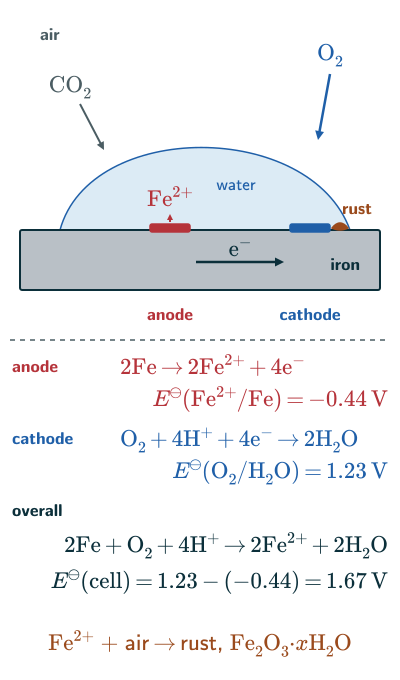
Rusting of iron happens in the presence of water and air. Its chemistry is complex, but it can be treated as an electrochemical process, a tiny galvanic cell on the surface of the metal (NCERT page 57).
-
Anode. At one spot iron is oxidised, and that spot acts as the anode (NCERT page 57):
2Fe(s) → 2Fe2+ + 4e−, with E⊖(Fe2+/Fe) = −0.44 V
-
Cathode in NCERT’s acidic representation. The electrons travel through the metal to another spot, where they reduce oxygen in the presence of H+. The H+ is thought to come from carbonic acid, H2CO3, formed as carbon dioxide from the air dissolves in the water, and from other acidic oxides from the air (NCERT page 57):
O2(g) + 4H+(aq) + 4e− → 2H2O(l), with E⊖ = 1.23 V
-
Neutral-water representation (reasoned): O2 + 2H2O + 4e− → 4OH−. Ordinary wet iron can rust without added acid or carbon dioxide; this is the same oxygen-reduction process written for neutral/basic conditions. H+ and OH− equations describe different pH conventions.
-
Overall acidic model (NCERT page 57):
2Fe(s) + O2(g) + 4H+(aq) → 2Fe2+(aq) + 2H2O(l), with E⊖cell = 1.23 − (−0.44) = 1.67 V
-
Rust. Atmospheric oxygen oxidises the ferrous ions further to ferric ions, which come out as rust, hydrated ferric oxide, Fe2O3·xH2O, producing more hydrogen ions (NCERT page 57): 2Fe2+ + 2H2O + ½O2 → Fe2O3 + 4H+ (NCERT Fig. 2.13). The equation in NCERT Fig. 2.13 leaves out the water of hydration; Fe2O3·xH2O is NCERT’s representation, and the one to write in an exam. Beyond the NCERT text: real rust is a mixture of iron(III) oxide, hydrated iron(III) oxides and iron(III) oxide-hydroxide, FeO(OH), rather than one compound of fixed composition (Wikipedia, “Rust”).
-
The positive E⊖cell means a negative ΔrG⊖ (NCERT Eq. (2.16), page 40): rusting is spontaneous. Since H+ is a reactant, the Nernst equation shows that more acidic water raises the cell’s emf (reasoned).
Prevention of corrosion
Preventing corrosion saves money and prevents accidents such as a bridge collapsing or a key component failing (NCERT page 57). NCERT names three ways (page 57):
- Keep air and water out. Cover the surface with paint or with some chemicals, for example bisphenol (NCERT page 57). Beyond the NCERT text: bisphenol A is a starting material for epoxy resins (Wikipedia, “Bisphenol A”), and it is these epoxy coatings that protect steel pipes and reinforcing bars from corrosion (Wikipedia, “Epoxy”).
- Cover it with another metal, such as tin or zinc, that is inert or reacts to save the object (NCERT page 57). Strictly, tin is not inert, only less reactive than iron (reasoned; see below).
- Sacrificial electrode. Join another metal, such as magnesium or zinc, to the object. It corrodes itself and saves the object (NCERT page 57).
Why these work, from the standard electrode potentials (reasoned from NCERT Table 2.1, page 37; see using the table):
- Zinc, −0.76 V, is a better reducing agent than iron, −0.44 V. Zinc can protect a scratch sacrificially while enough active zinc remains electrically connected to the iron and both contact the electrolyte. Large damage, isolation or zinc depletion can end protection.
- Tin, −0.14 V, is less reactive than iron. It normally protects as an intact barrier. In aerated water, a scratch can make iron the anode and accelerate its corrosion; real galvanic behaviour depends on the medium and surface films.
- Magnesium, −2.36 V, and zinc make good sacrificial electrodes. A metal with a more positive E⊖ than iron, such as copper (+0.34 V), would make the iron the anode and corrode it faster.
Solved examples
Example 1: Rusting as a cell (NCERT Intext Question 2.15)
Explain how rusting of iron can be seen as the setting up of an electrochemical cell.
Answer: On a wet iron surface, one spot acts as the anode, where iron is oxidised, Fe → Fe2+ + 2e−. The electrons pass through the metal, which acts as the external circuit, to another spot, the cathode, where oxygen is reduced with H+ from dissolved CO2, O2 + 4H+ + 4e− → 2H2O. The water film acts as the electrolyte (reasoned). The Fe2+ is then oxidised by air to rust, Fe2O3·xH2O (NCERT page 57).
Example 2: Gibbs energy of rusting
Find E⊖cell and ΔrG⊖ for 2Fe + O2 + 4H+ → 2Fe2+ + 2H2O.
Answer: E⊖cell = 1.23 − (−0.44) = 1.67 V (NCERT page 57). Four electrons are transferred, so ΔrG⊖ = −4 × 96 487 × 1.67 = −645 kJ mol−1: spontaneous (NCERT Eq. (2.16), page 40). These are standard values, for 1 M H+; an ordinary water film is far less acidic, so the actual potential depends on pH, oxygen and iron-ion activity; it stays positive at pH 7, about 1.25 V with air’s oxygen and unit Fe2+ (reasoned from NCERT Eq. (2.13), page 38). The stated reaction ends at Fe2+, so its ΔrG is not the complete Gibbs energy of forming hydrated rust. A negative ΔrG⊖ says rusting can happen, not how fast (reasoned).
Example 3: Scratched coatings
Iron sheets are coated with zinc in one case and with tin in another, and both coatings are scratched. Which sheet rusts at the scratch?
Answer: The tin-coated sheet. Zinc (−0.76 V) is more easily oxidised than iron (−0.44 V), so it corrodes in place of the iron; tin (−0.14 V) is less easily oxidised, so iron becomes the anode at the scratch (reasoned from NCERT Table 2.1, page 37).
Example 4: Choosing a sacrificial metal
Which of magnesium, zinc and copper could be used as a sacrificial electrode for an iron pipe?
Answer: Magnesium (−2.36 V) and zinc (−0.76 V), which are oxidised more easily than iron (−0.44 V). Copper (+0.34 V) would act as a cathode and make the iron corrode faster (reasoned from NCERT Table 2.1, page 37; method from NCERT page 57).
Common mistakes to avoid
Common mistake
Thinking iron rusts in dry air
Rusting needs both water and air (NCERT page 57): oxygen is reduced at the cathode, and the water film is the electrolyte (reasoned).
Common mistake
Treating a tin coating like a zinc one
In ordinary aerated water tin mainly protects as a barrier; connected active zinc can protect a scratch until it is depleted (reasoned from NCERT Table 2.1, page 37).
Common mistake
Writing rust as FeO
NCERT represents rust as hydrated ferric oxide, Fe2O3·xH2O (NCERT page 57); the equation in NCERT Fig. 2.13 leaves out the water.
Quick revision summary
- Corrosion: a metal’s surface is slowly coated with its oxides or other salts (NCERT); more generally, deterioration by reaction with the surroundings. Examples: rusting, tarnishing of silver, green coating on copper.
- Rusting needs water and air, and works as a tiny galvanic cell on the iron.
- Anode: Fe → Fe + 2e; cathode: O + 4H + 4e → 2HO; E⊖(cell) = 1.67 V. Fe is oxidised further to rust, FeO·xHO.
- Prevention: paint or chemicals; a coating of tin or zinc; a sacrificial electrode of magnesium or zinc.
Formula sheet
- Anode: 2Fe → 2Fe + 4e, E⊖(Fe/Fe) = −0.44 V
- Cathode: O + 4H + 4e → 2HO, E⊖ = 1.23 V
- Overall: 2Fe + O + 4H → 2Fe + 2HO, E⊖(cell) = 1.67 V
- Rust: FeO·xHO
Questions students ask
What is the difference between corrosion and rusting?
Rusting is one kind of corrosion: corrosion is deterioration through reaction with the environment (reasoned), which NCERT describes as slowly coating metal surfaces with oxides or other salts of the metal, while rusting is the corrosion of iron, which gives hydrated ferric oxide, Fe2O3·xH2O (NCERT page 57). So all rusting is corrosion, but not all corrosion is rusting: other metals corrode without forming rust (NCERT page 57). Beyond the NCERT text, silver’s tarnish, for example, is mainly silver sulphide, formed with hydrogen sulphide in the air (Wikipedia, “Passivation (chemistry)”), and steel, being mostly iron, rusts too (Wikipedia, “Rust”).
What is galvanisation, and how is it different from sacrificial protection?
Beyond the NCERT text, galvanisation is the name for NCERT’s zinc coating of iron or steel (NCERT page 57), usually applied by dipping the object in molten zinc (Wikipedia, “Galvanization”). A separate sacrificial-anode system uses a block of magnesium or zinc joined to the object (NCERT page 57), as on ship hulls and pipelines, and replaced when it is used up (Wikipedia, “Cathodic protection”). Both make the iron the cathode and the zinc or magnesium the anode (reasoned from NCERT Table 2.1), which is called cathodic protection; long pipelines are also protected by a DC supply that makes them the cathode (Wikipedia, “Cathodic protection”).
Why does aluminium not corrode away like iron, though it is more reactive?
Beyond the NCERT text, aluminium is protected by its own corrosion product: in air it is quickly covered by a thin, firmly attached layer of aluminium oxide that keeps oxygen and water off the metal, while rust is porous and flaky and falls away, exposing fresh iron (Wikipedia, “Passivation (chemistry)” and “Rust”). By E⊖ alone aluminium, −1.66 V, is more easily oxidised than iron, −0.44 V (NCERT Table 2.1): E⊖ tells whether a metal can be oxidised, not how fast it corrodes behind a film (reasoned). Stainless steel resists rust the same way, its chromium forming a thin, self-repairing chromium oxide film (Wikipedia, “Stainless steel”).
Is rusting of iron an exothermic reaction?
Yes, rusting of iron is exothermic: making iron(III) oxide from iron and oxygen releases 824.2 kJ per mole of Fe2O3, the magnitude of its negative standard enthalpy of formation (NCERT Class 11 Chemistry, page 151), or about 412 kJ per mole of iron; hydrated and oxyhydroxide rust products have different reaction enthalpies, so this number is specifically for FeO (reasoned). The heat goes unnoticed because rusting is slow, yet it outweighs the fall in entropy and makes the oxidation spontaneous (reasoned; Class 11 example). Beyond the NCERT text, air-activated hand warmers release it fast enough to feel (Wikipedia, “Hand warmer”).
Which chapter is corrosion in, and is it in the JEE Main and NEET syllabus?
Corrosion is in Unit 2, Electrochemistry, of NCERT Class 12 Chemistry Part I, as Section 2.8 (pages 57–58) with Intext Question 2.15, and the CBSE Class XII Chemistry syllabus for 2026–27 lists ‘Corrosion’ in Unit 2, Electrochemistry, so it counts for the CBSE Class 12 board exam. Corrosion is not named in the JEE Main or the NEET (UG) 2026 syllabus: Unit 7, Redox Reactions and Electrochemistry, of each ends with the dry cell, the lead accumulator and fuel cells. Why rusting is a redox reaction is answered on the Class 11 oxidation and reduction page.
Practice questions
Try each question first, then open the answer to check your working.
-
Q1. Where does acid in NCERT’s acidic rusting model come from, and is added acid essential for rusting?
Show answerHide answer
Dissolved carbon dioxide and other acidic atmospheric oxides can acidify the water (NCERT page 57). Added acid is not essential: in neutral water write oxygen reduction as O2 + 2H2O + 4e− → 4OH−.
-
Q2. Give three examples of corrosion.
Show answerHide answer
The rusting of iron, the tarnishing of silver and the green coating on copper and bronze (NCERT page 57).
-
Q3. How does a sacrificial electrode protect an iron object?
Show answerHide answer
Another metal, such as magnesium or zinc, is joined to the object; it corrodes itself and saves the object (NCERT page 57). It works because it is oxidised more easily than iron (reasoned from NCERT Table 2.1, page 37).