Fuel cells
NCERT Class 12 Chemistry Chapter 2 Section 2.7
Quick answer
A fuel cell generates electricity from reactants supplied continuously from outside the cell. A hydrogen–oxygen fuel cell oxidises hydrogen at the anode and reduces oxygen at the cathode, producing water. Efficiency depends on the technology and energy basis, while environmental impact also depends on how the hydrogen is produced.
With your textbook
NCERT Chemistry Part I (Class 12), Chapter 2 “Electrochemistry”, Section 2.7 “Fuel Cells”, pages 56–57.
Open the official NCERT chapter (PDF, 4.4 MB, ncert.nic.in) (opens in a new tab)
Checked against the 2026-27 reprint on .
What is a fuel cell?
Fuel cell
Galvanic cells that are designed to convert the energy of combustion of fuels like hydrogen, methane, methanol, etc. directly into electrical energy are called fuel cells.
NCERT Chemistry Part I (Class 12), Section 2.7, page 56
- Unlike a battery, a fuel cell is fed its reactants continuously, and its products are removed continuously, so it runs as long as the reactants are supplied (NCERT page 56). In practice its electrodes and catalyst must also stay in working order (reasoned).
- Like any galvanic cell, it converts chemical energy directly into electricity and is highly efficient (NCERT page 56): there is no step of making heat and steam first (reasoned). How a given fuel cell compares with a given power plant depends on their designs (reasoned).
In plain words: a steam power station burns fuel, makes steam and drives a turbine-generator, rejecting some energy as heat. Gas-turbine and combined-cycle plants use different arrangements. A fuel cell skips all of that. It lets hydrogen and oxygen react on two separate electrodes, so the electrons they exchange go through a wire and do work directly.
Why not just burn the fuel?
- In a thermal power plant the heat of combustion of coal, gas or oil first turns water into high-pressure steam, which runs a turbine to produce electricity. NCERT calls this not a very efficient method and a major source of pollution (page 56). Strictly, a heat engine must reject some of its heat, which limits its efficiency (reasoned).
- A fuel cell is a galvanic cell built to run on a continuous supply of fuel (NCERT page 56).
Hydrogen–oxygen fuel cell
- One of the most successful fuel cells uses the reaction of hydrogen with oxygen to form water. It provided electrical power in the Apollo space programme, and the water vapour it produced was condensed and added to the astronauts’ drinking water (NCERT page 56).
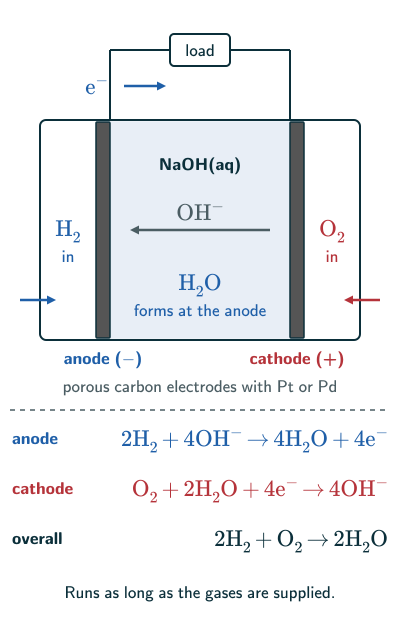
- Hydrogen and oxygen are bubbled through porous carbon electrodes into concentrated aqueous sodium hydroxide. Finely divided platinum or palladium in the electrodes acts as a catalyst, speeding up the electrode reactions (NCERT page 56).
- Beyond the NCERT text: alkaline fuel cells, the type used in the US space programme, normally use potassium hydroxide (US Department of Energy, “Fuel Cells” and “Types of Fuel Cells”). The reactions are the same; write NCERT’s sodium hydroxide unless a question offers potassium hydroxide.
- The electrode reactions (NCERT page 56):
- cathode: O2(g) + 2H2O(l) + 4e− → 4OH−(aq)
- anode: 2H2(g) + 4OH−(aq) → 4H2O(l) + 4e−
- overall: 2H2(g) + O2(g) → 2H2O(l)
- The cell runs continuously as long as the reactants are supplied (NCERT page 56). The hydroxide ions made at the cathode travel through the electrolyte to the anode, so the cell reaction uses up no NaOH; the water it makes would dilute the electrolyte, so it is removed continuously (reasoned from the electrode reactions; NCERT page 56).
- Its voltage. The overall reaction is the same as in acid, so the standard emf is the difference between O2/H2O and H+/H2 in NCERT Table 2.1: 1.23 − 0.00 = 1.23 V (reasoned from NCERT Table 2.1, page 37). In the alkaline cell the hydrogen couple, 2H2O + 2e− → H2 + 2OH−, is −0.83 V in NCERT Table 2.1, so the same 1.23 V puts O2/OH− at +0.40 V (reasoned).
Efficiency of fuel cells
- Fuel cells produce electricity with an efficiency of about 70%, against about 40% for thermal plants (NCERT pages 56–57).
- Beyond the NCERT text: the US Department of Energy says fuel cells can exceed 60% efficiency, and combustion power plants typically run at about 33% (US Department of Energy, “Fuel Cells” and “Types of Fuel Cells”). In an exam, use NCERT’s 70% and 40%; in a problem, use the values it gives. Real figures depend on the cell and the plant: state whether efficiency counts electricity alone or electricity plus recovered heat, and whether fuel energy uses the higher or lower heating value (reasoned).
- There has been tremendous progress in new electrode materials, better catalysts and electrolytes for increasing their efficiency; fuel cells have been used in automobiles on an experimental basis, and in view of their future importance, a variety of fuel cells have been fabricated and tried (NCERT page 57). Beyond the NCERT text: several vehicle manufacturers now have hydrogen fuel-cell vehicles (US Energy Information Administration, “Use of hydrogen”).
- NCERT slip (page 57): NCERT says fuel cells “are pollution free”. Only the hydrogen–oxygen cell earns that where it runs: its one product is water (US Department of Energy, “Fuel Cells” and “Types of Fuel Cells”). Methane and methanol cells give carbon dioxide (reasoned). Beyond the NCERT text: making the hydrogen can itself release carbon dioxide, since nearly all commercial hydrogen in the United States comes from steam reforming of methane (US Energy Information Administration, “Production of hydrogen”). In an exam, write NCERT’s “pollution free”; if a question asks about methane or methanol cells, or about where the hydrogen comes from, add the qualification.
- The standard-state ceiling at 298 K (reasoned; liquid-water product, higher-heating-value basis). The most electrical work a reaction can give is −ΔrG, the fall in its Gibbs energy, while burning it releases −ΔrH as heat. For H2 + ½O2 → H2O(l), with n = 2:
- ΔrG⊖ = −nFE⊖ = −2 × 96 487 × 1.23 = −237 kJ mol−1 (NCERT Eq. (2.16), page 40);
- ΔrH⊖ = −285.8 kJ mol−1, the enthalpy of formation of liquid water (NCERT Class 11 Chemistry, Unit 5, page 150);
- so in this reversible 298 K standard-state comparison, 237/285.8 = 83% of the reaction enthalpy can come out as electricity. NCERT puts practical cells at about 70% (NCERT page 56).
Ideal fuel-cell efficiency (reasoned)
The hydrogen economy
- Burning fossil fuels gives carbon dioxide, which is strengthening the greenhouse effect: the Earth’s surface warms, polar ice melts and sea levels rise, threatening low-lying coasts and island nations such as the Maldives (NCERT page 58).
- Hydrogen is an ideal alternative, because its combustion gives water only. Made by splitting water using solar energy, it can be used as a renewable and non-polluting source of energy (NCERT page 58).
- Beyond the NCERT text: hydrogen is an energy carrier, not a primary source, and it can be made from water, fossil fuels or biomass (US Energy Information Administration, “Hydrogen explained”), so its emissions depend on how it is made. Wind as well as solar power can drive the electrolysis (US Department of Energy, “Hydrogen Fuel Basics”).
- Both steps of this hydrogen economy, making hydrogen by electrolysis of water and using it in a fuel cell, rest on electrochemical principles (NCERT page 58).
Solved examples
Example 1: Fuels for fuel cells (NCERT Intext Question 2.14)
Suggest two materials other than hydrogen that can be used as fuels in fuel cells.
Answer: Methane and methanol (NCERT page 56).
Example 2: Hydrogen used
One hydrogen–oxygen fuel cell, with 100% current efficiency, delivers a steady 10.0 A for 1.00 hour. How much hydrogen does it use? (F = 96 487 C mol−1, H2 2.016 g mol−1.)
Answer: Q = 10.0 × 3600 = 36 000 C, so n(e−) = 36 000/96 487 = 0.373 mol. The anode reaction gives 2 electrons per H2, so 0.1866 mol of H2, 0.376 g (NCERT page 56; Q = It and F, NCERT page 52).
Example 3: Gibbs energy of the cell reaction
Find ΔrG⊖ for 2H2(g) + O2(g) → 2H2O(l) in the fuel cell, with E⊖cell = 1.23 V.
Answer: Four electrons are transferred: ΔrG⊖ = −4 × 96 487 × 1.23 = −475 kJ mol−1, that is −237 kJ per mole of water (NCERT Eq. (2.16), page 40).
Example 4: Why so efficient?
Why is a fuel cell more efficient than a thermal power plant?
Answer: The plant first turns the heat of combustion into high-pressure steam, which runs a turbine, and only then makes electricity; a galvanic cell converts chemical energy directly into electricity (NCERT page 56). NCERT’s figures are about 70% against about 40% (NCERT pages 56–57). Strictly, the heat-engine route must reject some heat, and a fair comparison of real systems needs the same fuel-energy basis (reasoned).
Common mistakes to avoid
Common mistake
Thinking a fuel cell stores energy like a battery
A fuel-cell stack relies on an external reactant supply rather than the finite internal active-material store of a conventional battery: it works only while fuel and oxygen are fed in, and its products are removed (NCERT page 56).
Common mistake
Putting the hydrogen at the cathode
Hydrogen is oxidised, at the anode; oxygen is reduced at the cathode (NCERT page 56).
Common mistake
Expecting 100% efficiency
At 298 K with liquid-water product under standard conditions, the ideal electrical limit is −ΔrG, about 83% of the higher heating value; NCERT puts practical cells at about 70% (reasoned; NCERT page 56).
Quick revision summary
- Fuel cell: a galvanic cell fed continuously with a fuel (hydrogen, methane, methanol) and oxygen; products removed continuously.
- NCERT alkaline H–O model: porous carbon electrodes with Pt or Pd and concentrated NaOH. Apollo used alkaline fuel cells; KOH is the typical space-cell electrolyte.
- Anode: 2H + 4OH → 4HO + 4e; cathode: O + 2HO + 4e → 4OH; overall 2H + O → 2HO, about 1.23 V.
- NCERT comparison: about 70% versus 40%; actual system efficiencies vary. Reversible 298 K standard-state limit for liquid-water product: ΔG/ΔH ≈ 83% (HHV).
- Hydrogen economy: hydrogen from water by solar-powered electrolysis, used in fuel cells.
Formula sheet
- Anode: 2H + 4OH → 4HO + 4e
- Cathode: O + 2HO + 4e → 4OH
- Overall: 2H + O → 2HO
- E⊖(cell) = 1.23 − 0.00 = 1.23 V
- Ideal efficiency at 298 K = ΔrG⊖/ΔrH⊖ ≈ 83% (H2O liquid, HHV)
Questions students ask
Is a fuel cell a primary or a secondary cell?
A fuel cell is neither a primary nor a secondary cell in NCERT’s grouping: NCERT divides batteries into primary and secondary (page 54) but gives fuel cells their own Section 2.7, and its Summary lists batteries and fuel cells as two useful forms of galvanic cell (page 59). A fuel cell is refuelled, not recharged: its electrodes are not used up but only carry out the reactions of the fuel and oxygen fed to them, while in a battery the electrode materials themselves react, such as the zinc can of a dry cell (NCERT pages 54–56; reasoned). Beyond the NCERT text, the US Department of Energy also says that fuel cells do not run down or need recharging (US DOE, “Fuel Cells”).
What is the difference between a fuel cell and an electrolyser?
A hydrogen–oxygen fuel cell and a water electrolyser run one reaction in opposite directions: the fuel cell, a galvanic cell, makes electricity from 2H2 + O2 → 2H2O (NCERT page 56), and the electrolyser, an electrolytic cell, uses electricity to split water (NCERT page 58). Beyond the NCERT text, both consist of an anode and a cathode separated by an electrolyte, KOH or NaOH in alkaline ones (US DOE, “Hydrogen Production: Electrolysis”). At 298 K with liquid water and standard gas conditions, the reversible fuel-cell emf is about 1.23 V; the electrolyser needs more, to overcome overpotential (reasoned; NCERT pages 37, 53).
Can a hydrogen–oxygen fuel cell use an acidic electrolyte instead of NaOH?
Yes, a hydrogen–oxygen fuel cell can work in acid, with the same reaction and 1.23 V standard emf: H2 → 2H+ + 2e− at the anode and O2 + 4H+ + 4e− → 2H2O at the cathode (reasoned from NCERT Table 2.1, page 37). Beyond the NCERT text, the proton exchange membrane cells in cars do this, with a solid acidic polymer electrolyte and a costly platinum catalyst (US DOE, “Types of Fuel Cells”). Alkaline cells like NCERT’s react fast enough for cheaper catalysts, but even the CO2 in air turns their hydroxide into carbonate, so conventional aqueous alkaline cells need CO2-free oxidant, such as pure oxygen or appropriately scrubbed air (US DOE, “Types of Fuel Cells”; Wikipedia, “Alkaline fuel cell”).
Why are fuel cells not widely used yet?
Beyond the NCERT text, fuel cells are held back mainly by cost and hydrogen supply: the proton exchange membrane cells used in vehicles need a costly platinum catalyst, which carbon monoxide in impure hydrogen poisons (US DOE, “Types of Fuel Cells”). Hydrogen is usually stored as a gas in tanks at 350–700 bar or as a liquid at −252.8 °C, its boiling point (US DOE, “Hydrogen Storage”), and 95% of the hydrogen made in the United States comes from natural gas, which gives carbon dioxide (US DOE, “Hydrogen Production: Natural Gas Reforming”). NCERT notes that fuel cells have been used in automobiles on an experimental basis (page 57).
Are fuel cells in the JEE Main and NEET syllabus?
Yes, fuel cells are in both syllabuses: Unit 7, Redox Reactions and Electrochemistry, of the JEE Main syllabus ends with “dry cell and lead accumulator, fuel cells”, and Unit 7 of the NEET (UG) 2026 syllabus ends with “Dry cell and lead accumulator; Fuel cells”. NCERT Class 12 Chemistry Part I covers them in Section 2.7 (pages 56–57), with Intext Question 2.14 and the Hydrogen Economy box on page 58. Neither syllabus names the hydrogen economy, so the hydrogen–oxygen cell, its electrode reactions and its efficiency are the core to learn (reasoned).
Practice questions
Try each question first, then open the answer to check your working.
-
Q1. What are the electrodes and the electrolyte of the hydrogen–oxygen fuel cell, and why are platinum or palladium added?
Show answerHide answer
Porous carbon electrodes and concentrated aqueous sodium hydroxide; finely divided platinum or palladium is a catalyst that speeds up the electrode reactions (NCERT page 56).
-
Q2. How was the water from the Apollo fuel cells used?
Show answerHide answer
The water vapour was condensed and added to the astronauts’ drinking water supply (NCERT page 56).
-
Q3. Give two advantages of fuel cells over thermal power plants.
Show answerHide answer
They are more efficient, about 70% against about 40%, and NCERT calls them pollution free (NCERT pages 56–57); the hydrogen–oxygen cell’s only product is water. Strictly, real efficiencies vary with the system, and making the hydrogen can release carbon dioxide (beyond the NCERT text; see the slip above).