Batteries
NCERT Class 12 Chemistry Chapter 2 Section 2.6
Quick answer
A battery supplies electricity from one or more cells during discharge. Primary batteries are designed for one discharge cycle, while secondary batteries can be recharged by reversing the main electrode reactions. NCERT describes the dry cell, historical mercury cell, lead storage cell and nickel-cadmium cell.
With your textbook
NCERT Chemistry Part I (Class 12), Chapter 2 “Electrochemistry”, Section 2.6 “Batteries”, pages 54–56.
Open the official NCERT chapter (PDF, 4.4 MB, ncert.nic.in) (opens in a new tab)
Checked against the 2026-27 reprint on .
What is a battery?
Battery
Any battery (actually it may have one or more than one cell connected in series) or cell that we use as a source of electrical energy is basically a galvanic cell where the chemical energy of the redox reaction is converted into electrical energy.
NCERT Chemistry Part I (Class 12), Section 2.6, page 54
- To be practical, a battery should be reasonably light and compact, and its voltage should not change much while it is used (NCERT page 54).
- In primary batteries the reaction occurs only once; after use over a period of time the battery becomes dead and cannot be reused. Secondary batteries can be recharged and used again (NCERT pages 54–55). That one discharge may be spread over many periods of use (reasoned).
In plain words: a battery contains one or more cells and supplies electricity galvanically during discharge. Cells may be vented or sealed and connected in series, parallel or both. A primary torch cell can power many sessions until discharged; it is then replaced. A phone or car battery can be recharged: the charger drives the same reaction backwards, and meanwhile the battery works as an electrolytic cell. Cells in series add their voltages.
Primary batteries
In NCERT’s words:
In the primary batteries, the reaction occurs only once and after use over a period of time battery becomes dead and cannot be reused again.
NCERT Chemistry Part I (Class 12), Section 2.6.1, page 54
The two NCERT examples are the dry cell and the mercury cell.
Dry cell and mercury cell
- Dry cell (Leclanché cell), named after its discoverer and used in transistor radios and clocks (NCERT page 54):
- anode: the zinc container;
- cathode: a carbon (graphite) rod surrounded by powdered manganese dioxide and carbon;
- electrolyte: a moist paste of ammonium chloride (NH4Cl) and zinc chloride (ZnCl2) between the electrodes.
- The reactions are complex, but approximately (NCERT page 54):
- anode: Zn(s) → Zn2+ + 2e−
- cathode: MnO2 + NH4+ + e− → MnO(OH) + NH3
- At the cathode manganese is reduced from the oxidation state +4 to +3. The ammonia forms a complex with Zn2+, [Zn(NH3)4]2+. The cell gives nearly 1.5 V (NCERT page 54). The graphite rod mainly collects the current; the MnO2 around it is what is reduced (reasoned from the cathode reaction).
- Mercury cell, suitable for low-current devices such as hearing aids and watches (NCERT pages 54–55). Beyond the NCERT text: because mercury is toxic, the sale of mercury batteries has since been banned in many countries (Wikipedia, “Mercury battery”).
- anode: zinc–mercury amalgam, Zn(Hg); cathode: a paste of HgO and carbon; electrolyte: a paste of KOH and ZnO;
- anode: Zn(Hg) + 2OH− → ZnO(s) + H2O + 2e−
- cathode: HgO + H2O + 2e− → Hg(l) + 2OH−
- overall: Zn(Hg) + HgO(s) → ZnO(s) + Hg(l)
- The mercury cell gives about 1.35 V, and this remains constant during its life, because the overall reaction involves no ion in solution whose concentration could change (NCERT page 55). Strictly, it is nearly rather than exactly constant: zinc in an amalgam is part of a mixture, not a pure solid, and its activity falls as the zinc is used up, so E drifts slightly; load and temperature also affect the terminal voltage (reasoned from the Nernst equation). In an exam, give NCERT’s reason.
- The caption of NCERT Figure 2.9 (page 55) names zinc as the reducing agent and mercury(II) oxide as the oxidising agent: zinc goes from 0 to +2, mercury from +2 to 0.
Secondary batteries
In NCERT’s words:
A secondary cell after use can be recharged by passing current through it in the opposite direction so that it can be used again.
NCERT Chemistry Part I (Class 12), Section 2.6.2, page 55
- A good secondary cell can go through a large number of discharging and charging cycles (NCERT page 55).
- In use it is a galvanic cell; while charging it is an electrolytic cell, driven by the charger (reasoned from NCERT pages 32 and 55).
Lead storage battery
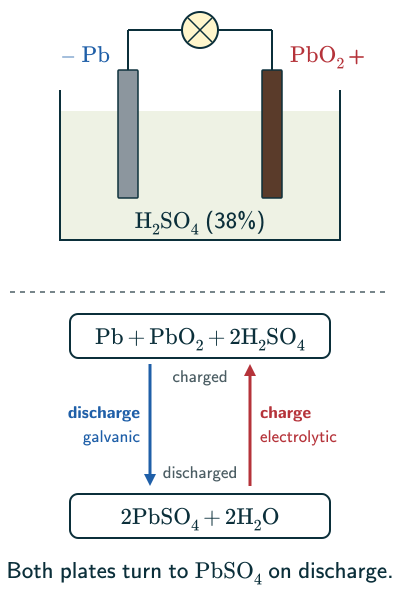
- NCERT calls it the most important secondary cell (page 55); it is used in automobiles and inverters. It has a lead anode and a grid of lead packed with lead dioxide (PbO2) as cathode, in a 38% solution of sulphuric acid (NCERT page 55).
- In use (discharge) (NCERT page 55):
- anode: Pb(s) + SO42−(aq) → PbSO4(s) + 2e−
- cathode: PbO2(s) + SO42−(aq) + 4H+(aq) + 2e− → PbSO4(s) + 2H2O(l)
- overall: Pb(s) + PbO2(s) + 2H2SO4(aq) → 2PbSO4(s) + 2H2O(l)
- Lead ends at +2 in PbSO4 on both plates, up from 0 at the anode and down from +4 at the cathode (reasoned from NCERT page 55).
- Charging reverses the reaction: the PbSO4 on the discharge anode and discharge cathode is converted back into Pb and PbO2, respectively (NCERT page 55).
- Naming on charge (NCERT page 55): NCERT keeps the discharge names while charging, saying the PbSO4 “on anode and cathode” is converted back. That treats the names as labels for the plates (reasoned). If anode and cathode mean the sites of the current reactions, the names swap on charge. Oxidation happens at the anode (NCERT pages 33 and 51). So on charging, the lead plate, where PbSO4 is reduced, is the cathode, and the PbO2 plate is the anode. The signs stay: lead negative, PbO2 positive (NCERT Figure 2.10, page 55). In an exam, quote NCERT’s sentence for what charging does; if asked which plate is the anode or the cathode during charging, name each by its reaction.
- Discharge uses up sulphuric acid and makes water, so the acid gets weaker: 1 mol of H2SO4 for every mole of electrons (reasoned from the overall equation). Sulphuric acid is denser than water, so the electrolyte’s density falls on discharge and rises on charging (reasoned). Beyond the NCERT text: this makes the density a guide to a lead–acid battery’s charge. In the nickel-cadmium cell the potassium hydroxide is not used up, so its density is no such guide (Wikipedia, “Nickel–cadmium battery”).
Nickel-cadmium cell
-
Another important secondary cell. It has a longer life than the lead storage cell but costs more to make (NCERT page 56); actual cost and cycle life depend on design and operating conditions (reasoned). Its plates are rolled up in a jelly-roll arrangement, separated by a layer soaked in moist sodium or potassium hydroxide (NCERT Figure 2.11, page 56).
-
NCERT gives the overall reaction during discharge as (NCERT page 56):
Cd(s) + 2Ni(OH)3(s) → CdO(s) + 2Ni(OH)2(s) + H2O(l)
-
NCERT slip (page 56): NCERT’s equation balances, but its Ni(OH)3 and CdO are an older, simplified way of writing the materials. Beyond the NCERT text: the charged positive material is nickel oxyhydroxide, NiO(OH), and cadmium and nickel form hydroxides on discharge; infrared spectroscopy showed that the discharge products are cadmium hydroxide and nickel hydroxide. The modern net reaction is Cd + 2NiO(OH) + 2H2O → Cd(OH)2 + 2Ni(OH)2, with a nearly steady 1.2 V (Wikipedia, “Nickel–cadmium battery”; the net equation is summed from its half reactions). For an NCERT-based question, write NCERT’s equation.
Solved examples
Example 1: Primary or secondary?
Classify: (a) a torch’s dry cell; (b) a car battery; (c) a watch’s mercury cell; (d) a rechargeable nickel-cadmium cell.
Answer: (a) and (c) are primary: the reaction occurs only once, and they cannot be reused. (b) and (d) are secondary: they are recharged by passing current the opposite way (NCERT pages 54–56).
Example 2: Electrons in the dry cell
Write the overall dry cell reaction from NCERT’s half reactions, and give the change in oxidation state of zinc and of manganese.
Answer: Zinc gives 2 electrons and each MnO2 takes 1, so double the cathode reaction: Zn + 2MnO2 + 2NH4+ → Zn2+ + 2MnO(OH) + 2NH3. Zinc goes from 0 to +2; manganese from +4 to +3 (NCERT page 54; overall equation reasoned).
Example 3: Acid used in a car battery
One lead storage cell delivers 9.65 A for 1.00 hour. How much sulphuric acid is used up? (H2SO4 98.1 g mol−1, F = 96 487 C mol−1.)
Answer: Q = 9.65 × 3600 = 34 740 C = 34 740/96 487 = 0.360 mol of electrons. The overall reaction uses 2 mol of H2SO4 for 2 mol of electrons, so 0.360 mol, 35.3 g per cell, of acid is used up (NCERT page 55; Q = It and F, NCERT page 52).
Example 4: Recharging the lead storage battery (NCERT Intext Question 2.13, page 58)
Write the chemistry of recharging the lead storage battery, naming every material involved.
Answer: A current is passed through the battery in the opposite direction, so it works as an electrolytic cell (NCERT page 55):
- at the lead plate, now the cathode: PbSO4(s) + 2e− → Pb(s) + SO42−(aq);
- at the PbO2 plate, now the anode: PbSO4(s) + 2H2O(l) → PbO2(s) + SO42−(aq) + 4H+(aq) + 2e−;
- overall: 2PbSO4(s) + 2H2O(l) → Pb(s) + PbO2(s) + 2H2SO4(aq).
Lead sulphate and water are used up, and lead, lead dioxide and sulphuric acid are made again, so the acid’s density rises (reasoned by reversing NCERT’s equations).
Example 5: Why the mercury cell’s voltage holds
Why does a mercury cell give a nearly constant 1.35 V while a dry cell’s voltage falls as it is used?
Answer: The mercury cell’s overall reaction, Zn(Hg) + HgO(s) → ZnO(s) + Hg(l), has no ion in solution whose concentration changes (NCERT page 55), so NCERT says its potential remains constant during its life. Strictly, its reaction quotient varies only a little while the active phases remain: the zinc activity in the amalgam falls as the zinc is used up, so Q changes slightly and the terminal voltage is not exactly constant (reasoned from NCERT Eq. (2.13), page 38). In the dry cell, the overall reaction (Example 2) makes Zn2+ and uses up NH4+, so Q grows as it runs and, by the Nernst equation, E falls (reasoned).
Common mistakes to avoid
Common mistake
Calling the zinc can of a dry cell the cathode
The zinc container is the anode; the cathode is the carbon rod with manganese dioxide (NCERT page 54).
Common mistake
Thinking a dry cell has no liquid at all
Its electrolyte is a moist paste of NH4Cl and ZnCl2; “dry” means it does not spill (NCERT page 54; reasoned).
Common mistake
Mixing the two meanings of anode and cathode on charge
NCERT keeps the discharge names while charging (page 55). Named by the reaction now taking place, the lead plate, where PbSO4 is reduced, is the cathode and the PbO2 plate the anode (reasoned from NCERT pages 33 and 55). Say which meaning you are using.
Common mistake
Forgetting that the acid is used up
The lead storage battery consumes H2SO4 on discharge and remakes it on charging (NCERT page 55).
Quick revision summary
- A battery contains one or more cells, which supply electricity galvanically during discharge; it should be light, compact and of steady voltage.
- Primary: the reaction occurs only once (dry cell, about 1.5 V; mercury cell, about 1.35 V and steady). Secondary: rechargeable (lead storage, nickel-cadmium).
- Dry cell: zinc can (anode), carbon rod with MnO (cathode), moist NHCl and ZnCl paste; Mn goes from +4 to +3.
- Lead storage: Pb anode, PbO cathode, 38% HSO; both plates turn to PbSO on discharge; charging reverses it.
- Nickel-cadmium: rechargeable; longer life than lead storage but more expensive (NCERT); nominally about 1.2 V.
Formula sheet
- Dry cell: Zn → Zn + 2e; MnO + NH + e → MnO(OH) + NH
- Mercury cell: Zn(Hg) + HgO → ZnO + Hg(l), about 1.35 V
- Lead storage (discharge): Pb + PbO + 2HSO → 2PbSO + 2HO
- Nickel-cadmium (NCERT): Cd + 2Ni(OH) → CdO + 2Ni(OH) + HO
Questions students ask
Is a lead accumulator the same as a lead storage battery?
Yes, the lead accumulator of the JEE Main and NEET syllabuses is NCERT’s lead storage battery, the most important secondary cell, used in automobiles and inverters (NCERT page 55). Unit 7 of the JEE Main syllabus lists “dry cell and lead accumulator, fuel cells” and Unit 7 of the NEET (UG) 2026 syllabus “Dry cell and lead accumulator; Fuel cells”, while NCERT Section 2.6.2 (page 55) says lead storage battery. Beyond the NCERT text, it is also called the lead–acid battery, and it is the oldest rechargeable battery, invented by Gaston Planté in 1859 (Wikipedia, “Lead–acid battery”).
What is the emf of a lead storage cell, and why is a car battery 12 V?
Beyond the NCERT text, one lead storage cell has a standard emf of 2.05 V and reads about 2.1 V on open circuit when fully charged, with a discharge cutoff around 1.8 V per cell under specified load conditions (the cutoff depends on the battery and discharge rate) (Wikipedia, “Lead–acid battery”). A battery may be several cells in series (NCERT page 54), and a 12 V car battery has six, as cells in series add their emfs: six cells of nominally 2 V give a nominal 12 V battery; fully charged open-circuit voltage is typically nearer 6 × 2.1 = 12.6 V (reasoned). Its voltage sags a little on discharge, because sulphuric acid is a reactant (NCERT page 55) and its falling concentration lowers the emf by the Nernst equation (reasoned).
What is the difference between a dry cell and a wet cell?
A dry cell holds its electrolyte as a moist paste, NH4Cl and ZnCl2 in NCERT’s Leclanché cell (NCERT page 54), while, beyond the NCERT text, a wet cell has a free liquid electrolyte, like the sulphuric acid of an ordinary lead storage battery (NCERT page 55; Wikipedia, “Lead–acid battery”). The Leclanché cell itself began in 1866 as a wet cell, its zinc and manganese dioxide electrodes standing in ammonium chloride solution, and Carl Gassner patented a dry version with a zinc case in 1886 (Wikipedia, “Leclanché cell” and “Zinc–carbon battery”). “Dry” says nothing about recharging: the dry cell is primary and the wet lead storage battery secondary (NCERT pages 54–55).
What is the difference between a dry cell and an alkaline battery?
Beyond the NCERT text, an alkaline battery is a dry cell with a different electrolyte: it keeps the zinc and manganese dioxide of NCERT’s dry cell but uses potassium hydroxide instead of the NH4Cl–ZnCl2 paste, and powdered zinc in a gel instead of a zinc can (Wikipedia, “Alkaline battery”). Both give about 1.5 V (NCERT page 54 for the dry cell), but the alkaline cell holds more energy for its size and keeps longer, as ammonium chloride slowly attacks the zinc can of a dry cell (Wikipedia, “Zinc–carbon battery”). Its reaction, Zn + 2MnO2 + H2O → ZnO + 2MnO(OH), uses up no hydroxide, and it too is a primary cell (Wikipedia, “Alkaline battery”).
Is a lithium-ion battery a primary or a secondary cell?
Beyond the NCERT text, a lithium-ion battery is rechargeable: lithium ions move between host electrode materials during discharge and return during charging (Wikipedia, “Lithium-ion battery”). Primary lithium-metal coin cells are a different category and are generally not rechargeable. Lithium-ion voltage depends on the particular electrode pair and composition; the aqueous Li+/Li standard potential in NCERT Table 2.1 cannot by itself predict the voltage of a nonaqueous intercalation cell.
Why are mercury cells no longer used?
Beyond the NCERT text, mercury batteries have largely been replaced in consumer devices because mercury creates environmental problems when released from waste. The US rule distinguishes battery types: the US Code provision on button mercuric-oxide cells bans sale of button-cell mercuric-oxide batteries, while the provision on other mercuric-oxide cells permits other mercuric-oxide batteries only with a collection system. The 25 mg exception in the provision on alkaline-manganese cells concerns alkaline-manganese button cells, not mercury-oxide button cells (US Code, Chapter 137; US EPA, “Mercury in Batteries”). NCERT’s mercury-cell chemistry remains useful to learn, but it is a historical textbook example, not a recommendation for buying a hearing-aid battery.
Practice questions
Try each question first, then open the answer to check your working.
-
Q1. What is the difference between a primary and a secondary battery? Give one example of each.
Show answerHide answer
In a primary battery the reaction occurs only once, and the battery cannot be reused, for example the dry cell. A secondary battery is recharged by passing current through it in the opposite direction, for example the lead storage battery (NCERT pages 54–55).
-
Q2. Name the anode, cathode and electrolyte of the mercury cell, and say what it is used for.
Show answerHide answer
Anode: zinc–mercury amalgam; cathode: a paste of HgO and carbon; electrolyte: a paste of KOH and ZnO. It is suitable for low-current devices such as hearing aids and watches (NCERT pages 54–55).
-
Q3. What concentration of sulphuric acid does the lead storage battery use, and what is the cathode made of?
Show answerHide answer
A 38% solution of sulphuric acid; the cathode is a grid of lead packed with lead dioxide, PbO2 (NCERT page 55).