Electrolytic cells and electrolysis
NCERT Class 12 Chemistry Chapter 2 Section 2.5
Quick answer
Electrolysis uses an external electrical source to drive electrode reactions, with reduction at the cathode and oxidation at the anode. Faraday’s laws relate the amount transformed to the charge used in that reaction; competing reactions reduce current efficiency. Products depend on composition, electrode material and kinetics as well as equilibrium potentials.
With your textbook
NCERT Chemistry Part I (Class 12), Chapter 2 “Electrochemistry”, Section 2.5 “Electrolytic Cells and Electrolysis”, pages 51–54.
Open the official NCERT chapter (PDF, 4.4 MB, ncert.nic.in) (opens in a new tab)
Checked against the 2026-27 reprint on .
What is electrolysis?
Electrolytic cell and electrolysis
In an electrolytic cell external source of voltage is used to bring about a chemical reaction.
NCERT Chemistry Part I (Class 12), Section 2.5, page 51
- The electrode changes driven this way are electrolysis. The source supplies work; in an ideal transfer between identical copper electrodes the net equilibrium chemical change can have zero Gibbs-energy change, although a real current still needs a voltage. For the textbook reversal of a galvanic reaction it is non-spontaneous: the outside source supplies the energy (NCERT pages 32 and 51).
- Reduction happens at the cathode, which the source makes negative; oxidation happens at the anode, which is positive (NCERT page 51).
- Faraday’s laws connect the amount of substance changed at an electrode to the charge passed (NCERT page 51).
In plain words: a battery pushes electrons into one electrode and pulls them out of the other. Reduction occurs at the cathode and oxidation at the anode. Actual products depend on concentration, electrode material and reaction rates as well as equilibrium potentials. Counting electrons gives the theoretical amount of product; competing reactions can reduce the amount actually collected.
Electrolytic cells at work
- Copper in copper sulphate. One of the simplest electrolytic cells has two copper strips dipping in aqueous copper sulphate. With a DC voltage applied (NCERT Eqs. (2.28)–(2.29), page 51):
- at the cathode, copper is deposited: Cu2+(aq) + 2e− → Cu(s);
- at the anode, copper dissolves: Cu(s) → Cu2+(aq) + 2e−.
- NCERT slip (page 51): NCERT Eq. (2.29) writes the product as Cu2+(s); the ions go into solution, Cu2+(aq). Write Cu2+(aq) in answers.
- This is the basis of refining copper: impure copper is made the anode and dissolves, and pure copper is deposited on the cathode (NCERT page 51).
- Making reactive metals. Metals such as Na, Mg and Al are produced on a large scale by electrochemical reduction of their cations, using suitable molten electrolytes. This does not mean chemical reduction is impossible: magnesium is also produced by thermal reduction with ferrosilicon under suitable conditions (beyond NCERT; Pidgeon and King, Discussions of the Faraday Society, 1948). Sodium and magnesium come from their fused (molten) chlorides, and aluminium from aluminium oxide dissolved in cryolite (NCERT page 51).
Faraday’s laws of electrolysis
Michael Faraday published his results on the electrolysis of solutions and melts in 1833–34 (NCERT page 51).
- First law. In NCERT’s words:
The amount of chemical reaction which occurs at any electrode during electrolysis by a current is proportional to the quantity of electricity passed through the electrolyte (solution or melt).
NCERT Chemistry Part I (Class 12), Section 2.5, page 51
- Second law. The amounts of different substances liberated by the same quantity of electricity are proportional to their chemical equivalent weights: the atomic mass of the metal divided by the number of electrons needed to reduce its cation (NCERT page 51).
- Quantity of electricity. There were no constant-current sources in Faraday’s time. Charge was measured with a coulometer, a standard electrolytic cell: the mass of silver or copper deposited or dissolved in it gave the charge. Today a constant electric current I flows for a time t, and Q = It, in coulombs when I is in amperes and t in seconds (NCERT page 52).
- Moles of electrons. The charge needed depends on the electrode reaction (NCERT Eqs. (2.30)–(2.32), page 52):
- Ag+(aq) + e− → Ag(s) needs 1 mol of electrons per mole of silver;
- Mg2+(l) + 2e− → Mg(s) needs 2 mol;
- Al3+(l) + 3e− → Al(s) needs 3 mol.
- The faraday. The charge on one mole of electrons is the Avogadro constant times the charge on one electron. NCERT gives it as 96 487 C mol−1, called a faraday, F, and uses 1 F ≈ 96 500 C mol−1 for approximate work (NCERT page 52).
- NCERT slip (page 52): NCERT’s working, 6.02 × 10²³ mol−1 × 1.6021 × 10−19 C, gives 96 446 C mol−1, not the 96 487 it prints. Since 2019 F has an exact value, 96 485.33 C mol−1 to two decimals (NIST, 2022 CODATA recommended values). Use whichever value a question gives.
- In industry currents of 50 000 A are used: about 0.518 F every second (NCERT page 52).
Mass deposited (reasoned from NCERT page 52)
These formulas assume 100% current efficiency for the specified reaction. If only a fraction η of the charge produces it, m = ηQM/(nF); for varying current, use total charge Q = ∫I dt. All numerical exercises here assume constant current and 100% efficiency unless stated otherwise.
Here M is the molar mass and n the electron count per formula unit of the specified product; M/n is the equivalent weight of the second law. Beyond the NCERT text: the mass deposited per coulomb, M/(nF), is the electrochemical equivalent Z, so m = ZIt (Wikipedia, “Faraday’s laws of electrolysis”).
Products of electrolysis
- The products depend on the material being electrolysed and on the electrodes. An inert electrode, such as platinum or gold, takes no part and only supplies or removes electrons; a reactive electrode takes part in the electrode reaction (NCERT page 52).
- They also depend on the oxidising and reducing species present and their standard electrode potentials. Some reactions, though feasible, are so slow that an extra potential, the overpotential, must be applied, which makes them harder to bring about (NCERT page 53).
- Molten NaCl has one cation and one anion: sodium is formed at the cathode, Na+ + e− → Na, and chlorine at the anode, Cl− → ½Cl2 + e− (NCERT page 53).
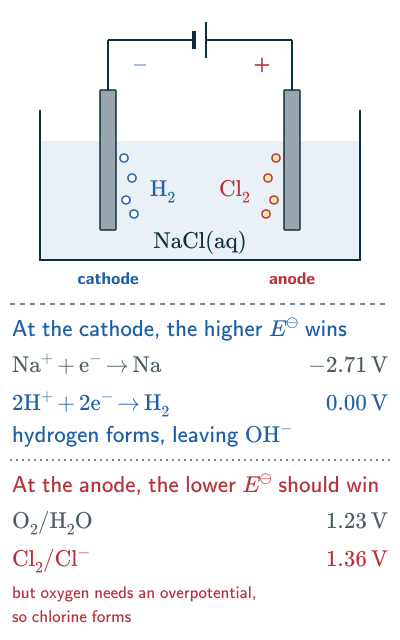
- Aqueous NaCl also has H+ and OH− ions and water, so reactions compete (NCERT page 53):
- at the cathode, Na+/Na has E⊖ = −2.71 V and H+/H2 0.00 V. Water reduction is favoured on ordinary non-amalgamating electrodes, so hydrogen forms. The hydrogen potential must be adjusted for the actual pH; it is not 0 V in neutral or alkaline brine; since H+ comes from water, the net cathode reaction is H2O(l) + e− → ½H2(g) + OH−(aq) (NCERT Eq. (2.35));
- at the anode, Cl2/Cl− has 1.36 V and O2/H2O 1.23 V. The lower value should win (a lower reduction potential means the reduced form gives up electrons more readily), so water should be oxidised first, but in concentrated brine on suitable chlorine-evolving electrodes, reaction kinetics and oxygen overpotential favour chlorine;
- net: NaCl(aq) + H2O(l) → Na+(aq) + OH−(aq) + ½H2(g) + ½Cl2(g). With cathode and anode products kept apart, the collected products are NaOH, Cl2 and H2. If chlorine mixes with alkali, further reactions occur (reasoned).
- Beyond the NCERT text: NCERT’s products are those of concentrated brine. In very dilute NaCl solution, oxygen is generally favoured at an inert anode: with little Cl− present, the Nernst equation raises the Cl2/Cl− potential and water wins, as with dilute sulphuric acid (reasoned from NCERT pages 53–54).
- NCERT slip (pages 53–54): NCERT labels the potentials beside the cathode reactions and Eqs. (2.36)–(2.39) E⊖(cell), even beside oxidations. They are standard reduction potentials of the couples, as in NCERT Table 2.1 (page 37); compare those in an exam. At real concentrations, the Nernst equation (NCERT Eq. (2.8), page 36) gives the potentials (NCERT page 53).
- Sulphuric acid. At the anode, 2H2O → O2 + 4H+ + 4e− (1.23 V) competes with 2SO42− → S2O82− + 2e−. Dilute acid normally gives oxygen; concentrated acid with suitable electrodes and current density can produce peroxodisulphate (NCERT Eqs. (2.38)–(2.39), pages 53–54). By E⊖ alone oxygen should always win; in concentrated acid the high sulphate concentration and oxygen’s overpotential let peroxodisulphate form (reasoned from NCERT page 53). Hydrogen forms at the cathode (reasoned). NCERT gives the second couple 1.96 V; data tables give 2.01 V (Wikipedia, “Standard electrode potential (data page)”). In a problem, use the value given.
Solved examples
Example 1: Copper deposited (NCERT Example 2.10)
A solution of CuSO4 is electrolysed for 10 minutes with a current of 1.5 A. What mass of copper is deposited at the cathode?
Answer: Q = It = 1.5 A × 600 s = 900 C. Cu2+ + 2e− → Cu needs 2F to deposit 1 mol, 63 g in NCERT’s working, so m = 63 × 900/(2 × 96 487) = 0.2938 g (NCERT Example 2.10, page 52). With 63.5 g mol−1, it is 0.2962 g.
Example 2: Counting electrons (NCERT Intext Question 2.10)
A current of 0.5 A flows through a metal wire for 2 hours. How many electrons flow through it?
Answer: Q = 0.5 × 7200 = 3600 C. Number of electrons = 3600/(1.6021 × 10−19) = 2.25 × 10²² (charge on the electron from NCERT page 52).
Example 3: Reducing dichromate (NCERT Intext Question 2.12)
How many coulombs are needed to reduce 1 mol of Cr2O72− in Cr2O72− + 14H+ + 6e− → 2Cr3+ + 7H2O?
Answer: 6 mol of electrons: 6F = 6 × 96 487 = 5.79 × 10⁵ C (NCERT page 52 for F).
Example 4: Cells in series (Faraday’s second law)
The same current passes through silver nitrate and copper sulphate solutions in series and deposits 1.08 g of silver. What mass of copper is deposited? (Ag 108, Cu 63.5 g mol−1.)
Answer: 1.08/108 = 0.0100 mol of Ag, so 0.0100 mol of electrons passed. Copper needs 2 per atom: 0.00500 mol × 63.5 = 0.318 g. Equivalently, the masses are in the ratio of the equivalent weights, 108/1 : 63.5/2 (NCERT page 51).
Example 5: Aluminium in industry
At the 50 000 A NCERT mentions, how long does it take to produce 1.00 kg of aluminium from Al3+? (Al 27.0 g mol−1.)
Answer: 1000/27.0 = 37.0 mol of Al needs 3 × 37.0 = 111 mol of electrons, Q = 111 × 96 487 = 1.07 × 10⁷ C, and t = Q/I = 1.07 × 10⁷/50 000 = 214 s, under 4 minutes (current from NCERT page 52).
Example 6: Copper sulphate with different electrodes
Predict the electrode products for aqueous CuSO4 (a) with copper electrodes and (b) with platinum electrodes.
Answer: In both, copper is deposited at the cathode, because Cu2+/Cu (0.34 V) is above H+/H2 (0.00 V) (NCERT Table 2.1, page 37). (a) The copper anode is reactive and dissolves (NCERT page 51). (b) The platinum anode is inert; sulphate is hard to oxidise, so water is oxidised and oxygen forms, leaving the solution acidic (reasoned from NCERT pages 52–54).
Common mistakes to avoid
Common mistake
Forgetting the electrons per ion
One faraday deposits 1 mol of Ag but only ½ mol of Cu and ⅓ mol of Al: divide by n (NCERT page 52).
Common mistake
Leaving time in minutes or hours
Q = It gives coulombs only with t in seconds (NCERT page 52).
Common mistake
Expecting oxygen from brine because 1.23 V is lower than 1.36 V
By E⊖ alone water would be oxidised first, but oxygen needs an overpotential, so chlorine forms (NCERT page 53).
Common mistake
Reducing the species with the lower E⊖ at the cathode
A higher reduction potential favours reduction thermodynamically, but use the actual composition and allow for electrode kinetics and overpotential; E⊖ alone is not a universal discharge rule. In the textbook brine example, H+ (0.00 V) before Na+ (−2.71 V) (NCERT page 53).
Quick revision summary
- Electrolytic cell: an outside voltage drives a non-spontaneous reaction; reduction at the negative cathode, oxidation at the positive anode.
- Faraday’s first law: amount reacted ∝ charge passed. Second law: amounts ∝ equivalent weights, M/n.
- Q = It; F = 96 487 C mol ≈ 96 500 C mol, the charge on 1 mol of electrons.
- Mass deposited: m = QM/(nF).
- Products depend on actual electrode potentials, concentration, electrode material and overpotential at both electrodes. Concentrated aqueous NaCl (brine) gives H, Cl and NaOH; molten NaCl gives Na and Cl.
- Na and Mg come from molten chlorides, Al from alumina in cryolite; copper is refined with an impure anode.
Formula sheet
- Q = It
- F = 96 487 C mol ≈ 96 500 C mol
- m = QM/(nF) = ItM/(nF)
- Second law: w/w = (M/n)/(M/n)
- Brine: cathode HO + e → ½H + OH; anode Cl → ½Cl + e
Questions students ask
Are Faraday’s laws of electrolysis in the JEE Main and NEET syllabus?
Faraday’s laws of electrolysis are not named in either syllabus: Unit 7 of the JEE Main syllabus and of the NEET (UG) 2026 syllabus lists “Electrochemical cells - Electrolytic and Galvanic cells” but not electrolysis or Faraday’s laws, and the only Faraday’s law either names is the physics law of induction. The laws are still worth learning with electrolytic cells, and NCERT Class 12 Chemistry Part I has not dropped them: its 2026–27 reprint keeps them in Section 2.5 (page 51), with Example 2.10 and Exercises 2.12–2.16. The CBSE Class XII Chemistry syllabus for 2026–27 lists ‘Electrolytic Cells and Electrolysis’ in Unit 2.
Why is direct current, not alternating current, used for electrolysis?
Electrolysis uses direct current because each electrode must keep one sign: in NCERT’s copper sulphate cell a DC voltage keeps the cathode negative, so copper is deposited there, while copper dissolves at the positive anode (NCERT page 51). With alternating current each electrode would be cathode and anode by turns, many times a second, so metal plated in one half-cycle would start to dissolve in the next, and the gases from water would come off mixed at both electrodes (reasoned). Faraday’s laws apply to charge in each electrode reaction, including each half-cycle; zero net signed charge does not guarantee no chemical products if reactions are irreversible. An ideal sinusoidal alternating current averages zero over a cycle (reasoned).
What is the difference between electrolysis and electroplating?
Beyond the NCERT text, electroplating is electrolysis used to coat an object with metal: the object is hung as the cathode in a solution of ions of the plating metal, and a bar of that metal often serves as the anode, dissolving to replace the ions used (Wikipedia, “Electroplating”). It is the cell NCERT uses for refining copper, where copper dissolves from the anode and is deposited on the cathode, Cu2+(aq) + 2e− → Cu(s) (NCERT page 51); in plating, the cathode is the object to be coated instead of a sheet of pure copper (reasoned). By Faraday’s first law the mass of the coat is proportional to the charge passed (NCERT page 51).
What is the difference between electrolysis and electrolytic dissociation?
Electrolytic dissociation is the separation of an electrolyte into free ions on dissolving (NCERT Class 11 Chemistry, pages 188–190), while electrolysis is the chemical change that a current brings about at the electrodes (NCERT page 51). Dissolved NaCl is already ions, yet H2 and Cl2 appear only when a voltage is applied (NCERT page 53; reasoned). Beyond the NCERT text, Faraday thought the current made the ions, but Arrhenius proposed that solutions hold ions with no current (Wikipedia, “Svante Arrhenius”), the theory that won him the 1903 Nobel Prize (NCERT Class 11 Chemistry, page 191).
Why is cryolite added in the electrolysis of alumina?
Beyond the NCERT text, cryolite, Na3AlF6, is added because molten cryolite dissolves alumina and conducts, so alumina can be electrolysed at about 940–980 °C instead of above its melting point, about 2072 °C (Wikipedia, “Hall–Héroult process”). NCERT says only that aluminium is made by electrolysis of aluminium oxide in the presence of cryolite (page 51). Water cannot be the solvent: Al3+/Al, −1.66 V, lies far below the reduction of water, −0.83 V (NCERT Table 2.1), so hydrogen would form instead (reasoned). The carbon anodes slowly burn away to carbon dioxide (Wikipedia, “Hall–Héroult process”).
What are the products of electrolysis of aqueous potassium iodide?
Electrolysis of aqueous potassium iodide with inert electrodes gives hydrogen at the cathode, iodine at the anode, with hydroxide generated near the cathode (reasoned from NCERT Table 2.1, page 37). At the cathode water is reduced, H2O + e− → ½H2 + OH−, rather than K+, −2.93 V, as with Na+ in brine (NCERT page 53). At the anode the lower E⊖ wins (NCERT page 53): I2/I−, 0.54 V, is well below O2/H2O, 1.23 V, so iodide is normally oxidised, 2I− → I2 + 2e−. Iodine can form triiodide in excess iodide and can react further if mixed with cathodic alkali; the simple primary-product answer assumes separated regions (reasoned).
Practice questions
Try each question first, then open the answer to check your working.
-
Q1. Suggest a list of metals that are extracted electrolytically. (NCERT Intext Question 2.11)
Show answerHide answer
Sodium, magnesium and aluminium are NCERT’s examples (page 51). Molten-salt electrolysis can also produce calcium and lithium. Very negative aqueous standard potentials alone do not prove that chemical extraction is impossible; industrial methods depend on high-temperature thermodynamics, kinetics and economics.
-
Q2. How many faradays are needed to deposit 1 mol of Al from molten Al2O3, and how many coulombs is that?
Show answerHide answer
Al3+ + 3e− → Al needs 3F = 3 × 96 487 = 2.89 × 10⁵ C (NCERT page 52).
-
Q3. Why does electrolysis of aqueous NaCl give hydrogen, not sodium, at the cathode?
Show answerHide answer
H+/H2 (0.00 V) has a much higher E⊖ than Na+/Na (−2.71 V), so water is reduced to hydrogen in preference (NCERT page 53).