Conductance of electrolytic solutions
NCERT Class 12 Chemistry Chapter 2 Section 2.4
Quick answer
Electrolyte solutions conduct through moving ions, and molar conductivity expresses conductivity per unit electrolyte concentration. In the usual dilute range, dilution lowers conductivity but raises molar conductivity; strong and weak electrolytes follow different trends. Kohlrausch’s law adds limiting ionic contributions, allowing estimates of weak-electrolyte dissociation under stated approximations.
With your textbook
NCERT Chemistry Part I (Class 12), Chapter 2 “Electrochemistry”, Section 2.4 “Conductance of Electrolytic Solutions”, pages 41–51.
Open the official NCERT chapter (PDF, 4.4 MB, ncert.nic.in) (opens in a new tab)
Checked against the 2026-27 reprint on .
What is electrolytic conductance?
Electrolytic conductance, conductivity and molar conductivity
Metals carry current by moving electrons; a solution of an electrolyte carries it by moving ions. In NCERT’s words:
The conductance of electricity by ions present in the solutions is called electrolytic or ionic conductance.
NCERT Chemistry Part I (Class 12), Section 2.4, page 43
- Conductivity, κ (kappa), is the inverse of resistivity. It is the conductance of a solution held between electrodes of unit area a unit length apart, in S m−1 or S cm−1 (NCERT pages 41 and 46–47).
- Molar conductivity, Λm = κ/c, puts every solution on the same footing of one mole of electrolyte (NCERT Eq. (2.21), page 45).
- On dilution κ falls but Λm rises, towards a limiting molar conductivity, Λ°m, at zero concentration (NCERT pages 46–47).
Conditions used below: compare solutions at the same temperature and in NCERT’s dilute range. Subtract the solvent background when defining the electrolyte’s limiting molar conductivity; otherwise dividing water’s finite conductivity by a concentration tending to zero would diverge. At very high concentrations, viscosity and ion association can make conductivity non-monotonic. The usual weak-acid formulas assume a monoprotic electrolyte, negligible water autoionisation and ion mobilities close to their limiting values.
In plain words: a salt solution conducts because its ions drift towards the electrodes. Add water and each cubic centimetre holds fewer ions, so it conducts less. But each mole of salt is now spread through more solution, its ions drag on one another less, and a weak electrolyte splits into more ions, so one mole’s worth conducts better. Molar conductivity tracks that one mole, and Kohlrausch’s law splits its limiting value into a share for each ion.
Resistance, resistivity and conductivity
- Resistance, R, is measured in ohm (Ω), and it can be measured with a Wheatstone bridge (NCERT page 41). In SI base units, Ω = kg m2 s−3 A−2.
- NCERT slip (page 41): NCERT writes the ohm as (kg m2)/(S3 A2). The unit there is the second, s; S is the siemens.
- R is proportional to the length l and inversely proportional to the area of cross-section A: R = ρl/A (NCERT Eq. (2.17), page 41). The constant ρ is the resistivity, in Ω m or Ω cm, with 1 Ω m = 100 Ω cm. IUPAC prefers “resistivity” to “specific resistance” (NCERT page 41).
- Conductance, G = 1/R = κA/l, is measured in siemens, S = Ω−1, once called mho (NCERT Eq. (2.18), page 41).
- Conductivity, κ = 1/ρ, once called specific conductance, is measured in S m−1 or S cm−1, with 1 S cm−1 = 100 S m−1 (NCERT page 41).
Resistance of a conductor (NCERT Eq. 2.17)
- Conductivity varies enormously with the nature of the material, and also with temperature and pressure. By conductivity, materials are conductors (metals and alloys; also graphite, carbon-black and some organic polymers), insulators (glass, ceramics) or semiconductors (silicon, doped silicon, gallium arsenide). Superconductors have zero resistivity; some ceramics and mixed oxides are superconducting at up to 150 K (NCERT page 42).
- NCERT Table 2.2 (page 42), at 298.15 K, for some aqueous solutions and others:
| Material | κ/S m−1 |
|---|---|
| 0.1 M HCl | 3.91 |
| 0.01 M KCl | 0.14 |
| 0.01 M NaCl | 0.12 |
| 0.1 M acetic acid | 0.047 |
| 0.01 M acetic acid | 0.016 |
| Germanium | 2.0 |
| Glass | 1.0 × 10⁻¹⁶ |
- NCERT slip (Table 2.2, page 42): the metals’ values (copper 5.9 × 10³ S m−1, for example) and graphite’s 1.2 × 10 S m−1 are about 104 times too small. NCERT’s own Physics book gives metals resistivities of 10−8 to 10−6 Ω m, that is, conductivities of 106 to 108 S m−1 (NCERT Physics Part I (Class 12), page 90; resistivity of materials). Copper’s is 5.96 × 10⁷ S m−1, and graphite’s along its layers 2 × 10⁵ to 3 × 10⁵ S m−1 (Wikipedia, “Electrical resistivity and conductivity”).
Electronic and electrolytic conductance
- Metallic or electronic conductance is due to the movement of electrons. It depends on the nature and structure of the metal, the number of valence electrons per atom, and the temperature: it usually decreases as the temperature rises for ordinary metals near room temperature. The metal’s composition does not change (NCERT pages 42–43).
- Electrolytic or ionic conductance is due to ions. It depends on (NCERT page 43):
- the nature of the electrolyte;
- the size of its ions and their solvation;
- the nature of the solvent and its viscosity;
- the concentration of the electrolyte;
- the temperature: it usually increases as the temperature rises, as ionic mobility increases.
- At 298 K, very pure water has about 10−7 M each of H+ and OH− ions, which give it a very low conductivity. An electrolyte dissolved in water adds its own ions and raises the conductivity (NCERT page 43).
- NCERT slip (pages 42–43): NCERT gives pure water’s conductivity as 3.5 × 10⁻⁵ S m−1. Its own figures give far less: c = 1.0 × 10⁻⁴ mol m−3 and Λ°m = 349.6 + 199.1 = 548.7 × 10⁻⁴ S m2 mol−1, so κ = cΛ°m = 5.5 × 10⁻⁶ S m−1 (reasoned from NCERT Table 2.4). The Xylem/WTW Conductivity Handbook gives 0.055 μS cm−1 at 25 °C, equivalent to 5.5 × 10⁻⁶ S m−1. NCERT’s value is about six times too high; in a problem, use the value the question gives.
- Passing direct current through an ionic solution for a long time changes its composition, by electrochemical reactions at the electrodes (NCERT page 43).
- NCERT’s footnote (page 42): in 1977 MacDiarmid, Heeger and Shirakawa found that polyacetylene exposed to iodine vapour acquires metallic lustre and conductivity; they shared the 2000 Nobel Prize in Chemistry for the discovery of conducting polymers, which are light and flexible.
Measurement of the conductivity of ionic solutions
- A Wheatstone bridge measures resistance accurately, but a solution raises two problems: direct current changes its composition, and a solution cannot be wired into the bridge like a metal wire (NCERT page 43).
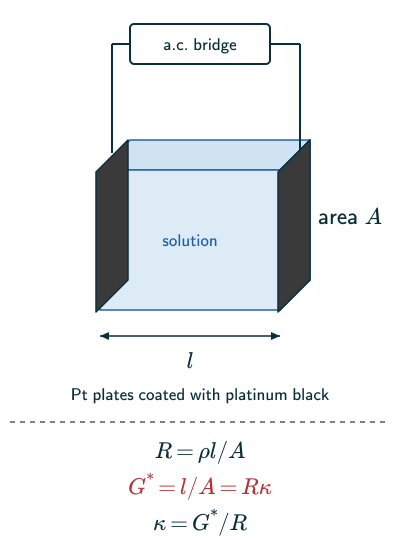
- The first is solved with an alternating current source; the second with a conductivity cell: two platinum electrodes coated with platinum black (platinised), each of area A, a distance l apart. The solution between them is a column of length l and cross-section A (NCERT page 43).
- In the bridge (NCERT Fig. 2.5, page 44), R3 and R4 are fixed, R1 is variable and the cell is the unknown R2. An oscillator feeds a.c. in the audio range, 550 to 5000 cycles per second, and a detector, such as a headphone, shows balance when no current passes through it. Then R2 = R1R4/R3 (NCERT Eq. (2.19), page 44). Inexpensive conductivity meters now read the conductance or resistance directly (NCERT page 44).
Cell constant and molar conductivity
- Cell constant. The quantity l/A is the cell constant, G*, with the dimension length−1. Measuring l and A is inconvenient and unreliable, so G* is found from the resistance of the cell filled with a solution of known conductivity, usually KCl (NCERT Table 2.3, page 44):
Cell constant (NCERT Eq. 2.18, page 44)
- Once G* is known, the conductivity of any solution follows from its resistance in the same cell (NCERT Eq. (2.20), page 44):
Conductivity from resistance (NCERT Eq. 2.20)
- NCERT Table 2.3 (page 44), KCl at 298.15 K:
| c/mol L−1 | κ/S m−1 | Λm/S cm2 mol−1 |
|---|---|---|
| 1.000 | 11.13 | 111.3 |
| 0.100 | 1.29 | 129.0 |
| 0.010 | 0.141 | 141.0 |
- Molar conductivity. Solutions of different electrolytes differ in conductivity because their ions differ in charge, size, concentration and ease of movement, so a more meaningful quantity is defined (NCERT Eq. (2.21), page 45):
Molar conductivity (NCERT Eq. 2.21)
- Units. With κ in S m−1 and c in mol m−3, Λm is in S m2 mol−1; 1 mol L−1 = 1000 mol m−3. With κ in S cm−1 and the molarity M in mol L−1, Λm = 1000κ/M in S cm2 mol−1. And 1 S m2 mol−1 = 104 S cm2 mol−1 (NCERT page 45).
- NCERT slip (page 45): NCERT’s first unit equation divides κ in S cm−1 by the concentration in mol m−3 and calls the result S cm2 mol−1. Dividing by mol m−3 needs κ in S m−1 and gives S m2 mol−1. For S cm2 mol−1, use NCERT’s next equation, with 1000 cm3 L−1.
Variation of conductivity and molar conductivity with concentration
- Conductivity falls on dilution. In NCERT’s words:
Conductivity always decreases with decrease in concentration both, for weak and strong electrolytes.
NCERT Chemistry Part I (Class 12), Section 2.4.2, page 46
- This is the trend in the dilute solutions considered here: on dilution, fewer ions per unit volume carry the current. The word “always” in the NCERT quotation should not be extended to highly concentrated solutions. κ is the conductance of one unit volume of solution between electrodes of unit area a unit length apart (NCERT pages 46–47).
- Molar conductivity rises on dilution. Λm is the conductance of the volume V of solution that holds one mole of electrolyte, between electrodes a unit length apart, so Λm = κV (NCERT Eq. (2.22), page 47). On dilution V grows faster than κ falls (NCERT page 47).
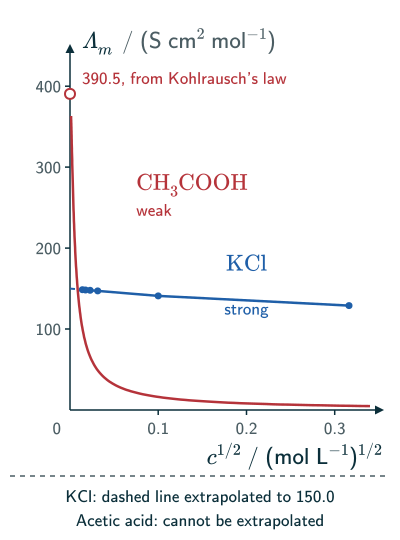
- As the concentration approaches zero, Λm approaches the limiting molar conductivity, Λ°m. How Λm varies is different for strong and weak electrolytes (NCERT Fig. 2.6, page 47).
Strong and weak electrolytes
- Strong electrolytes, fully ionised in solution, show Λm rising slowly on dilution (NCERT Eq. (2.23), page 47):
Strong electrolytes (NCERT Eq. 2.23)
- A plot of Λm against c1/2 is a straight line with intercept Λ°m and slope −A; this A is a constant, not an area. The constant A depends on the solvent, the temperature and the type of electrolyte, set by the charges on its ions: NaCl, CaCl2 and MgSO4 are 1-1, 2-1 and 2-2 electrolytes, and NCERT groups slopes by electrolyte type (page 47). More precisely, the limiting-law slope also depends on limiting ionic mobilities, so it is not identical for every electrolyte with the same charge type.
- Beyond the NCERT text: A depends mainly, not only, on the type, and NCERT Eq. (2.23) holds only in dilute solution (Wikipedia, “Molar conductivity”). With KCl’s 150.0 and 87.46 it gives 141.3 at 0.010 M, near NCERT Table 2.3’s 141.0, but 62.5 at 1.000 M against 111.3 (reasoned from NCERT Example 2.6).
- Weak electrolytes, such as acetic acid, are less dissociated at higher concentration. On dilution their degree of dissociation, and so the number of ions per mole, rises, and Λm rises steeply, especially at low concentration. So a simple straight-line extrapolation of Λm against √c is unreliable; near zero the conductivity is too low to measure accurately. It comes from Kohlrausch’s law instead (NCERT page 49).
- For a weak electrolyte at concentration c, the degree of dissociation is approximately α = Λm/Λ°m (NCERT Eq. (2.26), page 50), and the dissociation constant is Ka = cα2/(1 − α) (NCERT Eq. (2.27), page 50).
Kohlrausch’s law and its applications
- Kohlrausch noticed regularities in Λ°m of strong electrolytes at 298 K (NCERT page 49):
- Λ°m(KX) − Λ°m(NaX) ≈ 23.4 S cm2 mol−1 for X = Cl, Br and I;
- Λ°m(NaBr) − Λ°m(NaCl) = Λ°m(KBr) − Λ°m(KCl) ≈ 1.8 S cm2 mol−1.
- These led him to the law of independent migration of ions. In NCERT’s words:
The law states that limiting molar conductivity of an electrolyte can be represented as the sum of the individual contributions of the anion and cation of the electrolyte.
NCERT Chemistry Part I (Class 12), Section 2.4.2, page 49
- For an electrolyte that gives ν+ cations and ν− anions (NCERT Eq. (2.25), page 49):
Kohlrausch’s law (NCERT Eq. 2.25)
- NCERT Table 2.4 (page 49), limiting molar conductivities of ions in water at 298 K:
| Ion | λ°/S cm2 mol−1 |
|---|---|
| H+ | 349.6 |
| Na+ | 50.1 |
| K+ | 73.5 |
| Ca2+ | 119.0 |
| Mg2+ | 106.0 |
| OH− | 199.1 |
| Cl− | 76.3 |
| Br− | 78.1 |
| CH3COO− | 40.9 |
| SO42− | 160.0 |
- The table explains both regularities: λ°(K+) − λ°(Na+) = 73.5 − 50.1 = 23.4 and λ°(Br−) − λ°(Cl−) = 78.1 − 76.3 = 1.8 (reasoned from NCERT Table 2.4). H+ and OH− stand out as unusually fast.
- Applications (NCERT page 50):
- Λ°m of any electrolyte from the λ° of its ions;
- Λ°m of a weak electrolyte, for which straight-line extrapolation is unreliable, from the values of strong electrolytes;
- the degree of dissociation and the dissociation constant of a weak electrolyte, from Λm at one concentration and Λ°m.
Solved examples
Example 1: Cell constant and molar conductivity (NCERT Example 2.4)
A conductivity cell filled with 0.1 mol L−1 KCl (κ = 1.29 S m−1) has a resistance of 100 Ω. Filled with 0.02 mol L−1 KCl, it has 520 Ω. Find the conductivity and molar conductivity of the 0.02 mol L−1 solution.
Answer:
- Cell constant: G* = κR = 1.29 S m−1 × 100 Ω = 129 m−1 = 1.29 cm−1.
- κ = G*/R = 129 m−1/520 Ω = 0.248 S m−1.
- c = 0.02 × 1000 = 20 mol m−3, so Λm = 0.248/20 = 124 × 10−4 S m2 mol−1, which is 124 S cm2 mol−1 (NCERT Example 2.4, pages 45–46).
Example 2: A column of NaOH solution (NCERT Example 2.5)
A column of 0.05 mol L−1 NaOH solution, 1 cm in diameter and 50 cm long, has a resistance of 5.55 × 10³ Ω. Find its resistivity, conductivity and molar conductivity.
Answer:
- A = πr2 = 3.14 × 0.52 = 0.785 cm2.
- ρ = RA/l = 5.55 × 103 × 0.785/50 = 87.135 Ω cm.
- κ = 1/ρ = 0.01148 S cm−1.
- Λm = 1000κ/M = 1000 × 0.01148/0.05 = 229.6 S cm2 mol−1 (NCERT Example 2.5, page 46).
Example 3: Λ° and A for KCl (NCERT Example 2.6)
At 298 K, KCl solutions of 0.000198, 0.000309, 0.000521 and 0.000989 mol L−1 have Λm = 148.61, 148.29, 147.81 and 147.09 S cm2 mol−1. Show that Λm against c1/2 is a straight line, and find Λ°m and A.
Answer: c1/2 = 0.01407, 0.01758, 0.02283 and 0.03145, and the points lie nearly on a straight line. Its intercept gives Λ°m = 150.0 S cm2 mol−1, and A = −slope = 87.46 S cm2 mol−1/(mol L−1)1/2 (NCERT Example 2.6, page 48). A least-squares line meets the axis at 149.8, as NCERT Table 2.4 also gives for KCl (73.5 + 76.3); NCERT’s 150.0 is read off its graph (NCERT Fig. 2.7), and its 87.46 is the end-point slope (reasoned from NCERT Example 2.6).
NCERT slips (page 48): the working refers to “(Fig. 3.7)” for the plot, which is NCERT Fig. 2.7, and writes the unit of A with “(mol/L−1)1/2” for (mol L−1)1/2.
Example 4: Λ° of CaCl and MgSO (NCERT Example 2.7)
Using NCERT Table 2.4, calculate Λ°m for CaCl2 and MgSO4.
Answer:
- CaCl2 gives one Ca2+ and two Cl−: Λ°m = 119.0 + 2(76.3) = 271.6 S cm2 mol−1.
- MgSO4: Λ°m = 106.0 + 160.0 = 266 S cm2 mol−1 (NCERT Example 2.7, page 50).
NCERT slip (page 50): the example cites “Table 3.4”; the data are in NCERT Table 2.4.
Example 5: Λ° of a weak acid (NCERT Example 2.8)
Λ°m for NaCl, HCl and NaAc (sodium acetate) are 126.4, 425.9 and 91.0 S cm2 mol−1. Calculate Λ°m for HAc (acetic acid).
Answer: Λ°m(HAc) = λ°(H+) + λ°(Ac−) = Λ°m(HCl) + Λ°m(NaAc) − Λ°m(NaCl), since the Na+ and Cl− shares cancel. So Λ°m(HAc) = 425.9 + 91.0 − 126.4 = 390.5 S cm2 mol−1 (NCERT Example 2.8, page 50). Table 2.4 gives the same directly: 349.6 + 40.9 = 390.5.
Example 6: Dissociation constant of acetic acid (NCERT Example 2.9)
The conductivity of 0.001028 mol L−1 acetic acid is 4.95 × 10⁻⁵ S cm−1. Calculate its dissociation constant, given Λ°m = 390.5 S cm2 mol−1.
Answer:
- Λm = 1000κ/M = 4.95 × 10−5 × 1000/0.001028 = 48.15 S cm2 mol−1.
- α = Λm/Λ°m = 48.15/390.5 = 0.1233.
- Ka = cα2/(1 − α) = 0.001028 × 0.12332/0.8767 = 1.78 × 10⁻⁵ mol L−1 (NCERT Example 2.9, page 50).
NCERT slip (page 50): the working gives Λm in “S cm3 mol−1”; it is S cm2 mol−1, as in the next line.
Example 7: Methanoic acid (NCERT Intext Question 2.9)
The molar conductivity of 0.025 mol L−1 methanoic acid is 46.1 S cm2 mol−1. Find its degree of dissociation and dissociation constant, given λ°(H+) = 349.6 and λ°(HCOO−) = 54.6 S cm2 mol−1.
Answer: Λ°m = 349.6 + 54.6 = 404.2 S cm2 mol−1, so α = 46.1/404.2 = 0.114. Ka = 0.025 × 0.1142/(1 − 0.114) = 3.67 × 10⁻⁴ mol L−1 (NCERT Eqs. (2.26)–(2.27), page 50).
Common mistakes to avoid
Common mistake
Saying conductivity rises on dilution
It is molar conductivity that rises in the usual dilute regime. Conductivity falls there on dilution, because there are fewer ions in each unit volume (NCERT page 46).
Common mistake
Dropping the 1000 in molar conductivity
With κ in S cm−1 and concentration in mol L−1, Λm = 1000κ/M in S cm2 mol−1; the 1000 converts litres to cm3 (NCERT page 45).
Common mistake
Extrapolating a weak electrolyte to zero concentration
For acetic acid the curve is not the straight line used for dilute strong electrolytes; use Kohlrausch’s law (NCERT page 49).
Common mistake
Treating Λ/Λ° as α for a strong electrolyte
KCl is fully ionised, yet at 0.100 M its Λm/Λ°m = 129.0/149.8 = 0.86 (reasoned from NCERT Tables 2.3 and 2.4). Use α = Λm/Λ°m only for weak electrolytes (NCERT pages 49–50).
Common mistake
Forgetting the ion counts in Kohlrausch’s law
CaCl2 gives two chloride ions, so Λ°m = λ°(Ca2+) + 2λ°(Cl−) (NCERT Example 2.7, page 50).
Quick revision summary
- R = ρl/A; conductance G = 1/R; conductivity κ = 1/ρ, in S m or S cm.
- Cell constant G* = l/A, found with KCl of known conductivity; then κ = G*/R. Measure with a.c. and a platinised cell.
- Molar conductivity Λ = κ/c; in S cm mol, Λ = 1000κ/M.
- On dilution κ falls and Λ rises. Strong electrolytes: Λ = Λ° − A√c, a straight line in √c for dilute solutions. Weak electrolytes: a steep curved rise; use Kohlrausch’s law instead of simple linear extrapolation.
- Kohlrausch’s law: Λ° = νλ° + νλ°, the sum of the ions’ shares.
- Dilute monoprotic weak electrolytes: α ≈ Λ/Λ° and concentration-based K ≈ cα/(1 − α).
Formula sheet
- R = ρl/A; G = 1/R; κ = 1/ρ
- Cell constant = l/A = Rκ; κ = (cell constant)/R
- Λ = κ/c; Λ = 1000κ/M (S cm mol)
- Strong electrolytes: Λ = Λ° − A√c
- Kohlrausch: Λ° = νλ° + νλ°
- Weak electrolytes (dilute approximation): α ≈ Λ/Λ°; K ≈ cα/(1 − α)
Questions students ask
Why does the molar conductivity of a strong electrolyte rise on dilution if it is already fully ionised?
The molar conductivity of a strong electrolyte rises on dilution, though its number of ions per mole stays the same, because the ions hold one another back less: beyond the NCERT text, each ion is surrounded by a cloud of oppositely charged ions, its ionic atmosphere, which the field distorts so that it drags on the ion, and on dilution the ions are farther apart and the drag weakens (Wikipedia, “Debye–Hückel theory”). So Λm of KCl rises only slowly, from 111.3 S cm mol at 1.000 mol L to 141.0 at 0.010 mol L (NCERT Table 2.3, page 44); the same theory explains the A√c term of NCERT Eq. (2.23).
What is the difference between molar conductivity and equivalent conductivity?
Molar conductivity divides the conductivity by the concentration in moles, Λm = κ/c (NCERT Eq. (2.21), page 45), while the older equivalent conductivity divides it by the concentration in equivalents, an equivalent being the amount of ions with the charge of one mole of singly charged ions, such as ½ mol of Ca2+ (beyond the NCERT text; Wikipedia, “Molar conductivity”). For Na2SO4, two equivalents per mole, Λ°m = 2(50.1) + 160.0 = 260.2 S cm mol (NCERT Table 2.4) is twice the equivalent value, 130.1 S cm per equivalent. IUPAC has recommended dropping the term; NCERT uses only molar conductivity.
What is the unit of the cell constant, and what does it depend on?
The cell constant, G* = l/A, has the SI unit m and is often quoted in cm, with 1 cm = 100 m; it depends only on the cell, the distance between its electrodes and their area, not on the solution in it (NCERT page 44). It is calibrated with KCl solution of known conductivity and reused while geometry, immersion depth and measurement conditions remain suitable (NCERT page 44): in a cell with G* = 0.50 cm, a solution of resistance 250 Ω has κ = 0.50/250 = 2.0 × 10 S cm (NCERT Eq. (2.20)). A cell constant of 1 cm means that the conductivity in S cm equals the conductance in S (reasoned).
Why does Li+ conduct less than K+ in water though it is a smaller ion?
Li+ moves less readily than Na+ or K+ in water despite its smaller bare-ion radius: strong ion–water interactions increase the resistance to its motion (beyond NCERT’s list of solvation factors, page 43). Do not picture a permanent rigid Li(H2O)4+ ball: hydration shells exchange water, and coordination number is not the same as hydrodynamic size.
Why are the molar conductivities of H+ and OH− ions so high?
H+ and OH− ions have high limiting molar conductivities, 349.6 and 199.1 S cm mol against 50.1 for Na+ and 76.3 for Cl− (NCERT Table 2.4, page 49), because, beyond the NCERT text, they move by a relay of protons along the hydrogen bonds of water, the Grotthuss mechanism, in addition to ordinary molecular diffusion through the solvent (Wikipedia, “Grotthuss mechanism” and “Molar conductivity”). An H3O+ ion passes a proton to the next water molecule, which passes one on, so the charge moves without any one ion travelling far (reasoned). OH− moves the same way, by taking a proton from a neighbouring water molecule.
Is Kohlrausch’s law in the JEE Main and NEET syllabus?
Yes, Kohlrausch’s law is in both syllabuses: Unit 7, Redox Reactions and Electrochemistry, of the JEE Main syllabus and of the NEET (UG) 2026 syllabus lists “conductance in electrolytic solutions, molar conductivities and their variation with concentration” and “Kohlrausch’s law and its applications.” NCERT Class 12 Chemistry Part I covers the law in Section 2.4.2 (pages 49–50), with Examples 2.7–2.9 and Intext Questions 2.8–2.9; conductance as a whole is Section 2.4 (pages 41–51).
Practice questions
Try each question first, then open the answer to check your working.
-
Q1. Why does the conductivity of a solution decrease with dilution? (NCERT Intext Question 2.7)
Show answerHide answer
For a uniform cell, conductivity is conductance multiplied by length divided by area; volume alone does not fix conductance. On dilution there are fewer ions in each unit volume to carry the current (NCERT page 46).
-
Q2. Suggest a way to find Λ°m of water. (NCERT Intext Question 2.8)
Show answerHide answer
By Kohlrausch’s law, Λ°m(H2O) = λ°(H+) + λ°(OH−) = 349.6 + 199.1 = 548.7 S cm2 mol−1 (NCERT Table 2.4). This is the limiting ionic sum per mole of dissociated water; it is not the measured conductivity of bulk liquid water divided by its roughly 55.5 M molecular concentration. Equivalently, Λ°m(HCl) + Λ°m(NaOH) − Λ°m(NaCl) (reasoned from NCERT page 50).
-
Q3. Why is a conductivity cell measured with alternating current and not direct current?
Show answerHide answer
Direct current would change the composition of the solution by electrochemical reactions at the electrodes (NCERT page 43).