Electrochemical cells
NCERT Class 12 Chemistry Chapter 2 Section 2.1
Quick answer
An electrochemical cell couples oxidation at an anode to reduction at a cathode. A galvanic cell supplies electrical energy from a spontaneous reaction, while an electrolytic cell uses an external source to drive electrode changes. The Daniell cell illustrates the difference, with reversal at an opposing voltage above its emf in the ideal reversible model.
With your textbook
NCERT Chemistry Part I (Class 12), Chapter 2 “Electrochemistry”, Section 2.1 “Electrochemical Cells”, page 32.
Open the official NCERT chapter (PDF, 4.4 MB, ncert.nic.in) (opens in a new tab)
Checked against the 2026-27 reprint on .
What is an electrochemical cell?
Electrochemistry, galvanic and electrolytic cells
Electrochemistry is the study of production of electricity from energy released during spontaneous chemical reactions and the use of electrical energy to bring about non-spontaneous chemical transformations.
NCERT Chemistry Part I (Class 12), Chapter 2, Electrochemistry, page 31
- A galvanic or voltaic cell turns the chemical energy of a spontaneous redox reaction into electrical energy. The Daniell cell is one (NCERT pages 32–33).
- An electrolytic cell does the opposite: it uses electrical energy to drive a reaction that would not go by itself (NCERT page 32).
- Both are electrochemical cells: two electrodes in electrolytes, with oxidation at one electrode, the anode, and reduction at the other, the cathode (NCERT Fig. 2.2, page 32).
In plain words: a torch cell runs a chemical reaction that wants to happen and makes it push electrons round a wire. Charging a rechargeable battery does the reverse: electricity forces the reaction to run backwards. The ideal reversible Daniell cell illustrates both directions; practical primary batteries are not designed for recharging.
Why electrochemistry matters
- Making chemicals. Many metals, sodium hydroxide, chlorine, fluorine and many other chemicals are produced by electrochemical methods (NCERT page 31).
- Storing and supplying energy. Batteries and fuel cells convert chemical energy into electrical energy for all kinds of instruments and devices (NCERT page 31).
- Cleaner processes. Reactions carried out electrochemically can be energy efficient and less polluting, so electrochemistry matters for new eco-friendly technologies (NCERT page 31).
- Living things. Sensory signals travelling through cells to and from the brain, and communication between cells, have an electrochemical origin (NCERT page 31).
Daniell cell
-
Set-up. A zinc rod dips in a solution of a zinc salt and a copper rod in a solution of a copper salt, such as ZnSO4 and CuSO4. The rods are joined by a wire outside the cell and the solutions by a salt bridge (NCERT Figs. 2.1–2.2, page 32). Class 11 builds the Daniell cell step by step.
-
Reaction. The cell converts the chemical energy of this redox reaction into electrical energy (NCERT Eq. (2.1), page 32):
Zn(s) + Cu2+(aq) → Zn2+(aq) + Cu(s)
-
Voltage. NCERT uses 1.1 V for a Daniell cell with both ions at 1 mol dm−3 (page 32). More precisely, 1.10 V is its approximate standard emf at 298 K: dissolved species have unit activity, a dimensionless effective concentration. Replacing activity by concentration divided by 1 mol dm−3 is an ideal-solution approximation; a real 1 M solution need not satisfy it (IUPAC Gold Book, “Nernst equation”).
-
Electrodes. Zinc is oxidised, so the zinc rod is the anode and the negative electrode; copper ions are reduced, so the copper rod is the cathode and the positive electrode. Electrons flow through the wire from zinc to copper, and the current flows the other way, from copper to zinc (NCERT Fig. 2.2(a), page 32).
-
The name. In NCERT’s words:
Such a device is called a galvanic or a voltaic cell.
NCERT Chemistry Part I (Class 12), Section 2.1, page 32
- The 1.1 V comes from the two electrode potentials, 0.34 V for copper and −0.76 V for zinc: 0.34 − (−0.76) = 1.10 V (NCERT page 35).
Galvanic and electrolytic cells
Model for this section and its exercises: take the cell emf as 1.1 V and neglect resistance losses, overpotential and competing electrode reactions. A real charging current needs extra voltage; the emf also changes with composition. At the balancing voltage there is no net cell reaction, although microscopic forward and reverse electrode reactions continue.
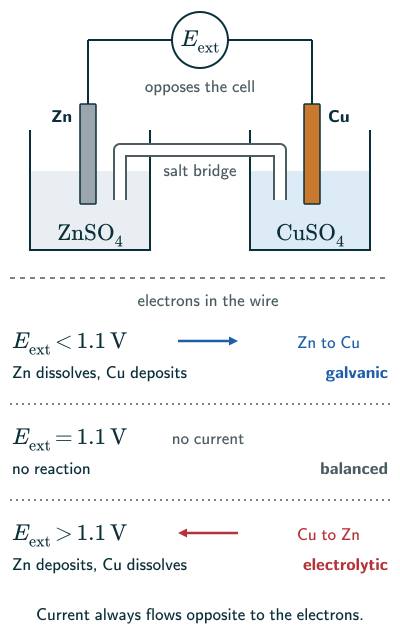
NCERT connects an external voltage, Eext, to the Daniell cell so that it opposes the cell’s own 1.1 V, and raises it slowly (NCERT Fig. 2.2, page 32):
-
Eext < 1.1 V: the reaction carries on as before. Electrons flow from the Zn rod to the Cu rod, zinc dissolves at the anode and copper deposits at the cathode. The cell is still galvanic.
-
Eext = 1.1 V: the net reaction stops. No net electron flow or current passes through the wire.
-
Eext > 1.1 V: the reaction starts again, in the opposite direction. Electrons flow from Cu to Zn, zinc is deposited at the zinc electrode and copper dissolves at the copper electrode:
Zn2+(aq) + Cu(s) → Zn(s) + Cu2+(aq)
This reverse reaction does not go by itself; the outside source drives it. In NCERT’s words:
It now functions as an electrolytic cell, a device for using electrical energy to carry non-spontaneous chemical reactions.
NCERT Chemistry Part I (Class 12), Section 2.1, page 32
| Feature | Galvanic cell | Electrolytic cell |
|---|---|---|
| Energy | chemical to electrical | electrical to chemical |
| Reaction | spontaneous | non-spontaneous, driven |
| Anode (oxidation) | negative | positive |
| Cathode (reduction) | positive | negative |
| Daniell cell | Zn anode, Cu cathode | Cu anode, Zn cathode |
- A spontaneous reaction is one with a negative Gibbs energy change, ΔG < 0. A galvanic cell turns that Gibbs energy into electrical work (NCERT page 33).
- The names follow the reaction, the signs follow the push. The anode is always where oxidation happens. When the Daniell cell turns electrolytic, the outside source pushes electrons into the zinc, so zinc is still the negative electrode and copper the positive one; only the names anode and cathode swap (reasoned from NCERT Fig. 2.2, page 32).
- NCERT slip (Fig. 2.2(c), page 32): the figure marks the zinc cathode with a plus sign and the copper anode with a minus sign. The signs should be the other way round, as in Fig. 2.2(a): in an electrolytic cell the cathode is negative and the anode positive.
- The balancing voltage, 1.1 V, is the potential of the cell when no current flows. That is its emf, the value NCERT uses for cell potentials (NCERT page 34).
Solved examples
Example 1: A small opposing voltage
A Daniell cell with 1 mol dm−3 Zn2+ and Cu2+ is opposed by Eext = 0.5 V. Which way do the electrons flow, which rod is the anode, and what happens at each rod?
Answer: 0.5 V is less than 1.1 V, so the cell still works as a galvanic cell. Electrons flow through the wire from zinc to copper; zinc is the anode and dissolves, Zn → Zn2+ + 2e−, and copper deposits on the cathode, Cu2+ + 2e− → Cu (NCERT Fig. 2.2(a), page 32).
Example 2: Reversing the cell
The same cell is now opposed by Eext = 1.5 V. Write the reaction at each electrode and the overall reaction. What kind of cell is it?
Answer: 1.5 V is more than 1.1 V, so the reaction reverses and it is an electrolytic cell (NCERT page 32). Electrons flow from Cu to Zn.
- Cathode (zinc rod), reduction: Zn2+(aq) + 2e− → Zn(s)
- Anode (copper rod), oxidation: Cu(s) → Cu2+(aq) + 2e−
- Overall: Zn2+(aq) + Cu(s) → Zn(s) + Cu2+(aq)
Example 3: Changes in mass
A Daniell cell works as a galvanic cell until 0.020 mol of electrons has passed through the wire. By how much does the mass of each rod change? (Zn 65.4 g mol−1, Cu 63.5 g mol−1.)
Answer: Each Zn atom gives 2 electrons and each Cu2+ ion takes 2, so 0.020 mol of electrons means 0.010 mol of each metal.
- Zinc rod: loses 0.010 × 65.4 = 0.654 g.
- Copper rod: gains 0.010 × 63.5 = 0.635 g.
Example 4: Galvanic or electrolytic?
Classify each: (a) a torch cell lighting a bulb; (b) a car’s lead storage battery being charged; (c) a Daniell cell opposed by exactly 1.1 V.
Answer: (a) Galvanic: a spontaneous reaction supplies electrical energy (NCERT page 31). (b) Electrolytic: a secondary cell is recharged by passing current through it in the opposite direction, which reverses the cell reaction (NCERT Section 2.6.2, page 55). (c) Neither runs: no net current flows and no net cell reaction takes place (NCERT page 32).
Common mistakes to avoid
Common mistake
Thinking the anode is always negative
The anode is where oxidation happens. It is negative in a galvanic cell but positive in an electrolytic cell, where the outside source draws electrons out of it (NCERT Fig. 2.2, page 32; reasoned).
Common mistake
Thinking the cell has run down when the current stops at 1.1 V
At Eext = 1.1 V the outside voltage just balances the cell. Lower Eext and the reaction starts again; raise it and the reaction runs backwards (NCERT page 32).
Common mistake
Thinking the reversed reaction is spontaneous
Zn2+ + Cu → Zn + Cu2+ runs only while the outside source drives it; below 1.1 V the cell runs forward again (NCERT page 32).
Common mistake
Copying the signs in NCERT Fig. 2.2(c)
The figure marks the zinc cathode positive and the copper anode negative. In the electrolytic mode zinc is still the negative electrode and copper the positive one (reasoned from NCERT Fig. 2.2, page 32).
Quick revision summary
- Electrochemistry: electricity from spontaneous reactions, and electricity used to drive non-spontaneous ones.
- Galvanic (voltaic) cell: chemical energy to electrical energy. Electrolytic cell: electrical energy to chemical change.
- Daniell cell: Zn + Cu → Zn + Cu, 1.1 V with both ions at 1 mol dm.
- Anode: oxidation; cathode: reduction, in every cell.
- An opposing Eext below 1.1 V leaves the cell galvanic; at 1.1 V there is no net cell reaction; above 1.1 V the reaction reverses and the cell is electrolytic.
Formula sheet
- Daniell cell: Zn + Cu → Zn + Cu, 1.1 V at 1 mol dm
- Eext < 1.1 V: galvanic, electrons Zn to Cu
- Eext = 1.1 V: no current, no net reaction
- Eext > 1.1 V: electrolytic, the reaction runs in reverse
- Galvanic: anode negative, cathode positive
- Electrolytic: anode positive, cathode negative
Questions students ask
Is an electrochemical cell the same as a galvanic cell?
No, an electrochemical cell is not strictly the same as a galvanic cell: “electrochemical cell” is the general name for two electrodes in an electrolyte where a redox reaction is linked to an electric current, and NCERT divides electrochemical cells into galvanic and electrolytic cells (NCERT Summary, page 58). Many books use “electrochemical cell” for the galvanic kind alone, which turns the chemical energy of a spontaneous reaction into electrical energy, but an electrolytic cell, which uses electrical energy to drive a reaction, is one too. A battery is one or more galvanic cells used as a source of electrical energy (NCERT page 54).
Why is the anode negative in a galvanic cell?
The anode of a galvanic cell is negative because the oxidation there leaves electrons behind in the metal: each zinc atom that goes into solution as Zn2+ leaves two electrons on the zinc rod, while Cu2+ ions take electrons from the copper cathode (NCERT page 33). So the zinc has a surplus of electrons and the copper a shortage, and when the circuit is closed electrons flow through the wire from the negative zinc to the positive copper. Which metal is the negative pole is set by the electrode potentials: zinc, −0.76 V, gives up electrons more readily than copper, +0.34 V (NCERT page 35).
What are some everyday and industrial examples of galvanic and electrolytic cells?
Galvanic cells in use include the dry cell in a wall clock, the button cells of watches and hearing aids, for which NCERT describes the mercury cell, and the hydrogen–oxygen fuel cells that powered the Apollo spacecraft (NCERT pages 54–56); each turns the energy of a spontaneous redox reaction into electricity. Electrolytic cells are mostly industrial: they refine impure copper and produce sodium, magnesium and aluminium (NCERT page 51), as well as sodium hydroxide and chlorine (NCERT page 31), each using electrical energy to drive a reaction that would not go by itself.
Why does a galvanic cell stop working after some time?
In the ideal model a galvanic cell reaches reaction equilibrium when its reversible emf becomes zero (NCERT page 39). For the Daniell reaction at 298 K, the activity ratio of zinc ions to copper ions then equals the equilibrium constant, about 2 × 10 with NCERT’s rounded constants. A practical cell can cease supplying useful current earlier because a reactant is depleted, its internal resistance grows or its electrodes become passivated; a zero terminal-voltage reading under load alone does not establish equilibrium (reasoned).
Does an electrolytic cell need a salt bridge?
An electrolytic cell usually needs no salt bridge, because both of its electrodes normally dip into one electrolyte, such as two copper strips in copper sulphate solution, or the fused chlorides from which sodium and magnesium are made (NCERT page 51). NCERT notes that when both electrodes dip in the same electrolyte solution, no salt bridge is required (page 33). An ionic connection, such as a salt bridge or suitable separator, is needed when the electrodes stand in separate solutions, as when a Daniell cell is driven backwards by an outside voltage (reasoned from NCERT page 32).
Practice questions
Try each question first, then open the answer to check your working.
-
Q1. What is the difference between a galvanic cell and an electrolytic cell?
Show answerHide answer
A galvanic cell converts the chemical energy of a spontaneous redox reaction into electrical energy; an electrolytic cell uses electrical energy to carry out a non-spontaneous reaction (NCERT pages 32–33).
-
Q2. What happens in a Daniell cell when an opposing external voltage of exactly 1.1 V is applied, with both ions at 1 mol dm−3?
Show answerHide answer
The net cell reaction stops and no current flows through the cell (NCERT page 32).
-
Q3. In a Daniell cell opposed by 2.0 V, which electrode is the anode and is it positive or negative?
Show answerHide answer
The reaction is reversed, so copper is oxidised: the copper rod is the anode. As in any electrolytic cell it is the positive electrode (NCERT page 32; sign reasoned).