Galvanic cells
NCERT Class 12 Chemistry Chapter 2 Section 2.2
Quick answer
A galvanic cell supplies electrical energy through a spontaneous redox reaction, with oxidation at the anode and reduction at the cathode. Its reversible emf is the cathode reduction potential minus the anode reduction potential. Standard potentials refer to unit activities and specified temperature, relative to the standard hydrogen electrode.
With your textbook
NCERT Chemistry Part I (Class 12), Chapter 2 “Electrochemistry”, Section 2.2 “Galvanic Cells”, pages 33–36.
Open the official NCERT chapter (PDF, 4.4 MB, ncert.nic.in) (opens in a new tab)
Checked against the 2026-27 reprint on .
What is a galvanic cell?
Galvanic cell and electrode potential
A galvanic cell is an electrochemical cell that converts the chemical energy of a spontaneous redox reaction into electrical energy. The Gibbs energy of the reaction is converted into electrical work, which can run a motor, a heater, a fan or a geyser (NCERT Section 2.2, page 33); the most electrical work it can give, when charge passes reversibly, equals the decrease in Gibbs energy (NCERT page 40).
Each electrode carries a potential relative to the solution it dips in. In NCERT’s words:
A potential difference develops between the electrode and the electrolyte which is called electrode potential.
NCERT Chemistry Part I (Class 12), Section 2.2, page 33
- When the concentrations of all the species in a half-cell are unity, the electrode potential is the standard electrode potential, E⊖ (NCERT prints it E°). By IUPAC convention, standard reduction potentials are now called standard electrode potentials (NCERT page 33); they are measured against the standard hydrogen electrode (NCERT pages 34–35).
- Beyond the NCERT text: strictly, the standard state means unit activity, the effective concentration, for dissolved species and 1 bar for gases, at a stated temperature (these tables use 298 K); 1 M is the ideal-solution approximation to it (Wikipedia, “Standard hydrogen electrode”). In an exam, give NCERT’s definition: all concentrations unity.
- The voltage of the cell is the difference between the two electrode potentials, Ecell = Eright − Eleft, with the cathode on the right (NCERT page 34).
In plain words: each electrode is a tug-of-war for electrons between the metal and its ions. The two electrodes of a cell pull with different strengths, and the difference between them is the cell’s voltage. No single pull can be measured on its own, so every electrode is compared with one chosen reference, the hydrogen electrode, which is given the value zero.
Half-cells and the salt bridge
- Two half reactions. The Daniell cell reaction, Zn(s) + Cu2+(aq) → Zn2+(aq) + Cu(s), is the sum of two half reactions (NCERT Eqs. (2.2)–(2.3), page 33):
- reduction, at the copper electrode: Cu2+ + 2e− → Cu(s);
- oxidation, at the zinc electrode: Zn(s) → Zn2+ + 2e−.
- These two portions of the cell are half-cells or redox couples: the copper electrode is the reduction half-cell and the zinc electrode the oxidation half-cell (NCERT page 33).
- Any two half-cells make a cell. Countless galvanic cells can be built on the Daniell pattern by combining different half-cells. Each half-cell is a metallic electrode dipped into an electrolyte. Outside, the two are joined by a metal wire through a voltmeter and a switch; inside, the electrolytes are joined through a salt bridge (NCERT page 33). Platinum or gold are used as inert electrodes (NCERT page 35); they serve couples with no metal of their own (reasoned). A current flows only if there is a potential difference between the two electrodes (NCERT Class 11 Chemistry, Unit 7, page 250).
- What the salt bridge does. It is a U-tube of an electrolyte such as potassium chloride or ammonium nitrate set in agar jelly. It provides an electric contact between the two solutions without allowing them to mix (NCERT Class 11 Chemistry, Section 7.4, page 250); strictly, a little diffusion still occurs, so it limits mixing rather than stopping it entirely (reasoned). Its ions move into the two solutions and keep each one electrically neutral (reasoned). KCl suits most half-cells because K+ and Cl− move almost equally fast, 73.5 and 76.3 S cm2 mol−1 (reasoned from NCERT Table 2.4, page 49); with a silver half-cell, ammonium nitrate avoids precipitating AgCl. The bridge electrolyte must not react with either half-cell (reasoned).
- No salt bridge needed when both electrodes dip in the same electrolyte solution (NCERT page 33), as in the lead storage battery, whose plates both stand in sulphuric acid (NCERT page 55).
Electrode potential
- At each electrode–electrolyte interface two tendencies compete (NCERT page 33):
- metal ions from the solution tend to deposit on the electrode, which tends to make it positive;
- metal atoms of the electrode tend to go into the solution as ions, leaving their electrons behind, which tends to make it negative.
- At equilibrium the charges are separated. Depending on which tendency wins, the electrode is positive or negative with respect to the solution, and the potential difference between them is the electrode potential (NCERT page 33).
- Some questions give oxidation potentials, the same values with the sign changed (Zn → Zn2+ + 2e−: +0.76 V); NCERT uses reduction potentials (reasoned from NCERT page 33).
- In a galvanic cell, the half-cell where oxidation takes place is the anode, with a negative potential with respect to the solution. The half-cell where reduction takes place is the cathode, with a positive potential (NCERT page 33).
- Strictly, the potential of a single half-cell cannot be measured (NCERT page 34), so read “negative” as negative compared with the cathode: the sign does not fix either electrode’s potential against the standard hydrogen electrode, and the anode’s own E⊖ can be positive, as for the copper anode (+0.34 V) of the Cu–Ag cell below (reasoned from NCERT page 34 and Table 2.1). In an exam, give NCERT’s statement: anode negative, cathode positive.
- When the switch is closed, electrons flow through the wire from the negative electrode to the positive one; the current flows the opposite way (NCERT page 33).
Cell potential and emf
- The potential difference between the two electrodes of a galvanic cell is the cell potential, measured in volts. It is the difference between the electrode potentials (reduction potentials) of the cathode and the anode (NCERT page 34).
- When no current is drawn from the cell, the cell potential is called its electromotive force (emf) (NCERT page 34). Once current flows, the voltage at the terminals is less than the emf, because of the cell’s internal resistance (NCERT Class 12 Physics, Chapter 3), and also because slow electrode reactions need an extra potential, the overpotential NCERT meets in electrolysis (reasoned from NCERT page 53).
- With the anode on the left and the cathode on the right, the emf is positive and is given by (NCERT page 34):
Emf of a cell (NCERT page 34)
- In standard conditions this reads E⊖cell = E⊖R − E⊖L, that is E⊖cathode − E⊖anode. Both values are reduction potentials taken straight from the table; the anode’s value is not reversed in sign first (reasoned from NCERT page 35).
Representing a galvanic cell
NCERT’s convention for writing a cell (page 34):
- the anode on the left, the cathode on the right;
- a single vertical line between a metal and its electrolyte solution;
- a double vertical line between the two electrolytes joined by a salt bridge.
NCERT slip (page 35): NCERT writes the bromine electrode Pt(s)|Br2(aq)|Br−(aq). Its own rule puts a single line between a metal and its solution (page 34), at a boundary between phases, but Br2(aq) and Br−(aq) are in the same solution (reasoned). Beyond the NCERT text: in cell notation a single line marks a phase boundary and a comma separates species in the same phase, Pt(s)|Br2(aq), Br−(aq) (Wikipedia, “Cell notation”). In an NCERT-based answer, NCERT’s form may be reproduced; the comma form is the strictly correct one.
Take the reaction Cu(s) + 2Ag+(aq) → Cu2+(aq) + 2Ag(s) (NCERT Eq. (2.4), page 34). Its half reactions are:
- cathode (reduction): 2Ag+(aq) + 2e− → 2Ag(s) (NCERT Eq. (2.5));
- anode (oxidation): Cu(s) → Cu2+(aq) + 2e− (NCERT Eq. (2.6)).
Silver is the cathode and copper the anode, so the cell is written
Cu(s)|Cu2+(aq)||Ag+(aq)|Ag(s)
and its emf is Ecell = EAg+|Ag − ECu2+|Cu (NCERT Eq. (2.7), page 34). With the standard values 0.80 V and 0.34 V (NCERT Table 2.1, page 37), E⊖cell = 0.80 − 0.34 = 0.46 V.
NCERT slip (page 34): the text says the sum of “(3.5) and (3.6)” gives the overall reaction; the half reactions are Eqs. (2.5) and (2.6).
Measurement of electrode potential
The potential of individual half-cell cannot be measured.
NCERT Chemistry Part I (Class 12), Section 2.2.1, page 34
-
Only the difference between two half-cell potentials, the emf of a cell, can be measured. So one electrode is chosen as a reference and given a potential by convention; every other electrode is measured against it (NCERT page 34). The reference is the standard hydrogen electrode, E⊖ = 0.
-
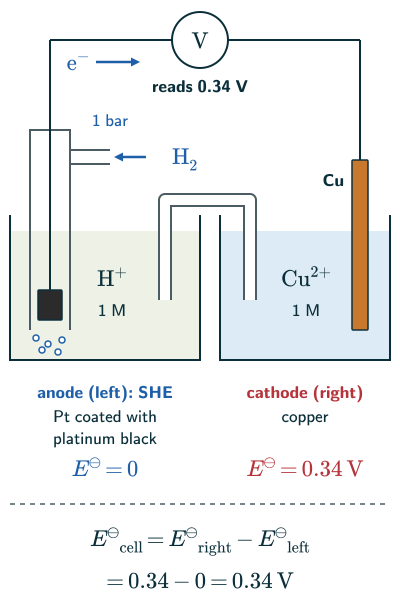
The method. At 298 K, build a cell with the standard hydrogen electrode as the anode (left, the reference half-cell) and the other half-cell as the cathode (right). Its emf is the reduction potential of the other half-cell; with unit concentrations it is the standard electrode potential E⊖R (NCERT page 35).
-
Strictly, left and right are positions. NCERT’s own zinc cell, with the hydrogen electrode on the left, reads −0.76 V (page 35): there the zinc on the right is oxidised, so it is the real anode (reasoned). What the method measures is the signed emf, right minus left, with no current drawn (reasoned). In an exam, describe NCERT’s cell: hydrogen electrode on the left as the anode, the test half-cell on the right.
E⊖ = E⊖R − E⊖L = E⊖R − 0 = E⊖R
-
Copper. The cell Pt(s)|H2(g, 1 bar)|H+(aq, 1 M)||Cu2+(aq, 1 M)|Cu has an emf of 0.34 V, so E⊖ for Cu2+ + 2e− → Cu(s) is +0.34 V (NCERT page 35).
-
Zinc. The same cell with Zn2+(aq, 1 M)|Zn on the right has an emf of −0.76 V, so E⊖ for Zn2+ + 2e− → Zn(s) is −0.76 V (NCERT page 35). The minus sign means that, connected this way, the zinc is really the negative electrode: electrons flow out of the zinc, not out of the hydrogen electrode (reasoned).
- What the signs mean. The positive value for copper means that Cu2+ ions are reduced more easily than H+ ions. Hydrogen ions cannot oxidise copper under standard conditions, so Cu does not dissolve in HCl; in nitric acid it is oxidised by the nitrate ion, not by H+. The negative value for zinc means hydrogen ions can oxidise zinc (NCERT page 35). Strictly, copper gives no hydrogen with dilute HCl, but dissolved oxygen can slowly oxidise it in acid, since O2/H2O at 1.23 V lies above Cu2+/Cu at 0.34 V (reasoned from NCERT Table 2.1, page 37). In an exam, write NCERT’s “Cu does not dissolve in HCl”.
- The Daniell cell again. Zinc on the left and copper on the right give E⊖cell = E⊖R − E⊖L = 0.34 V − (−0.76 V) = 1.10 V (NCERT page 35).
The standard hydrogen electrode
In NCERT’s words:
The standard hydrogen electrode consists of a platinum electrode coated with platinum black.
NCERT Chemistry Part I (Class 12), Section 2.2.1, page 34
- The electrode dips in an acidic solution, and pure hydrogen gas is bubbled through it (NCERT page 34).
- Both the reduced and the oxidised forms of hydrogen are kept at unit concentration: the hydrogen gas at 1 bar and the hydrogen ions at 1 molar (NCERT page 34).
- Beyond the NCERT text: strictly, the standard hydrogen electrode is defined for unit H+ activity in an ideal solution, with hydrogen at 1 bar; a platinum electrode in real 1 M acid is the older “normal hydrogen electrode”, a close approximation (Wikipedia, “Standard hydrogen electrode”). In an exam, give NCERT’s 1 bar and 1 molar.
- It is written Pt(s)|H2(g)|H+(aq), and by convention it is given zero potential at all temperatures, for the reaction H+(aq) + e− → ½H2(g) (NCERT page 34).
- The platinum takes no part in the reaction. It carries the electrons, and its surface is where H+ ions and H2 molecules exchange them (NCERT page 35).
- The zero is a choice, not a measurement. Any electrode could have been chosen; hydrogen is the agreed reference, and every E⊖ in NCERT Table 2.1 is relative to it (NCERT pages 34–37).
NCERT slip (page 34): the text refers to the standard hydrogen electrode as “(Fig.3.3)”; the figure is Fig. 2.3, on the same page.
Metal, gas and inert electrodes
- Metal–metal ion electrodes. A metal dips in a solution of its own ions, such as Zn|Zn2+ and Cu|Cu2+ in the Daniell cell (NCERT page 33). The metal itself takes part in the half reaction.
- Inert electrodes. Sometimes platinum or gold is used as an inert electrode (NCERT page 35), as when neither form of the couple is a metal that could act as the electrode (reasoned). In NCERT’s words:
They do not participate in the reaction but provide their surface for oxidation or reduction reactions and for the conduction of electrons.
NCERT Chemistry Part I (Class 12), Section 2.2.1, page 35
- Gas electrodes use an inert metal with a gas bubbling over it: the hydrogen electrode, Pt(s)|H2(g)|H+(aq), with H+(aq) + e− → ½H2(g) (NCERT page 35).
- Other inert-electrode couples. The bromine electrode, Pt(s)|Br2(aq)|Br−(aq) (NCERT’s notation; strictly Pt(s)|Br2(aq), Br−(aq), see above), with ½Br2(aq) + e− → Br−(aq) (NCERT pages 35–36). A couple of two ions, such as Fe3+/Fe2+ in NCERT Table 2.1, also needs an inert conductor such as platinum (reasoned).
- Metal–insoluble salt electrodes (reasoned from NCERT Table 2.1). AgCl(s) + e− → Ag(s) + Cl−, 0.22 V, needs silver, solid AgCl and chloride ions together: silver coated with AgCl in a chloride solution.
Using standard electrode potentials
NCERT Table 2.1 (page 37) lists reductions, oxidised form + ne− → reduced form, at 298 K. A few of its values follow; the Class 11 page lists more standard electrode potentials:
| Couple | E⊖/V |
|---|---|
| F2/F− | 2.87 |
| Cl2/Cl− | 1.36 |
| Ag+/Ag | 0.80 |
| Fe3+/Fe2+ | 0.77 |
| Cu2+/Cu | 0.34 |
| H+/H2 | 0.00 |
| Fe2+/Fe | −0.44 |
| Zn2+/Zn | −0.76 |
| Mg2+/Mg | −2.36 |
| Li+/Li | −3.05 |
- Positive E⊖: the reduced form is more stable than hydrogen gas. Negative E⊖: hydrogen gas is more stable than the reduced form (NCERT page 36).
- Read “more stable” as: a couple with positive E⊖ has a greater tendency to be reduced than H+/H2, and one with negative E⊖ a smaller tendency. It compares these balanced reactions under standard conditions, not the absolute stability of unrelated substances (reasoned).
- Top of the table. Fluorine has the highest E⊖: F2 has the greatest tendency to be reduced to F−, so it is the strongest oxidising agent, and F− is the weakest reducing agent (NCERT page 36).
- Bottom of the table. Lithium has the lowest E⊖: Li+ is the weakest oxidising agent, and lithium metal is the most powerful reducing agent in aqueous solution (NCERT page 36).
- Going down the table, E⊖ decreases, the oxidising power of the species on the left decreases and the reducing power of the species on the right increases (NCERT page 36).
- The electrochemical series. A list of metals in order of their tendency to release electrons is what NCERT Class 11 calls a “metal activity series or electrochemical series” (NCERT Class 11 Chemistry, Unit 7, page 239); a table of standard electrode potentials such as this one is that series in numbers, read from the bottom up for the metals (reasoned).
- Uses. Electrochemical cells are used to find the pH of solutions, solubility products, equilibrium constants and other thermodynamic properties, and for potentiometric titrations (NCERT page 36).
Solved examples
Example 1: Write the cell and find its emf
A cell is made from an aluminium electrode in 1 M Al3+ and a copper electrode in 1 M Cu2+. Which is the anode? Write the cell, its reaction and its standard emf. (E⊖: Al3+/Al −1.66 V, Cu2+/Cu 0.34 V, NCERT Table 2.1.)
Answer: Cu2+/Cu has the higher E⊖, so copper ions are reduced and copper is the cathode; aluminium is the anode.
- Cell: Al(s)|Al3+(aq)||Cu2+(aq)|Cu(s)
- Reaction: 2Al(s) + 3Cu2+(aq) → 2Al3+(aq) + 3Cu(s)
- E⊖cell = 0.34 − (−1.66) = 2.00 V, whatever the coefficients: an electrode potential does not depend on how many electrons the equation shows (reasoned).
Example 2: Measuring E⊖ for Mg|Mg (NCERT Intext Question 2.1)
How would you determine the standard electrode potential of the system Mg2+|Mg?
Answer: Set up the cell Pt(s)|H2(g, 1 bar)|H+(aq, 1 M)||Mg2+(aq, 1 M)|Mg at 298 K and measure its emf. Since E⊖ of the hydrogen electrode is zero, the emf is E⊖ for Mg2+|Mg (method of NCERT page 35). NCERT Table 2.1 gives −2.36 V, so magnesium is really the anode. Written the way it runs, Mg(s)|Mg2+(aq, 1 M)||H+(aq, 1 M)|H2(g, 1 bar)|Pt(s) has emf +2.36 V = 0 − E⊖(Mg). This is the textbook construction. Strictly, magnesium (−2.36 V) lies below the water couple 2H2O + 2e− → H2 + 2OH− (−0.83 V, NCERT Table 2.1), so a magnesium electrode also reacts with the water itself, and the reading would not simply equal E⊖ (reasoned).
Example 3: A zinc pot for copper sulphate? (NCERT Intext Question 2.2)
Can you store copper sulphate solution in a zinc pot?
Answer: No. Cu2+/Cu (0.34 V) is above Zn2+/Zn (−0.76 V), so Cu2+ ions oxidise zinc: Zn + Cu2+ → Zn2+ + Cu, with E⊖cell = 0.34 − (−0.76) = 1.10 V > 0. The pot would dissolve and copper would deposit on it (values from NCERT Table 2.1, page 37).
Example 4: Oxidising ferrous ions (NCERT Intext Question 2.3)
Using the table of standard electrode potentials, suggest three substances that can oxidise ferrous ions under suitable conditions.
Answer: Fe3+/Fe2+ has E⊖ = 0.77 V, so any oxidising agent with a clearly higher E⊖ can oxidise Fe2+, for example Cl2 (1.36 V), Br2 (1.09 V) and acidified MnO4− (1.51 V); acidified Cr2O72− (1.33 V) would also do (NCERT Table 2.1, page 37). For chlorine: Cl2 + 2Fe2+ → 2Cl− + 2Fe3+, E⊖cell = 1.36 − 0.77 = 0.59 V.
Example 5: Which metals give hydrogen with acid?
Which of these release hydrogen from 1 M HCl under standard conditions: Mg, Zn, Cu, Ag?
Answer: A metal can be oxidised by H+ if its E⊖ is negative. Mg (−2.36 V) and Zn (−0.76 V) do; Cu (0.34 V) and Ag (0.80 V) do not (NCERT page 35 and Table 2.1). For zinc, E⊖cell = 0.00 − (−0.76) = 0.76 V.
Common mistakes to avoid
Common mistake
Changing the sign of the anode’s potential before subtracting
E⊖cell = E⊖cathode − E⊖anode uses both values as reduction potentials from the table. Reversing the anode’s sign first and then subtracting counts it twice (NCERT page 35).
Common mistake
Thinking the anode must have a negative E⊖
Under standard conditions the anode is the electrode with the lower E⊖; at other compositions compare the actual electrode potentials. In the Cu–Ag cell it is copper, at +0.34 V (reasoned from NCERT page 34).
Common mistake
Writing the cathode on the left
By convention the anode is on the left and the cathode on the right, so that Ecell = Eright − Eleft comes out positive (NCERT page 34). Written the other way round, a cell has a negative emf, as with zinc against hydrogen, −0.76 V (NCERT page 35).
Common mistake
Thinking the hydrogen electrode was measured to be zero
No single electrode potential can be measured. Zero is the value given to the standard hydrogen electrode by convention, at all temperatures (NCERT page 34).
Quick revision summary
- Galvanic cell: oxidation and reduction sites joined by electronic and ionic paths; a salt bridge is one possible ionic connection. The Gibbs-energy decrease bounds the electrical work.
- Electrode potential: the potential difference between an electrode and its electrolyte; standard (E⊖) when all concentrations are unity (strictly, unit activities at a stated temperature).
- Anode: oxidation, negative; cathode: reduction, positive. Written anode | ion || ion | cathode.
- Emf: the cell potential when no current is drawn; E(cell) = E(right) − E(left), both reduction potentials. For the Daniell cell, 0.34 − (−0.76) = 1.10 V.
- SHE: Pt coated with platinum black, H2 at 1 bar, H+ at 1 M (strictly, unit activity); E⊖ = 0 at all temperatures by convention.
- Higher E⊖: stronger oxidising agent (F2 at the top); lower E⊖: stronger reducing agent (Li at the bottom).
Formula sheet
- E(cell) = E(right) − E(left) = E(cathode) − E(anode)
- E⊖(H+/H2) = 0.00 V at all temperatures
- Cell notation: anode | anode solution || cathode solution | cathode
- Daniell cell: E⊖(cell) = 0.34 − (−0.76) = 1.10 V
- E⊖ > 0: oxidised form reduced more easily than H+; E⊖ < 0: reduced form oxidised by H+
Questions students ask
Is a galvanic cell the same as a voltaic cell?
Yes, a galvanic cell and a voltaic cell are the same device, a cell that turns the chemical energy of a spontaneous redox reaction into electrical energy, and NCERT gives both names (NCERT page 32). Beyond the NCERT text, the names honour two scientists (Wikipedia, “Galvanic cell”): Luigi Galvani, who in the 1780s saw a frog’s leg twitch when it was touched with two different metals and took the electricity to come from the animal, and Alessandro Volta, who showed that two metals and an electrolyte were enough and built the first battery, the voltaic pile, a stack of discs of two different metals separated by layers of electrolyte, around 1800.
Can a metal wire be used instead of a salt bridge?
No, a metal wire cannot replace a salt bridge, because inside the cell the current between the two solutions must be carried by ions, and a wire carries only electrons (reasoned). Where a metal meets a solution, charge can cross only through an electrode reaction, so each end of the wire would become an extra electrode with its own reaction and potential, and the set-up would no longer be the cell you meant to build (reasoned). In NCERT’s Daniell cell, ions migrating through the salt bridge complete the circuit inside the cell (NCERT Class 11 Chemistry, Section 7.4, page 250).
Why is agar used in a salt bridge?
Agar is used in a salt bridge to set the salt solution as a jelly, so that it stays in the U-tube instead of running out into the beakers, while its ions can still move through the gel and carry the current: NCERT’s salt bridge holds potassium chloride or ammonium nitrate solution “usually solidified by boiling with agar agar and later cooling to a jelly like substance” (NCERT Class 11 Chemistry, Section 7.4, page 250). Beyond the NCERT text, a strip of filter paper soaked in KNO3 solution can do the same job (Wikipedia, “Salt bridge”). Why these salts are chosen is answered on the Class 11 page.
Why is electrode potential an intensive property?
Electrode potential is an intensive property because it is an energy per unit charge: in ΔrG⊖ = −nFE⊖, multiplying a half-reaction by any number multiplies the reaction Gibbs energy for the rescaled equation and n alike and leaves E⊖ unchanged, as NCERT notes for Ecell (NCERT page 40). For example, Cl2 + 2e− → 2Cl− and ½Cl2 + e− → Cl− both have E⊖ = 1.36 V (NCERT Table 2.1, page 37), though ΔrG⊖ is about −262 kJ mol for the first and −131 kJ mol for the second.
What is the difference between the standard hydrogen electrode and the calomel electrode?
The standard hydrogen electrode (SHE) is the primary reference, given E⊖ = 0 by convention (NCERT page 34), while the saturated calomel electrode, mercury with mercury(I) chloride, Hg2Cl2, in saturated KCl solution, is a secondary reference of about +0.24 V against the SHE at 25 °C (beyond the NCERT text; Wikipedia, “Saturated calomel electrode”). The SHE is awkward in daily use: it needs pure hydrogen at 1 bar, and its platinum black is easily poisoned by sulphur or arsenic compounds (Wikipedia, “Standard hydrogen electrode”). So laboratories usually measure against a calomel or a silver–silver chloride electrode (Wikipedia, “Reference electrode”).
Practice questions
Try each question first, then open the answer to check your working.
-
Q1. Why is a salt bridge needed in the Daniell cell, and when can a cell do without one?
Show answerHide answer
It provides an electric contact between the two electrolytes without allowing them to mix (NCERT Class 11 Chemistry, Section 7.4, page 250), and its ions keep each solution electrically neutral (reasoned). It is not needed when both electrodes dip in the same electrolyte (NCERT page 33).
-
Q2. Write the cell for the reaction Pb(s) + 2Ag+(aq) → Pb2+(aq) + 2Ag(s) and find its standard emf.
Show answerHide answer
Pb(s)|Pb2+(aq)||Ag+(aq)|Ag(s); E⊖cell = 0.80 − (−0.13) = 0.93 V (values from NCERT Table 2.1, page 37).
-
Q3. An older book gives standard oxidation potentials Fe +0.44 V and Cu −0.34 V. Find E⊖ of Fe(s)|Fe2+(aq)||Cu2+(aq)|Cu(s).
Show answerHide answer
Reverse the signs to get reduction potentials, −0.44 V and +0.34 V: E⊖cell = 0.34 − (−0.44) = 0.78 V (reasoned from NCERT page 33).