Abnormal molar masses and the van ’t Hoff factor
NCERT Class 12 Chemistry Chapter 1 Section 1.7
Quick answer
The measured van ’t Hoff factor compares a colligative effect with the ideal prediction for undissociated solute. In an ideal particle-count model, dissociation increases the factor and association decreases it, changing the apparent molar mass. Real factors also reflect interionic interactions and ion pairing, so an apparent degree of dissociation need not equal the actual chemical fraction.
With your textbook
NCERT Chemistry Part I (Class 12), Chapter 1 “Solutions”, Section 1.7 “Abnormal Molar Masses”, pages 23–26.
Open the official NCERT chapter (PDF, 3.9 MB, ncert.nic.in) (opens in a new tab)
Checked against the 2026-27 reprint on .
What is an abnormal molar mass?
Abnormal molar mass
Colligative properties count particles. If a solute dissociates into ions or associates into larger units in solution, the number of particles changes, and the molar mass worked out from a colligative property comes out wrong. In NCERT’s words:
Such a molar mass that is either lower or higher than the expected or normal value is called as abnormal molar mass.
NCERT Chemistry Part I (Class 12), Section 1.7, page 24
The van ’t Hoff factor i corrects for this: experimentally it is the observed colligative effect divided by the ideal effect calculated for undissociated solute. In an ideal particle-count model this equals the number of particles actually present divided by the number expected, and it multiplies each colligative formula, for example ΔTf = iKfm (NCERT page 24).
In plain words: a colligative property is a head count of solute particles. Dissolve one KCl unit and you get two ions, so the count doubles and KCl seems to weigh half as much as it does. Let two acid molecules pair up and the count halves, so the acid seems twice as heavy. The factor i tells you by how much the count has changed.
Association and dissociation of solutes
- Dissociation. Ionic compounds dissociate in water into cations and anions. One mole of KCl (74.5 g) should give one mole each of K+ and Cl−, two moles of particles. Ignoring interionic attractions, one mole of KCl in one kg of water should then raise the boiling point by 2 × 0.52 K = 1.04 K (NCERT page 23).
- Not knowing about the dissociation, we would conclude that 2 mol of particles has a mass of 74.5 g, so that one mole of KCl is 37.25 g. So when a solute dissociates into ions, the molar mass found by experiment is lower than the true value in the ideal dissociation model (NCERT pages 23–24).
- Association. In benzene, molecules of ethanoic acid (acetic acid) form dimers through hydrogen bonding, which happens mainly in solvents of low dielectric constant. This reduces the number of particles (NCERT page 24):
2CH3COOH ⇌ (CH3COOH)2
- If all the ethanoic acid molecules associated, ΔTb or ΔTf would be half the normal value, and the molar mass worked out from it would be twice the expected value (NCERT page 24).
- A molar mass that is lower or higher than the expected value in this way is an abnormal molar mass (NCERT page 24).
Van ’t Hoff factor
- Van ’t Hoff introduced a factor i to account for the extent of dissociation or association (NCERT page 24). The standard school model gives three equivalent expressions; for real solutions the first two are operational measures and the particle-count expression is an idealisation (NCERT page 24):
- i = normal molar mass ÷ abnormal molar mass;
- i = observed colligative property ÷ calculated colligative property;
- i = total moles of particles after association or dissociation ÷ moles of particles before.
- NCERT’s date (page 24): NCERT says van ’t Hoff introduced i in 1880. Beyond the NCERT text: we found no source for 1880. i is set out, with a section on determining it, in his 1887 paper (Zeitschrift für physikalische Chemie, volume 1, page 481; English translation in The Modern Theory of Solution, 1899), which builds on his earlier memoirs, including one to the Swedish Academy cited in its first footnote. For calculations, the definition and the measurement conditions matter more than the date; for an exam, an NCERT-based key expects 1880.
- Here the abnormal molar mass is the one found by experiment, and the calculated colligative property assumes that the solute neither associates nor dissociates (NCERT page 24).
- For association, i < 1; for dissociation, i > 1. For example, i is close to 2 for aqueous KCl and near 0.5 for ethanoic acid in benzene when dimerisation is nearly complete (NCERT page 24).
- Including i modifies the colligative formulas (NCERT page 24):
- relative lowering of vapour pressure: (p10 − p1)/p10 ≈ in2/n1 in a dilute solution; the exact ideal particle-count expression is in2/(n1 + in2);
- elevation of boiling point: ΔTb = iKbm;
- depression of freezing point: ΔTf = iKfm;
- osmotic pressure: Π = in2RT/V.
Depression of freezing point with the van ’t Hoff factor
- Strong electrolytes. NCERT Table 1.4 (page 25) gives measured values of i, which rise towards the value for complete dissociation, in brackets, as the solution becomes more dilute:
| Salt (full i) | 0.1 m | 0.01 m | 0.001 m |
|---|---|---|---|
| NaCl (2) | 1.87 | 1.94 | 1.97 |
| KCl (2) | 1.85 | 1.94 | 1.98 |
| MgSO4 (2) | 1.21 | 1.53 | 1.82 |
| K2SO4 (3) | 2.32 | 2.70 | 2.84 |
- For KCl, NaCl and MgSO4, i approaches 2 on dilution, and for K2SO4 it gets close to 3 (NCERT page 25). The values fall short because ions of opposite charge attract each other, more so in concentrated solutions and for doubly charged ions such as Mg2+ and SO42− (reasoned from the interionic attractions NCERT mentions on page 23). NCERT’s footnote to the table calls these “i values for incomplete dissociation”; strong electrolytes are predominantly ionic, but interionic nonideality and, in some salts, actual ion pairs both matter; so the degree of dissociation worked out from them, x = (i − 1)/(ν − 1) by the formula in the next section, is only an apparent one when inferred from an empirical colligative factor without a separate activity/speciation model (reasoned). That is i − 1 for NaCl, KCl and MgSO4 (ν = 2) but (i − 1)/2 for K2SO4 (ν = 3): at 0.001 m, (2.84 − 1)/2 = 0.92.
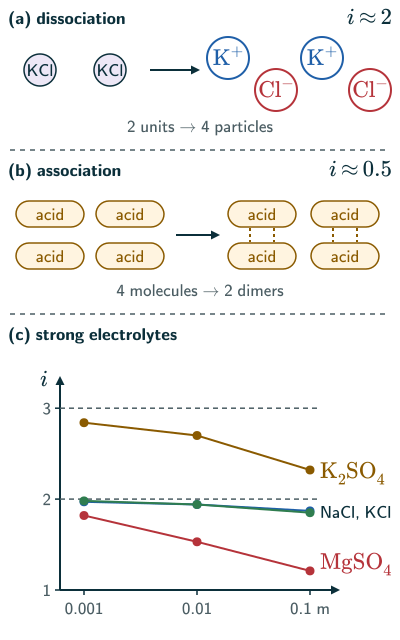
For MgSO4, ion pairing is supported directly by dielectric-spectroscopy studies (Akilan and colleagues, 2006, “Temperature effects on ion association and hydration in MgSO4”). A reduced measured factor cannot be interpreted solely as undissociated molecules.
Degree of association and dissociation
- From i, the degree of association or dissociation x follows by counting particles (NCERT Examples 1.12–1.13, pages 25–26).
- Dimerisation, 2A ⇌ A2: starting from 1 mol of A, (1 − x) mol stays single and x/2 mol of dimer forms, so i = 1 − x/2 (NCERT page 25).
- Dissociation into two ions, AB ⇌ A+ + B−: from n mol, n(1 − x) mol remains and nx mol of each ion forms, so i = 1 + x (NCERT page 26).
- In general (beyond the NCERT text): Arrhenius gave the rule in 1887 (Zeitschrift für physikalische Chemie, volume 1, page 631): a solute that dissociates into ν particles has i = 1 + (ν − 1)x. By the same counting, one that associates into groups of n has i = 1 − (1 − 1/n)x (reasoned from NCERT Example 1.12).
Degree of dissociation into ν particles
Solved examples
Example 1: Benzoic acid in benzene (NCERT Example 1.12)
2 g of benzoic acid (C6H5COOH) in 25 g of benzene lowers its freezing point by 1.62 K. Kf for benzene is 4.9 K kg mol−1. What percentage of the acid associates, if it forms dimers?
Answer: The experimental molar mass is M2 = 4.9 × 2 × 1000/(25 × 1.62) = 241.98 g mol−1. The true molar mass is 122 g mol−1, so i = 122/241.98 = 0.504. For dimers, i = 1 − x/2, so x/2 = 0.496 and x = 0.992: 99.2% of the acid is associated (NCERT Example 1.12, pages 25–26).
Example 2: Acetic acid in water (NCERT Example 1.13)
0.6 mL of acetic acid (density 1.06 g mL−1) is dissolved in 1 litre of water, and the freezing point falls by 0.0205 °C. Find the van ’t Hoff factor and the dissociation constant of the acid. (Kf for water = 1.86 K kg mol−1.)
Answer: n = 0.6 × 1.06/60 = 0.0106 mol, in approximately 1 kg of water, so m = 0.0106 mol kg−1. The predicted depression without dissociation is 1.86 × 0.0106 = 0.019716 K. Hence i = 0.0205/0.019716 ≈ 1.0398, and the ideal two-ion model gives x = i − 1 ≈ 0.0398, or 3.98%. Taking the dilute solution volume as about 1 L, c ≈ 0.0106 M, so Ka = cx/(1 − x) ≈ 1.75 × 10⁻⁵. This inference uses the freezing-point experiment and the ideal model; assigning it to another temperature requires an additional temperature-dependence assumption.
NCERT slips (page 26): the working calls i the ratio of the observed to the calculated “freezing point”; it is the ratio of the freezing point depressions. It also cites “equation (1.35)” for ΔTf = Kfm, which is Eq. (1.34), page 18; Eq. (1.35) is the same law written with masses. And because i is so close to 1, rounding matters: unrounded, i = 0.0205/0.019716 = 1.040, x = 0.0398 and Ka ≈ 1.75 × 10⁻⁵ (reasoned from NCERT Example 1.13). In an exam, NCERT-based keys expect i = 1.041 and 1.86 × 10⁻⁵.
Example 3: KCl raises the boiling point twice as much
Find the elevation of the boiling point of a 1 m aqueous KCl solution, taking complete dissociation and ignoring interionic attractions (Kb = 0.52 K kg mol−1).
Answer: i = 2, so ΔTb = 2 × 0.52 × 1 = 1.04 K, twice that of a 1 m sucrose solution (NCERT pages 17 and 23).
Example 4: Using measured values of i
Using NCERT Table 1.4, find the depression of the freezing point of 0.01 m aqueous K2SO4 (Kf = 1.86 K kg mol−1).
Answer: i = 2.70, so ΔTf = 2.70 × 1.86 × 0.01 = 0.0502 K; with i = 3 for complete dissociation it would be 0.0558 K (NCERT Table 1.4, page 25).
Example 5: Degree of dissociation of a salt
A 0.1 m solution of a salt AB that dissociates into two ions has i = 1.85. Find its apparent degree of dissociation.
Answer: i = 1 + x, so x = 0.85, that is, 85% (NCERT page 26). For a strong electrolyte this is only an apparent value: interionic correlations and possible ion pairing affect the colligative measurement, so 85% is not a direct measurement of molecular dissociation (reasoned).
Common mistakes to avoid
Common mistake
Expecting association to raise i
Association reduces the number of particles, so i < 1 and the apparent molar mass is too high; dissociation gives i > 1 and a molar mass too low (NCERT page 24).
Common mistake
Using i = 2 for every salt
i depends on how many ions the formula unit gives (3 for K2SO4) and can differ from that ideal count in real solutions (NCERT Table 1.4, page 25).
Common mistake
Writing i as abnormal over normal molar mass
It is normal molar mass divided by abnormal (experimental) molar mass (NCERT page 24).
Quick revision summary
- Dissociation raises the particle count (i > 1) and gives too low a molar mass; association lowers it (i < 1) and gives too high a molar mass.
- Measured i = normal ÷ apparent molar mass = observed ÷ ideal calculated colligative effect; a literal particle-count ratio applies in the ideal model.
- Modified formulas: ΔTb = iKbm, ΔTf = iKfm, Π = in2RT/V.
- Dilute KCl approaches i = 2; strong dimerisation can give i near 0.5. Measured factors also reflect interactions and measurement conditions.
- Dimerisation: i = 1 − x/2; dissociation into two ions: i = 1 + x.
Formula sheet
- i = normal molar mass ÷ abnormal molar mass
- ΔTb = i Kb m
- ΔTf = i Kf m
- Π = i n2 RT/V
- Dimerisation: i = 1 − x/2
- Dissociation into ν particles: i = 1 + (ν − 1) x
Questions students ask
Can the van ’t Hoff factor be negative or zero?
No, the van ’t Hoff factor i is always positive and has no unit, because it is a ratio of two positive quantities: the normal and abnormal molar masses, or the moles of particles after and before association or dissociation (NCERT page 24). In the ideal dilute model it is 1 for a solute that neither associates nor dissociates, above 1 for dissociation and below 1 for association, and even complete association into groups of n molecules only brings it down to 1/n, for example 1/3 when molecules join in threes (reasoned from NCERT page 25). So a negative or zero i in a calculation signals a mistake in the working.
How do you predict the van ’t Hoff factor of a salt from its formula?
For a strong electrolyte, the van ’t Hoff factor for complete dissociation is the number of ions one formula unit gives (NCERT pages 23–24): NaCl gives Na+ and Cl−, so i = 2; Na2SO4 gives 2Na+ and SO42−, so i = 3; Na3PO4 gives 4 ions and Al2(SO4)3 gives 5 (reasoned). These stoichiometric counts assume no hydrolysis, protonation, association or other side reactions; polyatomic ions are counted as intact units in that model, and non-electrolytes such as urea and sucrose have i = 1. Measured values, such as those in NCERT Table 1.4 (page 25), fall below these counts, for these dilute examples; this is not a universal bound at every concentration. When a question gives a measured i for its conditions, use it.
What is the difference between the van ’t Hoff factor and the degree of dissociation?
The van ’t Hoff factor i compares the number of particles after dissociation with the number before, while the degree of dissociation x is the fraction of the solute that has dissociated, between 0 and 1 (NCERT pages 24–26). For a solute giving ν particles they are linked by i = 1 + (ν − 1)x, so x = (i − 1)/(ν − 1), which many books write as α = (i − 1)/(n − 1), with n the number of ions from one formula unit; for a salt giving three ions with i = 1.60, x = 0.60/2 = 0.30, or 30%. For association into groups of n molecules, n is the size of the group instead, and x = (1 − i)/(1 − 1/n) (reasoned from NCERT Example 1.12).
How does the van ’t Hoff factor change with concentration?
The van ’t Hoff factor moves towards its limiting value on dilution: a strong electrolyte’s rises towards the number of ions, as KCl’s does from 1.85 at 0.1 m to 1.98 at 0.001 m (NCERT Table 1.4, page 25). A weak electrolyte’s rises as dilution raises its degree of ionisation, and that of ethanoic acid in benzene rises towards 1, as dilution shifts 2CH3COOH ⇌ (CH3COOH)2 towards single molecules, the side with more particles (Le Chatelier’s principle; reasoned). A measured i applies to its concentration, temperature and measurement conditions; values from different colligative properties need not be exactly interchangeable outside the ideal dilute limit.
Is the van ’t Hoff factor in the JEE Main and NEET syllabus, and what is its significance?
Yes, the van ’t Hoff factor is in Unit 5, Solutions, of both the JEE Main 2027 and the NEET (UG) 2026 syllabuses, which end with the abnormal value of molar mass, “van’t Hoff factor and its significance”, and NCERT’s 2026–27 reprint still teaches it in Section 1.7 (NCERT pages 23–26). In the ideal association/dissociation model it measures how far a solute dissociates (i > 1) or associates (i < 1), and putting it into the colligative formulas, as in ΔTf = iKfm, makes them fit such solutes. From a measured i one can then find the degree of association or dissociation and, for a weak acid, its dissociation constant (NCERT Examples 1.12–1.13).
Practice questions
Try each question first, then open the answer to check your working.
-
Q1. Why does ethanoic acid show a molar mass of about 120 g mol−1 in benzene?
Show answerHide answer
Its molecules pair up into hydrogen-bonded dimers, so there are about half as many particles and the molar mass worked out comes out about twice the true 60 g mol−1 (NCERT page 24).
-
Q2. Arrange 0.1 m aqueous solutions of glucose, NaCl and K2SO4 in order of increasing depression of freezing point.
Show answerHide answer
Glucose (i = 1) < NaCl (i = 1.87) < K2SO4 (i = 2.32), since ΔTf = iKfm (i from NCERT Table 1.4, page 25).
-
Q3. A solute gives a molar mass of 58.5 g mol−1 by formula but 31.5 g mol−1 by a freezing point experiment. Find i.
Show answerHide answer
i = normal ÷ abnormal = 58.5/31.5 = 1.86 (NCERT page 24).