Ionic equilibrium in solution
NCERT Class 11 Chemistry Chapter 6 Section 6.9
Quick answer
Ionic equilibrium is chemical equilibrium involving ions in solution, including weak-electrolyte ionisation and salt dissolution. Strong electrolytes are almost completely dissociated or ionised in the dissolved fraction, while weak electrolytes have concentration-dependent partial ionisation. Water’s polarity and hydration stabilise ions, and its own autoionisation supplies a small background.
With your textbook
NCERT Chemistry Part I (Class 11), Chapter 6 “Equilibrium”, Section 6.9 “Ionic Equilibrium in Solution”, pages 188–189.
Open the official NCERT chapter (PDF, 5.7 MB, ncert.nic.in) (opens in a new tab)
Checked against the 2026-27 reprint on .
What is ionic equilibrium?
Electrolytes and ionic equilibrium
Substances that conduct electricity in water are electrolytes; those that do not are non-electrolytes (NCERT Section 6.9, pages 188–189):
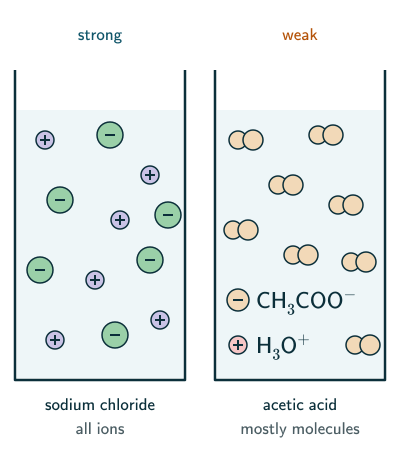
- a strong electrolyte, such as sodium chloride, is ionised almost completely in water;
- a weak electrolyte, such as acetic acid, is only partly ionised (about 1.3% for 0.10 M acetic acid at 25 °C; the fraction changes with dilution);
- in a weak electrolyte, the ions are in equilibrium with the un-ionised molecules. An equilibrium of this kind, involving ions in aqueous solution, is called ionic equilibrium.
In plain words: dissolve sugar in water and the molecules stay whole, so it contributes essentially no ions; water’s own ions give a small background conductance. Dissolve salt and it falls apart completely into Na+ and Cl− ions, which carry a current well. Acetic acid sits in between: most of its molecules stay whole and only a few split into ions, and the splitting and recombining go on all the time at equal rates. That two-way balance between molecules and ions is an ionic equilibrium, and it is what the rest of this unit (acids, bases, pH, buffers, solubility) is about.
We have already met one ionic equilibrium, Fe3+(aq) + SCN−(aq) ⇌ [Fe(SCN)]2+(aq), when we studied the effect of concentration on equilibrium (NCERT Section 6.8.1, page 186); NCERT recalls it at the start of Section 6.9 (page 188).
Strong and weak electrolytes
Dissolved sugar contributes essentially no charge-carrying ions; common salt does, and in the ordinary dilute range its conductance generally increases as more salt is dissolved (page 188). Michael Faraday sorted substances by this test into electrolytes and non-electrolytes; NCERT credits him also with dividing electrolytes into strong and weak (the modern strong–weak picture comes from Arrhenius’s theory of electrolytic dissociation; see NCERT’s box on him, page 191).
- The dissolved NaCl is almost entirely present as hydrated Na+ and Cl− ions; the solution also contains water and its small H3O+/OH− background.
- An aqueous solution of acetic acid contains mainly un-ionised CH3COOH molecules and only some acetate ions and hydronium ions: about 1.3% ionisation at 0.10 M and 25 °C. Here CH3COOH(aq) + H2O(l) ⇌ CH3COO−(aq) + H3O+(aq) is an ionic equilibrium.
In a weak electrolyte, equilibrium is set up between the ions and the un-ionised molecules:
This type of equilibrium involving ions in aqueous solution is called ionic equilibrium.
NCERT Chemistry Part I (Class 11), Section 6.9, page 189
Acids, bases and salts are all electrolytes, and each may be strong or weak (page 189).
How electrolytes ionise in water
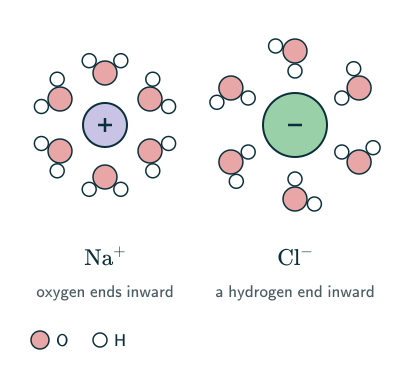
Ionic solids. Solid sodium chloride is a cluster of Na+ and Cl− ions held by electrostatic attraction (NCERT page 189). The force between two charges is inversely proportional to the dielectric constant of the medium, and water has a high relative permittivity, about 80 near room temperature. In a continuum electrostatic model this reduces the force by about 80 compared with vacuum at the same distance (a bulk estimate, not an exact microscopic hydration force), so the ions can move apart freely, and each is surrounded and kept apart by water molecules (hydration). The energy side of this, lattice enthalpy against hydration enthalpy, is on the page on enthalpy of solution.
Polar molecules. Hydrogen chloride (HCl) and acetic acid are both polar covalent molecules, yet HCl is completely ionised in water and acetic acid only partly (less than 5%). How far ionisation goes depends on the strength of the bond that must break and on how strongly the ions produced are solvated (page 190).
Dissociation and ionisation. In this introductory electrolyte context, dissociation describes the separation in water of ions that already exist in the solid, as in sodium chloride, and ionisation means a neutral molecule splitting into ions in solution, as in HCl or acetic acid. More generally, dissociation also includes separation of neutral species, such as N2O4 into NO2. Acid ionisation in water is proton transfer to water. NCERT often uses the two words interchangeably (page 190).
Hydrated protons. A bare proton is tiny (radius about 10−15 m) and cannot exist freely in water; it attaches to a lone pair of a water molecule, giving the hydronium ion H3O+, which is further hydrated (H5O2+, H7O3+, H9O4+). The hydroxide ion is hydrated too (H3O2−, H5O3−, H7O4−). H+(aq) and H3O+(aq) both mean the hydrated proton (NCERT box and Section 6.10.1, page 190).
Solved examples
Example 1: Sorting solutes
Classify each as a strong electrolyte, a weak electrolyte or a non-electrolyte in water: sodium chloride, hydrochloric acid, acetic acid, sugar (sucrose), sodium hydroxide, ethanol.
The dissolved portions of these ionic salts/bases dissociate almost completely, and HCl ionises almost completely; acetic acid ionises only partly; sugar and ethanol dissolve as whole molecules and give no ions.
Answer: strong: NaCl, HCl, NaOH; weak: acetic acid; non-electrolytes: sugar, ethanol.
Example 2: How much is ionised?
In a 0.10 M solution of acetic acid about 1.3% of the molecules are ionised at 25 °C (a value that follows from its ionisation constant, met later in this unit). Find [H3O+] and [CH3COOH] at equilibrium, and compare with 0.10 M HCl.
Ionised: 0.013 × 0.10 = 1.3 × 10⁻³ M, which is [H3O+] = [CH3COO−]. Un-ionised: 0.10 − 0.0013 = 0.0987 M. The fraction ionised, 0.013, is the degree of ionisation, α. In 0.10 M HCl, ionisation is complete, so [H3O+] = 0.10 M.
Answer: [H3O+] ≈ 1.3 × 10⁻³ M and [CH3COOH] ≈ 0.099 M; HCl of the same concentration has about 77 times as much H3O+.
Example 3: Water against a non-polar solvent
Why does sodium chloride dissolve and dissociate in water but not in benzene, whose dielectric constant is only about 2.3?
The attraction between the ions is divided by the dielectric constant: by 80 in water, but only by about 2.3 in benzene. Benzene molecules are also non-polar, so their ion solvation is much weaker than water’s (hydration is solvation by water).
Answer: in benzene the ions stay strongly attracted to each other and solvation does not compensate sufficiently for separating the lattice ions, so NaCl is practically insoluble.
Example 4: Dissociation or ionisation?
Using the introductory distinction above, which word fits each change: (a) KCl dissolving in water; (b) HCl gas dissolving in water; (c) acetic acid dissolving in water?
(a) The ions K+ and Cl− already exist in the crystal and are separated. (b) and (c) Neutral covalent molecules split into ions in water.
Answer: (a) dissociation; (b) and (c) ionisation (complete for HCl, partial for acetic acid). In practice, as NCERT says, the two words are used interchangeably.
Common mistakes to avoid
Common mistake
Thinking polar means strong electrolyte
HCl and acetic acid are both polar, but only HCl is fully ionised. Ionisation depends on bond strength and solvation of the ions, not on polarity alone.
Common mistake
Thinking a weak electrolyte is a dilute one
“Weak” describes how little of the substance ionises, a property of the substance, not how much is dissolved. Concentrated acetic acid is still weak and dilute HCl is still strong. A weak electrolyte in fact ionises more as it is diluted: acetic acid is about 1.3% ionised at 0.10 M but about 12% at 0.0010 M.
Common mistake
Writing H as a free particle in water
A bare proton cannot exist in water; it is always attached to water molecules as H3O+ and larger hydrated ions. H+(aq) is just shorthand.
Quick revision summary
- Electrolytes supply mobile ions in water; non-electrolytes such as sugar contribute essentially none.
- Strong electrolytes ionise almost completely (NaCl, HCl); weak ones partly at ordinary concentrations; the degree of ionisation changes with dilution.
- Ionic equilibrium: un-ionised molecules ⇌ ions, in a weak electrolyte’s solution.
- Water’s high relative permittivity (about 80) screens electrostatic forces in the bulk continuum model; hydration stabilises separated ions.
- H+(aq) means the hydrated proton, H3O+ and larger clusters.
Formula sheet
- Continuum electrostatic model: force in medium = force in vacuum/relative permittivity (water ≈ 80)
- Degree of ionisation = (moles ionised)/
(moles dissolved)
Questions students ask
What is the difference between ionic equilibrium and chemical equilibrium?
Ionic equilibrium is a particular kind of chemical equilibrium in which ions in solution take part, typically between the un-ionised molecules of a weak electrolyte and its ions, as in CH3COOH(aq) + H2O(l) ⇌ CH3COO−(aq) + H3O+(aq). Chemical equilibrium is the general term for any reversible reaction going at equal forward and reverse rates, including reactions of neutral gases such as N2 + 3H2 ⇌ 2NH3. The same law of chemical equilibrium governs both, so an ionic equilibrium responds to changes of concentration and temperature just as Le Chatelier’s principle predicts.
What factors affect the degree of ionisation of a weak electrolyte?
The degree of ionisation α of a weak electrolyte, the fraction of it present as ions, depends on the nature of the electrolyte (its ionisation constant), on the concentration (α rises on dilution), on the temperature, on the solvent (one of high dielectric constant, such as water, favours ionisation) and on the presence of a common ion, which pushes the ionisation back. For example, acetic acid is far less ionised in a solution that also contains sodium acetate, the common ion effect. A strong electrolyte has α close to 1 at all ordinary concentrations.
How do you identify strong and weak electrolytes?
Strong electrolytes are almost completely ionised in water and weak ones only partly, but conductance also depends on ionic mobility and concentration, so it is not a universal strength ranking across unrelated solutes; in practice they are recognised by type. Strong electrolytes are the strong acids (HCl, HBr, HI, HNO3, H2SO4 for its first ionisation, HClO4), the strong bases (the group 1 hydroxides and Ba(OH)2) and nearly all salts, including the dissolved fraction of sparingly soluble salts such as BaSO4. The second ionisation of H2SO4 is incomplete at many concentrations. Weak electrolytes are the weak acids (HF, HCN, H2CO3 and most organic acids), the weak bases (NH3 and amines) and water itself, while glucose and urea supply essentially no ions and are non-electrolytes.
What is Ostwald’s dilution law?
Ostwald’s dilution law says that the degree of ionisation α of a weak electrolyte increases as its solution is diluted: for HA ⇌ H+ + A− at concentration c, Ka = cα/(1 − α), which for small α gives α ≈ √(Ka/c). For a weak acid with Ka = 1.8 × 10 at 0.020 mol L, α ≈ √(9.0 × 10) = 0.030, so it is 3.0% ionised. This concentration form assumes a simple 1:1 equilibrium, dilute ideal behaviour, no added common ion and negligible water ionisation; the square-root approximation additionally needs small α. It is mainly useful for weak electrolytes, and NCERT derives it, without Ostwald’s name, under ionisation constants of weak acids.
Is ionic equilibrium in Class 11 or Class 12?
Ionic equilibrium is a Class 11 topic: in NCERT Chemistry Part I it is not a separate chapter but Sections 6.9 to 6.13 of Unit 6, Equilibrium, covering electrolytes, acids and bases, pH, buffers and solubility products. The JEE Main 2027 and NEET (UG) 2026 syllabuses both list it within Unit 6. Class 12 builds on it in Electrochemistry (conductance of strong and weak electrolytes) and in Solutions (the van ’t Hoff factor of electrolytes).
Practice questions
Try each question first, then open the answer to check your working.
-
Q1. Why does adding salt usually raise the conductance of a dilute aqueous solution, while adding pure sugar supplies essentially no charge carriers?
Show answerHide answer
More salt gives more ions to carry the current. Sugar dissolves as whole, uncharged molecules, so it supplies essentially no extra ions; the water background and impurities can still conduct.
-
Q2. In a 0.050 M solution of a weak acid HA, 2.0% of the HA is ionised. Find [H3O+], [A−] and [HA].
Show answerHide answer
Ionised: 0.020 × 0.050 = 1.0 × 10⁻³ M, so [H3O+] = [A−] = 1.0 × 10⁻³ M and [HA] = 0.050 − 0.001 = 0.049 M.
-
Q3. Which solution conducts better, 0.1 M HCl or 0.1 M acetic acid? Explain.
Show answerHide answer
0.1 M HCl: it is completely ionised, while acetic acid is less than 5% ionised, so the HCl solution contains far more ions to carry the current.