Equilibrium constant, reaction quotient and Gibbs energy
NCERT Class 11 Chemistry Chapter 6 Section 6.7
Quick answer
At fixed temperature and pressure, reaction Gibbs energy determines the thermodynamically favoured direction of reaction. Its standard value is linked to the dimensionless equilibrium constant, while the actual mixture also depends on the activity-based reaction quotient. At equilibrium the reaction Gibbs energy is zero and the quotient equals the constant; this does not determine the reaction rate.
With your textbook
NCERT Chemistry Part I (Class 11), Chapter 6 “Equilibrium”, Section 6.7 “Relationship between Equilibrium Constant K, Reaction Quotient Q and Gibbs Energy”, page 184.
Open the official NCERT chapter (PDF, 5.7 MB, ncert.nic.in) (opens in a new tab)
Checked against the 2026-27 reprint on .
How are K, Q and Gibbs energy related?
K, Q and ΔG
At fixed temperature and pressure, the equilibrium constant is tied to the reaction Gibbs energy (NCERT Section 6.7, page 184):
- ΔrG = ΔrG⊖ + RT ln Q, where Q is the reaction quotient of the mixture at that moment;
- at equilibrium ΔrG = 0 and Q = K, so ΔrG⊖ = −RT ln K, or K = e−ΔrG⊖/RT;
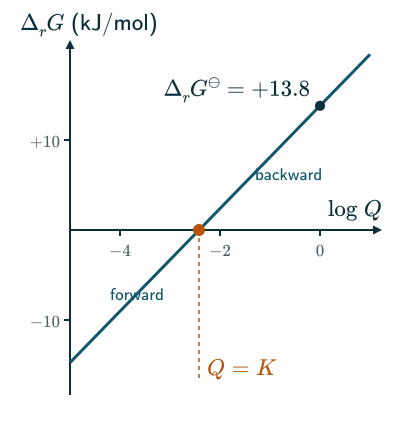
- ΔrG < 0: net reaction forward; ΔrG > 0: net reaction backward; ΔrG = 0: equilibrium.
In plain words: ΔrG is the “push” on a reaction mixture. It has two parts: a fixed part, ΔrG⊖, set by the reaction and the temperature, and a part RT ln Q that depends on how far the mixture has already gone. As products build up, Q grows and the push shrinks, until it vanishes at Q = K. That is the same rule as comparing Q with K, written in energy terms.
Here ΔrG is the instantaneous slope of the mixture’s Gibbs energy with reaction extent, per mole of reaction as written; it is not the finite total Gibbs energy change between two arbitrary mixtures. Its sign predicts a favoured direction, not a reaction rate.
Gibbs energy and the direction of reaction
NCERT states (page 184), recalling Unit 5:
- if ΔG is negative, the reaction is spontaneous and proceeds forward;
- if ΔG is positive, the forward reaction is non-spontaneous; the reverse reaction has a negative ΔG, so products are converted to reactants;
- if ΔG is 0, the reaction has reached equilibrium:
∆G is 0, reaction has achieved equilibrium; at this point, there is no longer any free energy left to drive the reaction.
NCERT Chemistry Part I (Class 11), Section 6.7, page 184
NCERT opens Section 6.7 by noting that the value of Kc does not depend on the rate of the reaction; it is fixed by the thermodynamics of the reaction. The relation between them (NCERT Eqs. 6.21–6.22):
Gibbs energy and the reaction quotient
ΔrG = ΔrG⊖ + RT ln Q
At equilibrium ΔrG = 0 and Q = K, so 0 = ΔrG⊖ + RT ln K:
Standard Gibbs energy and K
ΔrG⊖ = −RT ln K = −2.303 RT log K
K = e−ΔrG⊖/RT
Here ΔrG⊖ refers to specified standard states and Q and K are dimensionless activity products. For ideal gases use p/p⊖, usually with p⊖ = 1 bar; for dilute solutions use approximately c/c⊖, usually with c⊖ = 1 mol L−1. A real 1 M solution need not have unit activity. Present pure bulk solids and liquids have activity approximately 1. A gas concentration-standard K can also be used, but its standard Gibbs energy must match that convention; mixing concentration-based K with a pressure-standard Gibbs energy gives the wrong result when Δn ≠ 0.
Putting the two together gives a compact form, beyond the NCERT text but useful in JEE problems:
Q against K in energy terms
ΔrG = RT ln (Q/K)
So ΔrG < 0 exactly when Q < K, and the mixture moves forward; ΔrG > 0 when Q > K, and it moves backward (compare the standard Gibbs energy and K in Unit 5).
What the sign of ΔG⊖ tells us
From K = e−ΔrG⊖/RT (NCERT Eq. 6.23, page 184):
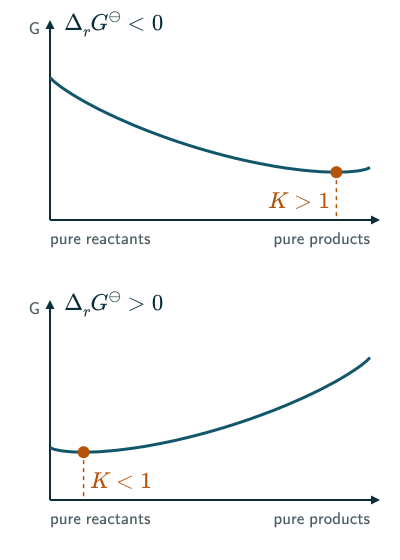
- ΔrG⊖ < 0 gives K > 1: the products are favoured at equilibrium;
- ΔrG⊖ > 0 gives K < 1: the reactants are favoured; the actual product fraction also depends on stoichiometry and initial amounts.
NCERT calls the first case “a spontaneous reaction” and the second “a non-spontaneous reaction”. That is a shorthand. The sign of ΔrG⊖ tells us whether K is above or below 1, and which way a mixture would go if every substance were in its standard state (Q = 1); “spontaneous” here means spontaneous under standard conditions. Whether a particular mixture reacts forward depends on ΔrG, that is on Q. A reaction with ΔrG⊖ > 0 still goes forward from pure reactants, when an absent gaseous or dissolved product makes Q approach zero, until Q = K. This is a limiting argument for ln Q, not a finite evaluation of ln 0; an absent pure solid product does not contribute a zero activity. (Two print slips on the same NCERT page: “G⊖ is standard Gibbs energy” should read ΔG⊖, the standard Gibbs energy change; and its two inequalities for e−ΔG⊖/RT are misprinted: they mean > 1 and < 1.)
Solved examples
Example 1: Phosphorylation of glucose (NCERT Problem 6.10, page 184)
ΔrG⊖ for the uncoupled phosphorylation of glucose by inorganic phosphate is 13.8 kJ mol−1. Find Kc at 298 K.
ln Kc = −ΔrG⊖/RT = −13 800/(8.314 × 298) = −13 800/2477.6 = −5.570.
Answer: Kc = e−5.570 ≈ 3.81 × 10⁻³. The actual first step of glycolysis is coupled to ATP hydrolysis; this positive value is for the uncoupled textbook reaction.
Example 2: Hydrolysis of sucrose (NCERT Problem 6.11, page 184)
Sucrose + H2O ⇌ glucose + fructose has Kc = 2 × 10¹³ at 300 K. Calculate ΔrG⊖.
ΔrG⊖ = −RT ln Kc = −8.314 × 300 × ln(2 × 10¹³) = −2494.2 × 30.63.
Answer: ΔrG⊖ ≈ −7.64 × 10⁴ J mol−1, about −76.4 kJ mol−1.
Example 3: Which way does the HI mixture go?
For H2(g) + I2(g) ⇌ 2HI(g), Kc = 57.0 at 700 K. A mixture has Qc = 8.0 (NCERT page 182). Find ΔrG and the direction. (Δn = 0, so Kp = Kc and Qp = Qc.)
ΔrG = RT ln(Q/K) = 8.314 × 700 × ln(8.0/57.0) = 5819.8 × (−1.964).
Answer: ΔrG ≈ −11.4 kJ mol−1: negative, so the mixture reacts forward, forming more HI, as the Q < K rule says.
Example 4: A positive ΔG<sup>⊖</sup> reaction that still goes forward
For N2O4(g) ⇌ 2NO2(g) at 298 K, ΔrG⊖ ≈ +4.7 kJ mol−1 (from standard Gibbs energies of formation at 298 K, NO2 51.31 and N2O4 97.89 kJ mol−1: 2 × 51.31 − 97.89 = 4.73). Find Kp, and ΔrG for (a) both gases at 1 bar; (b) N2O4 at 1 bar with only 0.01 bar of NO2.
Kp = e−4700/(8.314 × 298) = e−1.897 ≈ 0.15. (a) Q = 12/1 = 1, so ΔrG = ΔrG⊖ = +4.7 kJ mol−1. (b) Q = (0.01)2/1 = 10−4, so ΔrG = 4700 + 2477.6 × ln(10−4) = 4700 − 22 820.
Answer: Kp ≈ 0.15. (a) ΔrG = +4.7 kJ mol−1: NO2 combines to N2O4. (b) ΔrG ≈ −18.1 kJ mol−1: N2O4 dissociates, even though ΔrG⊖ is positive.
Common mistakes to avoid
Common mistake
Confusing ΔG with ΔG<sup>⊖</sup>
At equilibrium ΔrG = 0, but ΔrG⊖ = −RT ln K is zero only when K = 1. The direction of a given mixture is decided by ΔrG, not by ΔrG⊖.
Common mistake
Mixing kJ and J
R = 8.314 J mol−1 K−1, so ΔrG⊖ must be in J mol−1 before dividing by RT: 13.8 kJ mol−1 is 13 800 J mol−1.
Common mistake
Thinking K tells the speed
A very negative ΔrG⊖ means a large K, not a fast reaction. Hydrogen and oxygen, with K ≈ 1041 at 298 K for H2(g) + ½O2(g) → H2O(l) (about 1083 for 2H2 + O2 → 2H2O), stay mixed for years without a spark or a catalyst.
Quick revision summary
- ΔrG = ΔrG⊖ + RT ln Q; at equilibrium ΔrG = 0 and Q = K.
- ΔrG⊖ = −RT ln K = −2.303 RT log K, so K = e−ΔrG⊖/RT.
- ΔrG = RT ln(Q/K): negative when Q < K (forward), positive when Q > K (backward).
- ΔrG⊖ < 0: K > 1, products favoured; ΔrG⊖ > 0: K < 1.
Formula sheet
- ΔrG = ΔrG⊖ + RT ln Q
- ΔrG⊖ = −RT ln K; K = exp(−ΔrG⊖/RT)
- ΔrG = RT ln(Q/K)
Questions students ask
What is the difference between ΔG and ΔG⊖?
ΔrG⊖ is the Gibbs energy change for the specified standard states (unit activity, approximated by ideal gas at 1 bar or ideal solute at 1 mol L), so it has one fixed value for a reaction at a given temperature, while ΔrG is the Gibbs energy change for the mixture actually present and changes as the reaction proceeds. The two are linked by ΔrG = ΔrG⊖ + RT ln Q and are equal only when Q = 1. ΔrG⊖ fixes the position of equilibrium through K, while the sign of ΔrG tells which way a particular mixture will react.
Is the Q in ΔG = ΔG⊖ + RT ln Q the same as the heat q?
No, the Q in ΔrG = ΔrG⊖ + RT ln Q is the reaction quotient, not the heat q of the first law of thermodynamics, ΔU = q + w. It is written like the equilibrium constant but with the partial pressures (in bar) and concentrations (in mol L) of the mixture at that moment, each divided by its standard value so that Q is a pure number, and with pure solids and liquids left out. For N2(g) + 3H2(g) ⇌ 2NH3(g) with pN2 = 1.0 bar, pH2 = 3.0 bar and pNH3 = 0.50 bar, Q = 0.50/(1.0 × 3.0) ≈ 9.3 × 10.
What happens to ΔG⊖ and K when an equation is reversed or doubled?
ΔrG⊖ is quoted per mole of reaction as the equation is written, so reversing the equation changes its sign and doubling the equation doubles it; since ΔrG⊖ = −RT ln K, K is inverted on reversal and squared on doubling. For a reaction with ΔrG⊖ = −6.00 kJ mol at 298 K, K = e6000/2477.6 ≈ 11.3; the doubled equation has −12.0 kJ mol and K ≈ 127 (11.3), the reversed one +6.00 kJ mol and K ≈ 0.089. This is the thermodynamic reason behind the rules for changing the equation.
How does Le Chatelier’s principle follow from ΔG = ΔG⊖ + RT ln Q?
Le Chatelier’s principle for changes of concentration and pressure follows from ΔrG = RT ln(Q/K): selectively increasing a reactant activity or decreasing a product activity while holding the other activities fixed makes Q smaller than K, so ΔrG turns negative and the mixture reacts forward until Q = K again, while adding a product does the reverse. At 298 K, a change that halves Q in an equilibrium mixture gives ΔrG = 8.314 × 298 × ln 0.5 ≈ −1.7 kJ mol. A change of temperature is different: it changes ΔrG⊖ = −RT ln K, and so K itself.
Practice questions
Try each question first, then open the answer to check your working.
-
Q1. A reaction has K = 1.0 × 10⁻⁵ at 298 K. Find ΔrG⊖.
Show answerHide answer
ΔrG⊖ = −2.303 RT log K = −2.303 × 8.314 × 298 × (−5) ≈ +28.5 kJ mol−1.
-
Q2. For a reaction at 300 K, ΔrG⊖ = −20.0 kJ mol−1. Find K.
Show answerHide answer
ln K = 20 000/(8.314 × 300) = 20 000/2494.2 = 8.02, so K = e8.02 ≈ 3.0 × 10³.
-
Q3. A reaction has K = 10 at 298 K. A mixture has Q = 100. Find ΔrG and say which way the mixture moves.
Show answerHide answer
ΔrG = RT ln(Q/K) = 8.314 × 298 × ln 10 ≈ +5.7 kJ mol−1. It is positive, so the mixture moves backward, towards reactants, until Q falls to 10.