Dynamic equilibrium in chemical processes
NCERT Class 11 Chemistry Chapter 6 Section 6.2
Quick answer
Dynamic equilibrium is a reversible reaction’s balance of equal forward and reverse rates, so composition remains constant although reactions continue. NCERT’s isotope-mixing experiment demonstrates ongoing exchange, without proving a unique microscopic mechanism. At fixed temperature, volume and conserved atomic amounts, an accessible equilibrium can be approached from either side.
With your textbook
NCERT Chemistry Part I (Class 11), Chapter 6 “Equilibrium”, Section 6.2 “Equilibrium in Chemical Processes – Dynamic Equilibrium”, pages 172–174.
Open the official NCERT chapter (PDF, 5.7 MB, ncert.nic.in) (opens in a new tab)
Checked against the 2026-27 reprint on .
What is chemical equilibrium?
Dynamic equilibrium in a chemical reaction
A reaction that can go both ways is reversible. In a closed vessel at a fixed temperature, provided the necessary reaction paths remain accessible, it can settle into chemical equilibrium (NCERT Section 6.2, pages 172–174):
- the forward reaction (reactants → products) and the reverse reaction (products → reactants) go on all the time;
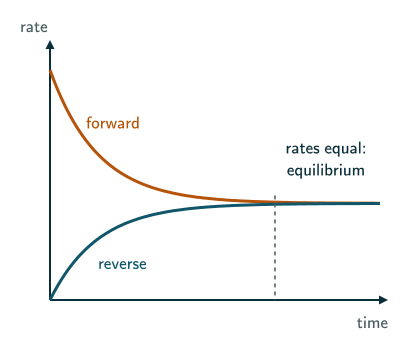
- at equilibrium their rates are equal, so the concentrations of reactants and products stay constant;
- the equilibrium is dynamic, not static: molecules keep reacting in both directions;
- the same equilibrium mixture is reached whether you start from the reactants or from the products, provided the same atoms are present in the same volume at the same temperature.
When the rates of the forward and reverse reactions become equal, the concentrations of the reactants and the products remain constant.
NCERT Chemistry Part I (Class 11), Section 6.2, page 172
In plain words: think of a busy shop with one door in and one door out. People keep coming in and going out, but if they enter and leave at the same rate, the number inside stays the same. This analogy illustrates balanced rates; a shop maintained by an external flow is only a steady state, not a thermodynamic equilibrium. A reaction mixture at equilibrium has balanced microscopic reactions: reactant molecules keep turning into products and products keep turning back, at the same rate, so nothing seems to change.
Reversible reactions and how far they go
For a general reversible reaction NCERT writes A + B ⇌ C + D, the two half-arrows showing that both directions go on at once. Reactions differ in how far they get before equilibrium is reached; NCERT sorts them into three groups (unit introduction, page 169):
- those that go nearly to completion, leaving only negligible (sometimes undetectable) amounts of reactants;
- those in which only small amounts of products form, most of the reactants remaining;
- those in which reactants and products end up at comparable concentrations.
How far a reaction goes depends on the conditions, such as the concentrations and the temperature. Choosing conditions so that equilibrium favours the desired product matters greatly in industry and in the laboratory (page 169).
How equilibrium is reached
Start with only A and B. As time passes, C and D build up and A and B are used up (NCERT Fig. 6.2, page 172). In the simple kinetic picture shown, the forward reaction slows down and the reverse reaction speeds up, until the two go at the same rate. From then on the concentrations stop changing. At fixed temperature and pressure, stable equilibrium minimises Gibbs energy; at fixed temperature and volume it minimises Helmholtz energy. For an interior reaction equilibrium, ΔrG = 0 in either description.
Equilibrium can be reached from either direction. NCERT’s example is H2(g) + I2(g) ⇌ 2HI(g) (page 174). Starting with equal concentrations of H2 and I2, their concentrations fall and that of HI rises until all three are constant. Starting with HI alone, its concentration falls and those of H2 and I2 rise until, again, all three are constant.
If total number of H and I atoms are same in a given volume, the same equilibrium mixture is obtained whether we start it from pure reactants or pure product.
NCERT Chemistry Part I (Class 11), Section 6.2, page 174
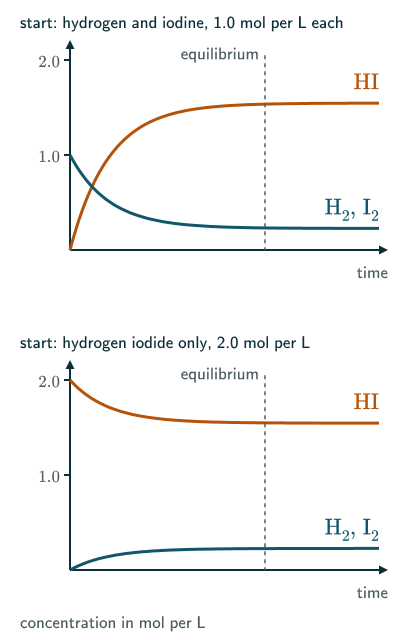
NCERT’s Fig. 6.5 shows the same idea as a sketch that is not to scale (in it HI rises by less than twice the fall in H2); use the figure above for sizes.
Proving it is dynamic: the deuterium experiment
How do we know the reactions have not simply stopped? NCERT describes the ammonia synthesis, N2(g) + 3H2(g) ⇌ 2NH3(g) (pages 172–174):
- Haber started with known amounts of N2 and H2 at high temperature and pressure and measured the ammonia at intervals. After a while the composition stopped changing, even though some N2 and H2 were still present (NCERT Fig. 6.4).
- The synthesis was repeated under exactly the same conditions with deuterium, D2, in place of H2. NCERT describes an analogous equilibrium with D2 and ND3 instead of H2 and NH3, treating isotope effects on composition as negligible.
- The two equilibrium mixtures were mixed and left for a while. In NCERT’s simplified account the total ammonia concentration remained approximately unchanged, but a mass spectrometer showed NH3, NH2D, NHD2 and ND3, and H2, HD and D2.
The H and D scrambling establishes ongoing bond rearrangement and isotope exchange. It does not by itself prove that every exchanged ammonia molecule fully decomposes to N2: catalytic exchange paths are possible. Real isotopic substitution can change equilibrium constants (IUPAC Gold Book, “isotope effect”), so exact equality of H/D equilibrium compositions is an approximation. If the reactions had stopped at equilibrium, there would have been no mixing of isotopes. So chemical equilibrium is dynamic: the forward and reverse reactions go on at equal rates with no net change in composition (page 174). Deuterium is a stable, non-radioactive isotope; the mass spectrometer tells the molecules apart by their masses.
NCERT’s activity: two cylinders
NCERT suggests a class activity to picture this (page 173). Half fill measuring cylinder 1 with coloured water and leave cylinder 2 empty. Dip a glass tube to the bottom of cylinder 1, close its top with a finger and move the water it holds into cylinder 2; with a second tube, move water from cylinder 2 back to cylinder 1. Keep transferring in both directions. The levels change at first and then stay fixed, though the transfers go on: a dynamic equilibrium, with the levels standing for concentrations.
Why the levels settle (NCERT leaves this for you; here is a simple model that ignores drips and the capillary rise of water in a narrow tube): a tube standing on the bottom of its cylinder holds a column of water as tall as the water in that cylinder, so each transfer moves (area of tube) × (depth). The levels stop changing when the two tubes carry equal volumes. With identical tubes the levels end equal (NCERT Fig. 6.3); with tubes of different diameters they end different, which NCERT asks you to explain (see Example 3 below). This area-times-depth model assumes simultaneous transfers or transfer volumes small enough to neglect the level change between sequential transfers.
Solved examples
Example 1: The same mixture from either side
At 731 K, a flask containing 1.00 mol L−1 each of H2 and I2 reaches equilibrium with about 0.23 mol L−1 each of H2 and I2 and 1.55 mol L−1 of HI. A second flask at the same temperature starts with 2.00 mol L−1 of HI only. What does it contain at equilibrium?
The second flask holds the same numbers of H and I atoms per litre: 2.00 mol L−1 of HI has 2.00 mol of H atoms and 2.00 mol of I atoms per litre, as does 1.00 mol L−1 each of H2 and I2. By NCERT’s rule it reaches the same mixture.
Answer: about 0.23 mol L−1 each of H2 and I2 and 1.55 mol L−1 of HI. (Check: H atoms 2 × 0.23 + 1.55 ≈ 2.00 mol L−1.)
Example 2: Reading the isotope experiment
In NCERT’s experiment the mixed equilibrium mixtures keep the same total ammonia concentration, but NH2D and NHD2 appear. Explain both observations.
In the textbook approximation, total ammonia remains nearly constant while isotope exchange continues. Ammonia molecules can exchange H and D through ongoing reversible reaction pathways; the observation does not identify a unique elementary mechanism.
Answer: the nearly constant total is consistent with a stationary composition; the mixed molecules NH2D and NHD2 (and HD) show that the forward and reverse reactions never stopped.
Example 3: Tubes of different diameters
In NCERT’s activity, the tube used in cylinder 1 has a diameter of 5 mm and the tube used in cylinder 2 one of 3 mm (the cylinders are identical). Compare the final levels.
A transfer moves (tube area) × (depth of water in that cylinder). At steady state the two transfers are equal: a1h1 = a2h2, so h2/h1 = a1/a2 = (5/3)2.
Answer: the water in cylinder 2 stands about 2.8 times as high as in cylinder 1. The ratio of the levels is fixed by the ratio of the tube areas, which play the part of the rate constants (how fast each reaction goes at a given concentration); in the same way the equilibrium ratio of concentrations is fixed by the equilibrium constant K (next topic, NCERT Section 6.3).
Example 4: Which group?
Place each reaction in one of NCERT’s three groups: (a) methane burning in excess oxygen; (b) nitrogen and oxygen of the air forming nitric oxide at room temperature; (c) H2 + I2 ⇌ 2HI at 731 K (Example 1).
(a) Combustion leaves essentially no methane. (b) Air does not turn into NO at room temperature; the equilibrium amount is negligible on ordinary laboratory scales. (c) In Example 1 the equilibrium mixture has 0.23 mol L−1 of each reactant and 1.55 mol L−1 of HI, all of comparable size.
Answer: (a) nearly complete; (b) only a very small amount of product; (c) comparable concentrations of reactants and products.
Common mistakes to avoid
Common mistake
Thinking the reaction stops at equilibrium
Both reactions continue at equal rates. Only the concentrations stop changing, as the isotope experiment proves.
Common mistake
Thinking the concentrations become equal
At equilibrium the concentrations are constant, not equal to one another. In Example 1 [HI] is about seven times [H2].
Common mistake
Thinking equilibrium can only be reached from the reactants
It can be reached from either side; with the same atoms in the same volume at the same temperature, the same mixture results.
Common mistake
Thinking the rate constants become equal
At equilibrium the forward and reverse rates are equal, not their rate constants. In the two-cylinder activity the tubes stay different; the levels adjust until the transfers match.
Quick revision summary
- Reversible reaction: goes both ways, A + B ⇌ C + D.
- Chemical equilibrium: forward rate = reverse rate; concentrations constant; a closed vessel prevents net loss in these laboratory examples.
- Dynamic: reactions continue; shown by D2 scrambling in ammonia (NH2D, NHD2, HD).
- Reached from either direction; same atoms in the same volume at the same temperature give the same mixture.
- Three groups: nearly complete, little product, comparable amounts.
Formula sheet
- At equilibrium: rate of forward reaction = rate of reverse reaction
- Concentrations constant (not equal) at equilibrium
Questions students ask
What is the difference between static and dynamic equilibrium in chemistry?
In a static equilibrium nothing changes because nothing is happening, like a book lying on a table, while in a dynamic equilibrium two opposite processes go on all the time at equal rates, so the system only looks still. Every chemical equilibrium is dynamic: in H2(g) + I2(g) ⇌ 2HI(g) at equilibrium, HI molecules keep forming and breaking up at the same rate, and water and its vapour in a sealed flask are dynamic too. In mechanics the words mean something else: zero net force on a body at rest or moving at constant velocity.
What is the difference between reversible and irreversible reactions?
A reversible reaction can go in both directions under the same conditions and, in a closed vessel, ends as an equilibrium mixture of reactants and products, as in H2(g) + I2(g) ⇌ 2HI(g); an irreversible reaction goes practically to completion in one direction, as in magnesium burning in air, 2Mg(s) + O2(g) → 2MgO(s). Strictly every reaction is reversible, but when the equilibrium constant is enormous, or a product escapes as a gas, the reverse reaction is negligible. Neutralisation of a strong acid by a strong base, H+ + OH− → H2O, counts as irreversible: its K is 1/Kw = 10 at 298 K.
What are some examples of dynamic equilibrium in daily life?
Everyday examples of dynamic equilibrium are a sealed bottle of soda water, in which CO2 leaves the liquid and dissolves again at equal rates; a closed bottle of water, in which evaporation and condensation balance; and a saturated salt or sugar solution standing over undissolved crystals. These are physical equilibria; a local chemical binding equilibrium is the simplified haemoglobin–oxygen model, Hb + O2 ⇌ HbO2. For the physical examples, let the phases reach equilibrium at fixed conditions with both phases present. Circulating blood as a whole is an open, driven system; local oxygen binding can be approximated by an equilibrium model.
Why does a reversible reaction never go to completion?
For an ideal homogeneous mixture with a finite equilibrium constant and accessible reverse reaction, equilibrium generally leaves some reactant: reverse and forward rates balance. A very large constant can make the residual amount negligible. This is not a universal prohibition on complete conversion: a pure solid phase can be exhausted in a heterogeneous system, and removing products changes the constraints. Actual conversion requires the equilibrium expression together with material balances.
Practice questions
Try each question first, then open the answer to check your working.
-
Q1. At a suitable high temperature, calcium carbonate can decompose completely in an open vessel, while a closed vessel containing enough solid reaches CaCO3(s) ⇌ CaO(s) + CO2(g) coexistence. Explain the role of CO2 pressure and the qualification “enough solid”.
Show answerHide answer
At a temperature where the surrounding CO2 partial pressure is below the coexistence pressure, escape of CO2 favours continued decomposition and can consume all the carbonate. In a closed vessel, CO2 can build to the coexistence pressure if enough carbonate remains. With too little solid or too much headspace, it can decompose completely there too; the reverse reaction is not literally impossible in an open vessel.
-
Q2. In NCERT’s two-cylinder activity, 50 mL of coloured water starts in cylinder 1, and the tubes have diameters of 4 mm (in cylinder 1) and 3 mm (in cylinder 2). The cylinders are identical. How much water ends up in each (in the simple model of this page)?
Show answerHide answer
At steady state a1h1 = a2h2, so h2/h1 = (4/3)2 = 16/9. For identical cylinders the volumes are in the same ratio: 50 × 9/25 = 18 mL in cylinder 1 and 50 × 16/25 = 32 mL in cylinder 2.
-
Q3. An equilibrium mixture of H2, I2 and HI is mixed with one of D2, I2 and DI at the same temperature. Which molecules are found after some time, and why?
Show answerHide answer
H2, HD, D2, I2, HI and DI. Because the equilibrium is dynamic, HI and DI keep splitting into hydrogen (or deuterium) and iodine, and the atoms recombine at random, giving the mixed molecule HD as well.