Law of chemical equilibrium and equilibrium constant
NCERT Class 11 Chemistry Chapter 6 Section 6.3
Quick answer
The equilibrium constant fixes the activity ratio of products to reactants at a given temperature for a specified reaction and standard states. Ideal-gas or dilute-solution problems approximate activities using partial pressures or concentrations, with stoichiometric coefficients as powers. Reversing the reaction inverts the constant; multiplying the equation raises it to that power.
With your textbook
NCERT Chemistry Part I (Class 11), Chapter 6 “Equilibrium”, Section 6.3 “Law of Chemical Equilibrium and Equilibrium Constant”, pages 174–177.
Open the official NCERT chapter (PDF, 5.7 MB, ncert.nic.in) (opens in a new tab)
Checked against the 2026-27 reprint on .
What is the equilibrium constant?
Law of chemical equilibrium
For an ideal-gas or sufficiently dilute-solution model at equilibrium at a given temperature, a particular ratio of concentrations, the equilibrium constant Kc, has the same value whatever the starting amounts (NCERT Section 6.3, pages 174–177):
- for a A + b B ⇌ c C + d D, Kc = [C]c[D]d/[A]a[B]b, with equilibrium concentrations in mol L−1;
- each concentration is raised to the power of its coefficient in the balanced equation;
- the value depends on the temperature and on how the equation is written: reversing it inverts Kc, and multiplying it by n raises Kc to the power n.
In plain words: mix hydrogen and iodine in different amounts and let each mixture settle. The equilibrium amounts come out different every time, yet one particular combination of them, [HI]2/[H2][I2], always works out to the same number at that temperature. That number characterises the specified reaction in this idealised concentration model. For real mixtures, the thermodynamic equilibrium constant uses activities, which account for nonideality; a concentration ratio may vary when activity coefficients change.
The law of mass action
From experiments on many reversible reactions, the Norwegian chemists Cato Maximilian Guldberg and Peter Waage proposed in 1864 that the concentrations in an equilibrium mixture of A + B ⇌ C + D are related by an equilibrium equation (NCERT Eq. 6.1, page 175; NCERT spells it Maximillian):
Equilibrium equation
Kc = [C][D]/[A][B]
Kc is the equilibrium constant, and the right-hand side is the equilibrium constant expression.
The equilibrium equation is also known as the law of mass action because in the early days of chemistry, concentration was called “active mass”.
NCERT Chemistry Part I (Class 11), Section 6.3, page 175
Evidence from H + I ⇌ 2HI
NCERT tests the idea with H2(g) + I2(g) ⇌ 2HI(g) in a sealed vessel at 731 K (Table 6.2, page 175). Experiments 1–4 started with different amounts of H2 and I2; experiments 5 and 6 started with HI alone. In experiments 1–4 the amounts of H2 and I2 that reacted were equal, each half the HI formed; in experiments 5 and 6, [H2] = [I2] at equilibrium.
The simple ratio [HI]/[H2][I2] is far from constant, but [HI]2/[H2][I2] is (NCERT Table 6.3, page 176):
| Experiment | [HI]/[H2][I2] | [HI]2/[H2][I2] |
|---|---|---|
| 1 | 1840 | 46.4 |
| 2 | 1610 | 47.6 |
| 3 | 1400 | 46.7 |
| 4 | 1520 | 46.9 |
| 5 | 1970 | 46.4 |
| 6 | 790 | 46.4 |
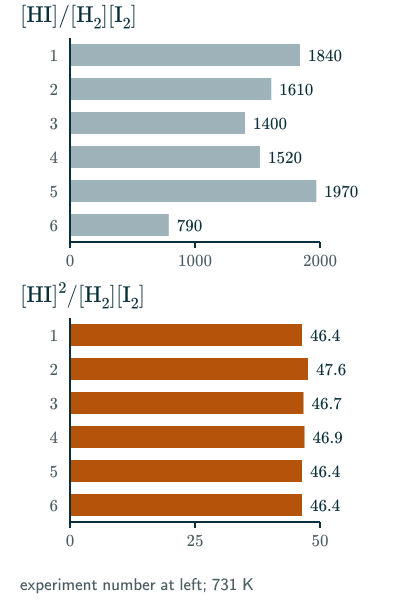
The powers in the constant ratio are the coefficients in the balanced equation, so Kc = [HI]2/[H2][I2] (NCERT Eq. 6.3). The subscript ‘eq’ is usually left out: the concentrations in a Kc expression are understood to be equilibrium values, and the subscript c means they are in mol L−1 (page 176). NCERT calls this result the Equilibrium Law or Law of Chemical Equilibrium: at a given temperature, the product of the concentrations of the products, each raised to its coefficient in the balanced equation, divided by the product of the concentrations of the reactants, each raised to its coefficient, has a constant value.
Writing Kc for any reaction
Equilibrium constant
Kc = [C]c[D]d/[A]a[B]b
for a A + b B ⇌ c C + d D (NCERT Eq. 6.4). For example (page 176):
4NH3(g) + 5O2(g) ⇌ 4NO(g) + 6H2O(g): Kc = [NO]4[H2O]6/[NH3]4[O2]5
Square brackets mean molar concentrations at equilibrium, and the phase symbols (s, l, g) are generally left out of the expression (the symbols only; pure solids and liquids are treated under heterogeneous equilibria, NCERT Section 6.5).
Reversing and multiplying the equation
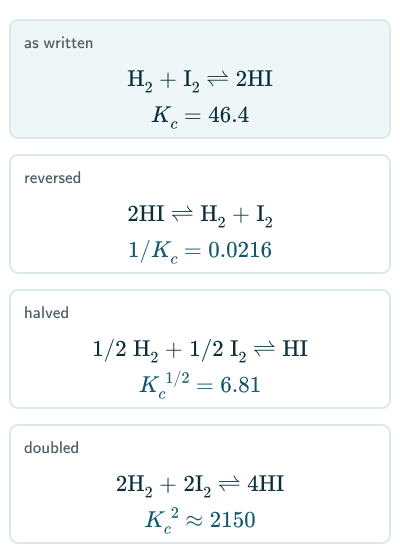
Kc belongs to the equation as written (NCERT Eqs. 6.5–6.11, Table 6.4, pages 176–177). If Kc = [HI]2/[H2][I2] = x for H2 + I2 ⇌ 2HI:
- reverse reaction, 2HI ⇌ H2 + I2: K′c = [H2][I2]/[HI]2 = 1/x = 1/Kc;
- halved, ½H2 + ½I2 ⇌ HI: K″c = [HI]/[H2]1/2[I2]1/2 = Kc1/2;
- multiplied by n, nH2 + nI2 ⇌ 2nHI: K‴c = Kcn (NCERT’s Eq. 6.11 has a stray “D” printed before the arrow).
Changing the equation
reverse: K′c = 1/Kc; multiply by n: K‴c = Kcn
So a value of Kc means nothing without its balanced equation (page 177). One more rule, which NCERT states later in this unit (NCERT Eq. 6.35, page 199): adding two equations at the same temperature, with consistent phases and standard-state conventions, multiplies their constants, K = K1 × K2, because the two expressions multiply and the shared species cancel.
For the link between K and the standard Gibbs energy change, see Gibbs energy and equilibrium.
Solved examples
Example 1: K<sub>c</sub> for ammonia at 500 K (NCERT Problem 6.1, page 177)
At equilibrium at 500 K, [N2] = 1.5 × 10⁻² M, [H2] = 3.0 × 10⁻² M and [NH3] = 1.2 × 10⁻² M. Calculate Kc for N2(g) + 3H2(g) ⇌ 2NH3(g).
Kc = [NH3]2/[N2][H2]3 = (1.2 × 10⁻²)2/
Answer: Kc ≈ 3.56 × 10² (355.6). Extra digits show the arithmetic; the two-significant-figure inputs justify about 3.6 × 10². NCERT’s 3.55 × 10² differs insignificantly at that precision. NCERT quotes Kc here without units; when the powers above and below differ it has units (NCERT page 180), here L2 mol−2.
Example 2: Nitric oxide at 800 K (NCERT Problem 6.2, page 177)
For the supplied idealised textbook dataset at 800 K, take [N2] = 3.0 × 10⁻³ M, [O2] = 4.2 × 10⁻³ M and [NO] = 2.8 × 10⁻³ M. Find Kc for N2(g) + O2(g) ⇌ 2NO(g).
Kc = [NO]2/[N2][O2] = (2.8 × 10⁻³)2/
Answer: Kc ≈ 0.622.
Example 3: Reversing and halving the ammonia equation
Using Kc = 355.6 at 500 K from Example 1, find the constants for (a) 2NH3(g) ⇌ N2(g) + 3H2(g) and (b) ½N2(g) + 3/2 H2(g) ⇌ NH3(g).
(a) is the reverse, so K′c = 1/355.6. (b) is the forward equation multiplied by ½, so K″c = (355.6)1/2.
Answer: (a) about 2.81 × 10⁻³; (b) about 18.9.
Example 4: Testing a ratio with NCERT’s data
In NCERT experiment 5, HI alone (3.04 × 10⁻² M) gave at equilibrium [H2] = [I2] = 0.345 × 10⁻² M and [HI] = 2.35 × 10⁻² M. Work out both ratios of Table 6.3 for this experiment.
[H2][I2] = (0.345 × 10⁻²)2 = 1.190 × 10⁻⁵. Then [HI]/[H2][I2] = (2.35 × 10⁻²)/(1.190 × 10−5) and [HI]2/[H2][I2] = (5.52 × 10⁻⁴)/
Answer: about 1970 and 46.4, matching NCERT Table 6.3. Only the second matches the other experiments (46.4 to 47.6). Also, 2 × 0.345 + 2.35 = 3.04: every HI that broke up gave H2 and I2.
Common mistakes to avoid
Common mistake
Using initial instead of equilibrium concentrations
Kc uses the concentrations at equilibrium. Starting amounts must first be converted to equilibrium amounts.
Common mistake
Forgetting the powers
Each concentration is raised to its coefficient: [NH3]2 and [H2]3, not [NH3] and [H2].
Common mistake
Quoting K without its equation
2HI ⇌ H2 + I2 and H2 + I2 ⇌ 2HI have constants that are reciprocals; halving the equation takes a square root. Always state the equation with K.
Quick revision summary
- Law of mass action (Guldberg and Waage, 1864): at equilibrium, products over reactants, each to the power of its coefficient, is constant at a given temperature.
- Kc = [C]c[D]d/[A]a[B]b, with equilibrium concentrations in mol L−1.
- Evidence: for H2 + I2 ⇌ 2HI at 731 K, [HI]2/[H2][I2] ≈ 46–48 in all six experiments.
- Reverse the equation: 1/K. Multiply by n: Kn. Add two equations: K1K2.
Formula sheet
- Kc = Cc Dd/(Aa Bb) for aA + bB ⇌ cC + dD, where A, B, C, D here stand for the equilibrium concentrations [A], [B], [C], [D] in mol/L
- Reverse reaction: Kc(reverse) = 1/Kc
- Equation multiplied by n: Kcn; halved: √Kc
- Equations added: K = K1 × K2
Questions students ask
What is the difference between the law of mass action and the rate law?
The law of mass action, as NCERT uses it, is the law of chemical equilibrium: in Kc each concentration is raised to its coefficient in the balanced equation, whatever the mechanism. A rate law, rate = k[A]m[B]n, gives how fast a reaction goes, and its orders m and n are found by experiment; they must equal the coefficients only for a single-step (elementary) reaction. For 2N2O5 → 4NO2 + O2 the rate is k[N2O5], first order, not second. Older books state it as rate ∝ product of active masses, true only for elementary steps; rate laws come in Class 12 Chemical Kinetics.
What is the difference between the equilibrium constant and the rate constant?
A rate constant k belongs to a stated kinetic law; a catalyst provides a different, faster pathway, while the equilibrium constant K measures how far the reaction goes and is not changed by a catalyst. For a single-step reaction they are linked: at equilibrium the forward and reverse rates are equal, so for A ⇌ B, kf[A] = kb[B] and Kc = [B]/[A] = kf/kb. With kf = 4.0 × 10 s and kb = 1.0 × 10 s, Kc = 40, and a catalyst that multiplies both rate constants by the same factor leaves K unchanged.
What does the equilibrium constant depend on?
For a specified equation, medium and standard states, the thermodynamic equilibrium constant is fixed by temperature: ΔrG⊖ = −RT ln K. Here K is dimensionless and built from activities. Concentration- or pressure-based expressions approximate it for dilute solutions or ideal gases; their numerical values also depend on units and reference conventions. Changing composition or pressure can alter activity coefficients, so an apparent concentration ratio need not stay exactly constant in a nonideal mixture. A catalyst changes the approach rate, not the thermodynamic constant.
Is a dissociation constant the same as an equilibrium constant?
Yes, a dissociation (or ionisation) constant is the equilibrium constant of a dissociation reaction, given its own symbol: Ka for a weak acid, HA ⇌ H+ + A−, and Kb for a weak base. The ionic product of water Kw, the solubility product Ksp and the hydrolysis constant are equilibrium constants too, written by the same law with pure-solid activities set to one and solvent-water activity approximated as one in dilute aqueous solution. So every rule for K applies to them: Ka × Kb = Kw for a conjugate acid–base pair in the same solvent is the rule for adding the corresponding two equations.
Practice questions
Try each question first, then open the answer to check your working.
-
Q1. Write Kc for 2SO2(g) + O2(g) ⇌ 2SO3(g), and for the reverse reaction.
Show answerHide answer
Kc = [SO3]2/[SO2]2[O2]. For 2SO3 ⇌ 2SO2 + O2, K′c = [SO2]2[O2]/[SO3]2 = 1/Kc.
-
Q2. For A(g) ⇌ 2B(g), Kc = 4.0 × 10⁻² at some temperature. Find the constants at the same temperature for (a) 2B(g) ⇌ A(g) and (b) 2A(g) ⇌ 4B(g).
Show answerHide answer
(a) Reverse: 1/(4.0 × 10−2) = 25. (b) Doubled: (4.0 × 10⁻²)2 = 1.6 × 10⁻³.
-
Q3. At a certain temperature an equilibrium mixture for 2NO2(g) ⇌ N2O4(g) contains [NO2] = 0.050 mol L−1 and [N2O4] = 0.020 mol L−1. Find Kc, and Kc for N2O4(g) ⇌ 2NO2(g).
Show answerHide answer
Kc = [N2O4]/[NO2]2 = 0.020/(0.050)2 = 0.020/0.0025 = 8.0. For the reverse, 1/8.0 = 0.125.