Homogeneous equilibria: Kp and Kc
NCERT Class 11 Chemistry Chapter 6 Section 6.4
Quick answer
A homogeneous equilibrium has all reacting species in one phase. For ideal gases, the concentration and partial-pressure constants are related through the gas law and the change in total gaseous stoichiometric coefficients. Their numerical conversion depends on consistent units or standard-state normalisation; neither constant is intrinsically larger.
With your textbook
NCERT Chemistry Part I (Class 11), Chapter 6 “Equilibrium”, Section 6.4 “Homogeneous Equilibria”, pages 177–179.
Open the official NCERT chapter (PDF, 5.7 MB, ncert.nic.in) (opens in a new tab)
Checked against the 2026-27 reprint on .
What is a homogeneous equilibrium?
Homogeneous equilibrium
In a homogeneous system, all the reactants and products are in the same phase.
NCERT Chemistry Part I (Class 11), Section 6.4, page 177
- All-gas example: N2(g) + 3H2(g) ⇌ 2NH3(g). Solution examples: CH3COOC2H5(aq) + H2O(l) ⇌ CH3COOH(aq) + C2H5OH(aq), and Fe3+(aq) + SCN−(aq) ⇌ Fe(SCN)2+(aq).
- For gases, the equilibrium constant can be written with partial pressures, Kp, as well as with concentrations, Kc.
- They are linked by Kp = Kc(RT)Δn, where Δn is the moles of gaseous products minus the moles of gaseous reactants.
In plain words: when everything is a gas, it is often easier to measure pressures than concentrations. For an ideal gas at fixed temperature, partial pressure is concentration times RT, so a constant written with pressures is the same idea as one written with concentrations; the two differ only by powers of RT, one for each mole of gas gained or lost in the reaction.
Equilibrium constant in gaseous systems
From the ideal gas equation, pV = nRT, so p = (n/V)RT. With concentration c in mol L−1 and pressure in bar (NCERT Section 6.4.1, pages 177–178):
Pressure and concentration
p = cRT = [gas]RT, with R = 0.0831 bar L mol−1 K−1
In the ideal-gas approximation at constant temperature, partial pressure is proportional to concentration. For H2(g) + I2(g) ⇌ 2HI(g):
Kp for hydrogen iodide
Kp = (pHI)2/(pH2 · pI2)
= [HI]2(RT)2/
= Kc
NCERT’s Eq. 6.12 labels the pressure ratio Kc; it should read Kp.
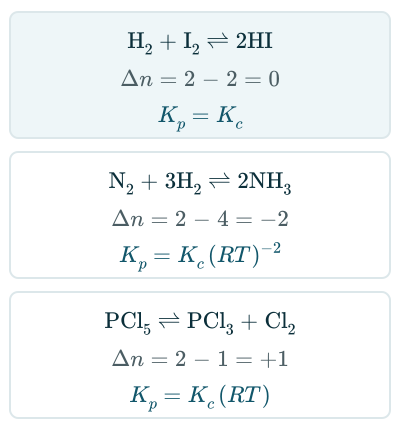
The RT factors cancel because there are 2 moles of gas on each side. That is not always so. For N2(g) + 3H2(g) ⇌ 2NH3(g), 2 moles of gas on the right but 4 on the left leave (RT)2 on top and (RT)4 underneath, so Kp = Kc(RT)−2 (NCERT Eq. 6.14).
The relation between Kp and Kc
For an ideal-gas reaction a A + b B ⇌ c C + d D, the same steps give (NCERT Eq. 6.15, page 178):
General case
Kp = pCc pDd/(pAa pBb)
= [C]c[D]d(RT)c+d / ([A]a[B]b(RT)a+b)
= Kc(RT)(c+d)−(a+b)
So:
Kp and Kc
Kp = Kc(RT)Δn, with Δn = (c + d) − (a + b), counting gases only
- Δn = 0: Kp = Kc (H2 + I2 ⇌ 2HI).
- Δn > 0 (more gas made): the numerical value of Kp in bar-based units exceeds that of Kc in mol L−1-based units when the numerical value of RT exceeds 1 in the matching units. This is a unit-dependent comparison, not an inequality between quantities with different dimensions.
- Δn < 0 (gas used up): the numerical pressure-based value is smaller in those same units and ordinary temperature range.
For a dimensional pressure product, any consistent pressure unit can be used with the matching R. For a dimensionless thermodynamic constant, divide each pressure by the chosen standard pressure, usually p° = 1 bar = 10 Pa. The ratio is unit-independent: 2 bar/1 bar equals 200 000 Pa/100 000 Pa. If both Kp and Kc are normalised, their relation contains [RTc°/p°]Δn, not the dimensionful RT alone.
Some Kp values (NCERT Table 6.5, page 178): N2 + 3H2 ⇌ 2NH3, 6.8 × 10⁵ at 298 K, 41 at 400 K and 3.6 × 10⁻² at 500 K; 2SO2 + O2 ⇌ 2SO3, 4.0 × 1024 at 298 K, 2.5 × 10¹⁰ at 500 K and 3.0 × 10⁴ at 700 K; N2O4 ⇌ 2NO2, 47.9 at 400 K and 1700 at 500 K. For N2O4 ⇌ 2NO2 at 298 K the table prints 0.98. ΔfG⊖ values (NO2 51.31, N2O4 97.89 kJ mol−1) give ΔG⊖ = +4.73 kJ mol−1 and Kp ≈ 0.15, and only a value of that size fits the table’s own 400 K and 500 K entries. NCERT itself, on page 182, gives Kc = 4.64 × 10⁻³ at 25 °C for this reaction, which corresponds to Kp ≈ 0.11.
Units of the equilibrium constant
With concentrations in mol L−1 and pressures in bar, K has units unless the powers on top and bottom are equal (NCERT box, page 180):
- H2(g) + I2(g) ⇌ 2HI(g): Kc and Kp have no unit;
- N2O4(g) ⇌ 2NO2(g): Kc is in mol L−1 and Kp in bar.
For these all-gas expressions, the unit of Kc is (mol L−1)Δn and that of Kp is barΔn. If each concentration is divided by the standard 1 mol L−1 and each pressure by the standard 1 bar, both constants become pure numbers; they still differ in value (unless Δn = 0), because the standard states differ (page 180). That is how K can appear inside a logarithm, as in ΔG⊖ = −RT ln K (see Gibbs energy and equilibrium and K, Q and Gibbs energy); for ideal gases with the usual 1 bar gas standard state, use pressure ratios p/p°; choosing a different standard state also requires the matching standard Gibbs energy.
Solved examples
Example 1: PCl<sub>5</sub> at 500 K (NCERT Problem 6.3, pages 178–179)
PCl5, PCl3 and Cl2 are at equilibrium at 500 K with [PCl3] = [Cl2] = 1.59 M and [PCl5] = 1.41 M. Calculate Kc for PCl5 ⇌ PCl3 + Cl2.
Kc = [PCl3][Cl2]/[PCl5] = (1.59)2/1.41 = 2.528/1.41.
Answer: Kc ≈ 1.79 (mol L−1, since Δn = +1).
Example 2: The water–gas shift at 800 K (NCERT Problem 6.4, page 179)
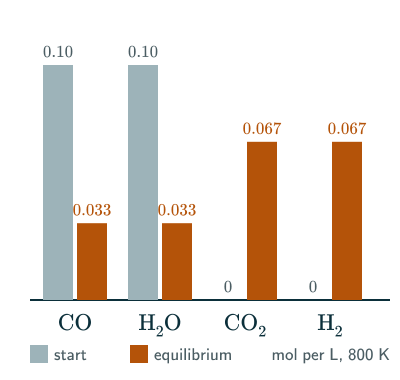
Kc = 4.24 at 800 K for CO(g) + H2O(g) ⇌ CO2(g) + H2(g). Starting with 0.10 M each of CO and H2O only, find the equilibrium concentrations.
If x M each of CO2 and H2 form, CO and H2O fall to (0.10 − x) M, so x2/(0.10 − x)2 = 4.24. The left side is a perfect square, so take the positive square root of both sides: x/(0.10 − x) = 2.059, giving x = 0.2059/3.059 = 0.067. (NCERT expands this into the quadratic 3.24x2 − 0.848x + 0.0424 = 0, whose roots are 0.067 and 0.194; 0.194 is rejected because it is more than the 0.10 M available.)
Answer: [CO2] = [H2] ≈ 0.067 M; [CO] = [H2O] ≈ 0.033 M.
Example 3: From K<sub>c</sub> to K<sub>p</sub> for NOCl (NCERT Problem 6.5, page 179)
For 2NOCl(g) ⇌ 2NO(g) + Cl2(g), Kc = 3.75 × 10⁻⁶ at 1069 K. Find Kp.
Δn = (2 + 1) − 2 = 1, so Kp = Kc(RT) = 3.75 × 10−6 × (0.0831 × 1069) = 3.75 × 10−6 × 88.8.
Answer: Kp ≈ 3.33 × 10⁻⁴ (bar). NCERT prints 0.033, which is a hundred times too large; its own working gives 3.33 × 10⁻⁴.
Example 4: From K<sub>p</sub> to K<sub>c</sub> for N<sub>2</sub>O<sub>4</sub>
Kp = 47.9 at 400 K for N2O4(g) ⇌ 2NO2(g) (NCERT Table 6.5). Find Kc.
Δn = 2 − 1 = 1, so Kc = Kp/(RT) = 47.9/(0.0831 × 400) = 47.9/33.2.
Answer: Kc ≈ 1.44 (mol L−1); Kp is larger numerically in these stated units because the conversion factor RT is about 33.2 and Δn = +1.
Common mistakes to avoid
Common mistake
Counting solids, liquids or all moles in Δn
Δn counts gaseous moles only: gaseous products minus gaseous reactants, from the balanced equation.
Common mistake
Using R = 8.314 in K<sub>p</sub> = K<sub>c</sub>(RT)<sup>Δn</sup>
With concentrations in mol L−1 and pressures in bar, R must be 0.0831 bar L mol−1 K−1. (8.314 J mol−1 K−1 goes with pascals and cubic metres.) If a problem gives pressures in atm, use R = 0.0821 L atm mol−1 K−1; Kp then comes out in atmΔn.
Common mistake
Taking the wrong root
In equilibrium problems keep only the root that gives positive concentrations no larger than what was available, as in Example 2.
Quick revision summary
- Homogeneous equilibrium: all reactants and products in one phase.
- For gases p = [gas]RT (R = 0.0831 bar L mol−1 K−1); Kp uses partial pressures in bar.
- Kp = Kc(RT)Δn; Δn = gaseous moles of products minus reactants; Δn = 0 gives Kp = Kc.
- Units: (mol L−1)Δn for Kc, barΔn for Kp; dimensionless when referred to standard states.
Formula sheet
- p = cRT = [gas]RT, R = 0.0831 bar L mol K
- Kp = Kc(RT)Δn
- Δn = (moles of gaseous products) − (moles of gaseous reactants)
Questions students ask
What is the difference between Kp and Kc?
Kc is the equilibrium constant written with molar concentrations in mol L, while Kp is written with partial pressures in bar, so only gases enter it; pure solids and liquids are left out of both. For the same ideal-gas equation at the same temperature the two are linked by Kp = Kc(RT)Δn, so Δn = 0 makes them equal independently of temperature and unit conversion. Both depend only on temperature and say the same thing about the extent of reaction; Kp is simply more convenient when pressures are what is measured.
How are Kp, Kc and Kx related?
Kx is the equilibrium constant written with mole fractions, and for ideal gases each partial pressure is the mole fraction times the total pressure, pi = xiP, the three are linked by Kp = Kc(RT)Δn = KxPΔn, with P in bar. Kp and Kc depend only on temperature, but Kx also changes with the total pressure unless Δn = 0: when Δn is negative, raising P raises Kx and the mole fractions shift towards the products, which is Le Chatelier’s principle in numbers. Kx is not in NCERT.
How is the degree of dissociation of PCl5 related to Kp?
For an ideal gas starting with pure PCl5 and no other gases, PCl5 ⇌ PCl3 + Cl2 gives Kp = αP/(1 − α), where α is the degree of dissociation and P the total pressure: one mole of PCl5 leaves (1 − α) mol of PCl5 and α mol each of PCl3 and Cl2, (1 + α) mol in all, and each partial pressure is its mole fraction times P. For example, α = 0.40 at P = 2.0 bar gives Kp = 0.16 × 2.0/0.84 ≈ 0.38 bar. When α is small, α ≈ √(Kp/P), so the dissociation falls as the pressure rises, as Le Chatelier’s principle predicts for a reaction that makes more moles of gas.
Practice questions
Try each question first, then open the answer to check your working.
-
Q1. For 2SO2(g) + O2(g) ⇌ 2SO3(g), Kp = 3.0 × 10⁴ at 700 K (NCERT Table 6.5). Find Kc.
Show answerHide answer
Δn = 2 − 3 = −1, so Kp = Kc(RT)−1 and Kc = Kp × RT = 3.0 × 104 × 0.0831 × 700, about 1.7 × 10⁶ (L mol−1).
-
Q2. Give the units of Kc and Kp for SO2(g) + ½O2(g) ⇌ SO3(g).
Show answerHide answer
Δn = 1 − 1½ = −½, so Kc is in (mol L−1)−1/2 = L1/2 mol−1/2, and Kp in bar−1/2.
-
Q3. Using Kc = 1.79 at 500 K for PCl5 ⇌ PCl3 + Cl2 (Example 1), find Kp.
Show answerHide answer
Δn = +1, so Kp = 1.79 × 0.0831 × 500 = 1.79 × 41.6, about 74 bar.