Cells in series and in parallel
NCERT Class 12 Physics Chapter 3 Section 3.11
Quick answer
A combination of cells acts like one cell of emf εeq and internal resistance req. In series, with each positive joined to the next negative, εeq = ε1 + ε2 and req = r1 + r2; a reversed cell subtracts its emf. In parallel, with positives joined, 1/req = 1/r1 + 1/r2 and εeq/req = ε1/r1 + ε2/r2, so n identical cells give the same emf with internal resistance r/n.
With your textbook
NCERT Physics Part I (Class 12), Chapter 3 “Current Electricity”, Section 3.11 “Cells in Series and in Parallel”, pages 95–97.
Open the official NCERT chapter (PDF, 2.2 MB, ncert.nic.in) (opens in a new tab)
Checked against the 2026-27 reprint on .
How do cells combine?
Cells in series and in parallel
NCERT starts from the comparison with resistors:
Like resistors, cells can be combined together in an electric circuit.
NCERT Physics Part I (Class 12), Section 3.11, page 95
For working out currents and voltages, a combination of cells can be replaced by one equivalent cell of emf εeq and internal resistance req (page 95; see emf and internal resistance). In series, the emfs and the internal resistances add; in parallel, the reciprocals of the internal resistances add (NCERT Eqs. (3.45)–(3.46) and (3.56)–(3.57), pages 95–97).
In plain words: stacking cells end to end, + to −, gives more push (more emf) but also more internal resistance. Putting them side by side, + to +, keeps the push about the same but shares the current, so the internal resistance drops.
Cells in series
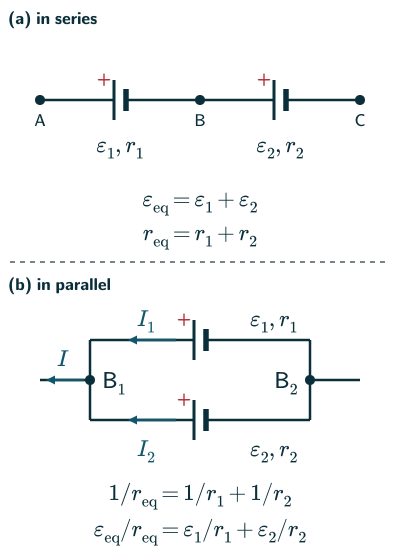
Two cells of emfs ε1, ε2 and internal resistances r1, r2 are joined with the negative terminal of the first to the positive terminal of the second, at B (NCERT page 95, Figure 3.13). With a current I:
- Across the first cell, VAB = ε1 − Ir1; across the second, VBC = ε2 − Ir2 (NCERT Eqs. (3.41)–(3.42), page 95).
- Adding, VAC = (ε1 + ε2) − I(r1 + r2) (NCERT Eq. (3.43)). Comparing with one cell, VAC = εeq − Ireq (NCERT Eq. (3.44)):
Cells in series (NCERT Eqs. 3.45–3.46)
- If instead the two negative terminals are joined, VBC = −ε2 − Ir2, and εeq = ε1 − ε2 for ε1 > ε2 (NCERT Eq. (3.47), page 96).
- The reversed cell’s internal resistance still adds, since the −Ir2 term is unchanged: req = r1 + r2. So n identical cells in series with m of them reversed give εeq = (n − 2m)ε and req = nr (reasoned from NCERT page 96).
- For n cells in series the equivalent emf is the sum of the emfs and the equivalent internal resistance the sum of the internal resistances, when the current leaves each cell from its positive electrode. A cell that the current leaves from its negative electrode enters εeq with a minus sign (page 96).
Cells in parallel
Two cells are joined with their positive terminals together at B1 and their negative terminals at B2 (NCERT page 96, Figure 3.14). I1 and I2 leave their positive electrodes:
- At B1, as much charge flows in as out (conservation of charge): I = I1 + I2 (NCERT Eq. (3.48), page 96).
- Both cells have the same terminal potential difference V: V = ε1 − I1r1 = ε2 − I2r2 (NCERT Eqs. (3.49)–(3.50)).
- So I1 = (ε1 − V)/r1 and I2 = (ε2 − V)/r2. Adding them, I = ε1/r1 + ε2/r2 − V/r1 − V/r2 (NCERT Eq. (3.51), page 96).
- Solve this for V and compare with one cell, V = εeq − Ireq (NCERT Eqs. (3.52)–(3.53)). This gives (NCERT Eqs. (3.54)–(3.55)):
Equivalent emf and internal resistance
NCERT writes the parallel results more simply (NCERT Eqs. (3.56)–(3.57), page 97):
Cells in parallel (NCERT Eqs. 3.56–3.57)
- If the negative terminal of the second cell is joined to the positive terminal of the first, the same equations hold with ε2 replaced by −ε2 (page 97).
- For n cells in parallel, 1/req = 1/r1 + … + 1/rn and εeq/req = ε1/r1 + … + εn/rn (NCERT Eqs. (3.58)–(3.59), page 97).
- Identical cells (emf ε, internal resistance r): n in series give nε and nr; n in parallel give ε and r/n (reasoned from NCERT Eqs. (3.45)–(3.46) and (3.58)–(3.59)).
- Mixed grouping: m rows in parallel, each of n identical cells in series, act as one cell of emf nε and internal resistance nr/m, so I = nε/(R + nr/m). With N = mn fixed, treating n as continuous gives the stationary optimum nr/m = R. Actual n and m must be positive integer factors of N: compare the allowed groupings, including all-series and all-parallel boundaries. For N = 6, r = 1 Ω and R = 100 Ω, all six in series give the greatest allowed current even though their 6 Ω internal resistance cannot equal R (reasoned from the same equations).
Solved examples
Example 1: Two cells in series
Two cells, each of emf 1.5 V and internal resistance 0.5 Ω, are joined in series across a 2.0 Ω resistor. Find the current.
Answer: εeq = 3.0 V and req = 1.0 Ω, so I = 3.0/(2.0 + 1.0) = 1.0 A (NCERT Eqs. (3.40), (3.45)–(3.46), pages 95–96).
Example 2: One cell the wrong way round
Cells of 6.0 V and 2.0 V, each of internal resistance 1.0 Ω, are joined in series with their negative terminals together, across a 2.0 Ω resistor. Find the current.
Answer: εeq = 6.0 − 2.0 = 4.0 V and req = 2.0 Ω, so I = 4.0/(2.0 + 2.0) = 1.0 A (NCERT Eq. (3.47), page 96).
Example 3: Two different cells in parallel
A cell of emf 2.0 V and internal resistance 1.0 Ω is joined in parallel with one of 1.5 V and 0.5 Ω, positive to positive, across a 1.0 Ω resistor. Find the equivalent cell and the current.
Answer: 1/req = 1/1.0 + 1/0.5 = 3, so req = 1/3 Ω. εeq/req = 2.0/1.0 + 1.5/0.5 = 5.0, so εeq = 5.0/3 ≈ 1.67 V. Then I = (5/3)/(1.0 + 1/3) = (5/3)/(4/3) = 1.25 A (NCERT Eqs. (3.56)–(3.57), page 97).
Example 4: Series or parallel?
Four identical cells, each of emf 1.5 V and internal resistance 2.0 Ω, are to drive a 1.0 Ω resistor. Which gives more current, all four in series or all four in parallel?
Answer: in series: I = 6.0/(1.0 + 8.0) ≈ 0.67 A. In parallel: I = 1.5/(1.0 + 0.5) = 1.0 A. In general, all in parallel wins when R < r and all in series when R > r (here R = 1.0 Ω < r = 2.0 Ω). At R = r the two are equal (reasoned from NCERT Eqs. (3.40), (3.45)–(3.46) and (3.58)–(3.59)).
Common mistakes to avoid
Common mistake
Adding emfs in parallel
In parallel, identical cells give the same emf as one cell; only the internal resistance changes, to r/n. For unlike cells use εeq/req = ε1/r1 + ε2/r2 (NCERT Eqs. (3.56)–(3.57), page 97).
Common mistake
Ignoring a reversed cell
A cell that the current leaves from its negative electrode subtracts its emf: εeq = ε1 − ε2 (NCERT Eq. (3.47), page 96).
Common mistake
Forgetting the internal resistances in series
In series the internal resistances add, req = r1 + r2, and they cut the current (NCERT Eq. (3.46), page 95).
Quick revision summary
Parallel formulas assume positive internal resistances and signed emfs referred to the same terminal orientation. A negative calculated branch current means current enters that cell’s positive terminal.
- A combination of cells acts as one cell of emf εeq and internal resistance req.
- Series (+ to −): εeq = ε1 + ε2 + …, req = r1 + r2 + …; a reversed cell’s emf enters with a minus sign, but its internal resistance still adds.
- Parallel (+ to +): 1/req = 1/r1 + 1/r2 + …, εeq/req = ε1/r1 + ε2/r2 + ….
- n identical cells: series nε and nr; parallel ε and r/n.
- External resistance below r: all in parallel gives more current; above r: all in series does; at R = r they are equal.
Formula sheet
- series: εeq = ε1 + ε2, req = r1 + r2
- reversed cell: εeq = ε1 − ε2
- parallel: 1/req = 1/r1 + 1/r2
- parallel: εeq/req = ε1/r1 + ε2/r2
- n identical: series nε, nr; parallel ε, r/n
Questions students ask
Why are cells connected in parallel, and does it give more current?
Cells are connected in parallel to lower the internal resistance and share the load, not to raise the emf: n identical cells in parallel act as one cell of emf ε and internal resistance r/n (reasoned from NCERT Eqs. (3.58)–(3.59), page 97), and each supplies only 1/n of the current, so at a fixed total current their combined internal heating is lower. With a fixed load, the total current rises, and total internal heating can increase even while efficiency improves. The current rises noticeably only when the external resistance is not much larger than r: with three 1.2 V cells of 0.30 Ω each, a 0.20 Ω load takes 2.4 A from one cell but 4.0 A from all three in parallel, while a 10 Ω load takes about 0.117 A and 0.119 A.
What happens when two cells of different emf are joined in parallel?
When two cells of different emf are joined in parallel, positive to positive, a current circulates round them even with no load, out of the higher-emf cell and into the other, in the charging direction (this does not mean a primary cell is rechargeable), with I = (ε1 − ε2)/(r1 + r2) (beyond the NCERT text, reasoned from NCERT Eqs. (3.48)–(3.50), page 96). For cells of 2.1 V, 0.35 Ω and 1.9 V, 0.15 Ω this is 0.20/0.50 = 0.40 A, and both terminals sit at 2.1 − 0.40 × 0.35 = 1.96 V, the εeq of NCERT Eq. (3.57). The circulating current wastes energy in both cells all the time, and equal emfs remove this circulating current in the ideal model.
Does adding another cell in series always increase the current?
No, adding a cell in series does not always raise the current, because the cell adds its internal resistance as well as its emf (NCERT Eqs. (3.45)–(3.46), page 95): beyond the NCERT text, reasoned from those equations, the current rises only if the new cell’s own short-circuit current, ε/r, is larger than the current already flowing. Two 1.5 V cells of 0.25 Ω drive 3.0/(4.5 + 0.50) = 0.60 A through a 4.5 Ω bulb, but adding a cell of 1.3 V and 6.0 Ω, whose ε/r is only about 0.22 A, cuts the current to 4.3/11.0 ≈ 0.39 A. So a cell with a high internal resistance should not be added to a series chain of good ones.
Is mixed grouping of cells in the JEE Main and NEET syllabus?
Mixed grouping of cells is not named in either syllabus, but it is covered by what they name: the JEE Main syllabus and the NEET (UG) 2026 syllabus both list “a combination of cells in series and parallel” in Unit 12, and a mixed grouping, rows of cells in series that are then joined in parallel, needs only the two NCERT rules applied one after the other (NCERT Eqs. (3.45)–(3.46) and (3.58)–(3.59), pages 95–97). NCERT Class 12 Physics Part I does not work an example of it; this page gives the result and the condition for the largest current (see mixed grouping).
Practice questions
Try each question first, then open the answer to check your working.
-
Q1. Three cells, each of emf 2.0 V and internal resistance 0.20 Ω, are in series. Find the equivalent emf and internal resistance.
Show answerHide answer
εeq = 6.0 V and req = 0.60 Ω (NCERT Eqs. (3.45)–(3.46), page 95).
-
Q2. Two identical cells of emf 1.5 V and internal resistance 1.0 Ω are joined in parallel. Find the equivalent cell.
Show answerHide answer
εeq = 1.5 V and req = 0.50 Ω (NCERT Eqs. (3.56)–(3.57), page 97).
-
Q3. What does it mean for a cell to enter εeq with a minus sign?
Show answerHide answer
The current leaves that cell from its negative electrode, as when two negative terminals are joined in series (NCERT page 96).