Basic properties of electric charge
NCERT Class 12 Physics Chapter 1 Section 1.4
Quick answer
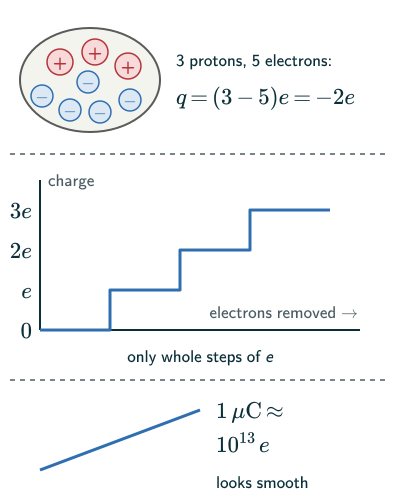
Electric charge is additive, conserved and quantised. The total charge of a system is the algebraic sum of its charges, and the total charge of an isolated system never changes, although charged particles can be created or destroyed, as when a neutron decays into a proton, an electron and a neutral antineutrino. Every free charge is a whole-number multiple of e, q = ne, where e = 1.6 × 10 C is the charge of a proton; the steps are so small that everyday charges look continuous.
With your textbook
NCERT Physics Part I (Class 12), Chapter 1 “Electric Charges and Fields”, Section 1.4 “Basic Properties of Electric Charge”, pages 4–6.
Open the official NCERT chapter (PDF, 4.0 MB, ncert.nic.in) (opens in a new tab)
Checked against the 2026-27 reprint on .
What are the basic properties of electric charge?
Basic properties of charge
Electric charge has three basic properties (NCERT Section 1.4, pages 4–6):
- Additivity: charges add up like real numbers, with their signs.
- Conservation: the total charge of an isolated system never changes.
- Quantisation: every free charge is a whole-number multiple of a basic unit, e.
NCERT states the last one as a definition:
The fact that electric charge is always an integral multiple of e is termed as quantisation of charge.
NCERT Physics Part I (Class 12), Section 1.4.3, page 5
In plain words: charge behaves like money in a closed room. You can add up what everyone holds, plus and minus. Money can change hands but the total in the room stays the same. And it only comes in whole coins: you can have 3 coins or 4, never 3.5. For charge the “coin” is e, so tiny that everyday amounts look smooth.
NCERT first introduces the point charge: when the sizes of charged bodies are very small compared with the distances between them, all the charge of each body is taken to be at one point (page 4).
Additivity of charges
- The total charge of a system is the algebraic sum of its charges: for charges q1, q2, …, qn it is q1 + q2 + … + qn (NCERT Section 1.4.1, page 4).
- Charge is a scalar: it has magnitude but no direction, like mass (page 4).
- One difference from mass: mass is always positive, but charge can be positive or negative, so the signs must be kept when adding. NCERT’s example: charges +1, +2, −3, +4 and −5, in some unit, total (+1) + (+2) + (−3) + (+4) + (−5) = −1 in the same unit (page 4).
Total charge of a system
Charge is conserved
- When bodies are charged by rubbing, electrons move from one body to the other; no new charges are created or destroyed. What one body gains, the other loses (NCERT Section 1.4.2, page 4).
- Within an isolated system, charges may be redistributed, but the total charge is always conserved. This has been established experimentally (page 4).
- The net charge of an isolated system cannot be created or destroyed, although charge-carrying particles can be. NCERT’s example: a neutron turns into a proton and an electron, which carry equal and opposite charges, so the total is zero before and after. The complete decay also emits an electrically neutral antineutrino (NCERT Chapter 13, Section 13.2); its omission here does not change the charge accounting (pages 4–5).
Quantisation of charge
Quantisation of charge (NCERT page 5)
Here n is any integer, positive or negative, and e is the charge carried by an electron or a proton: by convention the electron carries −e and the proton +e (NCERT Section 1.4.3, page 5).
- History: quantisation was first suggested by Faraday’s experimental laws of electrolysis and was demonstrated experimentally by Millikan in 1912 (page 5; NCERT Chemistry (Class 11) dates the oil-drop experiment 1906–14: see Millikan’s oil-drop experiment).
- Unit: the SI unit of charge is the coulomb (C), defined through the ampere: 1 C is the charge flowing through a wire in 1 s when the current is 1 A (page 5).
- Value of e: NCERT gives e = 1.602192 × 10⁻¹⁹ C (page 5). Since 2019 the SI fixes it exactly: beyond the NCERT text, e = 1.602 176 634 × 10−19 C exactly (US National Institute of Standards and Technology, CODATA values). For problems, use 1.6 × 10⁻¹⁹ C, as NCERT does in its examples (page 6).
- Why the steps are invisible: a body with n2 protons and n1 electrons has charge (n2 − n1)e, always a whole number of e. But e is tiny: there are about 6 × 10¹⁸ electrons in −1 C, and a charge of 1 µC contains something like 1013 electronic charges. At this macroscopic scale charge looks continuous and quantisation can be ignored (see continuous charge distributions); at the microscopic level, with a few tens or hundreds of e, it cannot (pages 5–6).
- Smaller units: 1 µC (microcoulomb) = 10−6 C and 1 mC (millicoulomb) = 10−3 C (page 5).
Solved examples
Example 1: How long to collect 1 C? (NCERT Example 1.1)
If 109 electrons move out of a body every second, how long does it take to collect a total charge of 1 C?
Answer: charge moved per second:
Time for 1 C:
Dividing by 365 × 24 × 3600 s per year gives about 198 years, roughly 200 years, so 1 coulomb is a very large unit for many practical purposes (NCERT page 6).
Example 2: Charge in a cup of water (NCERT Example 1.2)
How much positive and negative charge is there in a cup of water of mass 250 g?
Answer: one mole of water (6.02 × 10²³ molecules) has a mass of 18 g, so the cup holds (250/18) × 6.02 × 1023 molecules. That is
Each molecule has 10 electrons and 10 protons, so the total positive charge equals the total negative charge in size:
The two balance, so the water is neutral (NCERT page 6).
Example 3: Is this charge possible?
Can a body carry a charge of 2.4 × 10⁻¹⁹ C? Take e = 1.6 × 10⁻¹⁹ C.
Answer: n = q/e = 2.4/1.6 = 1.5. This is not an integer, so a free charge of this size is not possible (NCERT page 5).
Example 4: Touching two spheres
Two identical isolated metal spheres, with no nearby external charges, carry +6 µC and −2 µC. They are touched together and separated. What is the charge on each?
Answer: the total, (+6) + (−2) = +4 µC, is conserved (NCERT pages 4–5). By symmetry, identical spheres share it equally, as in Coulomb’s method of halving charges (NCERT page 7), so each carries +2 µC.
Common mistakes to avoid
Common mistake
Adding charges without signs
Charge is a scalar but can be negative; total charge is the algebraic sum, so +4 µC and −4 µC give zero (NCERT page 4).
Common mistake
Thinking conservation forbids creating charged particles
Charged particles can be created or destroyed; it is the net charge of an isolated system that cannot change. A neutron becomes a proton, an electron and a neutral antineutrino, with zero total charge before and after (NCERT pages 4–5).
Common mistake
Using quantisation for everyday charges
At the macroscopic level, quantisation has no practical consequence: a microcoulomb holds something like 1013 electronic charges (NCERT page 6).
Quick revision summary
- Point charge: a charged body much smaller than the distances involved.
- Additivity: total charge is the algebraic sum; charge is a scalar that can be positive or negative.
- Conservation: the total charge of an isolated system never changes; charged particles may be created or destroyed, but only with no change in the net charge.
- Quantisation: q = ne, with e the charge of a proton (+e) or electron (−e); suggested by Faraday’s laws of electrolysis, shown by Millikan in 1912.
- e = 1.6 × 10 C (NCERT prints 1.602192 × 10 C; the SI value is fixed at exactly 1.602 176 634 × 10 C). About 6 × 10 electrons make −1 C.
Formula sheet
- Q = q + q + … + q (with signs)
- q = ne, n an integer
- e = 1.6 × 10 C
- 1 C ≈ 6.25 × 10 e
- 1 µC = 10 C; 1 mC = 10 C
Questions students ask
What is the difference between electric charge and mass?
Electric charge and mass are both scalars; in the elementary non-relativistic description their amounts add like ordinary numbers, but charge can be positive or negative while mass is always positive, so charges must be added with their signs (NCERT page 4). Because of the two signs, electric forces can attract or repel and can cancel each other, while gravitational forces between masses only attract (NCERT pages 40–41). Charge is also quantised, in whole steps of e, and NCERT notes that there is no similar law of quantisation for mass (page 41).
Why is electric charge quantised?
No one knows why electric charge is quantised: NCERT calls the quantisation of charge a basic, unexplained law of nature, established by experiment (NCERT pages 5 and 41), and says again in Chapter 5 that we do not know why charge is quantised (page 151). Beyond the NCERT text, Dirac showed in 1931 that, in quantum mechanics, even one magnetic monopole anywhere would force electric charge to be quantised (Paul Dirac, Proceedings of the Royal Society A, volume 133, 1931). Fundamental magnetic monopoles have not been experimentally established; searches continue. NCERT’s Chapter 5 uses the no-monopole description of observed magnetism (page 151). This is not an experimental proof that monopoles are impossible, so Dirac’s link does not settle the question.
Do quarks, with charges of 2e/3 and −e/3, break the quantisation of charge?
Quarks do not break the quantisation of charge as NCERT states it, because the rule is about free charges: every free charge is a whole-number multiple of e (NCERT page 5). Beyond the NCERT text, quarks do carry fractions of e, +2e/3 for the up quark and −e/3 for the down quark, but the strong force keeps them bound inside particles such as protons and neutrons, and they are never found alone (Lawrence Berkeley National Laboratory, Research Review, Fall 1997; US Department of Energy, “DOE Explains…Quarks and Gluons”). A proton, two up quarks and a down quark, has a charge of 2e/3 + 2e/3 − e/3 = +e, so free particles still carry whole numbers of e.
What is the difference between conservation and invariance of charge?
Conservation of charge means that the total charge of an isolated system does not change with time in a given frame of reference, while invariance of charge means that a body’s charge has the same value in frames of reference moving relative to each other (NCERT page 41). NCERT stresses that these are independent properties (page 41). Beyond the NCERT text, momentum shows why: an isolated system’s total momentum is conserved in any one inertial frame, yet its value differs between frames in relative motion (reasoned from NCERT Class 11 Physics, Chapter 4; see conservation of momentum). Charge is both conserved and invariant.
Practice questions
Try each question first, then open the answer to check your working.
-
Q1. Find the total charge of a system of charges +3 µC, −7 µC and +2 µC.
Show answerHide answer
(+3) + (−7) + (+2) = −2 µC (NCERT page 4).
-
Q2. How many electrons must be removed from a neutral body to give it a charge of +1.6 µC? Take e = 1.6 × 10 C.
Show answerHide answer
n = (1.6 × 10⁻⁶)/(1.6 × 10−19) = 1.0 × 10¹³ electrons (NCERT page 5).
-
Q3. Who first demonstrated the quantisation of charge experimentally, and when?
Show answerHide answer
Millikan, in 1912 (NCERT page 5).