Forces between multiple charges
NCERT Class 12 Physics Chapter 1 Section 1.6
Quick answer
The principle of superposition says that the force on a charge due to several other charges is the vector sum of the forces due to each of them, taken one at a time, each given by Coulomb’s law as if the others were absent. So F = F + F + … + F, added by the parallelogram law. Together with Coulomb’s law, superposition is the basis of all of electrostatics.
With your textbook
NCERT Physics Part I (Class 12), Chapter 1 “Electric Charges and Fields”, Section 1.6 “Forces between Multiple Charges”, pages 11–14.
Open the official NCERT chapter (PDF, 4.0 MB, ncert.nic.in) (opens in a new tab)
Checked against the 2026-27 reprint on .
How do you find the force due to many charges?
Principle of superposition
Coulomb’s law gives the force between two charges. When a charge has several others around it, NCERT states what happens:
Experimentally, it is verified that force on any charge due to a number of other charges is the vector sum of all the forces on that charge due to the other charges, taken one at a time.
NCERT Physics Part I (Class 12), Section 1.6, page 11
Each of these forces is unaffected by the presence of the other charges. This is the principle of superposition (page 11).
In plain words: to find the force on one charge, take the other charges one at a time. Work out each force with Coulomb’s law as if that charge were alone, draw it as an arrow, and add the arrows tip to tail. For fixed point-charge values and positions, the other charges do not change a pair force; they add forces of their own. If charges can move or redistribute on conductors, first determine the new arrangement.
Principle of superposition
- Coulomb’s law alone cannot tell us the force on q1 due to q2, q3, …, qn together. Forces of mechanical origin add by the parallelogram law, and experiment shows that electrostatic forces do the same (NCERT page 11).
- The force on q1 due to q2 is the same as given by Coulomb’s law, unaffected by the other charges q3, q4, …, qn (page 12).
- The vector sum is found as usual, by the parallelogram law of vector addition (page 12).
- NCERT’s conclusion: all of electrostatics is basically a consequence of Coulomb’s law and the superposition principle (page 12).
Force on one charge due to many
For three charges, the total force on q1 is the sum of the two Coulomb forces on it (NCERT Eq. (1.4), pages 11–12):
Force on q due to q and q (NCERT Eq. 1.4)
Here k = 1/4πε0, as in Coulomb’s law, and r̂12 is the unit vector from q2 to q1; F13 has the same form with 3 in place of 2. For n charges, the sum runs over all the others, F1 = F12 + F13 + … + F1n (NCERT Eq. (1.5), page 12):
Superposition for n charges (NCERT Eq. 1.5)
Two equal forces. Many problems add two forces of the same size F with an angle θ between them. By the parallelogram law their sum has size 2F cos(θ/2), along the bisector when the resultant is nonzero (take 0 ≤ θ ≤ 180°): F when θ = 120°, √3 F when θ = 60°, and zero when θ = 180°.
Forces on three charges add to zero
NCERT Example 1.6 (worked below as Example 2) ends with the forces on three charges adding to zero, F1 + F2 + F3 = 0, and says this follows from Coulomb’s law being consistent with Newton’s third law, leaving the proof as an exercise (page 14). The proof:
- Write each total as its two parts: F1 = F12 + F13, F2 = F21 + F23, F3 = F31 + F32.
- Regroup the six forces in pairs: (F12 + F21) + (F13 + F31) + (F23 + F32).
- Each pair is zero, because F12 = −F21 and so on (NCERT page 9). So the sum is zero, for any three charges in any positions.
Solved examples
Example 1: A charge at the centroid (NCERT Example 1.5)
Charges q1, q2, q3, each equal to q, are at the vertices A, B, C of an equilateral triangle of side l. What is the force on a charge Q, of the same sign as q, at the centroid O?
Answer: the perpendicular AD to BC has AD = AC cos 30° = (√3/2)l, and the centroid is two-thirds of the way down it:
By symmetry AO = BO = CO, so each charge pushes Q away from itself with a force of the same size:
The three forces point along AO, BO and CO, at 120° to one another. The forces from B and C add to a force of the same size F along OA, by the parallelogram law, which cancels the force from A. The total force on Q is zero (NCERT pages 12–13).
NCERT adds a symmetry argument: a turn about O that leaves the charges looking the same cannot change the force on Q, yet it would turn any non-zero force to a new direction, so the force must be zero. NCERT says to turn the system through 60° (page 13), but a 60° turn does not bring the triangle back onto itself; the turn that does is 120°. (NCERT’s solution also spells symmetry as “symmatry”, page 12.)
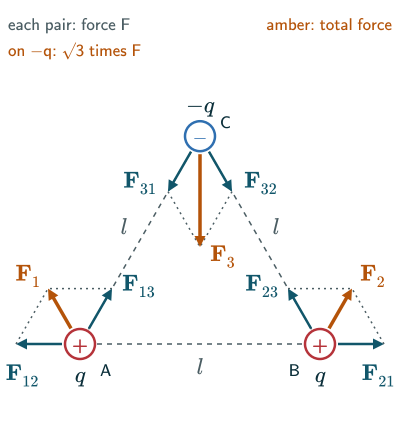
Example 2: Charges q, q and −q (NCERT Example 1.6)
Charges q, q and −q are at the vertices A, B and C of an equilateral triangle of side l. What is the force on each charge?
Answer: each pair is a distance l apart, so every pair force, attraction or repulsion, has the same size (NCERT page 13):
- On q at A: F12 along BA (pushed away by B) and F13 along AC (pulled towards C). These are at 120°, so F1 has size F, along BC.
- On q at B: by the same reasoning, F2 has size F, along AC.
- On −q at C: both forces pull towards A and B, at 60° to each other, so F3 has size √3 F, along the bisector of angle BCA.
The three totals add to zero, F1 + F2 + F3 = 0, as the third law requires (NCERT pages 13–14).
Example 3: Where is the force zero?
A charge +q is at x = 0 and +4q at x = d. Where on the line between them does a nonzero third charge feel no force? Assume q > 0 and d > 0.
Answer: between two like charges, the two forces on the third charge point opposite ways. At a distance x from +q they balance when
So (d − x)2 = 4x2, d − x = 2x, and x = d/3: one-third of the way from the smaller charge. The size and sign of a nonzero third charge do not matter, because they cancel; a zero test charge feels no force everywhere (NCERT Eq. (1.5), page 12).
If the third charge Q must also keep +q and +4q in place, it must be negative. Zero force on +q needs k|Q|q/(d/3)2 = 4kq2/d2, so Q = −4q/9 at x = d/3, and the forces on +4q then balance too.
Example 4: Forces at right angles
A charge of +1 µC is at the origin. Charges of +2 µC sit at (0.3 m, 0) and at (0, 0.3 m). Find the total force on the +1 µC charge.
Answer: each of the two charges is 0.3 m away, and kq1q2 = 9 × 109 × 2 × 10−12 = 1.8 × 10⁻² N m2. So each force has size
Both repel, so one force points along −x and the other along −y. At right angles, they add to √2 × 0.2 ≈ 0.28 N, directed midway between the −x and −y directions (NCERT page 12, the parallelogram law).
Common mistakes to avoid
Common mistake
Adding the sizes of forces
Forces from several charges add as vectors, by the parallelogram law, not as plain numbers (NCERT page 12). Two 1 N forces at 120° give 1 N, not 2 N.
Common mistake
Thinking other charges change a pair’s force
The force on q due to q is what Coulomb’s law gives for that pair, whatever other charges are present (NCERT pages 11–12).
Common mistake
Looking for the zero-force point in the wrong place
Between two like charges, the point lies between them, nearer the smaller charge. For two unlike charges it lies outside them, beyond the smaller charge. Outside the pair the two forces point opposite ways on either side, but only near the smaller charge can its force match that of the larger, farther charge. Two equal unlike charges have no such point.
Quick revision summary
- Principle of superposition: the force on a charge due to several charges is the vector sum of the forces due to each, taken one at a time; each force is unaffected by the other charges.
- F = F + F + … + F, each term given by Coulomb’s law, added by the parallelogram law.
- All of electrostatics is basically a consequence of Coulomb’s law and the superposition principle.
- Two equal forces F at an angle θ add to 2F cos(θ/2): F at 120°, √3 F at 60°.
- Equal charges at the corners of an equilateral triangle exert no net force on a charge at the centroid; for q, q and −q, the totals are F, F and √3 F, and they add to zero.
Formula sheet
- F = F + F + … + F
- F = (q/4πε) Σ (q/r) r̂, i = 2 to n
- F = (1/4πε)(qq/r) r̂
- two equal forces F at angle θ: 2F cos(θ/2)
- three charges: F + F + F = 0
Questions students ask
Can the superposition principle be proved, or is it just vector addition?
The superposition principle cannot be proved from Coulomb’s law: it is a separate fact of nature, verified by experiment (NCERT page 11). NCERT warns that it should not be taken as obvious or equated with the law of vector addition, because it says two things: the force between two charges is unaffected by other charges nearby, and there are no extra three-body or four-body forces that appear only when more than two charges are present (NCERT page 41). Vector addition is then just the way the separate pair forces are combined.
Does the superposition principle also apply to gravitational forces?
Yes, the superposition principle holds for gravitational forces too: the total gravitational force on a mass is the vector sum of the forces from each of the other masses, each found from Newton’s law as if the rest were absent. The Class 11 page on the law of gravitation applies it to three equal masses at the corners of a triangle, NCERT Class 11 Physics, Chapter 7, Example 7.2 (see gravitation and superposition); the method is the same as for charges in NCERT Example 1.5, and only the force law differs.
Which NCERT chapter and exam syllabus unit cover the superposition principle?
The superposition principle for electric forces is in NCERT Class 12 Physics Part I, Chapter 1, Section 1.6, Forces between Multiple Charges (pages 11–14), and NCERT uses it again for electric fields in Section 1.7.1. The JEE Main syllabus has it in Unit 11, Electrostatics: “Electric charges: conservation of charge, Coulomb’s law forces between two point charges, forces between multiple charges, superposition principle and continuous charge distribution.” The NEET (UG) 2026 syllabus lists the same topics in its Unit 11; the superposition of waves, a Class 11 topic, is in Unit 10 of both (see superposition of waves).
Is the zero-force point between two like charges a point of stable equilibrium?
Reasoning from Coulomb’s law and superposition (beyond the NCERT text), the zero-force point between two like charges is not a point of stable equilibrium in every direction: a third charge of the same sign is stable along the line joining them but unstable sideways. Pushed towards either charge, a like third charge is repelled more strongly by the nearer one and is driven back; moved sideways, off the line, it feels two repulsions that both have parts pointing away from the line, so it moves farther off. A third charge of the opposite sign does the reverse: it is unstable along the line and pulled back towards it from the side.
What is the force on a charge at the centre of a regular polygon of equal charges if one charge is removed?
With equal charges q at all the corners of a regular polygon, the net force on a charge Q at the centre is zero by symmetry, as NCERT shows for a triangle in Example 1.5 (NCERT pages 12–13). Remove one corner charge and, by superposition, the charges left exert a force equal and opposite to the one the removed charge used to exert, with magnitude k|Qq|/a, where a is the distance from the centre to a corner. For Q and q of the same sign it points towards the empty corner, since the missing charge no longer pushes Q away from it.
Practice questions
Try each question first, then open the answer to check your working.
-
Q1. A charge feels a force of 3 N from one charge and 4 N from another, at right angles to each other. What is the total force?
Show answerHide answer
√(32 + 42) = 5 N, by the parallelogram law (NCERT page 12).
-
Q2. State the principle of superposition for electrostatic forces.
Show answerHide answer
The force on any charge due to a number of other charges is the vector sum of the forces due to each of them, taken one at a time; each force is unaffected by the other charges (NCERT page 11).
-
Q3. Charges +q and +9q are at x = 0 and x = 0.4 m. Where between them does a third charge feel no force?
Show answerHide answer
1/x = 9/(0.4 − x), so 0.4 − x = 3x and x = 0.1 m from the +q charge (NCERT Eq. (1.5), page 12).