Electric dipole
NCERT Class 12 Physics Chapter 1 Section 1.10
Quick answer
An electric dipole is a pair of equal and opposite charges q and −q a distance 2a apart; its dipole moment is p = q × 2a, directed from −q to q. Far from the dipole (r ≫ a), its field is E = 2p/(4πεr) along p on the axis and E = p/(4πεr) opposite to p on the equatorial plane. The field falls as 1/r, faster than the 1/r field of a single charge, because the fields of the two charges nearly cancel.
With your textbook
NCERT Physics Part I (Class 12), Chapter 1 “Electric Charges and Fields”, Section 1.10 “Electric Dipole”, pages 23–27.
Open the official NCERT chapter (PDF, 4.0 MB, ncert.nic.in) (opens in a new tab)
Checked against the 2026-27 reprint on .
What is an electric dipole?
Electric dipole
An electric dipole is a pair of equal and opposite point charges q and –q, separated by a distance 2a.
NCERT Physics Part I (Class 12), Section 1.10, page 23
By convention, the direction of the dipole is from −q to q, and the midpoint of the two charges is the centre of the dipole (page 23). Its dipole moment is (NCERT Eq. (1.19), page 24):
In plain words: a dipole has no net charge, but its plus and minus are not in the same place. Close to it you feel both charges separately. Far away their fields almost cancel, and what is left falls off faster than the field of a single charge.
Dipole moment p = q × 2a
- The total charge of a dipole is zero, but its field is not zero: the two charges are apart, so their fields do not cancel exactly (NCERT page 23).
- Dipole moment: a vector of magnitude q × 2a, the charge times the separation, directed along the line from −q to q (NCERT Eq. (1.19), page 24). Its SI unit is C m (NCERT Example 1.9, page 26).
- Why this quantity? At large distances the dipole’s field depends on q and a only through the product qa, which suggests defining p (page 24).
- Point dipole: let the size 2a shrink to zero while q grows so that p = q × 2a stays finite. For such a dipole the far-field formulas below are exact for every r > 0 (page 25); the ideal point-dipole field is singular at r = 0.
- Chemistry draws bond dipoles the other way round, with a crossed arrow from the positive to the negative end: see polarity of bonds and dipole moment. In physics, p points from −q to q.
The field of an electric dipole
NCERT finds the field from Coulomb’s law and superposition at two kinds of points (Section 1.10.1, pages 23–24). Below, r is the distance from the centre of the dipole, k = 1/4πε0, and p̂ is the unit vector from −q to q.
On the axis, at P outside the pair on the side of +q, with r > a and q > 0 (NCERT Eqs. (1.13) and (1.14)): the nearer charge q gives a field kq/(r − a)2 along p̂, and −q gives kq/(r + a)2 towards itself, against p̂. Over a common denominator, 1/(r − a)2 − 1/(r + a)2 = 4ar/(r2 − a2)2, so the total is
along p̂, the direction of the dipole moment.
On the equatorial plane, the plane through the centre perpendicular to the axis (NCERT Eqs. (1.16) and (1.17)): both charges are √(r2 + a2) away, so their fields have equal size kq/(r2 + a2). Each field makes an angle with the axis whose cosine is a/√(r2 + a2). The parts across the axis cancel and the parts along it add:
which is
directed opposite to p̂ (page 24).
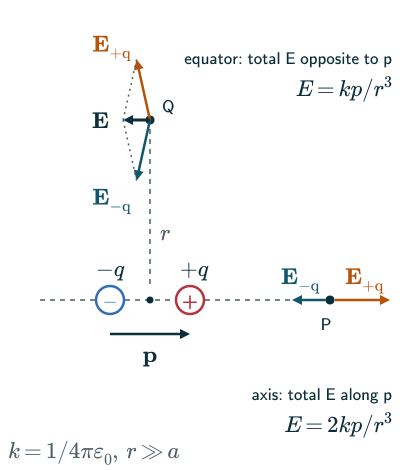
Field falls as 1/r at large distances
When r ≫ a, the a2 terms are negligible beside r2, and with p = 2qa the two results become (NCERT Eqs. (1.20) and (1.21), page 24):
Dipole field at large distances (r ≫ a)
The axial field points along p; the equatorial field points opposite to p. At the same distance, the axial field is twice the equatorial field.
- The dipole field falls off as 1/r3, not 1/r2 like the field of a single charge: far away, the fields of +q and −q nearly cancel (NCERT pages 23 and 25).
- Its size and direction depend on the distance r and also on the angle between the position vector r and p (page 25).
At any angle (for exams, beyond NCERT’s text): at distance r and angle θ from p (r ≫ a), split p into p cos θ along r and p sin θ across it. The first acts as an axial dipole and the second as an equatorial one, so
θ = 0 and θ = 90° give back the sizes in NCERT Eqs. (1.20) and (1.21).
Physical significance of dipoles
- In most molecules the centres of positive and negative charge lie at the same place, so the dipole moment is zero: carbon dioxide (CO2) and methane (CH4) are examples. Such molecules develop a dipole moment when an electric field is applied (NCERT Section 1.10.2, page 25).
- In some molecules the two centres do not coincide, so they have a permanent dipole moment even without a field. These are polar molecules; water (H2O) is one (page 25).
- The centre of a set of positive point charges is defined like a centre of mass, with charges in place of masses: rcm = Σqiri/Σqi (page 25, footnote).
Solved examples
Example 1: Field near a small dipole (NCERT Example 1.9)
Charges ±10 µC are 5.0 mm apart. Find the field (a) at P on the axis, 15 cm from the centre O on the side of the positive charge, (b) at Q, 15 cm from O on the line through O normal to the axis.
Answer: here a = 0.25 cm, and NCERT’s ε0 = 8.854 × 10⁻¹² C2 N−1 m−2 gives 1/4πε0 = 8.988 × 10⁹ N m2 C−2.
(a) P is 14.75 cm from +10 µC and 15.25 cm from −10 µC:
The first points away from the positive charge, the second towards the negative one, so the total is their difference, 2.7 × 10⁵ N C−1, along the dipole moment (NCERT page 26). Check with the far-field formula: p = (10−5 C)(5 × 10⁻³ m) = 5 × 10⁻⁸ C m, and
NCERT prints 2.6 × 10⁵ N C−1 for this step; the value is 2.66 × 10⁵, which rounds to 2.7 × 10⁵ (page 26).
(b) Q is √(152 + 0.252) cm from each charge, so each field is 3.99 × 10⁶ N C−1. Their parts along OQ cancel. Their parts parallel to the axis add, each being the field times 0.25/√(152 + 0.252) ≈ 0.25/15.0:
opposite to the dipole moment. The far-field formula p/(4πε0r3) gives the same 1.33 × 10⁵ N C−1, because r/a = 60 is large (NCERT pages 26–27).
Example 2: Charge and dipole moment of a system (NCERT Exercise 1.9)
Charges qA = 2.5 × 10⁻⁷ C and qB = −2.5 × 10⁻⁷ C are at A (0, 0, −15 cm) and B (0, 0, +15 cm). What are the total charge and the electric dipole moment?
Answer: total charge = 2.5 × 10⁻⁷ − 2.5 × 10−7 = 0. The separation is 30 cm, so
The moment points from −q to q, from B to A: along the −z direction (NCERT Eq. (1.19), page 24).
Example 3: Axis against equator
A small dipole is at the origin. Compare the field at 20 cm along its axis with the field at 20 cm along its equatorial line.
Answer: for r ≫ a, Eaxis = 2kp/r3 and Eequator = kp/r3, so the ratio is 2 : 1. The axial field points along p and the equatorial field opposite to it (NCERT Eqs. (1.20) and (1.21), page 24).
Example 4: Moving away from a dipole
The field 10 cm from a small dipole, along its axis, is 8.0 × 10⁴ N C−1. What is it 20 cm away along the same line?
Answer: E ∝ 1/r3, and doubling r divides E by 23 = 8: 1.0 × 10⁴ N C−1. A single charge’s field would only have fallen to a quarter (NCERT page 25).
Common mistakes to avoid
Common mistake
Pointing p from + to −
The dipole moment points from −q to +q (NCERT page 23). Chemistry’s crossed arrow runs the other way, from the positive to the negative end.
Common mistake
Using 1/r for a dipole’s far field
Far from a dipole the field falls as 1/r: doubling the distance divides it by 8, not 4 (NCERT page 25).
Common mistake
Giving the equatorial field the same direction as the axial field
Outside the two charges on the axis the field is along p; between the charges it is opposite to p. On the equatorial plane it is opposite to p (NCERT page 24).
Common mistake
Thinking zero net charge means zero field
A dipole’s total charge is zero, but its field is not, because the two charges are separated (NCERT page 23).
Quick revision summary
- Electric dipole: charges q and −q a distance 2a apart; total charge zero, field not zero.
- Dipole moment p = q × 2a, directed from −q to q; unit C m.
- For r ≫ a: on the axis E = 2p/(4πεr) along p; on the equatorial plane E = p/(4πεr) opposite to p.
- The dipole field falls as 1/r and depends on the angle between r and p.
- CO and CH have no permanent dipole moment; polar molecules such as HO do.
Formula sheet
- p = q × 2a, from −q to q
- axis, r ≫ a: E = 2p/(4πεr), along p
- equator, r ≫ a: E = p/(4πεr), opposite to p
- Eaxis : Eequator = 2 : 1 at the same r in the far field
- far field E ∝ 1/r
Questions students ask
Is electric dipole moment a vector, and what are its SI unit and dimensional formula?
Yes, the electric dipole moment is a vector: its size is q × 2a, the charge times the separation, and it points along the axis from −q to +q (NCERT page 24). Its SI unit is the coulomb metre, C m, and its dimensional formula is [L T A], charge [A T] times length [L] (NCERT page 40; see dimensional formulae). For molecules, chemistry usually quotes dipole moments in the debye, a non-SI unit: see polarity of bonds and dipole moment.
Why does the dipole moment point from −q to +q, when field lines run from +q to −q?
The electric dipole moment points from −q to +q by convention (NCERT page 23), a choice that makes p the sum of each charge times its position vector: with +q at r2 and −q at r1, qr2 − qr1 = q(r2 − r1), a vector from the negative to the positive charge (reasoned from NCERT Eq. (1.19), page 24). With it, the field on the axis outside the charges points along p (NCERT page 26), and in a uniform field the torque turns p towards E (page 27). Field lines run from +q to −q, but the field points exactly opposite to p only between the charges and on the equatorial plane.
What is the difference between an electric dipole and a magnetic dipole?
An electric dipole is a pair of equal and opposite charges, with moment p in C m, while a magnetic dipole is a current loop or a bar magnet, with magnetic moment m in A m (NCERT Chapter 4, page 134). Far away their fields match: NCERT’s dipole analogy turns the electric dipole’s 2p/4πε0r (axis) and p/4πε0r (equator) into a bar magnet’s by replacing p with m and 1/ε0 with μ0 (NCERT Chapter 5, Table 5.1, page 141). The sources differ: an electric dipole’s two charges can be separated, but isolated magnetic poles are not known to exist, so a bar magnet cut in two gives two smaller magnets (NCERT pages 129 and 151).
Why does a dipole’s field fall as 1/r instead of 1/r?
A dipole’s field falls as 1/r because its two charges are equal and opposite: far away their 1/r fields almost cancel, and what is left is only the small difference made by one charge being 2a nearer than the other (NCERT pages 23 and 25). Beyond the NCERT text, reasoned from Coulomb’s law: a 1/r field changes over a short distance 2a by about 4a/r times itself, so the leftover is a single charge’s field times a factor that shrinks as 1/r, one extra power of r. NCERT states the general rule: a charge configuration whose total charge is zero has a field that falls off faster than 1/r at large distances, and the dipole is the simplest example (NCERT page 41).
Is the electric field of a dipole zero at any point?
No, the electric field of an electric dipole is not zero at any point at a finite distance; it only approaches zero far away. Between the two charges both fields point the same way, from +q towards −q; on the axis outside them the fields are opposite, but the nearer charge’s field is always the stronger; and off the axis the two fields act along different lines, so they cannot cancel (reasoned from Coulomb’s law and superposition, NCERT page 23). Two equal charges of the same sign, by contrast, give zero field at their midpoint.
Practice questions
Try each question first, then open the answer to check your working.
-
Q1. Charges of ±3 nC are 2 mm apart. Find the dipole moment.
Show answerHide answer
p = q × 2a = (3 × 10⁻⁹)(2 × 10⁻³) = 6 × 10⁻¹² C m, from −q to +q (NCERT Eq. (1.19), page 24).
-
Q2. Far from a dipole, by what factor does the field fall when the distance is tripled?
Show answerHide answer
By 33 = 27, since E ∝ 1/r (NCERT page 25).
-
Q3. Name a molecule with a permanent dipole moment and one without.
Show answerHide answer
Water (H2O) has one; carbon dioxide (CO2) or methane (CH4) has none (NCERT page 25).