Conductors and insulators
NCERT Class 12 Physics Chapter 1 Section 1.3
Quick answer
Conductors contain mobile charge carriers: electrons in metals, and ions in electrolytes such as body fluids; insulators such as glass, plastic and dry wood offer high resistance. Excess charge redistributes on a conductor’s surface, while charge deposited on an insulator stays local. A metal held through a conducting path to ground loses its excess charge; insulation lets it retain charge.
With your textbook
NCERT Physics Part I (Class 12), Chapter 1 “Electric Charges and Fields”, Section 1.3 “Conductors and Insulators”, pages 3–4.
Open the official NCERT chapter (PDF, 4.0 MB, ncert.nic.in) (opens in a new tab)
Checked against the 2026-27 reprint on .
What are conductors and insulators?
Conductors and insulators
Materials differ in how readily they let charge through them. NCERT defines the first class:
Those which allow electricity to pass through them easily are called conductors.
NCERT Physics Part I (Class 12), Section 1.3, page 3
Most non-metals, such as glass, porcelain, plastic, nylon and dry wood, offer high resistance to the passage of electricity: they are insulators (page 3).
In plain words: in a metal, some electrons are mobile through the piece, so excess charge redistributes rapidly until electrostatic equilibrium is reached. In glass or plastic the electrons are held to their atoms, so charge put on one spot stays on that spot.
Free charges in conductors
- Conductors contain charges that are comparatively free to move. In metals these carriers are electrons (NCERT page 3); in electrolytes, including body fluids, positive and negative ions also carry current (NCERT Section 3.3, page 82).
- Metals, human and animal bodies and the earth are conductors (page 3).
- Insulators offer high resistance to the passage of electricity; most non-metals, such as glass, porcelain, plastic, nylon and dry wood, are insulators (page 3).
- Charge given to a conductor readily spreads over its entire surface. Charge put on an insulator stays where it is put. NCERT explains why in the next chapter (page 3).
Metals also conduct heat well; for heat, see conduction.
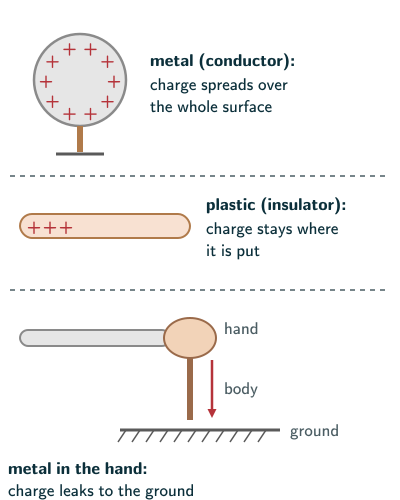
Why a metal spoon does not charge by rubbing
NCERT uses this property to explain an everyday observation (pages 3–4):
- A nylon or plastic comb becomes electrified when it is run through dry hair or rubbed, but a metal spoon held in the hand and rubbed does not.
- The charge on the metal leaks through our body to the ground, because both are conductors.
- If a metal rod with a wooden or plastic handle is rubbed without touching its metal part, it does show signs of charging: a dry insulating handle greatly reduces leakage. The hand-held-spoon example assumes a conducting path from the body to ground; insulation from ground can let a person and spoon retain charge.
Semiconductors as a third category
Most substances fall into one of the two classes. NCERT adds, in a footnote, a third category, the semiconductors, which offer a resistance to the movement of charges that is intermediate between those of conductors and insulators (page 3).
Solved examples
Example 1: Sort the materials
Classify as conductor or insulator, using NCERT’s list: copper wire, a nylon thread, the earth, a porcelain cup, a human body, a wooden ruler.
Answer: conductors: copper wire (a metal), the earth and a human body. Insulators: the nylon thread, the porcelain cup and the wooden ruler (NCERT page 3).
Example 2: The spoon that would not charge
A student rubs a steel spoon held by its metal handle and finds no charge on it. Explain, and say how she could charge it.
Answer: steel is a conductor, and so is her body, so any charge produced flows through her hand to the ground. If she holds the spoon by a wooden or plastic handle and rubs it without touching the metal, the charge cannot leak away, and the spoon shows signs of charging (NCERT pages 3–4).
Example 3: Where does the charge sit?
A small charge is placed at one point on (a) a metal sphere on an insulating stand, (b) a plastic sphere. Where is the charge a moment later?
Answer: (a) on the metal sphere it has spread over the entire surface, because its free electrons let charge move readily; (b) on the plastic sphere it stays at the point where it was placed (NCERT page 3).
Common mistakes to avoid
Common mistake
Thinking metals cannot be charged
A metal can hold charge; held in the hand, it simply loses the charge to the ground. On an insulating handle, a rubbed metal rod does show charging (NCERT pages 3–4).
Common mistake
Calling the human body an insulator
NCERT lists human and animal bodies, with metals and the earth, as conductors (page 3).
Common mistake
Expecting charge to spread over an insulator
Charge put on an insulator stays at the same place; only on a conductor does it spread over the whole surface (NCERT page 3).
Quick revision summary
- Conductors let electricity pass easily because mobile charge carriers can move: metals, human and animal bodies, the earth.
- Insulators offer high resistance: glass, porcelain, plastic, nylon, dry wood.
- Charge on a conductor spreads over its whole surface; charge on an insulator stays put.
- A hand-held metal rubbed does not stay charged, because the charge leaks through the body to the ground; with an insulating handle it does.
- Semiconductors are a third category, with intermediate resistance.
Formula sheet
- conductor: mobile charge carriers; excess charge redistributes on the surface
- insulator: very few mobile carriers; deposited charge stays local
- conductors: metals, human and animal bodies, earth
- insulators: glass, porcelain, plastic, nylon, dry wood
- semiconductor: resistance between the two
Questions students ask
Why does charge given to a conductor spread over its surface?
Charge given to a conductor spreads over its surface because its free electrons keep moving until the field inside the metal is zero, and in that static state no excess charge can stay inside it (NCERT page 3; the reason is given in NCERT Chapter 2, Section 2.9, page 62). The proof, from Gauss’s law, is on NCERT page 62.
Are conductors, insulators and semiconductors in the JEE Main and NEET syllabus?
Yes, conductors and insulators are in both syllabuses: the JEE Main syllabus and the NEET (UG) 2026 syllabus list “Conductors and insulators” in Unit 11, Electrostatics, together with dielectrics and capacitors. Semiconductors come later, in Unit 19, Electronic Devices, of both syllabuses, which begins with semiconductors and the semiconductor diode, the subject of NCERT Class 12 Physics Part II, Chapter 14. In NCERT Class 12 Physics Part I the topic is Section 1.3 (pages 3–4), and the electrostatics of conductors follows in Chapter 2, Section 2.9 (from page 61).
Does an electric field affect an insulator?
An electric field does act on an insulator, even though its charges do not flow freely: it stretches or turns the molecules into tiny dipoles, so the insulator, which NCERT then calls a dielectric, is polarised and the field inside it is reduced but not cancelled (NCERT Chapter 2, Section 2.10, page 65). How this works for polar and non-polar molecules is on NCERT pages 65–66, and it is also how a charged comb picks up uncharged bits of paper (see the comb and the paper).
Practice questions
Try each question first, then open the answer to check your working.
-
Q1. Name the charges that are free to move in a metal.
Show answerHide answer
Electrons (NCERT page 3). Not every conductor works this way: in electrolytic solutions, positive and negative charges both move (NCERT Section 3.3, page 82).
-
Q2. Why does a nylon comb get charged on combing dry hair while a metal spoon held in the hand does not?
Show answerHide answer
The comb is an insulator, so its charge stays on it; the spoon’s charge leaks through the body to the ground, as both are conductors (NCERT pages 3–4).
-
Q3. What is a semiconductor, according to NCERT?
Show answerHide answer
A material whose resistance to the movement of charges is intermediate between those of conductors and insulators (NCERT page 3).