Ligands, coordination number and other terms
NCERT Class 12 Chemistry Chapter 5 Section 5.2
Quick answer
A ligand binds a central atom through one or more donor atoms, and the coordination number counts the donor atoms directly attached in the ordinary complexes studied here. Denticity describes how many donor atoms a ligand uses, while homoleptic and heteroleptic describe whether one or several ligand types are present. Oxidation state is a formal charge assignment and is distinct from coordination number.
With your textbook
NCERT Chemistry Part I (Class 12), Chapter 5 “Coordination Compounds”, Section 5.2 “Definitions of Some Important Terms Pertaining to Coordination Compounds”, pages 121–122.
Open the official NCERT chapter (PDF, 3.7 MB, ncert.nic.in) (opens in a new tab)
Checked against the 2026-27 reprint on .
What are ligands and the coordination number?
Ligands and coordination number
Ligands are the ions or molecules bound to the central atom or ion of a coordination entity, and the coordination number is the number of ligand donor atoms bonded directly to the metal. In NCERT’s words:
The coordination number (CN) of a metal ion in a complex can be defined as the number of ligand donor atoms to which the metal is directly bonded.
NCERT Chemistry Part I (Class 12), Section 5.2, page 121
So in [PtCl6]2− the coordination number of platinum is 6, and in [Ni(NH3)4]2+ that of nickel is 4 (NCERT page 121).
In plain words: a complex is a metal atom or ion holding a set of partners, the ligands, which lend it electron pairs through their donor atoms; a didentate ligand such as en lends two. Count the donor atoms that actually touch the metal and you have the coordination number; the shape they make is the coordination polyhedron.
These terms build on Werner’s theory, in which the secondary valence is the coordination number (NCERT page 119).
Coordination entity and central atom
- Coordination entity: a central metal atom or ion bonded to a fixed number of ions or molecules, such as [CoCl3(NH3)3], in which cobalt is surrounded by three ammonia molecules and three chloride ions; others are [Ni(CO)4], [PtCl2(NH3)2], [Fe(CN)6]4− and [Co(NH3)6]3+ (NCERT Section 5.2, page 121).
- Central atom or ion: the one to which the ligands are bound in a definite geometrical arrangement: Ni2+ in [NiCl2(H2O)4], Co3+ in [CoCl(NH3)5]2+, Fe3+ in [Fe(CN)6]3−. NCERT also calls these central atoms and ions Lewis acids (page 121): they accept the electron pairs given by the ligands’ donor atoms, so the ligands act as Lewis bases (reasoned). A neutral atom can be the Lewis acid, as Ni(0) is in [Ni(CO)4].
Unidentate, didentate and polydentate ligands
- Ligands may be simple ions (Cl−), small molecules (H2O, NH3), larger molecules (H2NCH2CH2NH2, N(CH2CH2NH2)3) or even proteins (NCERT page 121).
- Unidentate: binds through one donor atom: Cl−, H2O, NH3.
- Didentate: binds through two donor atoms: ethane-1,2-diamine (en), H2NCH2CH2NH2, through its two N atoms; oxalate, C2O42−.
- Polydentate: several donor atoms, as in N(CH2CH2NH2)3. EDTA4− (ethylenediaminetetraacetate) is an important hexadentate ligand, usually binding through two nitrogen and four oxygen atoms (NCERT page 121).
Ambidentate ligands, denticity and chelation
- Chelate: when a di- or polydentate ligand uses two or more donor atoms at once to bind a single metal ion, it is a chelate ligand, and the complex a chelate complex. Chelate complexes tend to be more stable than similar complexes of unidentate ligands (NCERT page 121).
- Denticity: the number of ligating groups through which a ligand binds (NCERT page 121): 1 for NH3 and for either unidentate binding mode of the ambidentate examples here, 2 for en or oxalate, 4 for N(CH2CH2NH2)3 (four N atoms; reasoned) and 6 for EDTA4−.
- Ambidentate: a ligand with two different donor atoms, either of which can bind: NO2− through nitrogen or oxygen, SCN− through sulphur or nitrogen (NCERT page 121).
- Which atom binds. NCERT’s drawing on page 121 names both modes: M←NO2 (through N) is nitrito-N and M←ONO (through O) is nitrito-O; M←SCN is thiocyanato-S and M←NCS is thiocyanato-N. The donor atom is written next to the metal. In these mononuclear examples only one atom binds in either mode, so the denticity is one. The same ligand may adopt other modes, including bridging, in other compounds (reasoned). The two modes give linkage isomers, such as the yellow (–NO2) and red (–ONO) forms of [Co(NH3)5(NO2)]Cl2 (NCERT Section 5.4.3, page 127).
- NCERT slip (page 121): the ambidentate definition prints “ligetes”, a misprint for “ligates” (binds to the metal). The meaning is unaffected.
Coordination number
- Count donor atoms, not ligands. In [Fe(C2O4)3]3− and [Co(en)3]3+ the coordination number is 6, because oxalate and en are didentate (NCERT page 121).
- For the ordinary sigma-donor complexes here, count donor atoms once. The coordination number is set by the σ bonds the ligands form with the central atom; π bonds between them are not counted (NCERT page 122). So in [Ni(CO)4] each Ni–C bond has π as well as σ character (NCERT Section 5.6, page 136), yet the coordination number is 4.
Coordination sphere and coordination polyhedron
- Coordination sphere: the central atom and its ligands, written together in square brackets. The ionisable groups outside the bracket are counter ions: in K4[Fe(CN)6] the coordination sphere is [Fe(CN)6]4− and the counter ion K+ (NCERT page 122).
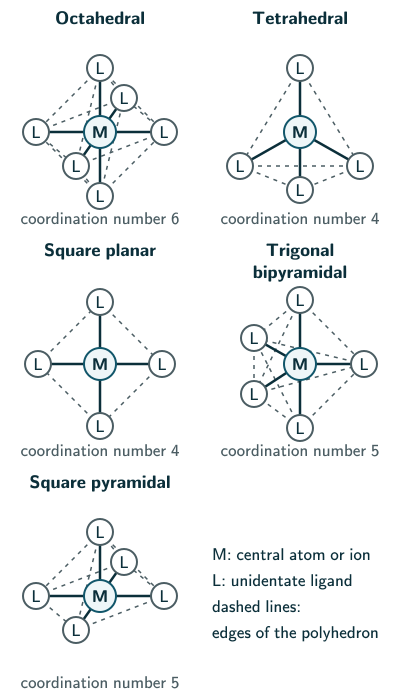
- Coordination polyhedron: the spatial arrangement of the ligand atoms attached directly to the central atom. The commonest are octahedral ([Co(NH3)6]3+), square planar ([PtCl4]2−) and tetrahedral ([Ni(CO)4]) (NCERT page 122). NCERT Fig. 5.1 (page 122) also draws two shapes for coordination number 5, trigonal bipyramidal and square pyramidal; [Fe(CO)5] is trigonal bipyramidal (NCERT Section 5.6, page 135).
Oxidation number of the central atom
- Definition: the formal charge the central atom would carry if all the ligands were removed with the electron pairs they share with it. It is written as a Roman numeral in brackets after the name: copper in [Cu(CN)4]3− is +1, written Cu(I) (NCERT page 122).
- Working it out: the charges of the ligands plus the oxidation number equal the charge on the entity. Neutral ligands (H2O, NH3, CO, en) count 0; anionic ones count their charge (Cl− −1, CN− −1, C2O42− −2) (reasoned from the rules for oxidation numbers).
Homoleptic and heteroleptic complexes
- Homoleptic: the metal is bound to only one kind of ligand, as in [Co(NH3)6]3+.
- Heteroleptic: the metal is bound to more than one kind of ligand, as in [Co(NH3)4Cl2]+ (NCERT page 122).
Solved examples
Example 1: Oxidation number and coordination number
Find the oxidation number and coordination number of the metal in K3[Fe(C2O4)3], [CoCl2(en)2]+ and [Ni(CO)4].
Answer: [Fe(C2O4)3]3−: x + 3(−2) = −3, so Fe +3; three didentate oxalates, CN 6. [CoCl2(en)2]+: x + 2(−1) + 0 = +1, so Co +3; 2 Cl + 2 × 2 N = CN 6. [Ni(CO)4]: x + 0 = 0, so Ni 0; CN 4 (reasoned from NCERT pages 121–122).
Example 2: Denticity and the coordination number
How many donor atoms bind the metal in [Co(EDTA)]− and in [CrCl2(en)2]+? Which is a chelate complex?
Answer: EDTA4− is hexadentate, so in [Co(EDTA)]− six donor atoms (2 N, 4 O) bind cobalt: CN 6. In [CrCl2(en)2]+, 2 × 2 + 2 = six: CN 6. Both are chelate complexes, since EDTA and en each bind the metal through more than one atom (NCERT page 121).
Example 3: Homoleptic or heteroleptic?
Classify K4[Fe(CN)6], [PtCl2(NH3)2] and [Co(en)3]3+.
Answer: [Fe(CN)6]4− and [Co(en)3]3+ each have one kind of ligand: homoleptic. The K+ ions of K4[Fe(CN)6] are counter ions outside the coordination sphere, so they do not count. [PtCl2(NH3)2] has two kinds: heteroleptic (NCERT page 122).
Common mistakes to avoid
Common mistake
Counting ligands instead of donor atoms
[Co(en)3]3+ has three ligands but six donor atoms: its coordination number is 6, not 3.
Common mistake
Calling a didentate ligand ambidentate
Didentate means two donor atoms binding at once (en, oxalate). Ambidentate means two possible donor atoms, of which only one binds (NO2−, SCN−).
Common mistake
Counting π bonds in the coordination number
Only the σ bonds from the ligands count; π bonds between a ligand and the metal do not.
Quick revision summary
- Coordination entity: central atom or ion plus a fixed set of ligands; the central atom is a Lewis acid, the ligands Lewis bases.
- Ligands: unidentate (Cl, HO, NH), didentate (en, CO), polydentate (EDTA, hexadentate); ambidentate (NO, SCN); chelates tend to be more stable than comparable unidentate complexes.
- Coordination number = number of donor atoms bonded to the metal (σ bonds only).
- Coordination sphere in brackets, counter ions outside; polyhedra: octahedral, square planar, tetrahedral.
- Oxidation number: the charge left on the metal when the ligands leave with their electron pairs; homoleptic (one kind of ligand) or heteroleptic.
Formula sheet
- Coordination number = number of donor atoms bonded to the metal
- Oxidation number + sum of ligand charges = charge on the entity
- Denticity: NH 1, en 2, CO 2, EDTA 6
Questions students ask
What is the difference between denticity and coordination number?
Denticity is a property of a ligand, the number of its donor atoms that bind the metal, while the coordination number is a property of the metal, the total number of donor atoms bonded to it, so the coordination number is the sum of the denticities of its ligands (reasoned from NCERT page 121). In [Ni(H2O)4(en)]2+ (NCERT page 134), en has denticity 2 and each water 1, so nickel’s coordination number is 2 + 4 × 1 = 6. A ligand’s structure sets the most donor atoms it can use, while the coordination number also depends on how many ligands the metal takes up (reasoned).
What is the difference between coordination number and oxidation number?
The coordination number counts the donor atoms bonded to the metal, while the oxidation number is the charge left on the metal when the ligands are removed with their electron pairs, so one is a count of donor atoms and the other a formal oxidation-state assignment, not the measured charge on the metal (NCERT pages 121–122). Neutral ligands raise the coordination number but add nothing to the oxidation number, so the two vary independently: in [Ag(NH3)2]+ silver has coordination number 2 and oxidation number +1, and in [Co(NO2)6]3− cobalt has 6 and +3 (reasoned). Only the oxidation number appears in the name, as a Roman numeral.
Why are chelate complexes more stable than complexes of unidentate ligands?
For many comparable complexes the chelate effect has a major entropy contribution; it is not an unconditional stability rule. In a simple particle-count picture, one en binding a metal ion in water sets two water molecules free, raising the number of free particles, while two unidentate amines taking the same two places leave that number unchanged (reasoned). Beyond the NCERT text, for cadmium(II), with four Cd–N bonds either way, log β is 10.62 with two en but 6.55 with four methylamine molecules, at 298 K approximately ΔG⊖ = −60.6 against −37.4 kJ mol, yet ΔH⊖ differs by less than 1 kJ mol, so the gap of about 23 kJ mol comes from the entropy term (Wikipedia, “Stability constants of complexes”, from Greenwood and Earnshaw). NCERT states only the effect (NCERT page 121).
Is cyanide (CN−) an ambidentate ligand?
Cyanide, CN−, can act as an ambidentate ligand, binding a metal through carbon (M–CN) or through nitrogen (M–NC), and it is one of the ligands that give linkage isomers (beyond the NCERT text; Wikipedia, “Linkage isomerism”). In practice the vast majority of transition-metal cyanide complexes are bound through carbon, while magnesium prefers the nitrogen end (Ballmann, Elsen and Harder, Angewandte Chemie International Edition, 2019, CC BY). NCERT’s examples are NO2− and SCN− (NCERT page 121), so give those in an exam; H2O and NH3 are not ambidentate, since each has only one donor atom.
Why is EDTA a hexadentate ligand?
EDTA4− is hexadentate because six of its atoms can bind one metal ion at the same time: its two amine nitrogens and one oxygen from each of its four carboxylate (–COO−) arms, the two N and four O that NCERT names (NCERT page 121). In the usual hexadentate mode each carboxylate contributes one oxygen, so the two N and four O donors close chelate rings. EDTA can also have lower denticity or other binding modes; six is its common textbook denticity, not a requirement for every complex (reasoned). Beyond the NCERT text, it usually completes an octahedron, but a metal can take more: in [Fe(EDTA)(H2O)]− iron(III) also holds a water molecule and is seven-coordinate (Wikipedia, “Ethylenediaminetetraacetic acid”).
Practice questions
Try each question first, then open the answer to check your working.
-
Q1. What is meant by unidentate, didentate and ambidentate ligands? Give two examples of each. (NCERT Exercise 5.4.)
Show answerHide answer
Unidentate: one donor atom, e.g. Cl−, NH3. Didentate: two donor atoms bind the metal at once, e.g. ethane-1,2-diamine, oxalate. Ambidentate: two different possible donor atoms, either of which binds, e.g. NO2− (N or O), SCN− (S or N) (NCERT page 121).
-
Q2. Specify the oxidation number of the metal in [CoBr2(en)2]+, [PtCl4]2− and K3[Fe(CN)6]. (Part of NCERT Exercise 5.5.)
Show answerHide answer
[CoBr2(en)2]+: x − 2 = +1, +3. [PtCl4]2−: x − 4 = −2, +2. [Fe(CN)6]3−: x − 6 = −3, +3 (reasoned).
-
Q3. Why is the coordination number of iron in [Fe(C2O4)3]3− 6 and not 3?
Show answerHide answer
Each oxalate ion is didentate and binds iron through two oxygen atoms, so three oxalates give six donor atoms (NCERT page 121).