Isomerism in coordination compounds
NCERT Class 12 Chemistry Chapter 5 Section 5.4
Quick answer
Coordination compounds can have the same composition but different bonding or spatial arrangements. Structural isomerism includes linkage, coordination, ionisation and solvate forms, while stereoisomerism includes geometrical forms and enantiomers. A chiral entity has a nonsuperimposable mirror image, but an equal mixture of enantiomers has no net optical rotation.
With your textbook
NCERT Chemistry Part I (Class 12), Chapter 5 “Coordination Compounds”, Section 5.4 “Isomerism in Coordination Compounds”, pages 125–128.
Open the official NCERT chapter (PDF, 3.7 MB, ncert.nic.in) (opens in a new tab)
Checked against the 2026-27 reprint on .
What is isomerism in coordination compounds?
Isomerism in coordination compounds
Coordination compounds of one formula can often exist in more than one form, and the forms differ in one or more physical or chemical properties (NCERT Section 5.4, page 125). NCERT defines isomers as follows:
Isomers are two or more compounds that have the same chemical formula but a different arrangement of atoms.
NCERT Chemistry Part I (Class 12), Section 5.4, page 125
In plain words: keep the same atoms but change either which atom is bonded to the metal, or only where the bonded groups sit in space, and you get a different compound. The first kind is structural isomerism, the second stereoisomerism.
Stereoisomerism and structural isomerism
NCERT divides the isomerism of coordination compounds into two principal types, each with subtypes (NCERT page 125; NCERT Exercise 5.8 asks for this list):
| Type | Subtypes |
|---|---|
| Stereoisomerism | geometrical, optical |
| Structural isomerism | linkage, coordination, ionisation, solvate |
- Stereoisomers have the same chemical formula and the same chemical bonds, but a different spatial arrangement (NCERT page 125).
- Structural isomers have different bonds (NCERT page 125).
Geometric isomerism
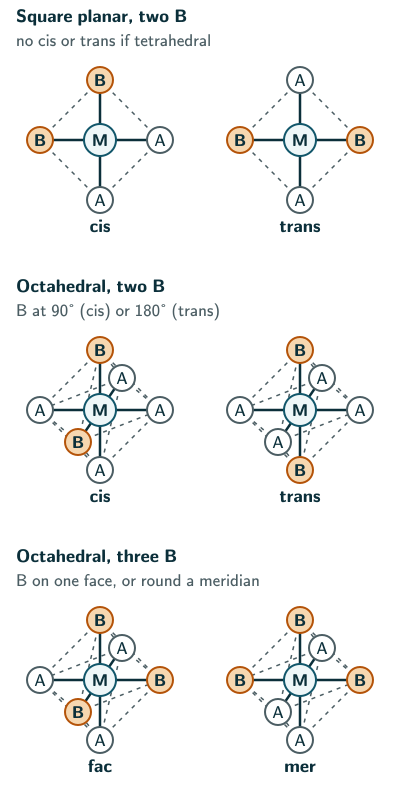
For the idealised ligand arrangements considered here, geometrical isomerism arises in heteroleptic complexes because the ligands can take up different geometric arrangements; important examples come with coordination numbers 4 and 6 (NCERT Section 5.4.1, page 125).
- Square planar [MX2L2] (X and L unidentate): the two X are side by side in the cis isomer and opposite each other in the trans isomer, as in [Pt(NH3)2Cl2] (NCERT page 125, Fig. 5.2).
- Square planar [MABXL] (four different unidentate ligands) has three geometrical isomers (NCERT page 125), each fixed by which ligand sits opposite A: B, X or L (reasoned). NCERT calls them “two cis and one trans”: take any one pair, say A and B, and it is trans in one isomer and cis in the other two (reasoned). None is chiral in this idealised model (Q7).
- Simple tetrahedral complexes with unidentate ligands show no geometrical isomerism, because all four positions are adjacent to one another: the relative positions of the ligands are the same in every arrangement (NCERT Example 5.4, page 126). A tetrahedral [MABCD] has no geometrical isomers but can be chiral, like a carbon atom carrying four different groups (reasoned from NCERT Class 12 Chemistry Part II, Unit 6, page 177).
- Octahedral [MX2L4]: the two X are cis or trans, as in [Co(NH3)4Cl2]+ (NCERT page 125, Fig. 5.3). The same holds for [MX2(L–L)2] with a didentate ligand such as en, for example [CoCl2(en)2]+ (NCERT page 126, Fig. 5.4).
- Octahedral [Ma3b3], such as [Co(NH3)3(NO2)3]: if the three identical donor atoms occupy the corners of one face of the octahedron, it is the facial (fac) isomer; if they lie round a meridian, it is the meridional (mer) isomer (NCERT page 126, Fig. 5.5).
Optical isomerism
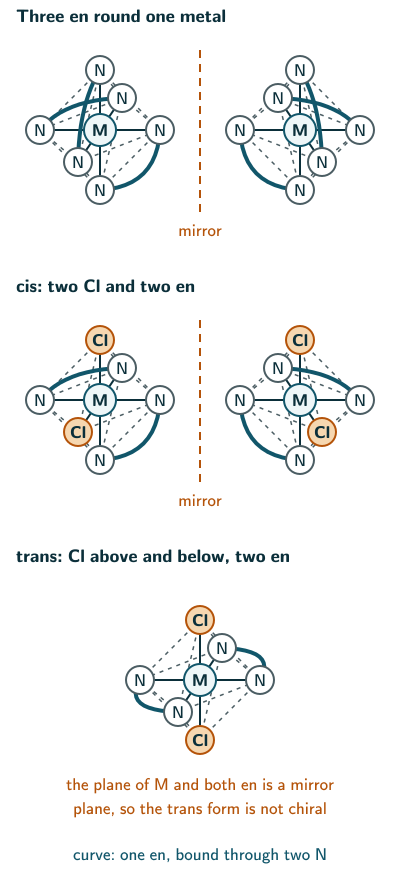
- Enantiomers. Optical isomers are mirror images that cannot be superimposed on one another; they are called enantiomers, and molecules or ions that cannot be superimposed on their mirror images are chiral (NCERT Section 5.4.2, page 126).
- d and l. An enantiomerically enriched sample may be dextro (d, +) or laevo (l, −), according to the direction in which it rotates the plane of polarised light in a polarimeter: d to the right, l to the left (NCERT page 126). An equal mixture of enantiomers is a racemate and has no net optical rotation. The measured sign is not inferred simply from the Δ or Λ configurational label.
- Where it occurs. Optical isomerism is common in octahedral complexes with didentate ligands, such as [Co(en)3]3+ (NCERT page 126, Fig. 5.6).
- Only cis is chiral. In [PtCl2(en)2]2+ only the cis isomer shows optical activity (NCERT page 126, Fig. 5.7). The trans isomer has a mirror plane through the metal and both en ligands, so it is its own mirror image (reasoned).
- The idealised square planar examples here, with achiral ligands and ligand conformations ignored, show no optical isomerism: the plane of the four ligands is itself a mirror plane (reasoned).
Linkage isomerism
- Linkage isomerism arises in a compound that contains an ambidentate ligand, which can bind through either of two atoms (NCERT Section 5.4.3, page 127).
- Thiocyanate may bind through nitrogen, M–NCS, or through sulphur, M–SCN (NCERT page 127).
- Jørgensen’s nitrite complexes. [Co(NH3)5(NO2)]Cl2 is obtained as a red form, with the nitrite bound through oxygen (–ONO), and a yellow form, bound through nitrogen (–NO2) (NCERT page 127). In names they are nitrito-O and nitrito-N.
Coordination isomerism
- When both ions of a salt are complex, the ligands can be shared out differently between the two metal ions (NCERT Section 5.4.4, page 127).
- In [Co(NH3)6][Cr(CN)6] the NH3 ligands are bound to Co3+ and the CN− ligands to Cr3+; in its coordination isomer [Cr(NH3)6][Co(CN)6] it is the other way round (NCERT page 127).
Ionisation isomerism
- Ionisation isomerism arises when the counter ion of a complex salt is itself a potential ligand: it can take the place of a ligand, which then becomes the counter ion (NCERT Section 5.4.5, page 127).
- [Co(NH3)5(SO4)]Br and [Co(NH3)5Br]SO4 are ionisation isomers (NCERT page 127). In cold, prompt tests they supply different counter ions, so they react differently: only the second gives a precipitate of BaSO4 with Ba2+, and only the first gives AgBr with Ag+ (NCERT answer to Intext Question 5.4, page 140).
- NCERT slip (page 140): Intext Question 5.4 asks about [Co(NH3)5Cl]SO4 and [Co(NH3)5(SO4)]Cl, but the printed answer works the bromide pair above. The same two tests decide the chloride pair, with AgCl in place of AgBr (Q2; reasoned). In an exam, write the tests for the pair the question names.
Solvate isomerism
- Solvate isomers differ by whether or not a solvent molecule is directly bonded to the metal ion or merely present as free solvent molecules in the crystal lattice; with water it is called hydrate isomerism, and it is similar to ionisation isomerism (NCERT Section 5.4.6, page 128). A lattice water molecule, though not bonded to the metal, may still hydrogen-bond (reasoned).
- Example: the aqua complex [Cr(H2O)6]Cl3 (violet) and its solvate isomer [Cr(H2O)5Cl]Cl2·H2O (grey-green) (NCERT page 128).
- Telling them apart. In water, [Cr(H2O)6]Cl3 releases three Cl− per formula and [Cr(H2O)5Cl]Cl2·H2O only two. In a prompt cold test with excess Ag+, one mole of each gives 3 mol and 2 mol of AgCl; the lattice water is not a ligand (reasoned).
Solved examples
Example 1: An iron complex (NCERT Example 5.5)
How many geometrical isomers does the octahedral [Fe(NH3)2(CN)4]− have?
Answer: It is of the type [MX2L4]: the two NH3 are either at 90° (cis) or at 180° (trans), so two (NCERT page 127). Oxidation state: x + 0 − 4 = −1, so iron is +3.
Example 2: Which is chiral? (NCERT Example 5.6)
Which of cis-[CrCl2(ox)2]3− and trans-[CrCl2(ox)2]3− is optically active?
Answer: The cis form is chiral (NCERT page 127). In the trans form the two Cl lie on one axis and the two oxalates in the plane between them, which is a mirror plane, so its mirror image is the same ion (reasoned). Charge check: x − 2 − 4 = −3, so chromium is +3.
Example 3: Counting stereoisomers
How many stereoisomers does [CoCl2(en)2]+ have?
Answer: Two geometrical isomers, cis and trans (NCERT Fig. 5.4, page 126). The cis isomer is chiral and exists as a d and an l form; the trans isomer is not (as for [PtCl2(en)2]2+, NCERT page 126). Total: 1 + 2 = three stereoisomers (reasoned; NCERT Exercise 5.11(i)).
Example 4: A nitrite complex (NCERT Intext Question 5.3(iii))
What isomers can [Co(NH3)5(NO2)](NO3)2 show?
Answer: Linkage: the nitrite can bind through N or O, [Co(NH3)5(NO2)]2+ and [Co(NH3)5(ONO)]2+. Ionisation: a nitrate can swap places with the nitrite, [Co(NH3)5(NO3)](NO3)(NO2). There are no geometrical isomers: with five NH3 and one other ligand, every position of the odd ligand is equivalent. Within the usual octahedral, unidentate nitrite/nitrate binding modes specified here, that makes three compounds (reasoned).
- NCERT slip (page 140): the answer to Intext Question 5.3(iii) says “There are 10 possible isomers”, and its hint lists geometrical isomers. An octahedral complex with five identical ligands and one different one has no geometrical isomers, and the linkage and ionisation isomers of Example 4 give three compounds in all (reasoned). In an exam, name linkage and ionisation isomerism and say that no geometrical isomers are possible. The printed 10 is inconsistent with this restricted structural model; do not treat it as a correct count for the stated assumptions.
Common mistakes to avoid
Common mistake
Looking for cis and trans in a tetrahedral complex
All four positions of a tetrahedron are adjacent, so tetrahedral complexes have no geometrical isomers (NCERT Example 5.4).
Common mistake
Calling the trans isomer optically active
In [PtCl2(en)2]2+ and [CoCl2(en)2]+ only the cis isomer is chiral; the trans isomer has a mirror plane.
Common mistake
Mixing up ionisation and coordination isomers
Ionisation isomers swap a ligand with the counter ion; coordination isomers swap ligands between two complex ions, so both ions must be complexes.
Common mistake
Telling linkage from ionisation isomers
Linkage isomers give the same counter ions but different complex ions in water: yellow [Co(NH3)5(NO2)]Cl2 and red [Co(NH3)5(ONO)]Cl2 both release two Cl−, so Ag+ cannot tell them apart, but their colours can (NCERT page 127). Ionisation isomers release different ions, so the Ba2+ and Ag+ tests separate them (reasoned).
Quick revision summary
- Stereoisomers: same bonds, different arrangement in space (geometrical, optical). Structural isomers: different bonds (linkage, coordination, ionisation, solvate).
- Geometrical: cis/trans for square planar [MXL] and octahedral [MXL], [MX(L–L)]; fac/mer for [Mab]; none for tetrahedral.
- Optical: non-superimposable mirror images (d and l), common with didentate ligands: [Co(en)], cis-[PtCl(en)].
- Linkage: ambidentate ligand (–NO/–ONO, –SCN/–NCS); coordination: [Co(NH)][Cr(CN)] and [Cr(NH)][Co(CN)].
- Ionisation: [Co(NH)(SO)]Br and [Co(NH)Br]SO; solvate: [Cr(HO)]Cl (violet) and [Cr(HO)Cl]Cl·HO (grey-green).
Formula sheet
- Square planar [MXL]: cis and trans
- Octahedral [MXL]: cis and trans; [Mab]: fac and mer
- Octahedral [M(L–L)]: d and l; [MX(L–L)]: trans + cis (d and l) = 3 stereoisomers
Questions students ask
Is there a formula for the number of geometrical isomers of a coordination compound?
There is no general formula for counting the geometrical isomers of a complex: place the ligands on the corners of its polyhedron and discard any arrangement that a rotation or reflection turns into one already drawn (reasoned). For octahedral complexes of unidentate ligands this gives 2 for [Ma4bc], 3 for [Ma3b2c], 5 for [Ma2b2c2], 9 for [Ma2bcde] and 15 for [Mabcdef]; counting mirror images separately, the last three have 6, 15 and 30 stereoisomers (beyond the NCERT text). The organic 2n rules are on the organic isomerism page.
How can you tell whether a coordination compound is optically active?
A coordination entity is chiral when its mirror image cannot be superimposed on it (NCERT page 126). A sample shows net optical rotation only if the enantiomer contributions do not cancel. A mirror plane or inversion centre rules out chirality; more generally any improper rotation symmetry does so (reasoned). Didentate ligands make chirality common in octahedral complexes (NCERT page 126), but they are not needed: the octahedral [Ma2b2c2] isomer in which every pair of identical ligands is cis has neither and exists as two enantiomers, while each of its other four geometrical isomers has a mirror plane (reasoned).
Has isomerism in coordination compounds been deleted from the JEE Main 2027 or NEET (UG) 2026 syllabus?
No, isomerism in coordination compounds has not been deleted: Unit 12 of both the JEE Main 2027 and the NEET (UG) 2026 syllabus lists “isomerism” right after the “IUPAC nomenclature of mononuclear co-ordination compounds”, and the 2026–27 NCERT reprint keeps it as Section 5.4 (pages 125–128). Neither syllabus names the subtypes, so prepare all six that NCERT treats, geometrical, optical, linkage, coordination, ionisation and solvate isomerism.
What is polymerisation isomerism in coordination compounds?
Polymerisation isomerism is a term some textbooks use, though NCERT and the IUPAC Red Book 2005 do not, for compounds that share an empirical formula but have formula units of different sizes, such as [Pt(NH3)2Cl2] and Magnus’s green salt, [Pt(NH3)4][PtCl4] (beyond the NCERT text; Wikipedia, “Magnus’s green salt”). They are not isomers in NCERT’s sense, which asks for the same chemical formula (NCERT page 125): the salt has two platinum atoms per formula unit, so its molar mass is twice as large (reasoned). The salt is named in Example 4 of the nomenclature page.
Practice questions
Try each question first, then open the answer to check your working.
-
Q1. Which of these can show geometrical isomerism: (i) a tetrahedral [MA2B2] complex, (ii) square planar [Pt(NH3)2Cl2], (iii) octahedral [Co(NH3)5Cl]2+? (Based on NCERT Example 5.4.)
Show answerHide answer
Only (ii), as cis and trans (NCERT Fig. 5.2, page 125). In (i) every position of a tetrahedron is adjacent to every other (NCERT Example 5.4, page 126). In (iii) every position of the single Cl is equivalent (reasoned, as in Example 4).
-
Q2. Give evidence that [Co(NH3)5Cl]SO4 and [Co(NH3)5(SO4)]Cl are ionisation isomers. (NCERT Intext Question 5.4.)
Show answerHide answer
They give different ions in water. [Co(NH3)5Cl]SO4 has free SO42−, so it gives a precipitate of BaSO4 with Ba2+ but no immediate AgCl from coordinated chloride in the cold test. [Co(NH3)5(SO4)]Cl has free Cl−, so it gives immediate AgCl with Ag+ but no immediate BaSO4 from coordinated sulphate (reasoned, as in NCERT’s answer for the bromide pair, page 140).
-
Q3. Write the coordination isomer of [Cu(NH3)4][PtCl4].
Show answerHide answer
[Pt(NH3)4][CuCl4]: the NH3 and Cl− ligands change metals, and both metals stay +2 (reasoned from NCERT page 127).