Rate of a chemical reaction
NCERT Class 12 Chemistry Chapter 3 Section 3.1
Quick answer
A reaction rate measures how rapidly reactants are consumed or products form. At constant volume, for one reaction without intermediate accumulation, divide each concentration-change rate by its stoichiometric coefficient to obtain a common reaction rate. Average rate uses a finite interval; instantaneous reactant disappearance rate is minus the tangent slope of its concentration–time graph.
With your textbook
NCERT Chemistry Part I (Class 12), Chapter 3 “Chemical Kinetics”, Section 3.1 “Rate of a Chemical Reaction”, pages 62–66.
Open the official NCERT chapter (PDF, 4.0 MB, ncert.nic.in) (opens in a new tab)
Checked against the 2026-27 reprint on .
What is the rate of a reaction?
Rate of a chemical reaction
In NCERT’s words, a reaction’s speed is measured like a car’s:
the speed of a reaction or the rate of a reaction can be defined as the change in concentration of a reactant or product in unit time.
NCERT Chemistry Part I (Class 12), Section 3.1, page 62
- It can be given as the rate of decrease in concentration of any one reactant, or the rate of increase in concentration of any one product (NCERT page 62).
- Chemical kinetics is the branch of chemistry that studies reaction rates and their mechanisms (NCERT page 61).
In plain words: a reaction’s rate is how fast its reactants are used up or its products are made, measured in moles per litre per second. Silver chloride precipitation can be very fast, so mixing itself may limit the observed time; iron rusts over months. Kinetics asks how fast, and what changes the speed.
Why kinetics matters
For any reaction, chemists want to know three things (NCERT page 61):
- Is it feasible? Thermodynamics answers this: at constant temperature and pressure a reaction with ΔG < 0 is feasible (Gibbs energy).
- How far will it go? Chemical equilibrium answers this.
- How fast will it get there? Only kinetics answers this.
In NCERT’s words:
Thermodynamics tells only about the feasibility of a reaction whereas chemical kinetics tells about the rate of a reaction.
NCERT Chemistry Part I (Class 12), Chapter 3, Chemical Kinetics, page 61
- At ordinary pressure and room temperature, diamond is thermodynamically less stable than graphite and should turn into it, but so slowly that the change cannot be seen, which is why “diamond is forever” (NCERT pages 61–62).
- Kinetics explains how fast food spoils, how to make a dental filling that sets quickly, and what controls how fast fuel burns in an engine (NCERT page 61).
- Rates vary enormously (NCERT page 62):
- very fast: ionic reactions, such as the precipitation of silver chloride on mixing silver nitrate and sodium chloride solutions;
- very slow: rusting of iron in air and moisture;
- moderate: inversion of cane sugar and hydrolysis of starch.
Average and instantaneous rate
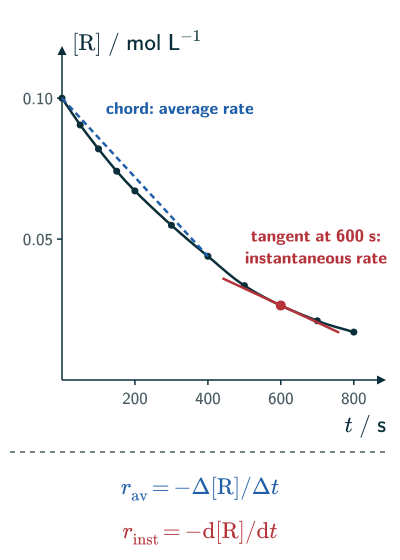
- For a single reaction R → P in a closed, constant-volume system, without appreciable intermediate accumulation or side reactions, with concentrations [R]1, [P]1 at time t1 and [R]2, [P]2 at t2 (square brackets mean molar concentration), the average rate is (NCERT Eqs. (3.1)–(3.3), pages 62–64):
Average rate (NCERT Eq. 3.3)
- Δ[R] is negative, since the reactant is being used up, so it is multiplied by −1 to make the rate positive (NCERT page 63).
- The average rate depends on the interval chosen, and it falls as the butyl chloride reaction proceeds (a trend, not a universal law for all reactions): in NCERT Table 3.1 (page 64), for the hydrolysis of butyl chloride, it falls from 1.90 × 10⁻⁴ to 0.4 × 10⁻⁴ mol L−1 s−1.
- Instantaneous rate. An average over an interval cannot give the rate at one moment. Letting Δt approach zero gives the rate at an instant, just as average velocity becomes instantaneous velocity (NCERT page 64; the comparison with velocity is ours):
Instantaneous rate (NCERT page 64)
- On a graph the rate at an instant comes from the tangent to the concentration–time curve; for a reactant the slope is negative, so the rate is minus the slope (NCERT page 65). For butyl chloride at 600 s, NCERT gives 5.12 × 10⁻⁵ mol L−1 s−1.
- NCERT slip (pages 64–65): a tangent drawn by hand is only an estimate, and two of NCERT’s readings are low against its own data. The tangent drawn in NCERT Figure 3.2 has a slope near 6.4 × 10⁻⁵, and the 500 s and 700 s values in NCERT Table 3.1 give an average rate of 6.25 × 10⁻⁵ between them. At 450 s NCERT prints “6.4 ×× 10−5”, with the sign doubled, though its 400–500 s average is 1.04 × 10⁻⁴. In an exam, use the value the question gives.
Units of rate
- Rate is concentration divided by time, so its units are concentration time−1: with mol L−1 and seconds, mol L−1 s−1 (NCERT page 63).
- For gases measured by partial pressure, the units are pressure per time, for example atm s−1 (NCERT page 63); in bar, bar s−1 (reasoned).
- Minutes or hours work too: multiply a rate per second by 60 to get it per minute (NCERT Example 3.2, page 66).
Rate and the balanced equation
- When every coefficient is 1, as in Hg(l) + Cl2(g) → HgCl2(s), the amounts change equally: −Δn(Hg)/Δt = −Δn(Cl2)/Δt = Δn(HgCl2)/Δt. Divide these by one fixed reference volume if a volume-normalised rate is wanted. A pure phase has nearly fixed internal concentration even while its amount changes, so differentiating [Hg] or [HgCl2] within that phase is inappropriate; follow chlorine or amounts instead (NCERT page 65; IUPAC rate-of-reaction definition).
- Otherwise, divide each species’ rate of change by its coefficient, so that the reaction has one rate. In 2HI(g) → H2(g) + I2(g), HI is used up twice as fast as H2 forms (NCERT page 65):
Rate of 2HI → H + I (NCERT page 65)
- In general, for aA + bB → cC + dD, rate = −(1/a)Δ[A]/Δt = −(1/b)Δ[B]/Δt = (1/c)Δ[C]/Δt = (1/d)Δ[D]/Δt (reasoned from NCERT page 65). For 5Br− + BrO3− + 6H+ → 3Br2 + 3H2O, the factors are 1/5, 1, 1/6, 1/3 and 1/3 (NCERT page 65).
Rate from changes in partial pressure
- For an ideal gas at constant temperature, its concentration is directly proportional to its partial pressure, so the rate of a gaseous reaction can be followed as the rate of change of partial pressure of a reactant or product (NCERT page 65).
- From the ideal gas equation, c = p/RT, so a rate in bar s−1 divided by RT (with R = 0.0831 L bar K−1 mol−1) gives mol L−1 s−1 (reasoned). Keep volume constant when interpreting concentration changes as chemical consumption or formation; dilution or compression otherwise contributes too.
Solved examples
Example 1: Average rates of hydrolysis (NCERT Example 3.1)
Butyl chloride is hydrolysed, C4H9Cl + H2O → C4H9OH + HCl. Its concentration falls from 0.100 mol L−1 at 0 s to 0.0905 at 50 s, 0.0820 at 100 s, 0.0741 at 150 s and 0.0671 at 200 s. Find the average rate over each interval.
Answer: rav = −Δ[C4H9Cl]/Δt (NCERT Table 3.1, page 64):
| Interval/s | Fall/mol L−1 | rav/10−4 mol L−1 s−1 |
|---|---|---|
| 0–50 | 0.0095 | 1.90 |
| 50–100 | 0.0085 | 1.70 |
| 100–150 | 0.0079 | 1.58 |
| 150–200 | 0.0070 | 1.40 |
The rate falls as the butyl chloride is used up.
NCERT slips (page 64): NCERT’s text writes the first rate as “1.90 × 0−4”, for 1.90 × 10⁻⁴. Its Table 3.1 also uses a value at 500 s, 0.0335 mol L−1, that is missing from the data printed in Example 3.1.
Example 2: Decomposition of NO (NCERT Example 3.2)
N2O5 in CCl4 at 318 K falls from 2.33 mol L−1 to 2.08 mol L−1 in 184 minutes, by 2N2O5 → 4NO2 + O2. Find the average rate per minute, per hour and per second, and the rate of production of NO2.
Answer (extra digits retained to show unit conversion):
- Rate = −½ Δ[N2O5]/Δt = ½ × 0.25/184 = 6.79 × 10⁻⁴ mol L−1 min−1.
- Per hour: × 60 = 4.08 × 10⁻² mol L−1 h−1 (NCERT rounds first and prints 4.07); per second: ÷ 60 = 1.13 × 10⁻⁵ mol L−1 s−1.
- Δ[NO2]/Δt = 4 × rate = 2.72 × 10⁻³ mol L−1 min−1 (NCERT Example 3.2, page 66).
NCERT slip (page 66): NCERT labels every species “(g)”, but its own text follows N2O5 dissolved in CCl4, so “(g)” does not fit N2O5. The labels do not change the arithmetic; use the equation as given.
Example 3: Rate in two units (NCERT Intext Question 3.1)
For R → P, the concentration of the reactant changes from 0.03 M to 0.02 M in 25 minutes. Find the average rate in minutes and in seconds.
Answer: rav = 0.01/25 = 4 × 10⁻⁴ mol L−1 min−1 = 4 × 10⁻⁴/60 = 6.67 × 10⁻⁶ mol L−1 s−1 (NCERT Eq. (3.1), page 62). The unrounded value is 6.666… × 10−6; NCERT’s 6.66 and 6.67 differ only by rounding. The supplied concentrations justify about one significant figure, 7 × 10⁻⁶, if their displayed precision is enforced.
Example 4: Dividing by the coefficient (NCERT Intext Question 3.2)
In 2A → products, [A] falls from 0.5 to 0.4 mol L−1 in 10 minutes. Find the rate.
Answer: Rate = −½ Δ[A]/Δt = ½ × 0.1/10 = 5 × 10⁻³ mol L−1 min−1 (NCERT page 65). Without the ½, −Δ[A]/Δt = 1 × 10⁻² mol L−1 min−1 is the rate at which A is used up.
- NCERT slip (page 88): the answer key prints “Rate of reaction = rate of diappearance of A = 0.005 mol litre−1 min−1”. For 2A → products the two are not equal: the rate of reaction is half the rate of disappearance of A, 0.005 against 0.01 mol L−1 min−1 (Example 4). The value 0.005 is right for the rate of reaction. In an exam, give the rate of reaction as −½ Δ[A]/Δt = 0.005 mol L−1 min−1, and give 0.01 only when the question asks how fast A is used up.
Example 5: Linked rates
In 5Br− + BrO3− + 6H+ → 3Br2 + 3H2O, bromine forms at 0.030 mol L−1 s−1. How fast are Br−, BrO3− and H+ used up?
Answer: Rate of reaction = (1/3) × 0.030 = 0.010 mol L−1 s−1. So Br− is used at 5 × 0.010 = 0.050, BrO3− at 0.010 and H+ at 6 × 0.010 = 0.060 mol L−1 s−1 (method of NCERT page 65).
Common mistakes to avoid
Common mistake
Forgetting the minus sign for a reactant
Δ[R] is negative, so the rate is −Δ[R]/Δt; this disappearance rate is positive while R is being consumed. A signed net rate can be zero at equilibrium or negative when the reverse direction dominates (NCERT page 63).
Common mistake
Forgetting to divide by the coefficient
In 2HI → H2 + I2, −Δ[HI]/Δt is twice the rate of the reaction; divide by 2 (NCERT page 65).
Common mistake
Treating an average rate as the rate at an instant
The average rate is constant over its interval; the rate at a moment needs the tangent, Δt → 0 (NCERT page 64).
Quick revision summary
- Rate: change in concentration of a reactant or product per unit time.
- Average rate r(av) = −Δ[R]/Δt = Δ[P]/Δt; instantaneous rate r(inst) = −d[R]/dt, minus the reactant tangent slope.
- Units: mol L s; for gases, atm s or bar s.
- For aA + bB → cC + dD, divide each rate of change by its coefficient to get one rate of reaction.
- For gases at constant temperature, rate can be followed by partial pressure.
Formula sheet
- r(av) = −Δ[R]/Δt = Δ[P]/Δt
- r(inst) = −d[R]/dt = d[P]/dt
- Rate = −(1/a)Δ[A]/Δt = (1/c)Δ[C]/Δt
- Units: mol L s; gases atm s
Questions students ask
When a rate of reaction is quoted, is it the average or the instantaneous rate?
A rate of reaction quoted without a time interval, such as the rate a rate law gives or “the rate at 600 s”, is the instantaneous rate at that moment, while an average rate belongs to a stated interval (NCERT pages 64–65 and 67). By the mean value theorem, the average rate over an interval equals the instantaneous rate at some moment inside it, so over a short interval the two are close (reasoned). They are equal throughout only when the rate does not change, as in a zero order reaction, whose rate is k until the reactant runs out (NCERT page 71).
Why is the rate of reaction divided by the stoichiometric coefficient?
Each species’ rate of change of concentration is divided by its stoichiometric coefficient so that a reaction has one rate, whichever species is followed, rather than a separate rate of disappearance or formation for each (NCERT page 65). Beyond the NCERT text, IUPAC defines it the same way, for one reaction at fixed volume where intermediates do not accumulate (IUPAC Gold Book, “rate of reaction”). The rate also depends on how the equation is written: NCERT writes both 2N2O5 → 4NO2 + O2 (page 66) and N2O5 → 2NO2 + ½O2 (page 74), and the same measurements give twice the rate with the second (reasoned).
Is the unit of rate of reaction 1/time?
No, the unit of rate of reaction is not 1/time: a rate is a change of concentration per unit time, so its units are mol L s, or atm s for a gas followed by its pressure (NCERT page 63). A 1/t is used as a relative rate when you time how long a fixed small change takes, as in the iodine clock, where rate ∝ 1/t. The unit s belongs to a first order rate constant, not to a rate as NCERT defines it; beyond the NCERT text, a catalyst’s rate per active site, its turnover frequency, is quoted in s (IUPAC Gold Book, “rate of reaction”).
How is the rate of a chemical reaction measured in the laboratory?
The rate of a chemical reaction is measured by following, at known times, something that changes with a reactant’s or product’s concentration: NCERT follows the concentration of N2O5 in solution and the total pressure of gases at constant volume (NCERT pages 66 and 75). Beyond the NCERT text, a coloured species is followed by the light it absorbs, by spectrophotometry, and fast reactions need methods such as stopped flow, which mixes the reactants in about a millisecond (Wikipedia, “Chemical kinetics”). A reaction that makes ions, such as the hydrolysis of butyl chloride, which forms HCl, can be followed by conductivity or by titrating samples with alkali (reasoned).
What is the initial rate of a reaction used for?
The initial rate of a reaction is its instantaneous rate at t = 0, from the tangent to the concentration–time curve there, in mol L s like any rate, and it is used to find rate laws (reasoned from NCERT pages 63–65). Initial concentrations can be prepared and measured with known uncertainty. If no product is initially added, reverse reaction is initially small, which is why NCERT Table 3.2 gives initial rates for 2NO + O2 (reasoned). Beyond the NCERT text, early changes are small and hard to measure accurately, so a rate law found this way is usually checked against the integrated rate equation (Wikipedia, “Rate equation”).
Is the rate of a chemical reaction in the JEE Main and NEET syllabus?
Yes, the rate of a chemical reaction is the first item of Unit 8, Chemical Kinetics, in both syllabuses: the JEE Main syllabus lists “Rate of a chemical reaction, factors affecting the rate of reactions: concentration, temperature, pressure and catalyst”, and the NEET (UG) 2026 syllabus “Rate of a chemical reaction, factors affecting the rate of reactions: concentration, temperature, pressure, and catalyst”. Neither syllabus names average and instantaneous rates as such; NCERT Class 12 Chemistry Part I defines both in Section 3.1 (pages 62–66), and the rest of Unit 8 builds on them.
Practice questions
Try each question first, then open the answer to check your working.
-
Q1. What three questions do chemists ask about a reaction, and which branch of chemistry answers each?
Show answerHide answer
Is it feasible? (thermodynamics); how far will it go? (chemical equilibrium); how fast? (chemical kinetics) (NCERT page 61).
-
Q2. Give NCERT’s examples of a very fast, a very slow and a moderately fast reaction.
Show answerHide answer
Precipitation of silver chloride on mixing AgNO3 and NaCl solutions; rusting of iron; inversion of cane sugar or hydrolysis of starch (NCERT page 62).
-
Q3. Write the rate of 2HI(g) → H2(g) + I2(g) in terms of each species.
Show answerHide answer
Rate = −½ Δ[HI]/Δt = Δ[H2]/Δt = Δ[I2]/Δt (NCERT page 65).