Experiment: kinetics of the iodide–hydrogen peroxide reaction
Beyond NCERT In the JEE Main and NEET syllabus; the Class 12 book has no section for it.
Quick answer
In acid, peroxide oxidises iodide to iodine while a fixed small thiosulphate dose rapidly reduces the iodine back to iodide. After thiosulphate is exhausted, iodine/polyiodide builds up and starch turns blue; at fixed dose and total volume, average iodine-production rate is proportional to 1/t. With small conversion and rapid mixing this approximates the initial rate, so changing iodide concentration tests its rate dependence.
What is the iodine clock experiment?
Iodide–hydrogen peroxide clock reaction
In acid solution hydrogen peroxide oxidises iodide ions to iodine. A little sodium thiosulphate turns the iodine straight back into iodide until the thiosulphate is used up; then iodine builds up and turns starch blue. The time until the blue appears measures how fast the first reaction goes, so it can show how the rate depends on the concentration of iodide ions (NCERT Laboratory Manual (Chemistry, Class 12), Experiment 2.2, pages 12–14).
The NCERT textbook gives the idea behind it:
Rate of reaction depends upon the experimental conditions such as concentration of reactants (pressure in case of gases), temperature and catalyst.
NCERT Chemistry Part I (Class 12), Section 3.2, page 66
In plain words: the reaction makes iodine slowly, and a fixed dose of thiosulphate quietly eats it. Nothing seems to happen, then the flask turns dark blue all at once, as if an alarm clock had gone off. The more iodide you start with, the faster the iodine is made, the sooner the thiosulphate runs out, and the sooner the blue appears.
The NCERT Class 12 textbook gives the theory (rate law and order, NCERT Section 3.2) but not this method. The JEE Main and NEET (UG) syllabuses list it among the practical chemistry experiments of Unit 20. The method below follows the NCERT Laboratory Manual (Chemistry, Class 12), Unit 2, Experiment 2.2 (pages 12–14).
Reaction of iodide ions with hydrogen peroxide
-
The aim: to study the effect of varying the concentration of iodide ions on the rate of their reaction with hydrogen peroxide at room temperature (Lab Manual page 12).
-
In acid, hydrogen peroxide oxidises iodide ions to iodine (Lab Manual page 12):
2I−(aq) + H2O2(aq) + 2H+(aq) → I2(aq) + 2H2O(l)
-
Lab Manual slip (page 12): the manual writes I2(g), here and in the next equation, and H2O2(l). Both are dissolved in the water: I2(aq) and H2O2(aq).
-
This is the slow reaction that the experiment times. NCERT gives its rate law, rate = k[H2O2][I−]: first order in each (NCERT Exercise 3.1 (ii), page 85, which writes the iodine as I3−). With [H2O2] and [H+] fixed, the rate is proportional to [I−] (reasoned).
Timing the blue colour with starch and thiosulphate
-
A measured amount of sodium thiosulphate is added with starch as indicator. The iodine reacts with thiosulphate as fast as it forms and is reduced back to iodide, until all the thiosulphate has been oxidised to tetrathionate (Lab Manual page 12):
I2(aq) + 2S2O32−(aq) → S4O62−(aq) + 2I−(aq)
-
Once the thiosulphate is used up, nothing removes the iodine; it continues forming, with a rate that may change as reactants are consumed, and its first traces form an intense blue complex with starch. The time needed to use up a fixed amount of thiosulphate is reproducible, so the reaction is called a clock reaction (Lab Manual page 12).
-
What the time means (reasoned). The thiosulphate stands for a fixed amount of iodine, half its own moles. So the average rate of iodine formation up to the blue is [S2O32−]0/(2t), and the rate is proportional to 1/t for a fixed thiosulphate dose and total volume. Iodide is regenerated rapidly, so free [I−] stays approximately near its starting value, and the small thiosulphate uses only about 2.3% of the H2O2 (Example 4): the measured average is a good approximation to the initial rate, provided mixing and indicator delay are small.
Rate from the clock time (reasoned)
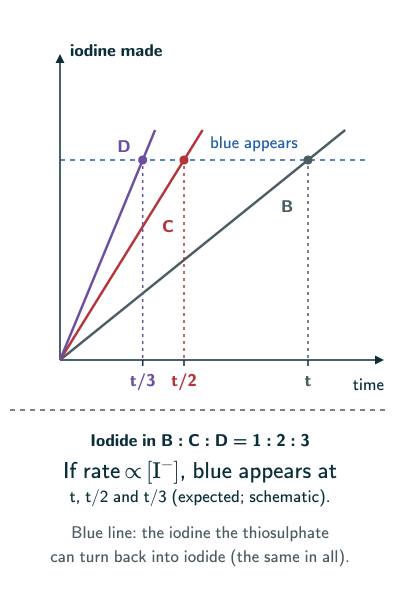
Apparatus and procedure
Materials (Lab Manual page 13): five 250 mL and one 500 mL conical flasks, a stop watch, a 100 mL measuring cylinder, a trough; starch solution, 2.5 M sulphuric acid, 0.1 M potassium iodide, 0.04 M sodium thiosulphate and 3% hydrogen peroxide.
Procedure (Lab Manual pages 13–14):
- Flask A (500 mL): 25 mL of 3% H2O2, 25 mL of 2.5 M H2SO4, 5 mL of freshly made starch solution and 195 mL of distilled water. Stir and keep in a water bath at room temperature.
- Flasks B, C and D (250 mL), each with 10 mL of 0.04 M sodium thiosulphate:
- B: 10 mL of 0.1 M KI and 80 mL of water;
- C: 20 mL of 0.1 M KI and 70 mL of water;
- D: 30 mL of 0.1 M KI and 60 mL of water. Shake, and keep them in the same bath. Flask E is kept empty for the reaction.
- Pour 25 mL of A into E. Add 25 mL of B with constant stirring, and start the stop watch when half of it has been added. Keep E in the bath and note the time for the blue colour to appear.
- Repeat with 25 mL of C, and then of D, each with 25 mL of fresh solution from A, using a clean reaction flask with no retained solution from the previous run.
- Repeat the runs and take the average time: the NCERT Laboratory Manual’s Table 2.3 has a first reading, a second reading and their average (Lab Manual page 14).
Practical precautions: use the prepared dilute reagents under teacher supervision, with eye protection and a lab coat. The 2.5 M sulphuric acid requires careful handling; 3% peroxide can irritate eyes and skin. Keep peroxide away from combustible contamination (Lab Manual page 13; Rutgers Chemistry demonstration guidance).
Effect of iodide concentration on the rate
- B, C and D differ only in their iodide, in the ratio 1 : 2 : 3, while the thiosulphate, peroxide and acid are the same in each mixture (Lab Manual page 13). In the 50 mL reaction mixture (reasoned):
| Mixture | [I−]0/mol L−1 | [S2O32−]0/mol L−1 |
|---|---|---|
| A + B | 0.0050 | 0.0020 |
| A + C | 0.0100 | 0.0020 |
| A + D | 0.0150 | 0.0020 |
- The manual asks for a generalisation about how the rate varies with iodide concentration (Lab Manual page 14). Since the rate ∝ 1/t, the result is read off the times: the more iodide, the shorter the time, so the rate rises with [I−] (Wikipedia, “Iodine clock reaction”).
- If the reaction is first order in iodide, doubling and tripling [I−] should cut the time to a half and to a third: tB : tC : tD = 1 : ½ : ⅓, so t × [I−]0 stays constant (reasoned). Checking that product on your own readings tests the order.
Precautions
From the Lab Manual (page 14):
- Always keep the concentration of sodium thiosulphate less than that of potassium iodide.
- Always use freshly prepared starch solution, and fresh hydrogen peroxide and potassium iodide.
- Measure with the same cylinders for the two sets of observations, and clean a cylinder before using it for another solution.
- Record the time at once when the blue colour appears.
Why the first precaution helps (reasoned): rapid iodine reduction regenerates iodide during the induction period. A small thiosulphate dose limits peroxide and acid consumption before the endpoint. Its being less concentrated than iodide alone does not guarantee an initial-rate measurement: compare its stoichiometric consumption with peroxide and acid too, and keep mixing time short relative to the clock time.
Solved examples
Example 1: Concentrations in the reaction flask
Find [I−] and [S2O32−] at the start in flask E for 25 mL of A + 25 mL of B.
Answer: 25 mL of B holds a quarter of B’s 100 mL: 2.5 mL of 0.04 M thiosulphate = 1.0 × 10⁻⁴ mol and 2.5 mL of 0.1 M KI = 2.5 × 10⁻⁴ mol. In 50 mL, [S2O32−]0 = 2.0 × 10⁻³ M and [I−]0 = 5.0 × 10⁻³ M (volumes from Lab Manual page 13; reasoned).
Example 2: Rate from a clock time
Mixture A + B turns blue after 80 s. Find the average rate of iodine formation over that time.
Answer: The 2.0 × 10⁻³ M thiosulphate removes 1.0 × 10⁻³ M of iodine, so rate = 1.0 × 10⁻³/80 = 1.25 × 10⁻⁵ mol L−1 s−1 (reasoned from Lab Manual page 12).
Example 3: Predicting the other times
If mixture A + B takes 80 s and the reaction is first order in iodide, how long should A + C and A + D take?
Answer: [I−] is doubled and tripled, so the times are 80/2 = 40 s and 80/3 ≈ 27 s (reasoned; first order in I− from NCERT Exercise 3.1 (ii), page 85).
Example 4: How much peroxide is used?
In flask E, what fraction of the hydrogen peroxide has reacted when the blue appears? (Take 3% H2O2 as 3 g per 100 mL; H2O2 34.0 g mol−1.)
Answer: Flask A holds 25 × 0.03 = 0.75 g = 0.0221 mol of H2O2 in 250 mL, so 25 mL of A brings 2.21 × 10⁻³ mol. Reaching the blue uses 5.0 × 10⁻⁵ mol, one H2O2 per I2: about 2.3%. The peroxide is nearly unchanged, so the measured average closely approximates the initial rate (reasoned).
Example 5: Oxidation number in tetrathionate
Find the oxidation number of sulphur in S4O62−, as the manual asks (Lab Manual page 14). Can it be a fraction?
Answer: 4x + 6(−2) = −2, so x = +2.5. An average oxidation number can be a fraction; the four sulphur atoms are not all alike: the two end sulphur atoms are +5 and the two middle ones 0, and +2.5 is their average (reasoned).
Common mistakes to avoid
Common mistake
Reading a longer time as a faster reaction
The blue appears when a fixed amount of iodine has been made, so a shorter time means a faster reaction; rate ∝ 1/t (reasoned from Lab Manual page 12).
Common mistake
Using too much thiosulphate
Keep it less than the iodide (Lab Manual page 14). Iodide is approximately regenerated before the endpoint, but more thiosulphate uses up more peroxide, so the time grows and no longer gives the initial rate (reasoned).
Common mistake
Starting the watch at the wrong moment
Start it when half of the second solution has been poured in, and stop it at the first blue (Lab Manual pages 13–14).
Quick revision summary
- Slow reaction: 2I + HO + 2H → I + 2HO; fast reaction: I + 2SO → SO + 2I.
- Blue appears with starch when the thiosulphate is used up: a clock reaction.
- Rate of iodine formation ≈ [SO]/(2t), so rate ∝ 1/t.
- Mixtures B, C, D: iodide 1 : 2 : 3, everything else the same; more iodide, shorter time.
- Precautions: thiosulphate less than iodide; fresh starch, HO and KI; same cylinders; note the time at once.
Formula sheet
- 2I + HO + 2H → I + 2HO (slow)
- I + 2SO → SO + 2I (fast)
- Rate ≈ [SO]/(2t); rate ∝ 1/t
- First order in I: t × [I] constant
Questions students ask
Is the iodine clock experiment in the JEE Main and NEET syllabus?
The iodide–hydrogen peroxide clock experiment is in both syllabuses: the JEE Main syllabus and the NEET (UG) 2026 syllabus list, in Unit 20, Principles Related to Practical Chemistry, “Kinetic study of the reaction of iodide ions with hydrogen peroxide at room temperature.” Neither names the iodine clock, starch or thiosulphate: the method is the NCERT Laboratory Manual’s Experiment 2.2 (pages 12–14), and the rate law behind it is in Unit 8, Chemical Kinetics. Unit 20 asks for the chemical principles of its experiments, so the two reactions, the roles of thiosulphate and starch and how the time gives the rate are what count (reasoned).
Why is the iodine clock reaction first order in iodide when its equation has 2I?
A measured first-order dependence on iodide does not follow from the coefficient 2 in the overall equation. At fixed acidity, the empirical law can be written rate ≈ kobs[H2O2][I−] (NCERT Exercise 3.1(ii)). One can propose a slow peroxide–iodide step followed by rapid iodine formation, but the observed law alone does not prove that mechanism. In particular, the alkaline iodide-catalysed peroxide decomposition is a different overall reaction and should not be presented as proof of the acidic clock mechanism; acidity changes the effective kinetics.
Why is sulphuric acid added in the iodine clock experiment?
Sulphuric acid is added because hydrogen ions are a reactant in the slow reaction, two for each H2O2 (NCERT Laboratory Manual, page 12), and the same large excess in every mixture keeps [H+] nearly constant (reasoned). In flask E the acid is 0.125 mol L (25 mL of 2.5 M in 250 mL of A, then halved), while reaching the blue uses 2.0 × 10 mol L of H+, two per I2: at most 1.6% of the H+ (reasoned). Beyond the NCERT text, more acid makes the reaction faster (Wikipedia, “Iodine clock reaction”); in alkaline solution iodide instead catalyses the decomposition of H2O2 into water and oxygen (NCERT page 70).
Why is the iodine clock experiment done in a water bath at room temperature?
The iodine clock flasks are kept in one water bath at room temperature because the rate constant rises steeply with temperature, and the times for mixtures with different iodide can be compared only if the iodide is the one thing that changes (NCERT Laboratory Manual, page 13; reasoned). If k nearly doubles for a 10° rise (NCERT page 78), each degree raises it by about 7%, since 21/10 ≈ 1.07, and a mixture 3 °C warmer than the rest would turn blue about 19% sooner, since 2−0.3 ≈ 0.81 (reasoned). That is enough to blur the 1 : ½ : ⅓ pattern of times that tests the order (reasoned).
Who discovered the iodine clock reaction?
Beyond the NCERT text, the iodine clock reaction was first observed in 1886 by the Swiss chemist Hans Heinrich Landolt, which is why it is sometimes called the Landolt reaction (Wikipedia, “Iodine clock reaction” and “Hans Heinrich Landolt”). His clock used iodic acid and sulphurous acid, as in the iodate variation, in which iodide forms slowly and excess iodate turns it into iodine. The hydrogen peroxide clock of the NCERT Laboratory Manual’s Experiment 2.2 (pages 12–14) is one of several variations of the clock (Wikipedia, “Iodine clock reaction”).
Practice questions
Try each question first, then open the answer to check your working.
-
Q1. Why is this experiment called a clock reaction?
Show answerHide answer
The blue colour appears suddenly, after a reproducible time, when a fixed amount of thiosulphate has been used up; the reaction “keeps time” (Lab Manual page 12).
-
Q2. What are the roles of iodine and of iodide ions in this experiment?
Show answerHide answer
Iodide is the reactant whose concentration is varied; H2O2 oxidises it to iodine. Iodine is the product that thiosulphate reduces back to iodide until the thiosulphate is gone, after which it gives the blue colour with starch (Lab Manual page 12).
-
Q3. Why should the concentration of sodium thiosulphate always be less than that of potassium iodide?
Show answerHide answer
So that the thiosulphate is a small amount that runs out early (Lab Manual page 14). Iodide is approximately regenerated during the induction period, but every two thiosulphate ions use up one H2O2. With little thiosulphate only about 2.3% of the peroxide reacts, so the time approximates the initial rate (reasoned; Example 4).